
Aortic Repair Devices Market Share, Size & Demand by 2034
Coverage: By Product (Stent Grafts, Catheters); Procedure (Abdominal Aortic Aneurysm Repair, Open Repair, Endovascular Aneurysm Repair, Thoracic Aortic Aneurysm Repair, Thoracic Endovascular Aneurysm Repair) , and Geography (North America, Europe, Asia Pacific, and South and Central America)
- Status : Data Released
- Report Code : TIPRE00023660
- Category : Life Sciences
- No. of Pages : 150
- Available Report Formats :


- Last update date : August 24, 2026


2025 Market Size
US$ 4.95 Bn
Base year value
2034 Forecast
US$ 7.83 Bn
Projected by 2034
CAGR 2026-2034
5.22 %
Growth rate
Addressable Market
US$ 57.95 Bn
(2026-2034)
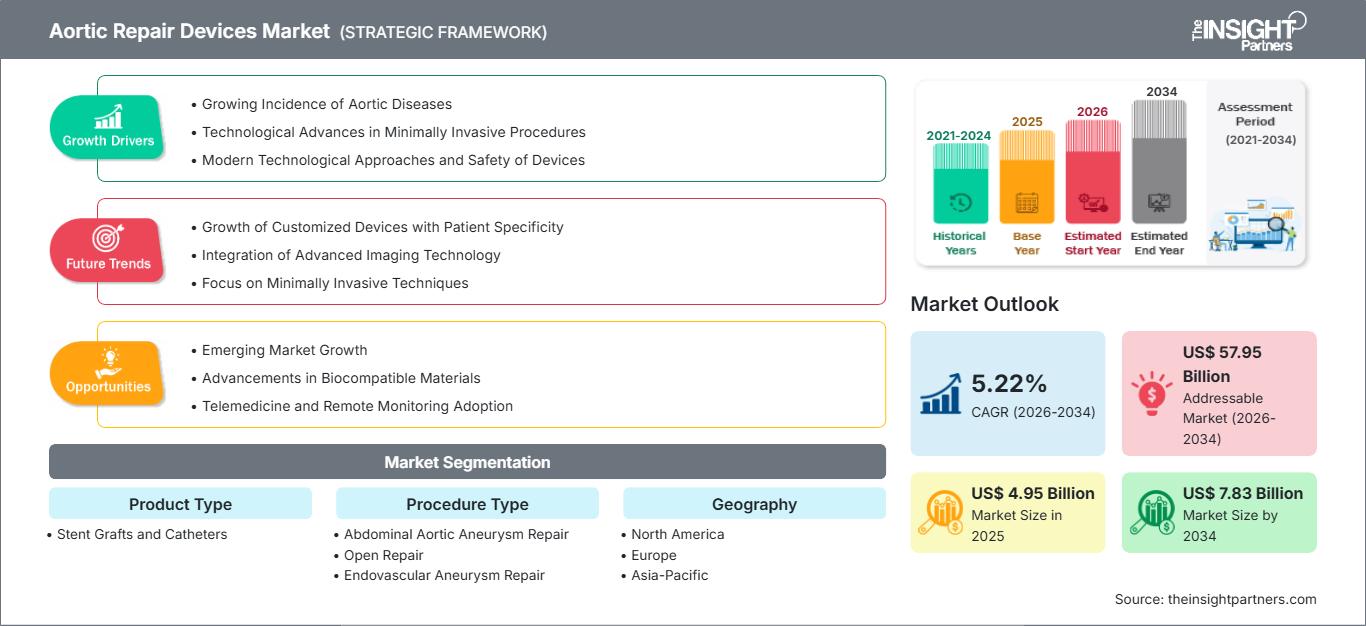
The aortic repair devices market was valued at US$ 4.95 Billion in 2025 and is projected to reach US$ 7.83 Billion by 2034, expanding at a CAGR of 5.22% during 2026–2034. Demand is supported by rising diagnosis of aortic aneurysms, continued use of endovascular repair, and device innovation focused on anatomical conformity, deployment accuracy, branch preservation, and durability. Product development increasingly targets complex anatomy and less invasive treatment pathways.
North America is expected to maintain a leading position, supported by established vascular surgery networks, high adoption of endovascular procedures, and favorable reimbursement for advanced repair technologies. The Aortic Repair Devices Market Size is projected to grow at a 4.8–5.8% CAGR during 2026–2034. Rising detection of abdominal and thoracic aneurysms, together with continued physician preference for catheter-based repair in suitable patients, should sustain replacement demand.
Aortic Repair Devices Market Assessment and Insights
- North America: North America held a 2025 share of 38–42% and is projected to expand at a 4.8–5.8% CAGR between 2026–2034, supported by mature vascular centers, established reimbursement, endovascular expertise, and continuing replacement of open procedures with catheter-based repair.
- US: The US represented 76–80% of North American revenue in 2025 and is expected to grow at a 4.9–5.9% CAGR during 2026–2034, supported by high procedure volumes and broad device availability.
- Europe: Europe accounted for a 2025 share of 29–33% and is expected to grow at a 5.0–6.0% CAGR during 2026–2034, with Germany, the UK, France, Italy, and Spain forming important procedure and procurement markets.
- Asia Pacific: Asia Pacific represented a 2025 share of 18–22% and is projected to expand at a 6.5–7.5% CAGR during 2026–2034, led by China, Japan, South Korea, India, and Australia as vascular infrastructure expands.
- Largest Segment: Stent Grafts represented a market share of 72–76% in 2025 and are projected to grow at a 5.0–6.0% CAGR during 2026–2034, reflecting their central role in endovascular aneurysm repair.
- High Growth Segment: Endovascular Aneurysm Repair represented a market share of 55–60% in 2025 and is expected to grow at a 6.0–7.0% CAGR during 2026–2034, supported by less invasive treatment.
- Key companies analyzed in detail: Terumo Aortic, Endologix Inc., JOTEC GmbH, Cardiatis, Cook Medical, Inc., Medtronic plc, Lombard Medical Technologies, W. L. Gore and Associates, Boston Scientific Corporation, Braile Biomedica.
Source: The Insight Partners' analysis based on proprietary research, government publications, company annual reports, investor presentations, industry databases, and expert interviews.
Technology development in the aortic repair devices market has shifted from conventional surgical grafting toward modular endovascular systems, lower-profile delivery catheters, conformable stent grafts, fenestrated and branched configurations, and devices designed for challenging proximal or distal anatomy. Production increasingly requires precision Nitinol components, advanced graft fabrics, controlled assembly, sterilization, and rigorous quality systems. Device design now emphasizes sealing, fixation, migration resistance, and preservation of branch-vessel flow.
Future demand should increasingly come from emerging vascular centers in the Asia Pacific, Latin America, and the Middle East, where tertiary hospitals are expanding complex cardiovascular capabilities. As highlighted in the Aortic Repair Devices Market Report, regulatory pathways, clinical registries, physician training, and government investment in advanced hospitals will support adoption. Manufacturers are also expected to prioritize devices for complex aneurysm morphology, arch repair, dissection, and ruptured cases, broadening the addressable population for endovascular technologies.
Aortic Repair Devices Market Report Scope
| Report Attribute | Details |
|---|---|
| Market size in 2025 | US$ 4.95 Billion |
| Market Size by 2034 | US$ 7.83 Billion |
| Global CAGR (2026 - 2034) | 5.22% |
| Historical Data | 2021-2024 |
| Forecast period | 2026-2034 |
Aortic Repair Devices Market Analysis
The aortic repair devices market growth is influenced by aging populations, hypertension, smoking-related vascular disease, improved imaging, and greater identification of asymptomatic aneurysms. Vascular surgeons, interventionalists, hospitals, radiology service providers, stent graft manufacturing companies, tissue/polymer suppliers, contract manufacturers, sterilizers, and distributors make up the ecosystem. The choice of treatment is dependent on the aneurysm location, diameter, shape, rupture state, patient’s age, surgical risk, and organizational experience.
The supply chain demands that there be stringent control in manufacturing since the stent grafts are made using metal structures together with engineered textile graft materials. Processing of Nitinol, cutting of the graft material, sewing, coating, extrusion of the catheter, assembly, packaging, and sterilization should all involve validated processes. Complex devices also demand extensive testing for issues such as fatigue, radial strength, fixation, leakage, deliverability, and dimensional accuracy.
The aortic repair devices market analysis shows competition increasingly centered on anatomical coverage, deployment control, profile reduction, durability, and treatment of complex aortic disease. Medtronic plc, Cook Medical Inc., Terumo Aortic, W.L. Gore & Associates, and Endologix Inc. are competing in key areas within endovascular devices, whereas Boston Scientific Corp. and others enhance competition with catheters and vascular portfolio products.
There is a strategic push into branched and fenestrated systems, arch repair systems, enhanced delivery systems, and wider anatomic indications. JOTEC GmbH, Cardiatis, Braile Biomedica, and Lombard Medical Technologies provide specialized technology, while existing players use clinical studies and physician education programs to secure access. Differentiation of the products depends more and more on predictability and surveillance performance.
● REPORT CUSTOMIZATION
Tailor This Report To Align With Your Specific Business Requirements
This report can be customized to align precisely with your business objectives, scope, and target markets. Customization options include tailored segmentation, geography, competitive analysis, and strategic insights to support informed decision-making.
Customize This Report →WHAT YOU CAN ADJUST
- ● Segmentations
- ● Geography
- ● Competitive Analysis
- ● Language Preferences
Aortic Repair Devices Market: Strategic Insights
Regional Insights
North America aortic repair devices market
North America accounted for a 38–42% of the aortic repair devices market share in 2025 and is projected to grow at a 4.8–5.8% CAGR through 2034. Strengths include the presence of existing vascular surgery centers, diagnostic imaging facilities, payment mechanisms, and qualified doctors. The United States is dominant in terms of regional earnings, whereas Canada participates with its tertiary hospitals and government-funded vascular programs. Endovascular repair becomes crucial when anatomy allows catheter approaches.
Medtronic plc, Cook Medical, Inc., Terumo Aortic, W. L. Gore and Associates, and Endologix Inc. are among competitors in this area. Hospitals start to assess devices in terms of procedure effectiveness, delivery capabilities, sealing properties, need for reinvention procedures, and long-term monitoring. The treatment of complex aneurysms promotes the demand for innovative and advanced graft designs.
U.S. aortic repair devices Market
The US represented 76–80% of North American revenue in 2025 and is expected to grow at a 4.9–5.9% CAGR through 2034. Its position reflects extensive vascular specialist networks, established endovascular operating pathways, and broad availability of approved stent graft systems. Key Aortic Repair Devices Market Trends include increasing adoption of minimally invasive aneurysm repair, expanding use of advanced stent graft technologies, and growing preference for endovascular interventions. Medtronic plc, Cook Medical, Inc., W. L. Gore and Associates, and Endologix Inc. maintain significant competitive presence across abdominal and thoracic applications.
Application trends favor EVAR and TEVAR when anatomy is suitable, while open repair remains important for complex cases, rupture, younger patients, and anatomy unsuitable for endovascular treatment. US centers increasingly emphasize preoperative CT planning, precise sizing, fixation, and postoperative surveillance. Device selection is therefore closely connected to imaging quality, operator experience, hospital procedure volume, and the availability of rescue capabilities.
Europe aortic repair devices Market
Europe held a 29–33% share in 2025 and is projected to grow at a 5.0–6.0% CAGR through 2034, with Germany serving as a leading market. The UK has centralized purchasing influences, Germany has extensive vascular-center capacity, and France, Italy, and Spain maintain substantial procedure networks and specialist expertise.
The UK increasingly emphasizes standardized vascular pathways and timely referral for aneurysm management. Germany combines a broad specialist infrastructure with an established adoption of endovascular repair. France has strong tertiary vascular centers, while Italy and Spain continue expanding access through regional hospitals and specialist programs. Across Europe, procurement increasingly considers clinical outcomes, device versatility, inventory efficiency, and evidence supporting complex endovascular applications.
APAC aortic repair devices Market
APAC held an 18–22% share in 2025 and is projected to expand at a 6.5–7.5% CAGR through 2034, with China leading. Japan, South Korea, India, and Australia also contribute significantly. Hospital modernization, specialist training, domestic device development, and improving access to vascular imaging are supporting adoption.
China is expanding advanced vascular capabilities, while Japan maintains sophisticated endovascular practice. South Korea and Australia have established specialist centers, and India is developing tertiary vascular infrastructure. Government healthcare investment, domestic manufacturing initiatives, and broader access to computed tomography support procedural growth. Pricing remains an important adoption consideration in emerging APAC markets.
Middle East & Africa aortic repair devices Market
The Middle East and Africa aortic repair devices Market is projected to grow at a 4.5–5.5% CAGR during 2026–2034, with Saudi Arabia leading regional adoption. The UAE and South Africa are important secondary markets, while the rest of MEA remains more constrained by specialist availability, reimbursement, and infrastructure. Gulf investment in advanced hospitals supports demand for complex vascular technologies.
Saudi Arabia and the UAE are developing tertiary cardiovascular capabilities through hospital modernization and specialist recruitment. South Africa provides an important regional referral base, while other markets depend heavily on major urban hospitals. Energy-sector revenues support healthcare infrastructure investment in Gulf economies, creating favorable conditions for advanced vascular programs and imported endovascular technologies.
Segmentation Analysis
Product Type
Product Type segment of the aortic repair devices Market is projected to expand at a 5.0–6.0% CAGR during 2026–2034. Stent grafts account for the majority of product demand because they provide the principal implant platform for EVAR and TEVAR. Product innovation increasingly targets smaller delivery profiles, improved fixation, enhanced conformability, and configurations capable of treating complex anatomy. Catheters remain essential to accurate device positioning and deployment.
- Stent Grafts: Stent grafts dominate procurement because they directly exclude aneurysmal segments and establish a controlled blood-flow channel. Demand increasingly favors modular, conformable, fenestrated, branched, and thoracic designs that address anatomical variation while maintaining reliable sealing and fixation.
- Catheters: Catheters support the delivery, positioning, deployment, and procedural control of implantable systems. Their strategic importance increases as manufacturers reduce device profiles and improve steerability, visibility, tracking, and controlled release across increasingly complex vascular anatomy.
Procedure Type
The Procedure Type segment of the aortic repair devices Market is expected to grow at a 5.8–6.8% CAGR during 2026–2034, driven by the continued use of EVAR and TEVAR in anatomically suitable patients. Procedure selection remains dependent on aneurysm location, rupture status, morphology, operative risk, age, and physician expertise. Complex interventions are supporting the development of more specialized graft and catheter configurations.
- Abdominal Aortic Aneurysm Repair: Abdominal aortic aneurysm repair remains a major treatment pathway because AAA represents a substantial portion of clinically managed aneurysmal disease. Device selection depends heavily on neck length, angulation, iliac anatomy, rupture status, and suitability for endovascular treatment.
- Open Repair: Open repair remains strategically necessary for patients with unsuitable anatomy, selected ruptures, complex disease, and situations requiring direct surgical reconstruction. Its role is reinforced by long-term durability considerations and availability in advanced vascular surgery centers.
- Endovascular Aneurysm Repair: Endovascular Aneurysm Repair is the principal growth area because catheter-based treatment can reduce surgical trauma and shorten recovery for appropriate patients. Continued refinement of graft fixation, sealing, delivery systems, and complex-anatomy solutions supports adoption.
- Thoracic Aortic Aneurysm Repair: Thoracic aortic aneurysm repair addresses disease involving the descending or thoracic aorta and requires careful management of branch vessels, spinal cord risk, landing zones, and anatomical access. Device selection is therefore highly dependent on imaging and specialist expertise.
- Thoracic Endovascular Aneurysm Repair: Thoracic Endovascular Aneurysm Repair is increasingly important for suitable thoracic disease because it provides a less invasive alternative to selected open procedures. Growth is supported by improved stent-graft conformability, branch-preservation technologies, and treatment of complex thoracic pathologies.
Opportunity Snapshot
| Segment Name | Revenue Contribution (High/Medium/Low) | Trend Tag | Adoption Stage |
| Abdominal Aortic Aneurysm Repair | High | AAA Screening | Mature |
| Open Repair | Medium | Durable Surgery | Mature |
| Endovascular Aneurysm Repair | High | Low Profile | Scaling |
| Thoracic Aortic Aneurysm Repair | Medium | Arch Planning | Scaling |
| Thoracic Endovascular Aneurysm Repair | High | Branch Preservation | Scaling |
Aortic Repair Devices Market Growth Drivers and Impact Analysis
Rising detection of abdominal and thoracic aortic aneurysms
The utilization of more ultrasounds, CT scans, MRI scans, and emergency imaging scans has resulted in the increased detection of aneurysms. Early detection provides scope for surveillance and intervention that is commercially important since elective interventions allow for better planning for device choice and scheduling at the hospital. Aging populations and the presence of cardiovascular risk factors lead to an increase in the number of individuals needing a vascular evaluation. This is particularly true in healthcare systems that have developed screening and referral processes in place and that make it easier to refer patients from general practitioners to specialists dealing with the condition. In terms of commercial implications, it means that there will be a recurring need for devices such as stent grafts and catheters.
Preference for minimally invasive vascular intervention
With the ongoing demand for minimally invasive approaches, the significance of endovascular tools has become increasingly strategic. In comparison to open surgeries, catheter systems could lower surgical trauma and shorten hospital stay for anatomically suitable cases. This makes hospitals invest in hybrid ORs, imaging systems, catheter tools, and physician education. The created structure will create an environment where more procedures mean more expertise and proficiency on the part of the hospital and the operator. As such, device manufacturers will have to develop ways of reducing delivery profile, making devices steerable, improving device deployment, and dealing with complicated anatomy. The implications of this technology stretch even outside of EVAR into other technologies like TEVAR, fenestrated repair, branched repair, and arch repair.
Expansion of complex endovascular treatment capabilities
The development of knowledge related to fenestrated, branched, thoracic, and arch repair increases the diseases that can be treated by endovascular treatment. Where complex anatomy previously required open reconstruction surgery or very specialized surgery, new graft designs allow preservation of blood flow within select branches while excluding the diseased segments. These present business opportunities for companies that have advanced planning, customization, and delivery options. High-volume hospitals can establish themselves as centers of excellence in order to drive the uptake of technology among physicians. The implications are especially important in markets where there is a well-developed infrastructure among specialists and where emerging markets are building their vascular centers. Clinical data, education, and regulatory considerations will influence the rate at which these technologies go from specialist to general use.
Aortic Repair Devices Market Future Trends
Expansion of branched and fenestrated repair platforms
The future product development is anticipated to focus more on branch and fenestrated technologies to deal with aneurysms of visceral, renal, mesenteric, or arch arteries. This type of system would allow expanding the opportunities of endovascular repair for patients with anatomy incompatible with standard straight or modular grafts. The development is forecasted to be aimed at improving planning software, customization of grafts, accuracy of deployment and branch positioning. It is possible that the clinical process will include preoperative imaging and patient-specific procedure planning prior to graft deployment. With accumulated experience, the hospital could form a special team for complex aortic procedures, including vascular surgery, interventional radiology, cardiothoracic surgery and advanced imaging. The ecosystem would provide opportunities for using complex aortic grafts and increase demand for special equipment and training.
Greater integration of imaging and procedural planning
Digital planning is expected to become increasingly integrated with device selection and procedural execution. Three-dimensional computed tomography reconstruction can support measurements of landing zones, vessel diameter, angulation, branch location, and access pathways before intervention. Future software may combine automated anatomical measurements with device libraries to improve sizing consistency and reduce planning time. Integration with navigation and imaging platforms could also provide procedural guidance during deployment. These capabilities may be particularly valuable for complex aneurysms, where small differences in anatomy can affect sealing, fixation, branch preservation, and reintervention risk. Manufacturers that connect devices with planning ecosystems can create stronger procedural relationships with hospitals. Adoption will depend on validation, interoperability, cybersecurity, regulatory clearance, and clinician confidence.
Aortic Repair Devices Market Opportunities
Localized manufacturing in high-volume emerging markets
Aortic repair devices market Forecasts point to opportunities for localized manufacturing and strategic partnerships in China, India, Brazil, and selected Middle Eastern markets. Local production can improve supply continuity, reduce import dependence, and support pricing strategies aligned with public and private healthcare procurement. Companies can consider licensing, contract manufacturing, regional assembly, or joint ventures according to regulatory requirements and expected demand. Localization should preserve stringent quality systems while adapting packaging, distribution, inventory, and physician-training models to local conditions. Partnerships with leading vascular centers can create reference sites and accelerate clinical familiarity. The strongest opportunities are likely to emerge where governments are expanding advanced cardiovascular infrastructure and where domestic medical-device manufacturing policies support technology transfer, skilled employment, and local supply-chain development.
Expansion of complex aortic referral centers
Investment in specialized aortic centers offers another opportunity for device manufacturers and healthcare providers. Concentrating complex cases within experienced referral centers can improve procedural expertise, enable multidisciplinary decision-making, and create stronger platforms for clinical evidence generation. Manufacturers can support these centers through physician education, procedural simulation, planning services, inventory optimization, and post-market data collection. Such partnerships can be particularly valuable for branched, fenestrated, and thoracic technologies that require advanced imaging and highly trained teams. Over time, successful centers can function as regional training hubs and referral destinations, increasing awareness of endovascular options. Investors should assess hospital infrastructure, procedure volumes, specialist density, reimbursement conditions, and local regulatory pathways when prioritizing geographic expansion.
Recent Developments
- January 2026: Terumo Aortic announced enrollment of the first patient in the RapidLink pivotal IDE study in the US and Europe. The study evaluates the RapidLink deployment device for repair or replacement of supra-aortic vessels during open surgical repair of thoracic aortic disease. The development strengthens Terumo Aortic's focus on technologies that simplify complex arch-vessel procedures and integrate with established surgical workflows.
- December 2025: W. L. Gore and Associates announced the first patient implantation of its investigational GORE Ascending Stent Graft in the ARISE III pivotal study for acute Type A dissection. The milestone represents continued development of endovascular approaches for ascending-aortic disease, an area historically dominated by open surgery and associated with substantial procedural complexity.
- September 2025: Medtronic plc received an FDA labeling decision for its Endurant stent graft systems removing a warning concerning emergency treatment of aneurysms and incorporating supporting information related to ruptured aneurysm treatment. The regulatory action expands the labeling context for the platform and reinforces the importance of evidence supporting use in urgent aortic repair.
Frequently Asked Questions

- Comprehensive Market Sizing and Forecast Analysis
- Detailed Segmentation Analysis
- In-Depth Market Dynamics Assessment
- Regional and Country-Level Insights
- Competitive Landscape and Company Benchmarking
- Strategic Business Intelligence
Recent Reports
Testimonials

The Insight Partners' SCADA System Market report is comprehensive, with valuable insights on current trends and future forecasts. The team was highly professional, responsive, and supportive throughout. We are very satisfied and highly recommend their services.
RAN KEDEM Partner, Reali Technologies LTDs
I requested a report on a very specific software market and the team produced the report in a few days. The information was very relevant and well presented. I then requested some changes and additions to the report. The team was again very responsive and I got the final report in less than a week.
JEAN-HERVE JENN Chairman, Future Analytica
We worked with The Insight Partners for an important market study and forecast. They gave us clear insights into opportunities and risks, which helped shape our plans. Their research was easy to use and based on solid data. It helped us make smart, confident decisions. We highly recommend them.
PIYUSH NAGPAL Sr. Vice President, High Beam Global
The Insight Partners delivered insightful, well-structured market research with strong domain expertise. Their team was professional and responsive throughout. The user-friendly website made accessing industry reports seamless. We highly recommend them for reliable, high-quality research services
YUKIHIKO ADACHI CEO, Deep Blue, LLC.
This is the first time I have purchased a market report from The Insight Partners.While I was unsure at first, I visited their web site and felt more comfortable to take the risk and purchase a market report.I am completely satisfied with the quality of the report and customer service. I had several questions and comments with the initial report, but after a couple of dialogs over email with their analyst I believe I have a report that I can use as input to our strategic planning process.Thank you so much for taking the extra time and making this a positive experience.I will definitely recommend your service to others and you will be my first call when we need further market data.
JOHN SUZUKI President and Chief Executive Officer, Board Director, BK Technologies
I wish to appreciate your support and the professionalism you displayed in the course of attending to my request for information regarding to infectious disease IVD market in Nigeria. I appreciate your patience, your guidance, and the fact that you were willing to offer a discount, which eventually made it possible for us to close a deal. I look forward to engaging The Insight Partners in the future, all thanks to the impression you have created in me as a result of this first encounter.
DR CHIJIOKE ONYIA MANAGING DIRECTOR, PineCrest Healthcare Ltd.Reason to Buy
- Informed Decision-Making
- Understanding Market Dynamics
- Competitive Analysis
- Identifying Emerging Markets
- Customer Insights
- Market Forecasts
- Risk Mitigation
- Boosting Operational Efficiency
- Strategic Planning
- Investment Justification
- Tracking Industry Innovations
- Aligning with Regulatory Trends





 Get Free Sample for