
Apple Juice Concentrates Market Growth, Size & Forecast by 2034
Coverage: By Type (Cloudy, De-Ionized, Clarified); Application (Dairy and Frozen Desserts, Bakery and Confectionery, Beverages, Sauces, Dips and Spreads, Others) , and Geography (North America, Europe, Asia Pacific, and South and Central America)
- Status : Data Released
- Report Code : TIPRE00019650
- Category : Food and Beverages
- No. of Pages : 150
- Available Report Formats :


- Last update date : August 26, 2026


2025 Market Size
US$ 5.17 Bn
Base year value
2034 Forecast
US$ 8.13 Bn
Projected by 2034
CAGR 2026-2034
5.15 %
Growth rate
Addressable Market
US$ 60.31 Bn
(2026-2034)
The Apple juice concentrates market was valued at US$ 5.17 Billion in 2025 and is projected to reach US$ 8.13 Billion by 2034; it is expected to register a CAGR of 5.15% from 2026 to 2034. Demand is supported by beverage reformulation, natural sweetening, bakery fillings, dairy inclusions, and shelf-stable ingredient procurement across multinational food and beverage manufacturers.
Across North America, apple juice concentrates market size is supported by steady demand from juice bottlers, frozen dessert manufacturers, and clean-label food processors. The region is estimated to grow at a CAGR range of 4.7–5.2% during 2026–2034, driven by traceable fruit sourcing, reduced-sugar product development, and wider use of concentrates as natural flavoring and sweetening systems.
Apple Juice Concentrates Market Assessment and Insights
- North America held 30–33% share in 2025 and is expected to grow at a CAGR between 2026–2034 of 4.7–5.2%, supported by branded juice demand, institutional foodservice use, and ingredient traceability programs.
- US accounted for 82–86% of North America in 2025 and is estimated to grow at a CAGR between 2026–2034 of 4.8–5.3%, led by beverages, bakery fillings, and frozen novelty applications.
- Europe represented 27–30% share in 2025 and is projected to grow at a CAGR between 2026–2034 of 4.5–5.0%, with Germany, Poland, Italy, France, Spain, and the UK shaping processing, imports, and downstream usage.
- Asia Pacific held 23–26% share in 2025 and is expected to grow at a CAGR between 2026–2034 of 5.8–6.4%, led by China, India, Japan, South Korea, and Australia.
- Largest Segment: Beverages held 54–58% market share in 2025 and is estimated to grow at a CAGR range of 4.9–5.4% during 2026–2034, reflecting direct use in juices, nectars, and blends.
- High Growth Segment: Dairy and frozen desserts held 12–15% market share in 2025 and is projected to grow at a CAGR range of 5.9–6.5% during 2026–2034, driven by fruit preparations and premium inclusions.
- Key companies analyzed in detail: Ingredion Incorporated, Cobell Limited, H and H Products Company, Welch Foods Inc., Ve.Ba. Cooperativa Ortofrutticola S.C., Döhler GmbH, Louis Dreyfus Company B.V., Sonnländer Getränke GmbH, Tree Top, Inc., LemonConcentrate S.L.
Source: The Insight Partners' analysis based on proprietary research, government publications, company annual reports, investor presentations, industry databases, and expert interviews.
Processing has shifted from basic evaporation-led concentration toward integrated filtration, aroma recovery, aseptic packaging, and customized Brix control. In the apple juice concentrates market, processors are increasingly balancing cloudy, clarified, and de-ionized variants to meet sensory, color, and sweetness specifications. Production economics remain linked to apple crop quality, industrial fruit availability, energy costs, and freight rates, making multi-origin sourcing essential for large beverage and food manufacturers.
Going forward, new demand hubs will include India, Southeast Asia, Gulf region economies, and upscale foodservice segments in urban markets. It is anticipated that there will be investments in cold chain-compatible concentrates, organic varieties, and low-color de-ionized versions that act as fruit-based sweeteners. With labeling, contamination, and sustainable packaging taking center stage from a regulatory perspective, companies with proven track records of traceability, residues, and diversified origins will be favored.
Apple Juice Concentrates Market Report Scope
| Report Attribute | Details |
|---|---|
| Market size in 2025 | US$ 5.17 Billion |
| Market Size by 2034 | US$ 8.13 Billion |
| Global CAGR (2026 - 2034) | 5.15% |
| Historical Data | 2021-2024 |
| Forecast period | 2026-2034 |
Apple Juice Concentrates Market Analysis
Food manufacturers are using fruit concentrates to reduce dependence on refined sweeteners while maintaining recognizable ingredient lists. The apple juice concentrates market growth is shaped by beverage innovation, bakery fruit fillings, sauces, and dairy preparations that need stable acidity and consistent soluble solids. Supply dynamics remain seasonal because industrial apples are strongly influenced by weather, orchard yields, storage losses, and competing demand from fresh fruit channels.
The value chain comprises growers, primary crushes, evaporators, aroma recovery plants, aseptic packers, traders, and laboratories for applications. The purchasers of concentrates evaluate the Brix levels, acidity levels, color, turbidity, pesticide standards, and microbiological stability of the concentrate before signing any contracts. Large users of the concentrates have been showing a preference for annual contracts with flexible origin clauses.
Competitive positioning is becoming more technical and application-led. The apple juice concentrates market analysis shows that suppliers such as Döhler GmbH, Ingredion Incorporated, LemonConcentrate S.L., and Tree Top, Inc. compete on formulation support, quality documentation, and regional logistics rather than price alone. Welch Foods Inc. and Louis Dreyfus Company B.V. add brand and supply-chain strength through broader fruit platforms.
Investment focus is increasingly becoming skewed towards sustainable sourcing, efficient processing, and specialized concentrate products. Cobell Limited, H and H Products Company, Sonnländer Getränke GmbH, and Ve.Ba. Cooperativa Ortofrutticola S.C. has been supporting its regional beverages and foods clientele with customized requirements. Strategic distinction is increasingly becoming associated with the ability to control residues, organics, aseptic performance, and management of the volatility that comes with agricultural crops.
● REPORT CUSTOMIZATION
Tailor This Report To Align With Your Specific Business Requirements
This report can be customized to align precisely with your business objectives, scope, and target markets. Customization options include tailored segmentation, geography, competitive analysis, and strategic insights to support informed decision-making.
Customize This Report →WHAT YOU CAN ADJUST
- ● Segmentations
- ● Geography
- ● Competitive Analysis
- ● Language Preferences
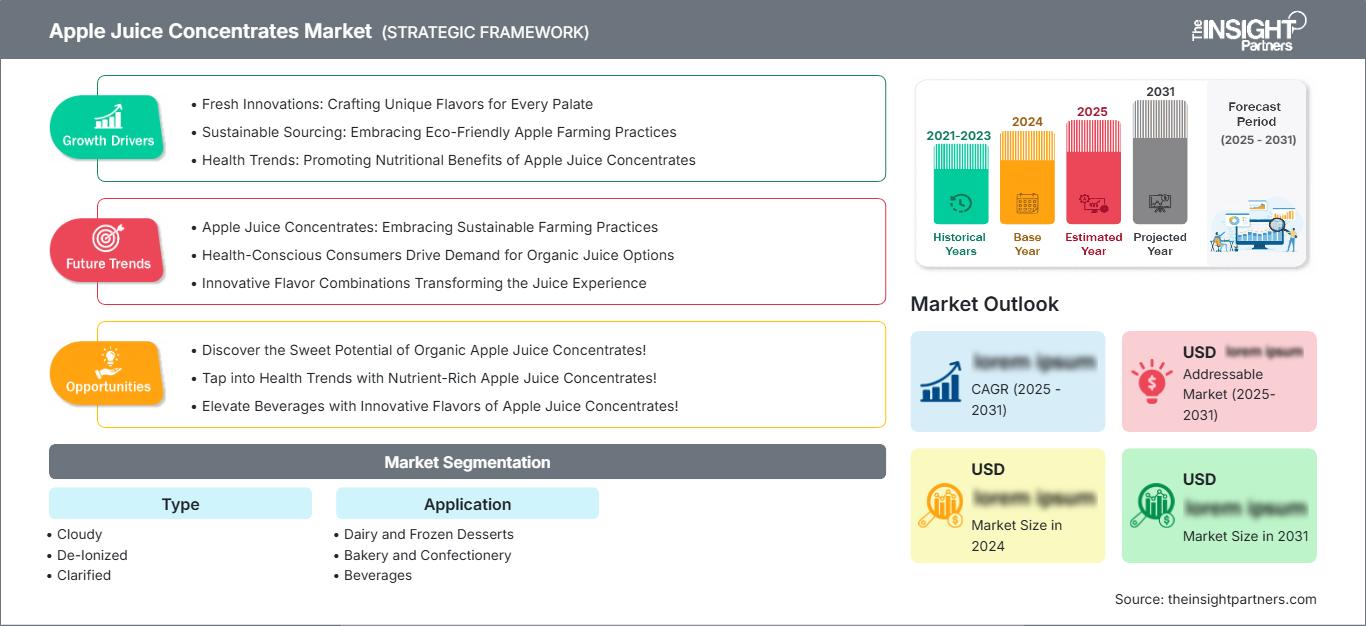
Apple Juice Concentrates Market: Strategic Insights
Regional Insights
North America apple juice concentrates market
North America accounted for 30–33% share of the apple juice concentrates market in 2025 and is projected to grow at a CAGR range of 4.7–5.2% from 2026 to 2034. The region benefits from established juice bottling infrastructure, strong snack and bakery manufacturing, and steady use of fruit-based sweetening systems. The United States leads regional demand, while Canada contributes through beverage blending, private-label food programs, and imported concentrate utilization.
The apple juice concentrates market share in North America is supported by processors that require documented allergen, non-GMO, kosher, organic, and residue-compliance files. Tree Top, Inc., Welch Foods Inc., Ingredion Incorporated, and H and H Products Company are positioned close to beverage and food manufacturers. Growth is expected to remain stable because formulation teams are using concentrates in both mainstream juice products and premium clean-label applications.
U.S. apple juice concentrates Market
The U.S. represented 82–86% of North America apple juice concentrates market in 2025 and is estimated to grow at a CAGR range of 4.8–5.3% from 2026 to 2034. The domestic market is driven by demand for juices, beverages, bakery fillings, applesauce applications, fruit snacks, frozen desserts, and foodservice ingredients. Processors appreciate concentrates for their ability to standardize sugar content, manage acid levels, and ensure year-round availability.
The company enjoys a wide presence, as its products are offered by Tree Top, Inc., Welch Foods Inc., H and H Products Company, and Ingredion Incorporated to industrial users via ingredient formulations and logistics capabilities. Trends in application areas point to growing usage in low-sugar beverages, dairy fruit blends, and snack fillings owing to the ability of apple concentrate to complement other fruit flavors without overpowering them.
Europe apple juice concentrates Market
Europe held 27–30% share of the apple juice concentrates market in 2025 and is projected to grow at a CAGR range of 4.5–5.0% from 2026 to 2034. Germany remains one of the leading countries because of beverage processing, food ingredient distribution, and high-quality standards. In the UK, the focus is on private label beverages, fruit preparations, and bakery product reformulation, while customers require well-developed documentation, consistency in color, and supply from different origins.
Germany and Italy are significant players in processing, blending, and industrial applications, with suppliers offering beverages, confectionery, and fruit preparation. France is sustaining the demand by providing dairy desserts, sauces, and top-quality juices. Spain has a benefit in ingredient trading and Mediterranean food production, while Poland's broader apple processing industry influences supply and prices in Europe.
Sonnländer Getränke GmbH, Döhler GmbH, Cobell Limited, Ve.Ba. Cooperativa Ortofrutticola S.C., and LemonConcentrate S.L. are examples of companies involved in European supply and application development. The growth rate will stay moderate since there is no demand for mature juice, while organic, cloudy, and de-ionized concentrates are used for natural sweeteners and reformulations of products.
APAC apple juice concentrates Market
Asia Pacific accounted for 23–26% share in 2025 and is forecast to grow at a CAGR range of 5.8–6.4% from 2026 to 2034. The top countries in the market include China, owing to its processing capabilities and export orientation, and India, because of packaged beverages, bakery chains, and dairy desserts.
Japan, South Korea, and Australia contribute to the demand for premium beverages and clean-label products. The drivers in industrialization include growth in urban retailing, cold chain development, and the use of concentrates in blended fruit drinks. Food safety and import documentation policies are motivating buyers to collaborate with suppliers that have strict traceability and testing facilities.
Middle East & Africa apple juice concentrates Market
The Middle East & Africa are projected to grow at a CAGR range of 5.1–5.7% from 2026 to 2034. Demand is driven by Saudi Arabia and UAE due to the growing manufacturing of beverages, growth in hospitality and improved retailing systems. Concentrates offer logistics benefits in high-temperature regions due to reduced weight during transportation and enabling shelf-stable products.
South Africa makes its contribution by offering juice blends, food service and bakery markets, while the rest of the MEA region is dependent on imports. Infrastructure development in the Gulf region to establish manufacturing zones for bottling of beverages helps the buyers in their efforts to use imported concentrate.
Segmentation Analysis
Type
The Type segment is expected to grow at a CAGR range of 4.8–5.4% during 2026–2034, reflecting diversified use across cloudy, de-ionized, and clarified concentrates. The apple juice concentrates market scope by type is shaped by beverage appearance, acidity targets, sweetness requirements, and processing compatibility. Buyers select formats based on final product clarity, label positioning, storage stability, and required sensory neutrality.
- Cloudy concentrates serve premium juices, smoothies, and natural-positioned beverages where pulp-like appearance and fuller mouthfeel matter. They are strategically important for brands emphasizing minimal processing and authentic fruit character.
- De-Ionized concentrates are used where neutral sweetness and low color impact are required. Demand is strongest in bakery, confectionery, sauces, and dairy systems needing fruit-based sweetening without dominant apple notes.
- Clarified concentrates remain widely used in mainstream beverages, nectars, and blended juices. Their stable appearance, predictable filtration behavior, and broad formulation compatibility make them commercially important for high-volume applications.
Application
The Application segment is expected to grow at a CAGR range of 5.0–5.6% during 2026–2034, driven by multifunctional use in beverages, dairy desserts, bakery, confectionery, sauces, dips, and spreads. Concentrates help manufacturers manage sweetness, acidity, fruit solids, and flavor consistency in scaled production. Application-led growth is strongest where clean-label positioning and cost-efficient fruit content are both important.
- Dairy and Frozen Desserts use concentrates in fruit preparations, variegates, yogurts, ice creams, and frozen novelties. The segment is strategically important because premiumization favors recognizable fruit ingredients and controlled sweetness.
- Bakery and Confectionery applications include fillings, glazes, fruit snacks, soft candies, and bars. Concentrates support moisture control, sweetness, mild acidity, and natural fruit positioning in shelf-stable products.
- Beverages remain the largest application, spanning juices, nectars, cider-style drinks, smoothies, and blends. Concentrates offer scalable sweetness, acidity balance, year-round supply, and efficient transport for bottlers.
- Sauces, Dips and Spreads use concentrates for sweetness balance, viscosity support, and flavor rounding. They are important in chutneys, marinades, fruit spreads, barbecue sauces, and condiment systems.
Opportunity Snapshot
| Application | Revenue Contribution | Trend Tag | Adoption Stage |
| Dairy and Frozen Desserts | Medium | Fruit Prep | Scaling |
| Bakery and Confectionery | Medium | Clean Fillings | Scaling |
| Beverages | High | Juice Blends | Mature |
| Sauces, Dips and Spreads | Low | Flavor Balance | Emerging |
Apple Juice Concentrates Market Growth Drivers and Impact Analysis
Clean-label reformulation across beverages and foods
Reformulation towards clean label is one of the key demand drivers since companies are substituting artificial flavors, artificial sweeteners, and hard-to-understand ingredients for more fruit-based ingredients. Apple concentrate adds natural sweetness, acidity, and fruitiness without being too dominant in the formulation and thus can be used in juices, bakery fillings, dairy applications, and sauces. This demand driver exerts its greatest influence on products whose ingredient lists consumers compare and on cases where retailers push for simple labeling. Premium positioning is facilitated by this demand driver through fruit-based sweetening since it can help achieve natural, non-GMO, organic, and kid-friendly positioning of the product.
Efficiency benefits in storage, transport, and manufacturing
Concentrated formats reduce transportation volume, storage space, and spoilage risk compared with single-strength juice, making them attractive for manufacturers managing global procurement. Aseptic drums, frozen formats, and bulk tanker options allow buyers to optimize logistics based on plant scale and production frequency. The impact is particularly visible in regions with high freight costs or limited local apple processing, where importing concentrate is more efficient than transporting finished juice. Food and beverage plants also gain better control over soluble solids, acidity, and recipe repeatability. As manufacturers focus on cost discipline, apple juice concentrates market suppliers that provide consistent specifications and flexible packaging formats gain stronger sourcing relevance.
Expansion of fruit-based applications beyond juice
The scope of demand is increasing because of the incorporation of apple concentrate in foods where it is not necessarily used for its flavor. Its versatility means that it can be used as a base sweetener, acid regulator, binder, and flavor medium in candies, bakery products, dessert sauces, and other confections. This broadens the scope of the market demand beyond packaged juices and exposes it to a new cycle of consumption. There will be great benefits from such products for companies that have application laboratories that can assist consumers in balancing the pH, viscosity, Brix, and flavor release.
Apple Juice Concentrates Market Future Trends
Greater adoption of de-ionized fruit sweetening systems
The most important apple juice concentrates market trends will include wider adoption of de-ionized formats as brands seek fruit-based sweetness with reduced color and flavor interference. Such concentrates may be useful for bakery fillings, confectionery centers, sauces and dairy applications where the requirement is for sweetness without the pronounced apple character. In the coming years, technical differentiation will be based on qualities such as ion-exchange efficiency, mineral management, low coloring, and consistency. If the suppliers are able to market the de-ionized concentrates as formulation tools and not as commodity ingredients, they may land premium contracts from global food manufacturers that aim to have cleaner labels.
Traceability-led premiumization in industrial sourcing
Traceability will become more important in purchases as retailers and food processors will examine pesticide content, origin, carbon footprint, and labor issues in suppliers. The industrial purchasers will go beyond standard spec sheets towards mapping of crop origins, third-party certifications, and sustainability scorecards of their suppliers. This will happen even in categories where cost is more critical since the brands cannot afford recalls, non-compliance, or exposure. Suppliers who will have concentrated operations, proven growers’ networks, and digitized quality and testing systems will have an advantage for long-term partnerships. Premiumization will not only mean sensory but also certification and reliability-based differentiation.
Apple Juice Concentrates Market Opportunities
Application partnerships with dairy and dessert manufacturers
Dairy and frozen dessert applications offer attractive opportunities because fruit preparations must deliver taste, texture, stability, and label appeal simultaneously. Suppliers can invest in co-development programs with yogurt, ice cream, and frozen novelty manufacturers to customize acidity, color, fruit solids, and sweetness profiles. This is especially relevant in premium and children’s nutrition products where recognizable fruit ingredients support brand positioning. The apple juice concentrates market Forecasts indicate that application-specific solutions can command stronger margins than bulk clarified concentrate. Companies that combine concentrate supply with stabilizer, texture, or fruit prep expertise can become preferred development partners rather than transactional ingredient vendors.
Regional supply hubs for emerging beverage markets
New beverage markets in India, Southeast Asia, the Gulf and Africa offer possibilities for local blending and distribution centers. Local producers may require small batches, halal certification, importing assistance and technical help before entering into an annual agreement. Suppliers can develop an edge by having products closer to consumer demand points, Brix range options and assisting with beverage development for heat stability and storage. This is an investment play since it requires warehousing, training of distributors and paperwork for regulatory reasons. Companies that provide localized service but retain global buying flexibility will win market share as modern beverage distribution grows.
Frequently Asked Questions

- Comprehensive Market Sizing and Forecast Analysis
- Detailed Segmentation Analysis
- In-Depth Market Dynamics Assessment
- Regional and Country-Level Insights
- Competitive Landscape and Company Benchmarking
- Strategic Business Intelligence
Recent Reports
Testimonials

The Insight Partners provided valuable market intelligence that supported our global go-to-market strategy. Their team was professional, responsive, and attentive to our feedback, providing thoughtful analysis and helpful methodological clarifications throughout the project.
Junmo Kim Chief Financial Officer (CFO), Enertech Co., Ltd.
The Insight Partners' SCADA System Market report is comprehensive, with valuable insights on current trends and future forecasts. The team was highly professional, responsive, and supportive throughout. We are very satisfied and highly recommend their services.
RAN KEDEM Partner, Reali Technologies LTDs
I requested a report on a very specific software market and the team produced the report in a few days. The information was very relevant and well presented. I then requested some changes and additions to the report. The team was again very responsive and I got the final report in less than a week.
JEAN-HERVE JENN Chairman, Future Analytica
We worked with The Insight Partners for an important market study and forecast. They gave us clear insights into opportunities and risks, which helped shape our plans. Their research was easy to use and based on solid data. It helped us make smart, confident decisions. We highly recommend them.
PIYUSH NAGPAL Sr. Vice President, High Beam Global
The Insight Partners delivered insightful, well-structured market research with strong domain expertise. Their team was professional and responsive throughout. The user-friendly website made accessing industry reports seamless. We highly recommend them for reliable, high-quality research services
YUKIHIKO ADACHI CEO, Deep Blue, LLC.
This is the first time I have purchased a market report from The Insight Partners.While I was unsure at first, I visited their web site and felt more comfortable to take the risk and purchase a market report.I am completely satisfied with the quality of the report and customer service. I had several questions and comments with the initial report, but after a couple of dialogs over email with their analyst I believe I have a report that I can use as input to our strategic planning process.Thank you so much for taking the extra time and making this a positive experience.I will definitely recommend your service to others and you will be my first call when we need further market data.
JOHN SUZUKI President and Chief Executive Officer, Board Director, BK Technologies
I wish to appreciate your support and the professionalism you displayed in the course of attending to my request for information regarding to infectious disease IVD market in Nigeria. I appreciate your patience, your guidance, and the fact that you were willing to offer a discount, which eventually made it possible for us to close a deal. I look forward to engaging The Insight Partners in the future, all thanks to the impression you have created in me as a result of this first encounter.
DR CHIJIOKE ONYIA MANAGING DIRECTOR, PineCrest Healthcare Ltd.Reason to Buy
- Informed Decision-Making
- Understanding Market Dynamics
- Competitive Analysis
- Identifying Emerging Markets
- Customer Insights
- Market Forecasts
- Risk Mitigation
- Boosting Operational Efficiency
- Strategic Planning
- Investment Justification
- Tracking Industry Innovations
- Aligning with Regulatory Trends





 Get Free Sample for