
Apple Juice Market Demand, Size & Forecast by 2034
Coverage: By Category (Organic, Conventional); Packaging (Bottles, Cartons, Others); Distribution Channel (Hypermarkets and supermarkets, Convenience stores, Online retail, Others) , and Geography (North America, Europe, Asia Pacific, and South and Central America)
- Status : Data Released
- Report Code : TIPRE00019942
- Category : Food and Beverages
- No. of Pages : 150
- Available Report Formats :


- Last update date : August 26, 2026


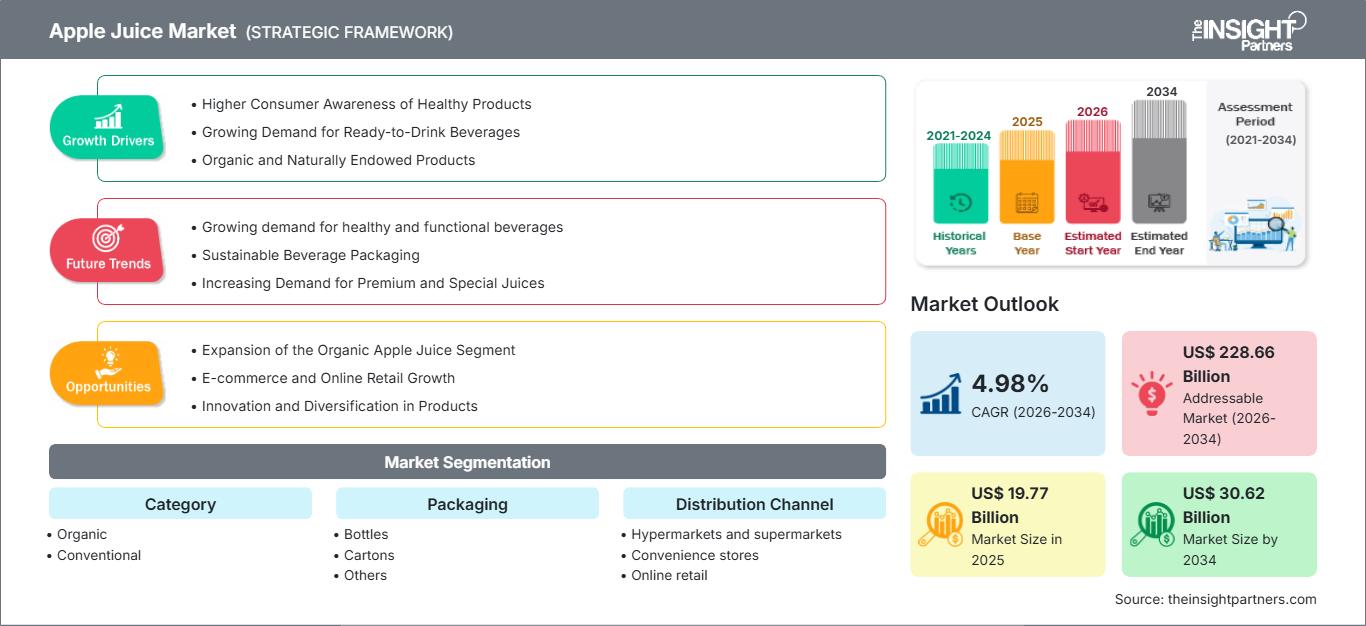
2025 Market Size
US$ 19.77 Bn
Base year value
2034 Forecast
US$ 30.62 Bn
Projected by 2034
CAGR 2026-2034
4.98 %
Growth rate
Addressable Market
US$ 228.66 Bn
(2026-2034)
The apple juice market is projected to grow from US$ 19.77 Billion in 2025 to US$ 30.62 Billion by 2034, registering a CAGR of 4.98% during 2026–2034. Growth drivers include consistent consumption of household beverages, increasing availability of packaged juices, and continuing demand for fruit-based refreshers. The category is well-positioned between regular household beverages and premium juice products.
In North America, high brand presence, cold chain development, demand for school lunch boxes, and visibility of 100% juices ensure strong growth prospects. The regional apple juice market size is expected to expand at an estimated 4.3–4.8% CAGR during 2026–2034, supported by organic juice adoption, lower-sugar product reformulation, and retailer investment in shelf-stable and refrigerated beverage assortments.
Apple Juice Market Assessment and Insights
- North America accounted for 27–30% share in 2025 and is projected to grow at a CAGR between 4.3–4.8% during 2026–2034, supported by premium bottled juices, school-focused packs, and strong grocery-chain penetration.
- US represented 76–79% of North America in 2025 and is expected to grow at a CAGR between 4.2–4.7% during 2026–2034, led by national brands and private labels.
- Europe held 23–26% share in 2025 and is forecast to grow at a CAGR between 4.0–4.5% during 2026–2034, with Germany, the UK, France, Italy, and Spain leading processed fruit beverage demand.
- Asia Pacific captured a 25–28% share in 2025 and is projected to grow at a CAGR between 5.6–6.2% during 2026–2034, driven by China, India, Japan, South Korea, and Australia.
- Largest Segment: Conventional held 78–82% market share in 2025 and is expected to grow at a CAGR between 4.5–5.0% during 2026–2034 due to affordability and broad availability.
- High Growth Segment: Organic held 18–22% market share in 2025 and is projected to grow at a CAGR between 6.1–6.8% during 2026–2034 as clean-label demand strengthens.
- Key companies analyzed in detail: Del Monte Foods, Inc.; Dabur India Limited; Parle Agro Pvt. Ltd.; Tropicana Products, Inc.; Hector Beverages Pvt. Ltd.; S. Martinelli & Company; Lassonde Industries Inc.; Ocean Spray Cranberries, Inc.; Mott's LLP; Lakewood Organic Juices, Inc.
Source: The Insight Partners' analysis based on proprietary research, government publications, company annual reports, investor presentations, industry databases, and expert interviews.
Processing has moved from basic clarified juice toward differentiated blends, not-from-concentrate formats, organic lines, and controlled-origin apple sourcing. Concentrate handling, aseptic filling, enzymatic clarification, and cold-fill technology have improved shelf life while reducing flavor degradation. Supply dynamics remain tied to global apple harvests, especially China, the European Union, and the U.S., where crop quality, juice-stock pricing, and residue testing influence formulation economics across the apple juice market.
In the coming years, the emergence of new demand is expected to take place in the Asia Pacific, the Middle East, and urban African beverage retail channels, where there will be an expansion in modern trade of packaged beverages. Concerns about contaminants, sugar content, and labeling will lead to higher testing costs, but it will help to promote reliable brands of beverages. The investment will concentrate on recyclable packaging, organic certification, and regional flavor extensions.
Apple Juice Market Report Scope
| Report Attribute | Details |
|---|---|
| Market size in 2025 | US$ 19.77 Billion |
| Market Size by 2034 | US$ 30.62 Billion |
| Global CAGR (2026 - 2034) | 4.98% |
| Historical Data | 2021-2024 |
| Forecast period | 2026-2034 |
Apple Juice Market Analysis
The apple juice market growth trajectory reflects the category’s resilience within family beverages, school consumption occasions, and ambient packaged drinks. Factors influencing demand include customers’ desire for known fruit flavors, vitamin C content, and convenient forms of consumption. Supply factors include the availability of juice-grade apples, concentrate imports, transportation, and seasonality in harvest quality.
The supply chain involves producers, concentrate producers, bottle makers, carton makers, brand owners, distributors, retail outlets and online marketplaces. Food safety testing has become more important in light of increased attention to the threat posed by inorganic arsenic and patulin. Those producers with diversified sourcing and production capacity can keep products available even when crop conditions worsen or prices rise.
Competition is fragmented across multinational beverage companies, regional juice specialists, and organic-focused producers. The apple juice market analysis indicates that Del Monte Foods, Inc., Tropicana Products, Inc., Mott's LLP, S. Martinelli & Company, and Lassonde Industries Inc. compete through brand recognition, while Lakewood Organic Juices, Inc. and premium specialists emphasize authenticity and ingredient transparency.
Trends in investments include the use of organic ranges, simplified labeling, multipacks, and pack sizes for particular channels. Dabur India Limited, Parle Agro Pvt. Ltd., and Hector Beverages Pvt. Ltd. have an advantage in having extensive coverage in the Indian retail market, whereas Ocean Spray Cranberries, Inc. provides a blending facility across fruits. Positioning is now becoming more about price and pack structure, retailer relations, and quality.
● REPORT CUSTOMIZATION
Tailor This Report To Align With Your Specific Business Requirements
This report can be customized to align precisely with your business objectives, scope, and target markets. Customization options include tailored segmentation, geography, competitive analysis, and strategic insights to support informed decision-making.
Customize This Report →WHAT YOU CAN ADJUST
- ● Segmentations
- ● Geography
- ● Competitive Analysis
- ● Language Preferences
Apple Juice Market: Strategic Insights
Regional Insights
North America apple juice market
North America held 27–30% share in 2025 and is projected to expand at a CAGR between 4.3–4.8% during 2026–2034. The region’s apple juice market share is supported by mature supermarket penetration, established school lunch consumption, and strong household familiarity with 100% juice packs. High-quality glass bottles, organic gallons, and shelf-stable packaging support various price points.
Expansion will be tempered by an examination of sugar consumption, but new formulations, smaller portions, and preservative-free product lines enhance the brand's relevance. The United States continues to provide the greatest contribution, and Canada is helped by health-focused retail outlets and private-label juice development.
U.S. apple juice Market
The U.S. accounted for 76–79% of North America in 2025 and is expected to grow at a CAGR between 4.2–4.7% through 2034. Mott's LLP, S. Martinelli & Company, Lassonde Industries Inc., and Lakewood Organic Juices, Inc. maintain visible positions across mainstream grocery, club stores, specialty retail, and online channels.
Application trends involve lunchbox packs, family-size packs, toddler-specific packs, and organic refrigerated items. Factors influencing demand include recommendations for fruit intake provided by the USDA, the nutrition program of the retailers, and contamination levels in juice. Competing private label brands impact prices, but well-known national brand names offer quality and children’s packaging benefits.
Europe apple juice Market
Europe represented 23–26% share in 2025 and is forecast to grow at a CAGR between 4.0–4.5% during 2026–2034. Germany is the leading country, supported by a strong apple processing infrastructure, high household juice penetration, and consumer familiarity with clear and cloudy juice formats. The UK remains important through supermarket private labels and ready-to-drink multipacks.
Germany’s demand is reinforced by local orchards, regional juice houses, and a preference for minimally processed beverages, while the UK favors convenience packaging and value ranges. France emphasizes quality labels and origin cues, Italy benefits from family consumption occasions, and Spain shows resilient demand through tourism-linked retail, hospitality, and ambient juice formats.
APAC apple juice Market
APAC held 25–28% share in 2025 and is projected to grow at a CAGR between 5.6–6.2% during 2026–2034. China is the leading country due to large apple production, concentrated availability, and expanding modern retail. Japan and South Korea favor premium packs, while India’s demand is led by affordable juice drinks and urban supermarkets.
Industrial drivers include beverage line automation, rising cold-chain capacity, and domestic brand expansion. Policy attention to food safety, packaged beverage standards, and agricultural processing supports higher-quality output. Australia remains smaller but premium-oriented, with organic and not-from-concentrate products gaining visibility.
Middle East & Africa apple juice Market
The Middle East & Africa is expected to grow at a CAGR between 4.7–5.3% during 2026–2034. Saudi Arabia and the UAE lead demand through high modern retail penetration, imported beverage reliance, and hospitality consumption. South Africa contributes through domestic fruit processing capability and regional distribution links.
Energy-intensive cold chains and packaging infrastructure remain cost factors, but ambient cartons and bottles reduce distribution complexity. Youth demographics, supermarket growth, and hotel, restaurant, and catering channels support volume development. The rest of MEA markets remain price-sensitive, creating opportunities for value packs and blended formulations.
Segmentation Analysis
Category
The Category segment is projected to grow at a CAGR between 4.8–5.3% during 2026–2034. The apple juice market scope across category lines is widening as conventional products maintain household affordability, while organic products attract health-conscious and premium shoppers. Certification, residue limits, and origin assurance increasingly influence shelf placement and retailer assortment decisions.
- Organic products occupy a premium position, supported by clean-label expectations, parenting-focused purchases, and specialty retail demand. Strategic value lies in higher margins, certification credibility, and differentiated sourcing narratives.
- Conventional products dominate mass-market consumption because of better price accessibility, stronger availability, and multipack formats. They remain strategically important for scale, private-label participation, and everyday family beverage occasions.
Packaging
The Packaging segment is expected to grow at a CAGR between 4.6–5.1% during 2026–2034. Bottles, cartons, and alternative formats address different consumption missions across home storage, school use, travel, and premium gifting. Packaging decisions increasingly reflect recyclability, portion control, shelf life, logistics efficiency, and visual differentiation at retail.
- Bottles are still significant in all categories, including family sizes, premium glass, and individual servings. They offer high visibility on shelves, resalable packaging, and perceived quality in mass market and specialty sections.
- Cartons are key for school packs, room temperature distribution, and multipacks. Their light construction minimizes freight costs and fits well for value-based repurchasing by households.
- Other packaging options include pouches, cans, and food service packaging, which cater to specific needs such as convenience, institutional distribution, or seasonal promotion programs.
Distribution Channel
The Distribution Channel segment is projected to grow at a CAGR between 5.0–5.5% during 2026–2034. Channel dynamics reflect the balance between impulse purchase, planned grocery replenishment, and digital convenience. Modern retailers influence assortment through nutrition standards and private-label expansion, while online retail improves access to organic, imported, and bulk-pack products.
- Hypermarkets and supermarkets are key players in organized retail sales through variety, offers, refrigeration, and branded lines. They are important for discovering new brands and bulk purchases for households.
- Convenience stores cater to instant consumption, travel, and smaller pack sizes. Their relevance lies mainly in urban lanes, fuel sales, and snacking and beverage needs.
- E-retail is growing in terms of subscription packs, organic products, and bulk family pack orders. It enables small brands to reach their consumers without necessarily needing shelves.
- Some others include institutional retailing, horeca, direct to consumer, and regional specialty retailing. These outlets enable niche formats and serve special needs of demand and regional brand presence.
Opportunity Snapshot
| Segments | Revenue Contribution (High/Medium/Low) | Trend Tag (MAX 2 words, specific) | Adoption Stage (Emerging/Scaling/Mature) |
| Organic | Medium | Clean Label | Scaling |
| Conventional | High | Value Packs | Mature |
| Bottles | High | Premium Glass | Mature |
| Cartons | High | Lunchbox Packs | Mature |
| Others | Low | Foodservice Packs | Emerging |
| Hypermarkets and supermarkets | High | Shelf Control | Mature |
| Convenience stores | Medium | Single Serve | Scaling |
| Online retail | Medium | Bulk Orders | Scaling |
| Others | Low | Institutional Supply | Emerging |
Apple Juice Market Growth Drivers and Impact Analysis
Rising Preference for Familiar Fruit-Based Beverages
Apple juice possesses one of the most widely agreed-upon fruit flavors in the market, allowing its durability in appealing to consumers of all ages, socio-economic status levels, and channels. Apple juice tends to be chosen by parents for consistent flavors and easy-to-manage portions, whereas adults choose it for consumption as a morning drink, a mix or an ingredient in drinks. This is reflected in the consistent presence on shelves of both 100% apple juice, juice drinks and organic varieties despite the reduction of consumption of carbonated beverages. Brands that successfully communicate about sweetness can keep their position intact.
Expansion of Modern Retail and Packaged Beverage Access
Modern grocery formats, convenience chains, and e-commerce platforms are expanding access to packaged juices in emerging and developed markets. This channel shift improves product visibility, standardizes pricing, and supports multipack sales that are difficult to execute through fragmented trade. For producers, modern retail also creates data-led opportunities to tailor pack sizes, run promotions, and test organic or premium offerings. The impact on the apple juice market is stronger replenishment behavior, wider brand comparison, and better penetration of ambient cartons and PET bottles. Retailer-owned brands will intensify competition, but they also normalize packaged juice consumption in price-sensitive households.
Food Safety Standards Driving Trusted Brand Selection
Issues relating to contamination in food, like those involving inorganic arsenic and patulin, have increased the significance of laboratory testing, supplier validation, and traceability. While compliance adds costs of operations, it helps build trust in the consumer for organizations that have mature quality systems in place. At the same time, retailers are becoming stricter on their suppliers, which favors producers that have verifiable sources, batch control systems, and rapid recall capability. The effect in the market is an evolutionary transition from unverified and low-profile sources of supply to known brands.
Apple Juice Market Future Trends
Premiumization Through Organic and Origin-Led Positioning
The next phase of apple juice market trends will likely emphasize origin identity, organic certification, and minimally processed product cues. The consumer will not only be required to compare taste and cost but also to assess the orchard from which the fruit came, cultivation process, sustainability of the packaging, and risk of contamination. Glass packaging, position of cold-pressing technology, and the "not from concentrate" label will just be some of the methods by which producers justify their high prices. It is highly unlikely that this trend will replace traditional volume sales; nevertheless, it may have an impact on profit margins.
Portion-Controlled and Lower-Sugar Product Architecture
Innovations going forward will be targeted towards small packs, low-concentration juice drinks, hybrid fruit water products, and mixed blends that tackle the sugar problem without sacrificing the apple taste. Such innovations become particularly pertinent when it comes to school use, lunches, and health-oriented families who make purchasing decisions based on caloric information. As opposed to relying solely on 100% juice innovations, manufacturers can develop diversified product lines with variations of full strength, lower sugar content, and functional blends. The business significance here becomes the retention of consumption opportunities, which would otherwise shift towards flavored water, dairy drinks, or low-calorie alternatives.
Apple Juice Market Opportunities
Organic Supply Chain Development in High-Value Retail
Organic products offer an investment route for processors, growers, and retailers seeking margin expansion beyond conventional juice. Building certified sourcing networks, residue-testing programs, and dedicated production runs can improve trust and support premium placement. The opportunity is strongest where parents, wellness-oriented consumers, and specialty grocers already accept higher price points. Apple juice market Forecasts indicate that organic lines can outperform the broader category if supply remains reliable and pricing does not widen excessively. Companies should prioritize transparent farm partnerships, certification visibility, and pack formats that make organic products accessible for both trial and repeat household purchase.
Digital Retail and Direct Household Replenishment
Online shopping enables possibilities such as bulk packs, subscriptions, and niche products, which have limited physical shelf space. Regional or smaller brands of juices can leverage the online platform to showcase their credentials about sourcing, offer various flavor combinations, and aim at repeat purchases from families. Big companies can leverage the data available from e-commerce and streamline the packaging process, as well as minimize dependence on the promotional cycle in the supermarket setting. This opportunity is very realistic since juice belongs to a replenishment category with definite usage at home.
Frequently Asked Questions

- Comprehensive Market Sizing and Forecast Analysis
- Detailed Segmentation Analysis
- In-Depth Market Dynamics Assessment
- Regional and Country-Level Insights
- Competitive Landscape and Company Benchmarking
- Strategic Business Intelligence
Recent Reports
Testimonials

The Insight Partners provided valuable market intelligence that supported our global go-to-market strategy. Their team was professional, responsive, and attentive to our feedback, providing thoughtful analysis and helpful methodological clarifications throughout the project.
Junmo Kim Chief Financial Officer (CFO), Enertech Co., Ltd.
The Insight Partners' SCADA System Market report is comprehensive, with valuable insights on current trends and future forecasts. The team was highly professional, responsive, and supportive throughout. We are very satisfied and highly recommend their services.
RAN KEDEM Partner, Reali Technologies LTDs
I requested a report on a very specific software market and the team produced the report in a few days. The information was very relevant and well presented. I then requested some changes and additions to the report. The team was again very responsive and I got the final report in less than a week.
JEAN-HERVE JENN Chairman, Future Analytica
We worked with The Insight Partners for an important market study and forecast. They gave us clear insights into opportunities and risks, which helped shape our plans. Their research was easy to use and based on solid data. It helped us make smart, confident decisions. We highly recommend them.
PIYUSH NAGPAL Sr. Vice President, High Beam Global
The Insight Partners delivered insightful, well-structured market research with strong domain expertise. Their team was professional and responsive throughout. The user-friendly website made accessing industry reports seamless. We highly recommend them for reliable, high-quality research services
YUKIHIKO ADACHI CEO, Deep Blue, LLC.
This is the first time I have purchased a market report from The Insight Partners.While I was unsure at first, I visited their web site and felt more comfortable to take the risk and purchase a market report.I am completely satisfied with the quality of the report and customer service. I had several questions and comments with the initial report, but after a couple of dialogs over email with their analyst I believe I have a report that I can use as input to our strategic planning process.Thank you so much for taking the extra time and making this a positive experience.I will definitely recommend your service to others and you will be my first call when we need further market data.
JOHN SUZUKI President and Chief Executive Officer, Board Director, BK Technologies
I wish to appreciate your support and the professionalism you displayed in the course of attending to my request for information regarding to infectious disease IVD market in Nigeria. I appreciate your patience, your guidance, and the fact that you were willing to offer a discount, which eventually made it possible for us to close a deal. I look forward to engaging The Insight Partners in the future, all thanks to the impression you have created in me as a result of this first encounter.
DR CHIJIOKE ONYIA MANAGING DIRECTOR, PineCrest Healthcare Ltd.Reason to Buy
- Informed Decision-Making
- Understanding Market Dynamics
- Competitive Analysis
- Identifying Emerging Markets
- Customer Insights
- Market Forecasts
- Risk Mitigation
- Boosting Operational Efficiency
- Strategic Planning
- Investment Justification
- Tracking Industry Innovations
- Aligning with Regulatory Trends





 Get Free Sample for