
Application Modernization Services Market Share, Demand & Growth by 2034
Coverage: By Service (LEGACY ASSESSMENT, DATABASE MIGRATION, CODE CONVERSION, TEST AUTOMATION); Organization Size (SMEs, Large Enterprises); Industry Vertical (BFSI, Retail and Consumer Goods, IT and Telecom, Manufacturing, Healthcare and Life Sciences, Government and Public Sector, Others) , and Geography (North America, Europe, Asia Pacific, and South and Central America)
- Status : Data Released
- Report Code : TIPRE00006385
- Category : Technology, Media and Telecommunications
- No. of Pages : 150
- Available Report Formats :


- Last update date : August 26, 2026


2025 Market Size
US$ 13.63 Bn
Base year value
2034 Forecast
US$ 39.67 Bn
Projected by 2034
CAGR 2026-2034
14.29 %
Growth rate
Addressable Market
US$ 253.69 Bn
(2026-2034)
The application modernization services market is projected to grow from US$ 13.63 Billion in 2025 to US$ 39.67 Billion by 2034, registering a CAGR of 14.29% from 2026 to 2034. Demand is being reinforced by enterprise pressure to retire technical debt, cloud-enable legacy estates, automate software delivery, and prepare core applications for AI-driven business operations across regulated and high-volume sectors.
Across North America, the application modernization services market size is supported by a mature cloud ecosystem, extensive mainframe dependency, and strong enterprise spending on secure digital operating models. The region is estimated to advance at a CAGR range of 13.4–14.2% during 2026–2034, driven by banking platform upgrades, healthcare interoperability needs, federal cloud programs, and modernization of customer-facing retail and telecom systems.
Application Modernization Services Market Assessment and Insights
- North America held an estimated 37–41% share in 2025 and is expected to grow at a CAGR of 13.4–14.2% during 2026–2034, supported by hyperscale cloud adoption, regulated-sector demand, and legacy modernization in banking, insurance, healthcare, and government.
- US accounted for 78–82% of North America in 2025 and is projected to grow at a CAGR of 13.2–14.0% during 2026–2034, led by federal IT renewal and enterprise AI-readiness programs.
- Europe represented 24–28% share in 2025 and is expected to grow at a CAGR of 12.8–13.6% during 2026–2034, with the UK, Germany, and France leading modernization across financial services, manufacturing, and public administration.
- Asia Pacific captured 22–26% share in 2025 and is forecast to grow at a CAGR of 16.0–16.8% during 2026–2034, led by China, India, Japan, South Korea, and Australia across digital banking, telecom, and manufacturing technology stacks.
- Largest Segment: Legacy Assessment held a market share of 32–36% in 2025 and is expected to grow at a CAGR of 12.5–13.5% during 2026–2034 due to portfolio rationalization demand.
- High Growth Segment: Test Automation held a market share of 18–22% in 2025 and is projected to grow at a CAGR of 16.0–17.5% during 2026–2034 as release cycles accelerate.
- Key companies analyzed in detail: Accenture plc, Aspire Systems India Pvt. Ltd., Dell Technologies Inc., HCL Technologies Limited, IBM Corporation, Microsoft Corporation, Oracle Corporation, Tech Mahindra Limited, Infosys Limited, Zensar Technologies Limited.
Source: The Insight Partners' analysis based on proprietary research, government publications, company annual reports, investor presentations, industry databases, and expert interviews.
Enterprise modernization has moved from selective rehosting to full-stack transformation involving code refactoring, API enablement, database conversion, automated testing, observability, and DevSecOps integration. The application modernization services market is increasingly shaped by hybrid cloud architectures, container orchestration, and AI-assisted software engineering. Production dynamics are shifting toward reusable accelerators, migration factories, and industry-specific blueprints that reduce delivery risk while preserving business continuity.
In the coming forecast period, the adoption of the solution is anticipated to increase in the Asia-Pacific region, the Middle-East, as well as governments who have seen an increased need for digitization due to policy support leading to increased demand for compliant cloud solutions. The vendors will be investing in modernization studios, AI-driven code analysis, and partner-driven cloud migration offerings.
Application Modernization Services Market Report Scope
| Report Attribute | Details |
|---|---|
| Market size in 2025 | US$ 13.63 Billion |
| Market Size by 2034 | US$ 39.67 Billion |
| Global CAGR (2026 - 2034) | 14.29% |
| Historical Data | 2021-2024 |
| Forecast period | 2026-2034 |
Application Modernization Services Market Analysis
The application modernization services market growth is driven by enterprises seeking faster releases, lower infrastructure cost, and stronger resilience across aging application portfolios. Legacy systems continue to be deeply entrenched in the processes of banking, telecommunications, healthcare, and the government sector, which makes modernization an iterative process in the value chain, rather than just a once-off migration. Service providers analyze legacy portfolios, re-code, migrate databases, automate testing, and integrate applications with cloud-native platforms.
There is an increasing specialization in the supply side of the market with cloud platform providers, systems integration firms, independent software vendors, and testing specialists forming a delivery ecosystem. Services offered by Microsoft Azure, Oracle Cloud, IBM hybrid cloud platforms, and Dell infrastructure are used for modernizing legacy systems at various levels.
The application modernization services market analysis shows a competitive landscape led by global integrators that combine consulting, cloud engineering, data migration, and automation assets. Accenture plc, Infosys Limited, HCL Technologies Limited, Tech Mahindra Limited, and Zensar Technologies Limited are marketing modernization services as part of a broader digital transformation offering, whereas IBM Corporation, Microsoft Corporation, Oracle Corporation, and Dell Technologies Inc. provide platform-led modernization solutions.
Funding is being directed into tools and services for AI-based coding translation, automated dependency analysis, test creation, and mainframe to cloud migration. Aspire Systems India Pvt. Ltd. and other providers stand out through specialized expertise in areas like product engineering, testing, and application managed services. Differentiation is now achieved through reusable IP, knowledge of industry compliance, scale of delivery, and non-disruptive modernization.
● REPORT CUSTOMIZATION
Tailor This Report To Align With Your Specific Business Requirements
This report can be customized to align precisely with your business objectives, scope, and target markets. Customization options include tailored segmentation, geography, competitive analysis, and strategic insights to support informed decision-making.
Customize This Report →WHAT YOU CAN ADJUST
- ● Segmentations
- ● Geography
- ● Competitive Analysis
- ● Language Preferences
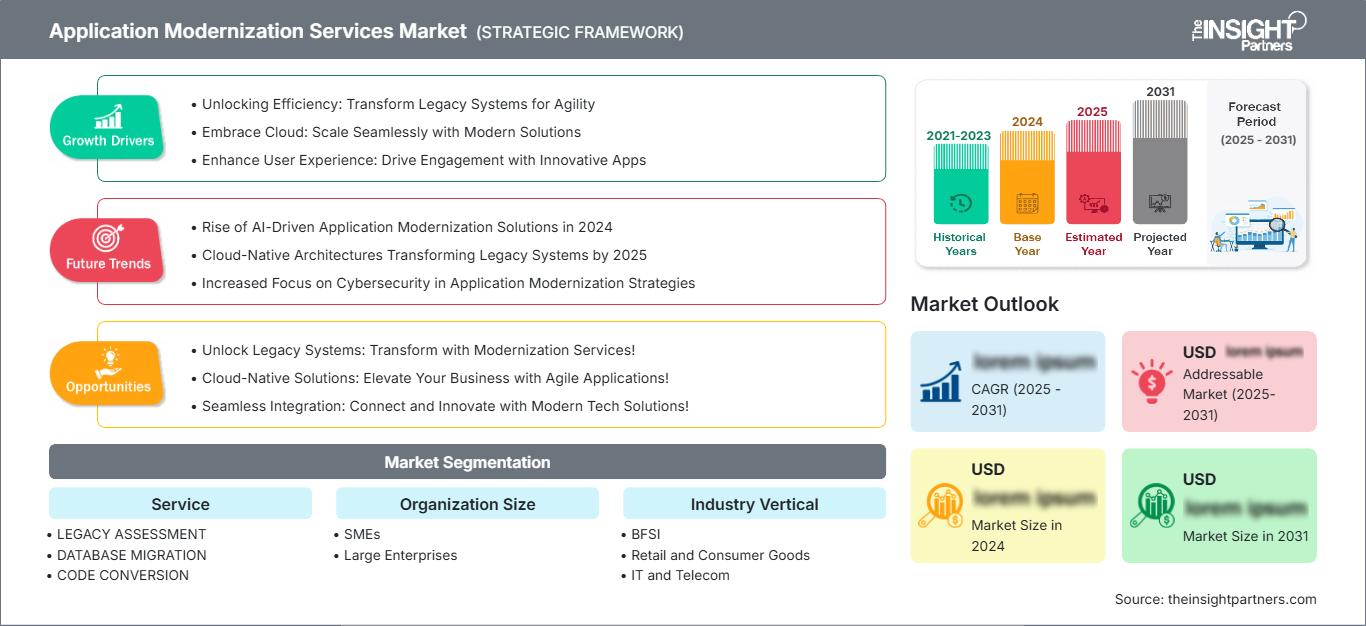
Application Modernization Services Market: Strategic Insights
Regional Insights
North America application modernization services market
North America accounted for an estimated 37–41% share in 2025, with a forecast CAGR of 13.4–14.2% during 2026–2034. The region benefits from concentrated hyperscale cloud capacity, mature managed services adoption, and large inventories of legacy applications in BFSI, healthcare, telecom, and public-sector agencies. Enterprises are prioritizing modernization to reduce technical debt and support AI-ready data pipelines.
The application modernization services market share in North America is also supported by cybersecurity mandates, operational resilience programs, and modernization of customer-facing digital channels. US and Canadian organizations are adopting database migration, test automation, and phased refactoring to reduce transformation risk. Demand is particularly strong where core systems interact with analytics, regulatory reporting, and real-time customer engagement platforms.
U.S. application modernization services Market
The US represented 78–82% of North America in 2025 and is expected to grow at a CAGR of 13.2–14.0% during 2026–2034. Large banks, insurance companies, healthcare organizations, retailers, cloud native software companies, and federal organizations are upgrading their applications for better resiliency and less reliance on expensive legacy talent. Business presence is robust in Microsoft Corporation, IBM Corporation, Oracle Corporation, Accenture plc, and Infosys Limited.
Application trends in the US are mainly focused on mainframe modernization, upgrading Java and .NET, monolith to microservices transition, database migration, and test automation. Continuous demand for Federal cloud projects, healthcare interoperability initiatives, and financial compliance workloads drives the market. Moreover, the US is a leading country when it comes to pilot projects using AI due to larger codebases and greater budgets of enterprises.
Europe application modernization services Market
Europe held an estimated 24–28% share in 2025 and is forecast to grow at a CAGR of 12.8–13.6% during 2026–2034. The largest economy is that of the United Kingdom, due to digital banking transformation, insurance platforms transformation, and cloud in the public sector. Cloud transformation in United Kingdom firms is directly linked to business resilience, data security, and modernization of customer services.
Germany has one of the largest economies, due to software estates in industries like automobiles, manufacturing, logistics, and engineering-driven firms. In Germany, modernization includes the transformation of SAP customizations, database transformation, and cloud transformation of factory systems. France, Italy, and Spain have increasing activities ranging from pilot projects to scale-up through public administration digitization, omnichannel retail transformation, and IT transformation in health care.
APAC application modernization services Market
Asia Pacific accounted for 22–26% share in 2025 and is projected to grow at a CAGR of 16.0–16.8% during 2026–2034. China leads regional spend by volume, while India shows rapid services-led growth as banks, telecom operators, and public digital platforms modernize core systems. Japan and South Korea emphasize secure modernization for manufacturing and financial applications.
Australia contributes steady enterprise demand through cloud-first public-sector policy, banking compliance, and healthcare system renewal. Regional growth is supported by industrial automation, digital payments, 5G monetization, and sovereign cloud initiatives. The application modernization services market is also gaining from local delivery centers that lower engineering costs and accelerate phased transformation across large application portfolios.
Middle East & Africa application modernization services Market
The Middle East & Africa is expected to grow at a CAGR of 14.5–15.3% during 2026–2034, with Saudi Arabia leading regional demand. Applications related to smart government, energy management, banking operations, airlines, and infrastructure initiatives are being modernized in Saudi Arabia and the UAE. Cloud regions, along with digital strategies, are contributing to better enterprise confidence in staged migration.
South Africa is a strong base of demand in Africa, fueled by banking IT renewal, telecoms transformation, and the digitization of public services. Adoption of the rest of MEA continues to be inconsistent yet progressing with better cloud connectivity, cybersecurity practices, and managed services. Energy sector players are increasingly turning towards modernization of field systems, analytics, and ERP environments.
Segmentation Analysis
Service
The Service segment is expected to grow at a CAGR of 13.7–14.8% during 2026–2034. The application modernization services market scope across services spans assessment, migration, code transformation, and testing automation. Enterprises are combining these capabilities to prioritize applications, reduce migration risk, and create repeatable modernization pipelines for large estates.
- Legacy Assessment remains the entry point for modernization programs, helping enterprises map dependencies, technical debt, business criticality, security exposure, and migration readiness before committing budget to execution.
- Database Migration is gaining importance as organizations move from monolithic databases to cloud-native, distributed, and analytics-ready platforms while preserving compliance, data quality, performance, and transactional integrity.
- Code Conversion supports the transformation of COBOL, RPG, Java, .NET, and legacy scripts into maintainable architectures, improving developer availability, integration flexibility, and long-term platform resilience.
- Test Automation is becoming strategically critical because modernized applications require repeatable validation, regression coverage, performance testing, and security checks across frequent release cycles.
Organization Size
The Organization Size segment is projected to grow at a CAGR of 13.9–14.7% during 2026–2034. Large enterprises continue to dominate complex modernization spending, while SMEs increasingly adopt packaged migration services, cloud-native application redesign, and managed modernization support to avoid internal skills shortages and reduce transformation cost.
- SMEs prefer modular modernization services that address immediate issues such as cloud migration, database upgrades, security remediation, and application performance without requiring large internal engineering teams.
- Large Enterprises invest in multi-year modernization roadmaps covering portfolio rationalization, platform engineering, AI-readiness, DevSecOps, and business-critical application transformation across regions and departments.
Industry Vertical
The Industry Vertical segment is expected to grow at a CAGR of 14.0–14.9% during 2026–2034. BFSI and IT and telecom lead demand due to high transaction volumes, regulatory scrutiny, and complex application estates. Healthcare, manufacturing, retail, and government are scaling modernization to support digital services, automation, and secure data exchange.
- BFSI modernizes core banking, claims, payments, customer onboarding, fraud systems, and regulatory reporting applications to improve resilience, compliance, personalization, and real-time transaction processing.
- Retail and Consumer Goods demand is tied to omnichannel platforms, loyalty systems, inventory visibility, customer analytics, and modernization of commerce applications supporting faster campaign execution.
- IT and Telecom organizations use modernization to support 5G services, cloud operations, billing transformation, network analytics, customer care automation, and faster deployment of digital products.
- Manufacturing adoption focuses on connecting legacy shop-floor applications with enterprise systems, analytics platforms, digital twins, and supply-chain visibility tools.
- Healthcare and Life Sciences modernizes clinical, claims, laboratory, and patient engagement systems to improve interoperability, compliance, data security, and service continuity.
- Government and Public Sector demand is driven by digital citizen services, secure cloud migration, legacy registry modernization, tax platforms, defense applications, and policy-backed technology renewal.
Opportunity Snapshot
| Industry Vertical | Revenue Contribution | Trend Tag | Adoption Stage |
| BFSI | High | Core Banking | Mature |
| Retail and Consumer Goods | Medium | Omnichannel | Scaling |
| IT and Telecom | High | 5G Platforms | Mature |
| Manufacturing | Medium | Smart Factory | Scaling |
| Healthcare and Life Sciences | Medium | Interoperability | Scaling |
| Government and Public Sector | Medium | Digital Services | Emerging |
Application Modernization Services Market Growth Drivers and Impact Analysis
Rising Technical Debt Across Mission-Critical Systems
Technical debt has become a measurable operating constraint as enterprises run decades-old applications alongside cloud-native services. In banking, insurance, telecom, healthcare, and public administration, legacy code limits integration speed, raises maintenance costs, and increases dependence on scarce skills. The impact on the application modernization services market is direct because organizations need structured assessment, code remediation, database migration, and automated testing before they can scale AI or analytics. Modernization also reduces operational risk by replacing unsupported components and improving observability. As executives connect technical debt with revenue leakage, compliance exposure, and slower product launches, modernization budgets are shifting from discretionary IT projects to board-level transformation priorities.
Cloud Migration Moving Toward Application-Level Transformation
Initially, cloud adoption started by focusing on the migration of infrastructure; however, businesses are now becoming more aware of the fact that simply lifting and shifting does not help in maximizing their potential with respect to scalability, resiliency, and cost efficiency. In such cases, application-level modernization becomes necessary for transforming monoliths, containerizing the workload, restructuring databases, and implementing DevSecOps principles. The application modernization services market benefits as clients seek providers that can assess business dependencies, sequence transformations, and integrate modernized applications with cloud services. The real-world impact is a stronger demand for migration factories, cloud-native patterns, testing automation, and ongoing managed services that maintain performance after transformation.
AI Readiness Creating Demand for Cleaner Application Architectures
There are inherent issues being revealed with the integration of AI in relation to fragmented applications, data model inconsistencies, and manual software delivery mechanisms. An enterprise cannot achieve scalability of AI applications when critical business processes are reliant on legacy applications that do not have adequate documentation or batch processing data flow. Modernizing an application would result in better API access, data availability, data governance, and application telemetry, which makes the deployment of AI more robust. The application modernization services market gains from this link between application architecture and enterprise AI outcomes. Organizations are increasingly treating modernization as the foundation for intelligent automation, not only as technical renewal.
Application Modernization Services Market Future Trends
AI-Assisted Modernization Factories
AI-assisted delivery models will reshape the application modernization services market trends by reducing manual effort in code analysis, documentation, test generation, and dependency mapping. In future modernization factories, a combination of generative AI technologies and engineering expertise will be used in order to speed up modernization while maintaining governance. Enterprise customers will need to have human validation as they will not be able to use only automated conversions in their regulated workloads. The key vendors will be able to distinguish themselves in terms of proprietary accelerators, model governance, and industry playbooks. It is going to allow scaling of modernization for large portfolios, including thousands of applications.
Platform Engineering as the Operating Model
Platform engineering will emerge as one of the key modernization outputs as companies start moving from upgrading applications to standardizing their internal developer platforms. Such platforms would enable the reuse of components, compliance testing, deployment pipeline, observability, and approved cloud services. This development will bring more consistency among modernization efforts, as well as boost the productivity of developers once migration is completed. Increasingly, buyers will judge service providers by their capabilities to deliver sustainable operating models, not just code transformation. As internal platforms mature, the application modernization services market demand will shift toward lifecycle support, governance automation, and continuous optimization across hybrid and multicloud environments.
Application Modernization Services Market Opportunities
Industry-Specific Modernization Blueprints
There are many opportunities for providers to bundle their modernization initiatives into those industries that need controlled processes. Banking needs modernization of payments, risks, and core banking; healthcare organizations need interoperability and workflow of patient information; manufacturing companies need integration of legacy systems and analytic tools. Market Forecasts for application modernization services indicate higher adoption levels if vendors cut down discovery process times and synchronize technical roadmaps with industry regulations. Actionable providers can make use of reusable reference architecture, pre-tested migration methodologies, and data models specific to the industry.
SME-Focused Modular Modernization Services
There is an untapped opportunity with SMEs, as they often use old business applications but do not have large teams for business transformation. The solution to this problem lies in vendor solutions such as modular assessment, fixed-scope migration to the database, test automation and modernization packages. Transparency in pricing, speed of implementation and presence on cloud marketplaces will be critical for the adoption process. The service providers who make modernization simple by offering them in the form of repeatable products will benefit from the demands of regional retailers, healthcare organizations, manufacturing companies and professional services firms.
Frequently Asked Questions

- Comprehensive Market Sizing and Forecast Analysis
- Detailed Segmentation Analysis
- In-Depth Market Dynamics Assessment
- Regional and Country-Level Insights
- Competitive Landscape and Company Benchmarking
- Strategic Business Intelligence
Recent Reports
Testimonials

The Insight Partners' SCADA System Market report is comprehensive, with valuable insights on current trends and future forecasts. The team was highly professional, responsive, and supportive throughout. We are very satisfied and highly recommend their services.
RAN KEDEM Partner, Reali Technologies LTDs
I requested a report on a very specific software market and the team produced the report in a few days. The information was very relevant and well presented. I then requested some changes and additions to the report. The team was again very responsive and I got the final report in less than a week.
JEAN-HERVE JENN Chairman, Future Analytica
We worked with The Insight Partners for an important market study and forecast. They gave us clear insights into opportunities and risks, which helped shape our plans. Their research was easy to use and based on solid data. It helped us make smart, confident decisions. We highly recommend them.
PIYUSH NAGPAL Sr. Vice President, High Beam Global
The Insight Partners delivered insightful, well-structured market research with strong domain expertise. Their team was professional and responsive throughout. The user-friendly website made accessing industry reports seamless. We highly recommend them for reliable, high-quality research services
YUKIHIKO ADACHI CEO, Deep Blue, LLC.
This is the first time I have purchased a market report from The Insight Partners.While I was unsure at first, I visited their web site and felt more comfortable to take the risk and purchase a market report.I am completely satisfied with the quality of the report and customer service. I had several questions and comments with the initial report, but after a couple of dialogs over email with their analyst I believe I have a report that I can use as input to our strategic planning process.Thank you so much for taking the extra time and making this a positive experience.I will definitely recommend your service to others and you will be my first call when we need further market data.
JOHN SUZUKI President and Chief Executive Officer, Board Director, BK Technologies
I wish to appreciate your support and the professionalism you displayed in the course of attending to my request for information regarding to infectious disease IVD market in Nigeria. I appreciate your patience, your guidance, and the fact that you were willing to offer a discount, which eventually made it possible for us to close a deal. I look forward to engaging The Insight Partners in the future, all thanks to the impression you have created in me as a result of this first encounter.
DR CHIJIOKE ONYIA MANAGING DIRECTOR, PineCrest Healthcare Ltd.Reason to Buy
- Informed Decision-Making
- Understanding Market Dynamics
- Competitive Analysis
- Identifying Emerging Markets
- Customer Insights
- Market Forecasts
- Risk Mitigation
- Boosting Operational Efficiency
- Strategic Planning
- Investment Justification
- Tracking Industry Innovations
- Aligning with Regulatory Trends





 Get Free Sample for