
Digital Circular Economy Market Trends, Demand & Growth by 2034
Digital Circular Economy Market Size and Forecasts (2021 - 2034), Global and Regional Share, Trends, and Growth Opportunity Analysis Report Coverage : By Offering (Software, Services); Technology (Blockchain And Distributed Ledger Technology (DLT), IoT, AI & ML, AR & VR, VR-Based Training, Cloud Computing, Big Data Analytics, Others ); Vertical (Consumer Electronics, IT & Telecom, Automotive, Manufacturing, Construction And Building, Healthcare And Medical Devices, Others )
- Status : Data Released
- Report Code : TIPRE00039813
- Category : Technology, Media and Telecommunications
- No. of Pages : 150
- Available Report Formats :


- Last update date : July 30, 2026


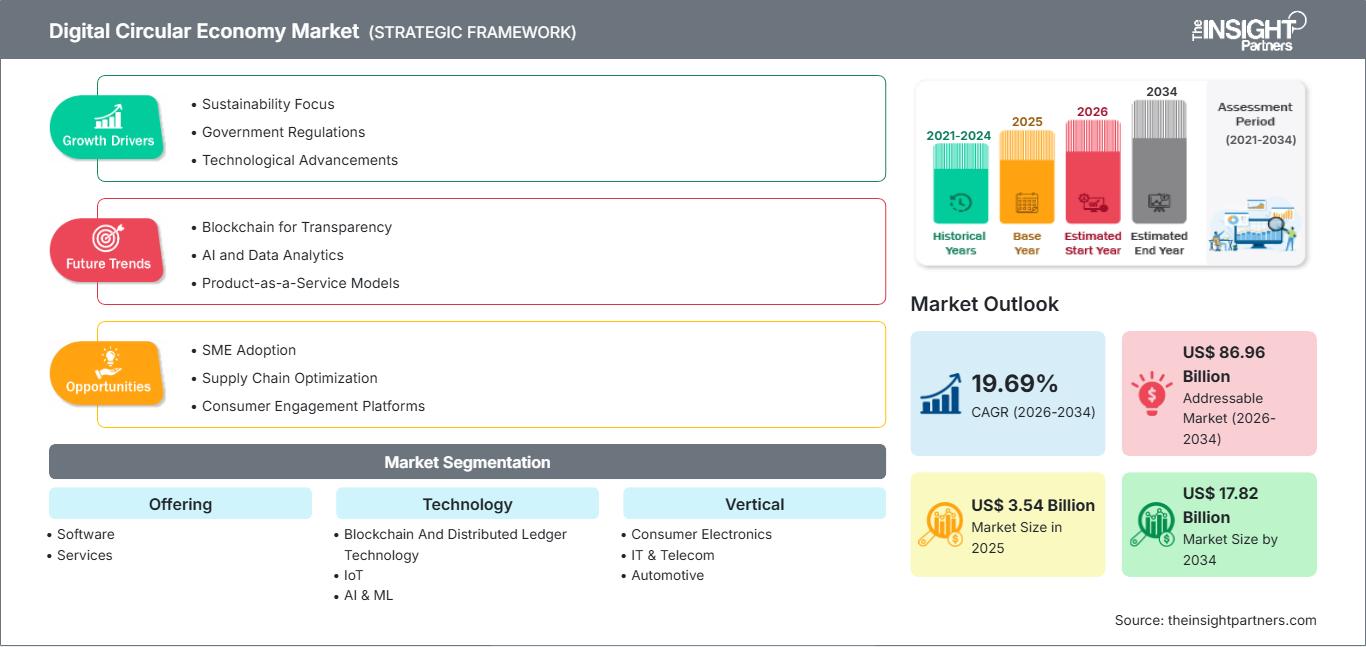
2025 Market Size
US$ 3.54 Bn
Base year value
2034 Forecast
US$ 17.82 Bn
Projected by 2034
CAGR 2026-2034
19.69 %
Growth rate
Addressable Market
US$ 86.96 Bn
(2026-2034)
The digital circular economy market was valued at US$ 3.54 Billion in 2025 and is projected to reach US$ 17.82 Billion by 2034, registering a CAGR of 19.69% during 2026–2034. The market is advancing as organizations integrate digital platforms, intelligent analytics, connected systems, and automation technologies to improve resource utilization, extend product lifecycles, and support circular business models across industries.
The digital circular economy market size expansion is influenced by increasing enterprise adoption of software-enabled circularity solutions, sustainability reporting requirements, and technology investments across North America. The region is expected to witness a CAGR range of 18–21% during 2026–2034, supported by advanced digital infrastructure, industrial modernization initiatives, and rising corporate focus on resource efficiency and traceability.
Digital Circular Economy Market Assessment and Insights
- North America: held a 32–36% share in 2025 and is expected to expand at a CAGR of 18–21% between 2026–2034. Strong enterprise digitization, sustainability frameworks, and adoption of circular platforms support market development.
- US: Accounted for 24–28% share in 2025 and is projected to grow at a CAGR of 18–20% during 2026–2034. Industrial technology investments and cloud-based circular solutions influence adoption.
- Europe: Represented a 28–32% share in 2025 and is estimated to register a CAGR of 17–20% from 2026–2034. Germany, the UK, France, and Italy lead adoption through regulatory alignment and industrial sustainability programs.
- Asia Pacific: Captured a 22–26% share in 2025 and is expected to achieve a CAGR of 21–24% between 2026–2034. China, Japan, India, and South Korea are advancing digital circularity through manufacturing transformation.
- Largest Segment: Software accounted for a 45–50% market share in 2025 and is expected to grow at a CAGR of 18–21% during 2026–2034, driven by enterprise platform adoption.
- High Growth Segment: AI & ML represented a 12–16% share in 2025 and is projected to expand at a CAGR of 23–26% during 2026–2034 due to predictive optimization capabilities.
- Key companies analyzed in detail: SAP, Capgemini, Dassault Systèmes, Cisco, IBM, Oracle, Ingram Micro, Honeywell, Accenture, Hitachi
Source: The Insight Partners' analysis based on proprietary research, government publications, company annual reports, investor presentations, industry databases, and expert interviews.
The digital circular economy market has evolved from basic recycling management systems toward integrated digital ecosystems that connect product lifecycle data, supply chain visibility, and resource optimization. Companies increasingly deploy cloud platforms, IoT networks, blockchain solutions, and artificial intelligence tools to improve material tracking and operational efficiency. Manufacturing organizations are shifting from linear production models toward data-driven circular processes, where digital twins and analytics support maintenance, reuse, and remanufacturing decisions. This transformation reflects a broader industrial movement toward measurable sustainability outcomes and improved asset utilization.
Future expansion of the digital circular economy market is expected to be supported by emerging economies investing in smart manufacturing infrastructure and digital sustainability frameworks. Government initiatives focused on waste reduction, extended producer responsibility, and resource efficiency are encouraging enterprises to adopt technology-based circular solutions. Investments are also increasing in interoperable platforms that enable collaboration among manufacturers, suppliers, recyclers, and consumers. Advancements in AI-powered decision systems and connected asset management are expected to create additional opportunities across industrial and consumer-focused applications.
Digital Circular Economy Market Report Scope
| Report Attribute | Details |
|---|---|
| Market size in 2025 | US$ 3.54 Billion |
| Market Size by 2034 | US$ 17.82 Billion |
| Global CAGR (2026 - 2034) | 19.69% |
| Historical Data | 2021-2024 |
| Forecast period | 2026-2034 |
Digital Circular Economy Market Analysis
Organizations across industries are adopting digital circular economy market solutions to improve visibility across product lifecycles and optimize resource management. The ecosystem includes technology providers, manufacturing enterprises, service organizations, logistics participants, and recycling networks. Demand is increasing as companies seek measurable sustainability performance while reducing operational inefficiencies. Software platforms provide lifecycle tracking, material intelligence, and reporting capabilities, while services support implementation, integration, and consulting requirements.
Supply dynamics are shaped by the increasing availability of cloud infrastructure, connected devices, and advanced analytics capabilities, contributing to the growth of the digital circular economy market share. Technology providers are developing integrated solutions that combine multiple digital capabilities to support circular operations. The growing participation of industrial companies and technology firms is strengthening the ecosystem by improving solution scalability, interoperability, and industry-specific customization.
The competitive landscape of the digital circular economy market includes established technology companies, consulting firms, and industrial solution providers developing circularity-focused offerings. SAP, IBM, Oracle, and Dassault Systèmes are strengthening their positions through enterprise platforms and lifecycle management capabilities. Digital transformation service offerings related to sustainability are being offered by Capgemini and Accenture, whereas Cisco, Honeywell, Hitachi, and Ingram Micro provide services via connectivity and industrial solutions.
The investments are moving in the direction of AI, digital twins, traceability using blockchain technology, and cloud solutions for sustainability. The organizations are looking forward to forming strategic partnerships and enhancing solutions to meet the changing customer needs. The competitive advantage lies in the integration capability of technology, industry experience, and improved sustainability performance.
● REPORT CUSTOMIZATION
Tailor This Report To Align With Your Specific Business Requirements
This report can be customized to align precisely with your business objectives, scope, and target markets. Customization options include tailored segmentation, geography, competitive analysis, and strategic insights to support informed decision-making.
Customize This Report →WHAT YOU CAN ADJUST
- ● Segmentations
- ● Geography
- ● Competitive Analysis
- ● Language Preferences
Digital Circular Economy Market: Strategic Insights
Regional Insights
North America Digital circular economy market
North America accounted for a 32–36% share of the digital circular economy market in 2025 and is projected to expand at a CAGR of 18–21% during 2026–2034. The region benefits from strong digital infrastructure, widespread enterprise software adoption, and sustainability commitments across manufacturing, technology, and consumer industries. The US constitutes the leading contributor owing to the presence of industrial automation and circular economy efforts among companies.
Technology spending by big companies is driving the use of connected assets management, optimization through artificial intelligence, and cloud-based lifecycle management solutions. Firms are adopting digital technologies to enhance visibility within their supply chain, reduce wastage, and fulfill regulatory obligations. The contribution from Canada and Mexico is coming from manufacturing efficiency and resource management initiatives.
U.S. Digital circular economy market
The U.S. digital circular economy market represented approximately 74–78% of the North American market share in 2025 and is anticipated to register a CAGR of 18–20% during 2026–2034. The nation holds its position strongly owing to the adoption of the latest technologies, enterprise software ecosystem, and rising investments towards sustainability.
Technology vendors and consulting firms are extending the application of the circular economy in terms of cloud services, analysis solutions, and lifecycle management systems. Technology is being used by manufacturing, automotive, health care, and electronics firms for efficient resource management and monitoring. Government policies for sustainability, along with environmental policies of corporations, are motivating companies towards making digital investments.
Europe Digital circular economy market
Europe held a 28–32% share of the digital circular economy market in 2025 and is expected to grow at a CAGR of 17–20% between 2026–2034. It is one of the important markets because of its focus on sustainable production, designing based on circularity, and efficient use of resources. Germany is one of the major countries in this region, owing to the high level of manufacturing capabilities and industry sustainability projects.
The United Kingdom has contributed through its digital sustainability projects and adoption of technology and circular economy strategy by corporations in industries like retailing, electronics, and manufacturing. The German industries drive demand for lifecycle management and smart production technology. France, Italy, and Spain have developed their capability through governmental environmental projects and industrial transformation, along with enterprises adopting digital solutions for traceability and efficient resource use.
APAC Digital circular economy market
APAC represented a 22–26% share of the digital circular economy market in 2025 and is projected to record a CAGR of 21–24% during 2026–2034. China leads the regional market due to manufacturing scale, technology deployment, and industrial digitalization programs.
Japan, South Korea, India, and Australia are expanding adoption through smart manufacturing investments, sustainability policies, and technology modernization. Industrial organizations are implementing IoT platforms, analytics solutions, and cloud systems to improve resource efficiency. Government initiatives supporting waste reduction and digital infrastructure development are expected to strengthen regional growth.
Middle East & Africa Digital circular economy market
Middle East & Africa accounted for an estimated 7–10% share of the digital circular economy market in 2025 and is expected to expand at a CAGR of 16–19% during 2026–2034. The UAE is considered a market leader because of the investments made in smart infrastructure, sustainability efforts, and digital transformation.
The circular economy is being promoted in Saudi Arabia through economic diversification efforts and industrialization. South Africa is contributing to the circular economy through resource management efforts and the use of technology in industries. Digital technology is being utilized by other MEA countries in waste management, efficiency in infrastructure, and sustainable resource utilization.
Segmentation Analysis
Offering
The Offering segment is expected to register a CAGR of 18–21% during 2026–2034, according to the digital circular economy market report. Digital solutions and supporting services form the foundation of circular economy transformation by enabling organizations to monitor resources, optimize processes, and implement lifecycle-based strategies. Software platforms are increasingly integrated with enterprise systems, while services assist companies with deployment, consulting, and operational improvements.
- Software provides lifecycle visibility, resource tracking, analytics capabilities, and sustainability reporting functions. Enterprises increasingly adopt software platforms to integrate circular operations with existing business management systems and improve decision-making.
- Services support implementation, customization, consulting, and maintenance requirements for circular economy technologies. Organizations rely on service providers to integrate digital solutions with operational workflows and sustainability objectives.
Technology
The Technology segment is projected to achieve a CAGR of 21–24% during 2026–2034, according to the digital circular economy market forecast. Advancements in emerging technologies are enabling more accurate resource monitoring, predictive analysis, and automated decision-making. Enterprises are combining multiple digital capabilities to create connected circular ecosystems that improve efficiency and transparency throughout product lifecycles.
- Blockchain and distributed ledger technology enable secure data exchange, product traceability, and transparent transaction records across supply chains. Adoption is increasing among organizations requiring reliable lifecycle information and verification mechanisms.
- IoT supports real-time monitoring of assets, equipment conditions, and resource utilization. Connected devices help industries improve operational visibility and enable predictive maintenance strategies.
- AI & ML enhance circular operations through predictive analytics, automated optimization, and intelligent resource planning. Organizations use these capabilities to improve forecasting and maximize asset utilization.
- AR & VR assist companies through visualization, product design improvement, and operational training applications. These technologies support better collaboration during development and maintenance processes.
- VR-Based Training improves workforce capabilities by providing immersive learning environments. Industries use virtual training solutions to enhance operational knowledge and support safer technology adoption.
- Cloud Computing enables scalable access to digital circularity platforms and supports collaboration among distributed stakeholders. Cloud infrastructure improves flexibility, integration, and data accessibility.
- Big Data Analytics helps organizations process complex datasets related to materials, supply chains, and product performance. Analytics capabilities support informed circular economy decisions.
Vertical
The Vertical segment is expected to grow at a CAGR of 19–22% during 2026–2034. Industries are adopting digital circular economy market solutions to improve sustainability performance, optimize resources, and comply with evolving environmental requirements. Different sectors are implementing technology according to their operational needs and lifecycle management priorities.
- Consumer Electronics adopts digital circular solutions for product lifecycle management, component recovery, and material tracking. Growing electronic waste concerns are encouraging manufacturers to improve reuse and recycling processes.
- IT & Telecom uses circular technologies to manage equipment lifecycle, improve asset utilization, and support responsible technology disposal practices across large-scale infrastructure networks.
- Automotive integrates digital platforms for vehicle lifecycle tracking, component reuse, and manufacturing optimization. Circular strategies are gaining importance due to electrification and material efficiency requirements.
- Manufacturing applies digital tools to improve production efficiency, reduce waste generation, and enable smarter resource management. Industrial organizations increasingly integrate connected systems into manufacturing processes.
- Construction and building leverage digital solutions for material tracking, efficient resource use, and sustainable project management. Technology adoption supports improved lifecycle planning across construction activities.
- Healthcare And Medical Devices utilize circular solutions for equipment management, compliance tracking, and resource optimization. Digital platforms help organizations improve asset visibility and operational efficiency.
Opportunity Snapshot
| Industry Vertical | Revenue Contribution (High/Medium/Low) | Trend Tag | Adoption Stage |
| Consumer Electronics | High | Device Recovery | Scaling |
| IT & Telecom | High | Asset Lifecycle | Scaling |
| Automotive | High | Circular Mobility | Scaling |
| Manufacturing | High | Smart Production | Mature |
| Construction And Building | Medium | Material Tracking | Emerging |
| Healthcare And Medical Devices | Medium | Equipment Reuse | Emerg |
Digital Circular Economy Market Growth Drivers and Impact Analysis
Expansion of digital traceability across supply chains
Growing demand for transparent supply chains is accelerating the adoption of digital circular economy market solutions across manufacturing, electronics, and automotive industries. Blockchain, Internet of Things (IoT), and analytics systems are being utilized by companies to gain better visibility of material flow, the history of products, and asset management. Digital traceability allows companies to find out ways to recover materials, improve inventory management, and become more compliant with sustainability regulations. This is especially crucial for companies whose supply chain is complicated and resource monitoring becomes an issue. More data can be used in collaboration among manufacturing companies, recyclers, and services to operate a better circular model. Due to rising requirements in material transparency, enterprises choose technologies that offer accurate lifecycle data.
Integration of artificial intelligence for resource optimization
Artificial intelligence adoption is becoming a major driver of digital circular economy market trends as organizations seek advanced methods to improve resource efficiency and operational decision-making. With AI-based platforms, huge amounts of operational data are analyzed in order to discover waste reduction options, forecast equipment needs, and streamline production processes. For industrial companies, this includes the implementation of predictive maintenance and higher efficiency in the use of assets and lower downtimes. By combining machine learning technologies with connected systems, organizations can build adaptive circular models that can react to changes in demand and availability of resources. There is an increasing trend for companies to invest in intelligent automation in order to deliver more sustainable results without sacrificing their efficiency.
Increasing enterprise adoption of cloud-based circular platforms
With the help of cloud-based systems, organizations are able to adopt scalable circular economy models without having to make large infrastructural investments. Cloud systems have been embraced by companies to help integrate information related to life cycles and to facilitate connectivity between various parties. Information sharing among suppliers, manufacturers, and service providers is made easier and more effective with the use of cloud systems, leading to increased efficiency in value chains. More small and medium-sized businesses are enjoying subscription-based models, which minimize the technological barriers that may be experienced. With cloud integration, the ability to integrate sustainability management software with enterprise systems is improved.
Digital Circular Economy Market Future Trends
Rise of digital twins for circular product lifecycle management
Digital twins will emerge as one of the key trends in the future because of their capacity to create more precise representations of physical products, assets, and production systems. It is possible to simulate the behavior and operation of a digital twin in order to monitor its state, perform maintenance, and improve it. The use of digital twins will spread from manufacturing to construction, healthcare, and infrastructure in the future because such models are essential for lifecycle optimization. Digital twins will help make better decisions because of the combination of operational and predictive data. With growing concerns over extending the lifetime of products and minimizing resource usage, the features of digital twins will be incorporated into circular economy systems.
Growth of interoperable circular economy ecosystems
Further developments in the future circular economy will be based on the creation of interoperable digital ecosystems that involve many actors throughout value chains. Enterprises tend to adopt platforms where the exchange of data among suppliers, manufacturers, customers, and recyclers would be more effective. The use of standardized data models and connectivity technologies will foster collaboration and provide better transparency of material flows. Such digital ecosystems will assist organizations in handling their sustainability challenges and will create additional possibilities for recycling and reusing products. Interoperability is likely to encourage cross-sector collaboration and facilitate resource sharing among different industries.
Digital Circular Economy Market Opportunities
Expansion of circular solutions in emerging manufacturing economies
Manufacturing in emerging economies provides many potential opportunities for technology companies as these industries transform their manufacturing processes into more sustainable models. The countries in APAC, Latin America, and certain regions in the Middle East are adopting technologies to support the digitalization of their industries and need the use of circular technology platforms. Organizations can leverage these opportunities by providing a solution that caters to the regional needs of the manufacturing industry in terms of the supply chain and the regulatory framework. Collaboration with regional industrial organizations and technology integration can assist in entering this new market. There is a great emphasis on sustainable manufacturing that makes this market attractive for investment.
Development of AI-driven sustainability intelligence platforms
The growing requirement for metrics associated with sustainable outcomes makes way for businesses developing artificial intelligence platforms for intelligence. Businesses require sophisticated solutions that can help them translate data into useful insights to optimize resources, manage emissions, and enhance the lifecycle. AI-powered platforms of sustainability can enable businesses to detect inefficiencies, predict their resource needs, and plan strategically. There are numerous investment opportunities in software, analytics, and use cases within various industries. Businesses that are keen on integrating their AI platforms with enterprise resource planning systems and other technologies can create more traction within large corporations.
Frequently Asked Questions

- Comprehensive Market Sizing and Forecast Analysis
- Detailed Segmentation Analysis
- In-Depth Market Dynamics Assessment
- Regional and Country-Level Insights
- Competitive Landscape and Company Benchmarking
- Strategic Business Intelligence
Recent Reports
Testimonials

The Insight Partners' SCADA System Market report is comprehensive, with valuable insights on current trends and future forecasts. The team was highly professional, responsive, and supportive throughout. We are very satisfied and highly recommend their services.
RAN KEDEM Partner, Reali Technologies LTDs
I requested a report on a very specific software market and the team produced the report in a few days. The information was very relevant and well presented. I then requested some changes and additions to the report. The team was again very responsive and I got the final report in less than a week.
JEAN-HERVE JENN Chairman, Future Analytica
We worked with The Insight Partners for an important market study and forecast. They gave us clear insights into opportunities and risks, which helped shape our plans. Their research was easy to use and based on solid data. It helped us make smart, confident decisions. We highly recommend them.
PIYUSH NAGPAL Sr. Vice President, High Beam Global
The Insight Partners delivered insightful, well-structured market research with strong domain expertise. Their team was professional and responsive throughout. The user-friendly website made accessing industry reports seamless. We highly recommend them for reliable, high-quality research services
YUKIHIKO ADACHI CEO, Deep Blue, LLC.
This is the first time I have purchased a market report from The Insight Partners.While I was unsure at first, I visited their web site and felt more comfortable to take the risk and purchase a market report.I am completely satisfied with the quality of the report and customer service. I had several questions and comments with the initial report, but after a couple of dialogs over email with their analyst I believe I have a report that I can use as input to our strategic planning process.Thank you so much for taking the extra time and making this a positive experience.I will definitely recommend your service to others and you will be my first call when we need further market data.
JOHN SUZUKI President and Chief Executive Officer, Board Director, BK Technologies
I wish to appreciate your support and the professionalism you displayed in the course of attending to my request for information regarding to infectious disease IVD market in Nigeria. I appreciate your patience, your guidance, and the fact that you were willing to offer a discount, which eventually made it possible for us to close a deal. I look forward to engaging The Insight Partners in the future, all thanks to the impression you have created in me as a result of this first encounter.
DR CHIJIOKE ONYIA MANAGING DIRECTOR, PineCrest Healthcare Ltd.Reason to Buy
- Informed Decision-Making
- Understanding Market Dynamics
- Competitive Analysis
- Identifying Emerging Markets
- Customer Insights
- Market Forecasts
- Risk Mitigation
- Boosting Operational Efficiency
- Strategic Planning
- Investment Justification
- Tracking Industry Innovations
- Aligning with Regulatory Trends





 Get Free Sample for