
Apricot Oil Market Size, Share & Trends by 2034
Coverage: By Application (Food, Pharmaceutical, Cosmetic, Others); Distribution Channel (Online, Offline), and Geography (North America, Europe, Asia Pacific, and South and Central America)
- Status : Data Released
- Report Code : TIPRE00015927
- Category : Consumer Goods
- No. of Pages : 150
- Available Report Formats :


- Last update date : October 26, 2026


2025 Market Size
US$ 2.21 Bn
Base year value
2034 Forecast
US$ 3.65 Bn
Projected by 2034
CAGR 2026-2034
5.74 %
Growth rate
Addressable Market
US$ 26.57 Bn
(2026-2034)
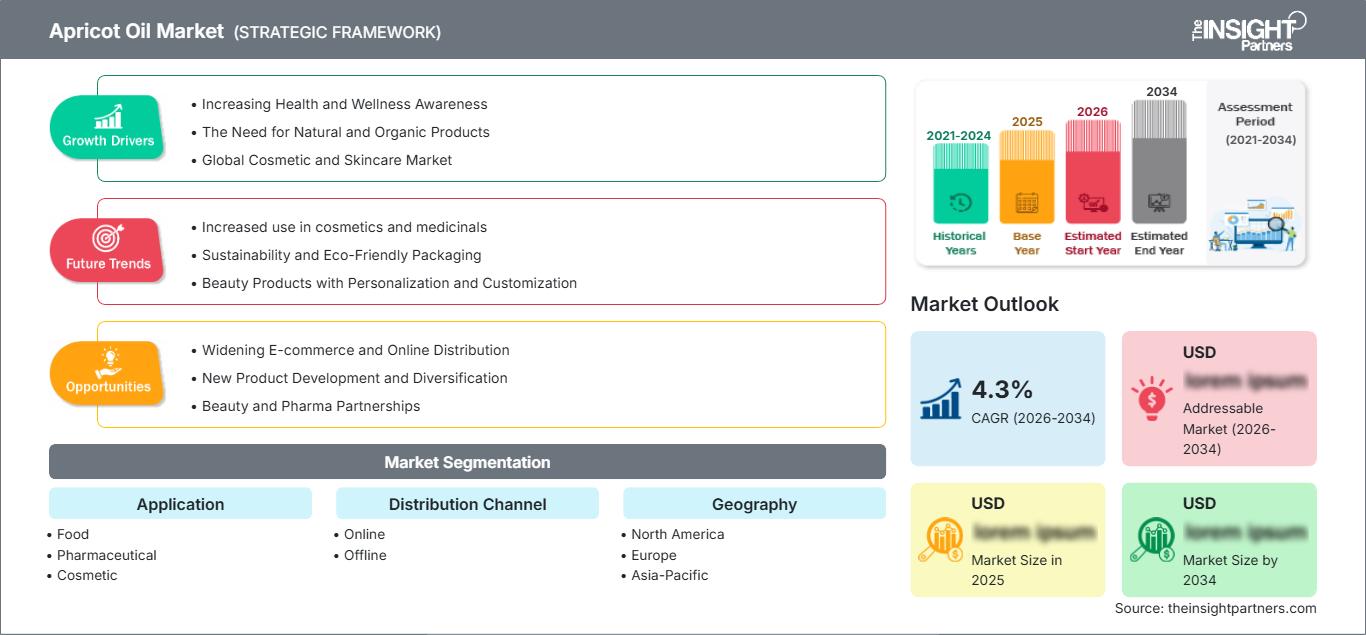
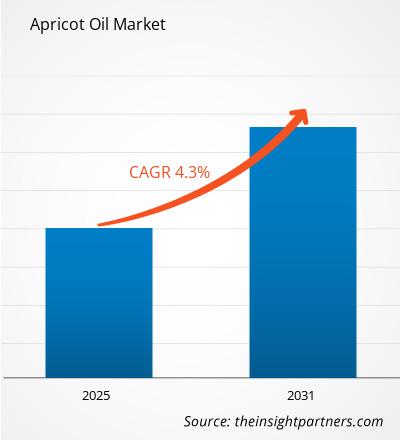
The apricot oil market was valued at US$ 2.21 Billion in 2025 and is projected to reach US$ 3.65 Billion by 2034, expanding at a CAGR of 5.74% during 2026–2034. Its development reflects rising demand for plant-derived lipids, specialized personal-care ingredients, and traceable botanical inputs across consumer and industrial formulations. The category spans food, pharmaceutical, cosmetic, and other uses across global ingredient and finished-product value chains.
North America is positioned for a modeled CAGR of 5.9–6.5% through 2034, supported by established natural-ingredient distribution, premium personal-care formulation, and online purchasing. The apricot oil market size is also influenced by clean-label positioning and increasing scrutiny of ingredient identity and quality. FDA records identify apricot kernel oil as a food-use substance, including flavoring or adjuvant applications, strengthening the regulatory basis for selected food uses.
Apricot Oil Market Assessment and Insights
- North America held a modeled 32–36% share in 2025 and is expected to grow at a 5.9–6.5% CAGR during 2026–2034. The region benefits from mature retail, strong cosmetic formulation activity, and established online channels for botanical oils.
- US represented 68–72% of North America's 2025 value and is projected to expand at a 5.8–6.4% CAGR during 2026–2034, supported by diversified personal-care and ingredient distribution.
- Europe accounted for 26–30% in 2025 and is forecast to grow at a 5.5–6.1% CAGR during 2026–2034. Germany, the UK, France, Italy, and Spain remain important markets because of cosmetic formulation, natural ingredients, and specialty food demand.
- Asia Pacific captured 22–26% in 2025 and is modeled to grow at a 6.2–6.9% CAGR during 2026–2034. China, India, Japan, South Korea, and Australia combine expanding beauty markets with domestic botanical sourcing and processing capabilities.
- Largest Segment: Cosmetic applications represented a modeled 43–47% market share in 2025 and are expected to expand at a 6.2–6.8% CAGR during 2026–2034, supported by emollient and skin-care formulation use.
- High Growth Segment: Pharmaceutical applications held 14–18% in 2025 and are modeled to grow at a 6.4–7.0% CAGR during 2026–2034, reflecting formulation research and demand for plant-derived excipients and topical ingredients.
- Key companies analyzed in detail: AMD Oil LLC; Aura Cacia; Greenwood Essential; NOW Health Group, Inc.; Frontier Natural Products Co-op; Nature's Alchemy; Hobe Laboratories, Inc.; Proteco Oils; Lotus Touch; Starwest Botanicals, Inc.; Forest Essentials; AOS Products Pvt. Ltd.
Source: The Insight Partners' analysis based on proprietary research, government publications, company annual reports, investor presentations, industry databases, and expert interviews.
Changes in extraction, filtration, packaging, and quality testing are reshaping the category. Cold pressing is increasingly relevant where producers seek to preserve fatty-acid and minor-component profiles, while refined grades remain important where odor, color, stability, and formulation consistency take priority. Buyers are consequently placing greater emphasis on specification control, processing conditions, storage, and batch-level testing when selecting botanical oil suppliers.
Looking ahead, growth is likely to favor suppliers that combine reliable kernel sourcing with documented origin, batch testing, and flexible grades. Emerging Asian production bases can improve access to raw material, while North American and European buyers will continue emphasizing traceability, contaminant controls, and documentation. Regulatory attention to botanical ingredients should encourage more disciplined labeling and quality systems rather than simply expanding volumes.
Apricot Oil Market Report Scope
| Report Attribute | Details |
|---|---|
| Market size in 2025 | US$ 2.21 Billion |
| Market Size by 2034 | US$ 3.65 Billion |
| Global CAGR (2026 - 2034) | 5.74% |
| Historical Data | 2021-2024 |
| Forecast period | 2026-2034 |
Apricot Oil Market Analysis
Demand in the apricot oil market is being shaped by connected ecosystems: personal-care formulators, food manufacturers, and botanical ingredient distributors. Market growth is contingent on the reliable sourcing of the kernel, extraction efficiency through mechanical or solvent-based methods, filtration, storage, and packaging. Consumers in the cosmetic industry are more concerned about performance and oxidation resistance, while consumers in the food industry prefer purity, flavor, specification conformance, and intended use.
Supply chain fragmentation is due to the fact that the apricot kernels come from various fruit-growing locations and may be an additional by-product of fruit processing. This provides room for processors who are capable of aggregating kernels, controlling moisture and impurities, and improving extraction efficiency. In addition to this, distribution also plays a role as offline specialty shops facilitate discovery, while online distribution facilitates geographical reach.
The apricot oil market report assesses competition among botanical specialists, natural-product distributors, and personal-care or wellness companies. The market analysis indicates that differentiation is less dependent on commodity scale than on certification, origin transparency, extraction method, packaging, and formulation support. Companies such as Aura Cacia, NOW Health Group, Inc., Frontier Natural Products Co-op, and Starwest Botanicals, Inc. use broader botanical portfolios to cross-sell related ingredients.
Smaller specialty players such as AMD Oil LLC, Greenwood Essential, Nature’s Alchemy, Hobe Laboratories, Inc., Proteco Oils, and Lotus Touch are able to compete using flexible sourcing, specialized grades, and customer connections. Forest Essentials and AOS Products Pvt. Ltd. bring regional insights into formulations and supplies. The investments would be made more in quality systems, traceable sourcing, e-commerce, and private label scale manufacturing than just capacity.
● REPORT CUSTOMIZATION
Tailor This Report To Align With Your Specific Business Requirements
This report can be customized to align precisely with your business objectives, scope, and target markets. Customization options include tailored segmentation, geography, competitive analysis, and strategic insights to support informed decision-making.
Customize This Report →WHAT YOU CAN ADJUST
- ● Segmentations
- ● Geography
- ● Competitive Analysis
- ● Language Preferences
Apricot Oil Market: Strategic Insights
Regional Insights
North America apricot oil market
North America holds an apricot oil market share of 32–36% of global value in 2025 and is modeled at a 5.9–6.5% CAGR through 2034. The US drives regional demand, and Canada enables niche specialty natural product and cosmetic ingredient commerce. Structural growth is fueled by established personal care product formulation, high-end botanical formulation, penetration via online retailing, and the need for guaranteed quality. Food usage possibilities are more limited compared to cosmetic usage; however, regulatory history exists to validate food usage channels for apricot kernel oil.
Competitive pressures among regional suppliers come in the form of cold-pressing, refining, organics, and limited production. Consumers evaluate peroxide values, fatty acid content, allergen management, traceability, packaging, and shelf life. The distribution network includes specialty retailers, cosmetic ingredient wholesalers, an online marketplace and direct-to-brand marketing. The scale of the region offers an opportunity to build demand through formulation alternatives to more common carrier oils and consumer recognition of botanical ingredients.
U.S. apricot oil Market
The US represented 68–72% of North America's 2025 value and is projected to grow at 5.8–6.4% through 2034. Demand is concentrated in skin care, hair care, massage products, aromatherapy, specialty food formulations, and ingredient resale. Aura Cacia, NOW Health Group, Inc., Frontier Natural Products Co-op, Hobe Laboratories, Inc., and Starwest Botanicals, Inc. provide relevant market presence across botanical and wellness channels. Online discovery further broadens access to niche grades.
Trends in applications are more inclined toward lightweight emollients, natural carrier oils, and multi-tasking ingredients. Apricot kernel oil is registered under the FDA's food substance database as a flavoring agent and adjuvant, with the responsibility on the food manufacturers to utilize it properly. For private labeling, opportunities can be gained through smaller packaging, ready-to-formulate specifications, whereas for industrial use, documentation and regular supply are key factors.
Europe apricot oil Market
Europe accounted for a modeled 26–30% share of the apricot oil market in 2025 and is expected to expand at 5.5–6.1% through 2034. Germany is the leading national market, supported by sophisticated cosmetics manufacturing, ingredient distribution, and demand for documented natural inputs. In addition, the UK still retains a good specialty beauty industry as well as e-commerce activities, while France provides high-end skin care formulation and botanical products. Italy and Spain offer support via cosmetics, wellness, and specialty food channels to have a wide regional consumer base.
In Germany, purchasing practices place a greater focus on specification, certification, and documentation requirements, which means that processors will need to make an effort towards improving traceability and testing. Formulation opportunities include face oils, body care, and personal care in France and Italy. There are Mediterranean cosmetic and food networks in Spain, while the UK is still relevant for e-commerce specialty retail activities. Thus, the overall European market environment creates a greater significance for quality providers.
APAC apricot oil market
APAC held a modeled 22–26% share in 2025 and is forecast to grow at 6.2–6.9% through 2034. China is at the heart of regional value, whereas India represents a growing market due to botanical processing and increased demand for personal care products. Japan and South Korea bring their cosmetic formulation expertise, while Australia is good for the retailing of natural products.
The region features a combination of industrial processing capabilities along with agricultural presence and interest in plant ingredients. India and China are most relevant for sourcing and formulation, respectively, while Japan and South Korea have a preference for high-quality cosmetic ingredients. Regional suppliers may win market share through integration of kernel collection, standardized extraction, and export-ready testing.
Middle East & Africa apricot oil Market
The Middle East and Africa apricot oil market represented a smaller global base in 2025 but is modeled to grow at 4.8–5.6% through 2034. Saudi Arabia and the UAE are key demand centers for premium beauty and wellness products, while South Africa supports natural-product retail and regional distribution. Rest-of-region demand remains fragmented.
Infrastructure investment, hospitality development, specialty retail, and expanding personal-care imports support adoption. UAE distribution hubs can facilitate re-export, while Saudi Arabia provides a sizable premium consumer market. South Africa offers a bridge to Southern African buyers. Suppliers entering the region must manage heat exposure, packaging stability, shelf-life documentation, and dependable logistics because storage conditions can materially affect oil quality.
Segmentation Analysis
Application
The apricot oil market scope spans Application and is expected to expand at a 5.9–6.6% CAGR during 2026–2034 as cosmetic, food, and pharmaceutical formulators seek plant-derived oils with differentiated sensory and functional characteristics. Cosmetics remain the largest use because the oil functions as an emollient and carrier, while food and pharmaceutical applications require tighter specification and documentation.
- Food: Demand is centered on specialty formulations and flavor-related uses where a mild nutty profile and plant origin provide differentiation. Buyers prioritize purity, intended-use compliance, oxidation control, and consistent sensory characteristics.
- Pharmaceutical: Adoption focuses on topical preparations, excipient roles, and formulation research. Strategic value comes from predictable composition, documented quality, compatibility with other ingredients, and controlled processing.
- Cosmetic: The segment benefits from skin-care, hair-care, massage, and facial-oil applications. Its strategic importance is linked to emolliency, lightweight texture, botanical positioning, and compatibility with premium formulations.
Distribution Channel
Distribution Channel is projected to grow at a 5.4–6.0% CAGR during 2026–2034 as online discovery expands alongside established specialty and ingredient distribution. Channel economics differ by pack size, customer type, certification needs, and frequency of replenishment.
- Online: E-commerce supports niche discovery, direct-to-consumer brands, private-label sourcing, and smaller pack formats. Strategic importance comes from geographic reach, product education, reviews, and lower barriers for specialized botanical products.
- Offline: Specialty stores, pharmacies, cosmetic ingredient distributors, and natural-product retailers remain important for physical discovery and professional purchasing. The channel supports bulk procurement, relationship selling, and customers needing technical assistance.
Opportunity Snapshot
| Application | Revenue Contribution (High/Medium/Low) | Trend Tag (MAX 2 words) | Adoption Stage (Emerging/Scaling/Mature) |
| Food | Medium | Clean Label | Scaling |
| Pharmaceutical | Medium | Topical Formulation | Scaling |
| Cosmetic | High | Skin Barrier | Mature |
| Others | Low | Specialty Blends | Emerging |
Apricot Oil Market Growth Drivers and Impact Analysis
Rising preference for botanical formulation inputs
Consumers and formulators are turning to plant-based ingredients as part of a wider trend towards clean-labeling and natural positioning products. This trend will influence not only purchasing decisions made at the end product level but even more so in the upstream stages, since brands have to rely on suppliers who would be able to provide information about the botanical origin, extraction process, and other details. For apricot oil, the implication would be a slow transition from purchasing non-specific carrier oils to buying different grades with clear technical specifications. Being able to provide such information for each batch allows suppliers to negotiate better with premium buyers. It should be noted that the trend is most noticeable in cosmetic products due to their sensory characteristics.
Expansion of premium skin-care and hair-care formats
Higher-end personal care products are opening up greater formulation possibilities for specialty botanical oils that can deliver emollient benefits, texture and distinction without necessitating complicated blends of ingredients. The apricot oil can be used in facial oils, serums, body products, scalp treatments and massage formulas, thus providing manufacturers with various avenues of using a single ingredient. The manufacturers can meet such a trend through supplying different kinds of oil, including refined and cold-pressed oils, where possible, organic versions and technical data for cosmetic formula development. This driver is motivating the private label manufacturers to create botanical ranges rather than products.
Greater emphasis on ingredient traceability and quality assurance
Quality control is fast emerging as a competitiveness parameter insofar as there is demand for uniform composition and extended shelf life stability. Apricot kernels can be varied by variety, geographic location, harvesting circumstances, storage methods, and processing processes, which implies that even when the botanical name is the same, oil compositions may differ. Quality control in terms of standardized raw material testing, standard extraction, filtering process, antioxidant regulation, and proper packaging can help minimize variations. Implications of this driver on the market include the fact that those who have quality control equipment will get more stringent customers, while small-scale producers will require laboratory/processing partners to meet purchase requirements.
Apricot Oil Market Future Trends
Traceable micro-origin sourcing
The apricot oil market trends are likely to move toward micro-origin sourcing in which processors identify growing areas, kernel collection networks, harvest periods, and extraction batches more precisely. Lot record data that is digital, QR-coded, and available through a supplier portal could make origin data available to the formulator without having proprietary manufacturing data disclosed. Such an approach might differentiate supply from the Himalayas, Mediterranean, Central Asia, or any other region based on compositional characteristics being consistently recorded. It will also incentivize processors to keep kernel streams segregated based on variety and quality level instead of combining them together. For the brands, this means being able to provide a more powerful story about ingredients with data to support them.
Functional blends designed for specific formulations
The future direction in the area of product development could be the provision of optimized blends rather than a single botanical oil. For example, apricot oil can be formulated together with other carrier oils, antioxidants, or even botanical ingredients to provide for an appropriate sensory experience, oxidation resistance, spreadability, and overall behavior in formulations. Such blends could help small brands with limited resources to develop new products faster since all the information related to the behavior of the blend would be provided by the supplier. Also, this could be another way to provide value-added services for contract manufacturers who might want to formulate some products with the targeted effects on the skin, hair, or massaging.
Apricot Oil Market Opportunities
Integrated kernel-to-oil processing platforms
Apricot oil market forecasts support an attractive investment opportunity in integrated systems that connect apricot fruit processors with kernel collectors, extraction facilities, refiners, and ingredient distributors. These facilities can aid traceability and offer improved control over the quality of kernels prior to oil extraction. The regional plants situated close to major producers of apricots will help reduce the costs involved in transportation and make small-scale feedstock viable. Investors and processors can generate several income streams by separating out the oil, high-protein meal, and other components of the kernels, as economically feasible. The greatest opportunity lies in regions where there is processing of fruits in place, along with efficient collection networks. Alliance building with cosmetic and specialty food formulators can offer demand visibility prior to scale-up.
Application-led private-label ingredient programs
A second opportunity is the development of private-label programs that combine apricot oil with packaging, technical specifications, formulation guidance, and e-commerce-ready product information. Smaller beauty and wellness brands often need reliable ingredients but lack purchasing scale and regulatory resources. Suppliers can address this gap by offering sample sizes, technical documentation, flexible minimum orders, bulk replenishment, and application-specific support. Such programs can increase customer retention because the supplier becomes integrated into product development rather than remaining a commodity vendor. Digital ordering can complement offline technical sales, allowing repeat purchases to be automated while specialists handle formulation questions. The approach also creates a pathway for suppliers to expand from raw oil into blended or finished products without abandoning their core ingredient capabilities.
Frequently Asked Questions

- Comprehensive Market Sizing and Forecast Analysis
- Detailed Segmentation Analysis
- In-Depth Market Dynamics Assessment
- Regional and Country-Level Insights
- Competitive Landscape and Company Benchmarking
- Strategic Business Intelligence
Recent Reports
Testimonials

The Insight Partners provided valuable market intelligence that supported our global go-to-market strategy. Their team was professional, responsive, and attentive to our feedback, providing thoughtful analysis and helpful methodological clarifications throughout the project.
Junmo Kim Chief Financial Officer (CFO), Enertech Co., Ltd.
The Insight Partners' SCADA System Market report is comprehensive, with valuable insights on current trends and future forecasts. The team was highly professional, responsive, and supportive throughout. We are very satisfied and highly recommend their services.
RAN KEDEM Partner, Reali Technologies LTDs
I requested a report on a very specific software market and the team produced the report in a few days. The information was very relevant and well presented. I then requested some changes and additions to the report. The team was again very responsive and I got the final report in less than a week.
JEAN-HERVE JENN Chairman, Future Analytica
We worked with The Insight Partners for an important market study and forecast. They gave us clear insights into opportunities and risks, which helped shape our plans. Their research was easy to use and based on solid data. It helped us make smart, confident decisions. We highly recommend them.
PIYUSH NAGPAL Sr. Vice President, High Beam Global
The Insight Partners delivered insightful, well-structured market research with strong domain expertise. Their team was professional and responsive throughout. The user-friendly website made accessing industry reports seamless. We highly recommend them for reliable, high-quality research services
YUKIHIKO ADACHI CEO, Deep Blue, LLC.
This is the first time I have purchased a market report from The Insight Partners.While I was unsure at first, I visited their web site and felt more comfortable to take the risk and purchase a market report.I am completely satisfied with the quality of the report and customer service. I had several questions and comments with the initial report, but after a couple of dialogs over email with their analyst I believe I have a report that I can use as input to our strategic planning process.Thank you so much for taking the extra time and making this a positive experience.I will definitely recommend your service to others and you will be my first call when we need further market data.
JOHN SUZUKI President and Chief Executive Officer, Board Director, BK Technologies
I wish to appreciate your support and the professionalism you displayed in the course of attending to my request for information regarding to infectious disease IVD market in Nigeria. I appreciate your patience, your guidance, and the fact that you were willing to offer a discount, which eventually made it possible for us to close a deal. I look forward to engaging The Insight Partners in the future, all thanks to the impression you have created in me as a result of this first encounter.
DR CHIJIOKE ONYIA MANAGING DIRECTOR, PineCrest Healthcare Ltd.Reason to Buy
- Informed Decision-Making
- Understanding Market Dynamics
- Competitive Analysis
- Identifying Emerging Markets
- Customer Insights
- Market Forecasts
- Risk Mitigation
- Boosting Operational Efficiency
- Strategic Planning
- Investment Justification
- Tracking Industry Innovations
- Aligning with Regulatory Trends





 Get Free Sample for