
Arrowroot Market Size, Demand & Growth by 2034
Coverage: By Category (Organic, Conventional); Application (Food and Beverages, Pharmaceuticals and Nutraceuticals, Others) , and Geography (North America, Europe, Asia Pacific, and South and Central America)
- Status : Data Released
- Report Code : TIPRE00011413
- Category : Food and Beverages
- No. of Pages : 150
- Available Report Formats :


- Last update date : August 28, 2026


2025 Market Size
US$ 527.62 Mn
Base year value
2034 Forecast
US$ 895.5 Mn
Projected by 2034
CAGR 2026-2034
6.05 %
Growth rate
Addressable Market
US$ 6,443.18 Mn
(2026-2034)
The global Arrowroot market was valued at US$ 527.62 million in 2025 and is expected to reach US$ 895.5 million by 2034; it is estimated to record a CAGR of 6.05% during 2026-2034.
Arrowroot Market Assessment and Insights
- North America: North America accounted for 29–32% share in 2025 and is expected to grow at a CAGR range of 6.5–7.0% during 2026–2034, driven by gluten-free baking, organic grocery expansion, and specialty ingredient retailing.
- US: The U.S. represented 72–76% of North America in 2025 and is expected to grow at a CAGR range of 6.4–6.9% during 2026–2034, led by clean-label pantry use.
- Europe: Europe held 24–27% share in 2025 and is expected to grow at a CAGR range of 5.9–6.4% during 2026–2034, with the UK, Germany, France, Italy, and Spain leading specialty bakery adoption.
- Asia Pacific: Asia Pacific accounted for 31–34% share in 2025 and is expected to grow at a CAGR range of 7.3–7.8% during 2026–2034, supported by India, China, Japan, South Korea, and Australia.
- Largest Segment: Food and Beverages held 68–72% market share in 2025, growing at a CAGR range of 6.6–7.1% during 2026–2034 due to bakery and sauce applications.
- High Growth Segment: Pharmaceuticals and Nutraceuticals held 18–22% market share in 2025, growing at a CAGR range of 7.4–7.9% during 2026–2034 as excipient and digestive positioning improves.
- Key companies analyzed in detail: Archer-Daniels-Midland Company, Aryan International, Coöperatie Koninklijke Avebe U.A., Azure Standard, Bob’s Red Mill Natural Foods, Inc., Bramble Berry Inc., Britannia Industries Limited, The Great American Spice Company, Mountain Rose Herbs, and J Sainsbury plc.
Source: The Insight Partners' analysis based on proprietary research, government publications, company annual reports, investor presentations, industry databases, and expert interviews.
Processing has shifted from small-batch culinary powders toward standardized starch ingredients designed for consistent color, viscosity, and particle behavior. In the arrowroot market, functional performance now matters as much as natural origin because food manufacturers compare arrowroot against tapioca, potato, and corn starch in cost-sensitive formulations. As the supply continues to be limited to tropical root vegetables, it is becoming increasingly common for buyers to broaden their supply sources and stock up to handle volatility issues.
In terms of future trends, the manufacturing sector will consider traceable botanical origin, organic product, and technical data necessary to support claims made by ingredient buyers about the gluten-free nature of products. Consumption in Asia-Pacific and high-end supermarkets in North America will continue to play an important role.
Arrowroot Market Report Scope
| Report Attribute | Details |
|---|---|
| Market size in 2025 | US$ 527.62 Million |
| Market Size by 2034 | US$ 895.5 Million |
| Global CAGR (2026 - 2034) | 6.05% |
| Historical Data | 2021-2024 |
| Forecast period | 2026-2034 |
Arrowroot Market Analysis
The arrowroot market growth is anchored by a practical formulation need: replacing wheat-derived or chemically modified thickeners without compromising mouthfeel. Arrowroot is used by food processors for clear sauces, gravies, infant formula, bakery ingredients, and dessert fillings because of its neutral taste and the formation of smooth textures at modest usage levels. The regulation by the FDA mandating that the gluten level in gluten-free foods should be below 20 parts per million increases the demand for gluten-free starches.
The supply chain is still less stable compared to that of corn and potato starch because arrowroot cultivation is lower volume, seasonal, and more localized. Thus, buyers weigh cost differentials according to functional values, particularly when dealing with organic products. The supply chain consists of farmers, primary processors, ingredient suppliers, private label manufacturers, branded pantry producers, food manufacturers, and nutraceutical manufacturers who need specifications, allergen management, and logistics.
The arrowroot market analysis shows a fragmented competitive structure where large ingredient companies shape starch technology while specialist brands develop consumer pull. The Archer-Daniels-Midland Company and the Coöperatie Koninklijke Avebe U.A. affect industry standards for starch substitutions, whereas Bob’s Red Mill Natural Foods, Inc., Mountain Rose Herbs, Azure Standard, and The Great American Spice Company cover retail and foodservice requirements.
Positioning is becoming increasingly application-oriented, and not just about pricing. The Britannia Industries Limited represents an example of downstream usage of arrowroot by way of arrowroot biscuits, and J Sainsbury plc helps ensure retail accessibility in Europe. Aryan International and Bramble Berry Inc. boost supply to niche markets for specialty ingredients and natural products. Expected investments will target organics, smaller packaging, and quality assurance systems.
● REPORT CUSTOMIZATION
Tailor This Report To Align With Your Specific Business Requirements
This report can be customized to align precisely with your business objectives, scope, and target markets. Customization options include tailored segmentation, geography, competitive analysis, and strategic insights to support informed decision-making.
Customize This Report →WHAT YOU CAN ADJUST
- ● Segmentations
- ● Geography
- ● Competitive Analysis
- ● Language Preferences
Arrowroot Market: Strategic Insights
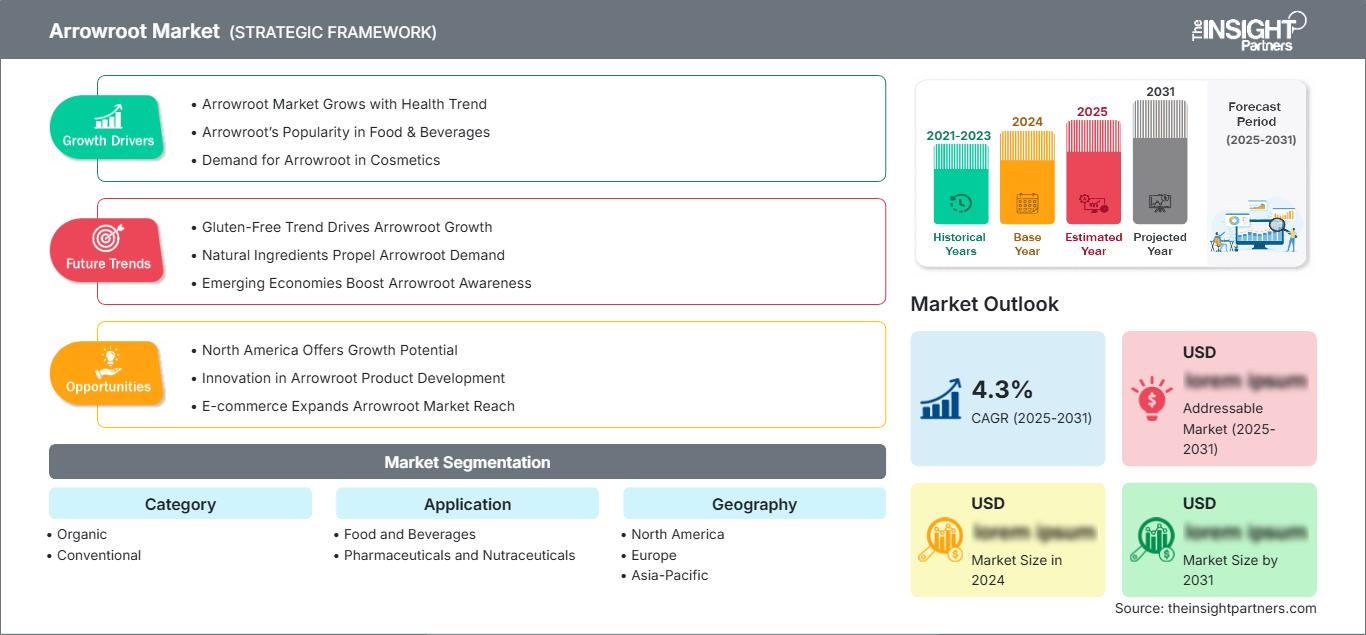
Regional Insights
North America Arrowroot Market
North America held 29–32% share in 2025 and is projected to grow at a CAGR range of 6.5–7.0% during 2026–2034. The region benefits from strong gluten-free bakery penetration, high household use of pantry thickeners, and organized specialty retail. The arrowroot market share is further supported by organic product sales momentum, where U.S. certified organic sales reached US$ 71.6 billion in 2024.
The ingredient purchasing companies in the area are increasingly seeking non-GMO, gluten-free, kosher, and vegan certifications, favoring branded manufacturers. The leading companies that support premium retail sales include Bob’s Red Mill Natural Foods, Inc., Azure Standard, Mountain Rose Herbs, and Bramble Berry Inc. The growth is mostly witnessed in baking mixes, sauces, soups, and allergen-friendly household meals.
U.S. Arrowroot Market
The U.S. represented 72–76% of North America Arrowroot Market in 2025 and is expected to grow at a CAGR range of 6.4–6.9% during 2026–2034. Demands arise from gluten-free baking, replacement of corn in thickener products, and clean-label pantry behaviors. Additionally, the industry receives support from the FDA gluten-free standards that give a clear definition of arrowroot as a naturally gluten-free starch product.
Branded presence is established through retail operations, specialty e-commerce, and ingredient distributors. Arrowroot starch is produced by Bob’s Red Mill Natural Foods, Inc. for use in gluten-free baking and as a thickener, while Azure Standard and Mountain Rose Herbs cater to the needs of sourcing health-conscious individuals. Applications in food and beverages dominate, while the nutraceutical sector is increasingly gaining interest in the product.
Europe Arrowroot Market
Europe accounted for 24–27% share of the Arrowroot Market in 2025 and is expected to grow at a CAGR range of 5.9–6.4% during 2026–2034. The UK is the leading country, supported by supermarket access and home-baking use. J Sainsbury plc sells arrowroot powder as a thickener or glaze, indicating mainstream retail recognition beyond specialist health stores.
Germany is well-served by technical expertise in starches and the reformulation trend for clean labels in bakery and dairy alternatives. Ingredient formulators evaluate arrowroot alongside potato and tapioca starches, so reliable viscosity characteristics and allergen labeling are paramount. The expertise of Coöperatie Koninklijke Avebe U.A. adds to the overall starch expertise in Europe, despite the fact that arrowroot is a less popular botanical starch.
There is a select demand for arrowroot in France, Italy, and Spain among pastry, dessert, sauces, and natural food formulators. The adoption rate is lower than in the UK and Germany due to the presence of other starch alternatives. However, growing awareness among consumers of the additives, vegan products, and free-from bakery lines will drive slow adoption.
APAC Arrowroot Market
Asia Pacific held 31–34% share in 2025 and is projected to grow at a CAGR range of 7.3–7.8% during 2026–2034. India is the market leader, driven by familiarity with root crops, biscuit production, and healthy positioning of snacks. China, Japan, South Korea, and Australia are witnessing rising acceptance via bakery applications, baby foods, and clean-label packaged food products.
Drivers within the industrial and policy context include investments in food processing, availability in urban retailing, and improved quality standards of packaged ingredients. In India, the example of Britannia Industries Limited shows downstream usage in the form of arrowroot biscuits. Regional processors benefit from geographical proximity to tropical agriculture.
Middle East & Africa Arrowroot Market
The Middle East & Africa market is expected to grow at a CAGR range of 5.5–6.0% during 2026–2034. The dominant countries include Saudi Arabia, UAE, South Africa, and RO MEA. Consumption occurs primarily in foreign specialty food products, baking applications, and high-end retailing of health-conscious customers.
Availability of packaging is determined by energy-based revenue cycles and investments in infrastructure, particularly in Gulf nations. Re-export and specialty groceries are well-supported in the UAE, whereas South Africa offers an established retail environment. The market grows at a slow pace due to price sensitivity and a lack of domestic processing capacity, unlike tapioca, corn, and potato starches.
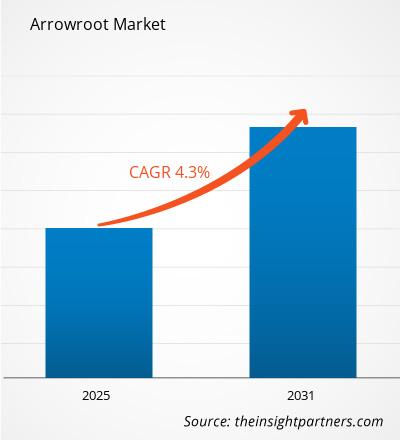
Segmentation Analysis
Category
The Category segment is expected to grow at a CAGR range of 6.7–7.2% during 2026–2034. The arrowroot market scope across category types is shaped by the balance between price-competitive conventional supply and premium organic demand. Clean-label buyers increasingly seek residue transparency, while processors still depend on conventional grades for volume applications where cost and availability remain decisive.
- Organic: Organic arrowroot holds strategic value in premium bakery, baby food, and wellness retail channels where certification, traceability, and perceived purity justify higher pricing and tighter supplier qualification requirements.
- Conventional: Conventional arrowroot remains the volume backbone for sauces, biscuits, household thickening, and foodservice use because it offers broader availability, lower procurement cost, and easier substitution against competing starches.
Application
The Application segment is expected to grow at a CAGR range of 6.9–7.4% during 2026–2034. Food and beverages dominate because arrowroot delivers texture, clarity, and neutral taste in everyday formulations. Pharmaceuticals and nutraceuticals are gaining attention as formulators explore plant-based excipients, digestive health positioning, and naturally derived binders in capsules, tablets, and functional powders.
- Food and Beverages: Food and beverages lead adoption through bakery mixes, biscuits, sauces, soups, desserts, and baby food, where arrowroot supports gluten-free, corn-free, and clean-label product development.
- Pharmaceuticals and Nutraceuticals: Pharmaceuticals and nutraceuticals represent a higher-growth route as brands evaluate arrowroot for tablet binding, powder carriers, digestive-friendly formulations, and botanical identity in wellness products.
Opportunity Snapshot
| Application | Revenue Contribution | Trend Tag | Adoption Stage |
| Food and Beverages | High | Clean Label | Mature |
| Pharmaceuticals and Nutraceuticals | Medium | Plant Excipients | Scaling |
Arrowroot Market Growth Drivers and Impact Analysis
Rising Need for Gluten-Free and Corn-Free Thickeners
The gluten-free formula has now become a structural component as opposed to a passing fad. Arrowroot is gluten-free by nature and is capable of substituting cornstarch in many recipes, providing a good choice for brands that cater to consumers with gluten sensitivity issues and celiac disease. Practical applications are mostly seen in bakery mixes, gravies, dessert fillings, and baby foods. In the arrowroot market, this driver supports premium pricing because buyers are not purchasing starch only for thickening. They are purchasing a claim-compatible ingredient that supports label simplicity, allergen-conscious positioning, and consumer trust when supported by testing, supplier documentation, and clean manufacturing controls.
Expansion of Organic and Clean-Label Retail Channels
Increased popularity of organic and clean-label products within the retail industry has improved the recognition of arrowroot powder among other products. In the U.S., organic product sales have increased to US$ 71.6 billion in 2024, showing that consumers still care about their familiar products that require minimal processing. As a result, arrowroot stands its ground among modified starches in premium food applications despite the lower cost of traditional raw materials. The trend can be seen by the availability of arrowroot in smaller packages, direct-to-consumer platforms, and private-label bakery ingredients. Suppliers that can offer organic certification, non-GMO status, and particle consistency have higher chances of success.
Food Processing Demand for Neutral Texture Solutions
Food processors are still looking for starches that can work without altering the taste, color, or identity of the food products. Arrowroot is preferred owing to the fact that it is tasteless and helps achieve a glossier texture and works well with several sauces, fillings, and soups, if used correctly. This factor will have a direct bearing on the formulation trials of companies that are trying to limit artificial ingredients. Even though it may not be the most economical starch available, the clean sensory nature of arrowroot makes it an important option in premium foods.
Arrowroot Market Future Trends
Greater Use of Verified Botanical Origin
The next phase of arrowroot market trends will center on verified botanical origin, supplier traceability, and stronger documentation from farm to finished powder. Buyers should expect a need for more concrete proof of the root source, processing methods, allergen precautions, and organic supply chain because premium labeling is subject to substitution threats. This would mean that buyers will need to invest in batch testing, digital documentation, and grower partnerships. Eventually, traceability will help reduce uncertainty on the part of buyers, facilitate export clearances, and maintain price premiums in applications where consumers identify arrowroot as clean, easy-to-digest plant-based ingredients.
Blended Starch Systems for Better Cost Control
Starch systems that combine arrowroot are expected to increase due to the ability of the manufacturers to control the cost disparity between arrowroot and other starches. In place of using arrowroot in place of tapioca, potato, or corn starch, arrowroot will be used in small quantities for texture improvement, labeling benefits, or even for digestion improvement. This is a strategy that increases demand without necessarily having to fully substitute the other materials used. This will be advantageous to manufacturers of technical advice, testing applications, and blend customization.
Arrowroot Market Opportunities
Premium Formulation Partnerships in Free-From Foods
Partnerships with free-from food manufacturers provide a practical commercialization route for suppliers. The strongest opportunities sit in gluten-free baking mixes, clean-label sauces, infant foods, and premium desserts where ingredient claims are visible to consumers. Arrowroot market Forecasts indicate that brands able to combine consistent supply with formulation support will capture higher-value demand than commodity packers. Investors should prioritize suppliers with application labs, allergen-controlled facilities, and relationships with organic growers. Co-development can reduce customer switching risk because arrowroot performance depends on recipe design, heat exposure, hydration method, and final product texture objectives.
Nutraceutical Excipient and Digestive Wellness Positioning
Nutraceutical formulators represent a smaller market, but one that is promising due to the growing importance of excipients and carriers of plant origin, as well as easy-to-digest formulations. Arrowroot can serve as an ingredient in capsules, powders, and mixtures, as its flavor is neutral and it is derived from plants. The business rationale here relies upon the ability to meet standards related to pharmaceutical-grade documentation, microbial limits, moisture requirements, and batch uniformity. In order to enter the technical market, companies should improve their quality system to go beyond just the food-grade market.
Frequently Asked Questions

- Comprehensive Market Sizing and Forecast Analysis
- Detailed Segmentation Analysis
- In-Depth Market Dynamics Assessment
- Regional and Country-Level Insights
- Competitive Landscape and Company Benchmarking
- Strategic Business Intelligence
Recent Reports
Testimonials

The Insight Partners provided valuable market intelligence that supported our global go-to-market strategy. Their team was professional, responsive, and attentive to our feedback, providing thoughtful analysis and helpful methodological clarifications throughout the project.
Junmo Kim Chief Financial Officer (CFO), Enertech Co., Ltd.
The Insight Partners' SCADA System Market report is comprehensive, with valuable insights on current trends and future forecasts. The team was highly professional, responsive, and supportive throughout. We are very satisfied and highly recommend their services.
RAN KEDEM Partner, Reali Technologies LTDs
I requested a report on a very specific software market and the team produced the report in a few days. The information was very relevant and well presented. I then requested some changes and additions to the report. The team was again very responsive and I got the final report in less than a week.
JEAN-HERVE JENN Chairman, Future Analytica
We worked with The Insight Partners for an important market study and forecast. They gave us clear insights into opportunities and risks, which helped shape our plans. Their research was easy to use and based on solid data. It helped us make smart, confident decisions. We highly recommend them.
PIYUSH NAGPAL Sr. Vice President, High Beam Global
The Insight Partners delivered insightful, well-structured market research with strong domain expertise. Their team was professional and responsive throughout. The user-friendly website made accessing industry reports seamless. We highly recommend them for reliable, high-quality research services
YUKIHIKO ADACHI CEO, Deep Blue, LLC.
This is the first time I have purchased a market report from The Insight Partners.While I was unsure at first, I visited their web site and felt more comfortable to take the risk and purchase a market report.I am completely satisfied with the quality of the report and customer service. I had several questions and comments with the initial report, but after a couple of dialogs over email with their analyst I believe I have a report that I can use as input to our strategic planning process.Thank you so much for taking the extra time and making this a positive experience.I will definitely recommend your service to others and you will be my first call when we need further market data.
JOHN SUZUKI President and Chief Executive Officer, Board Director, BK Technologies
I wish to appreciate your support and the professionalism you displayed in the course of attending to my request for information regarding to infectious disease IVD market in Nigeria. I appreciate your patience, your guidance, and the fact that you were willing to offer a discount, which eventually made it possible for us to close a deal. I look forward to engaging The Insight Partners in the future, all thanks to the impression you have created in me as a result of this first encounter.
DR CHIJIOKE ONYIA MANAGING DIRECTOR, PineCrest Healthcare Ltd.Reason to Buy
- Informed Decision-Making
- Understanding Market Dynamics
- Competitive Analysis
- Identifying Emerging Markets
- Customer Insights
- Market Forecasts
- Risk Mitigation
- Boosting Operational Efficiency
- Strategic Planning
- Investment Justification
- Tracking Industry Innovations
- Aligning with Regulatory Trends





 Get Free Sample for