
Artemether Market Size, Growth & Trends by 2034
Coverage: by Type (Injectables, Capsules, Tablets); Application (Hospital, Clinic, Laboratory, Others), and Geography (North America, Europe, Asia Pacific, and South and Central America)
- Status : Data Released
- Report Code : TIPRE00011110
- Category : Life Sciences
- No. of Pages : 150
- Available Report Formats :


- Last update date : September 01, 2026


2025 Market Size
US$ 556.46 Mn
Base year value
2034 Forecast
US$ 683.57 Mn
Projected by 2034
CAGR 2026-2034
2.61 %
Growth rate
Addressable Market
US$ 5,709.33 Mn
(2026-2034)
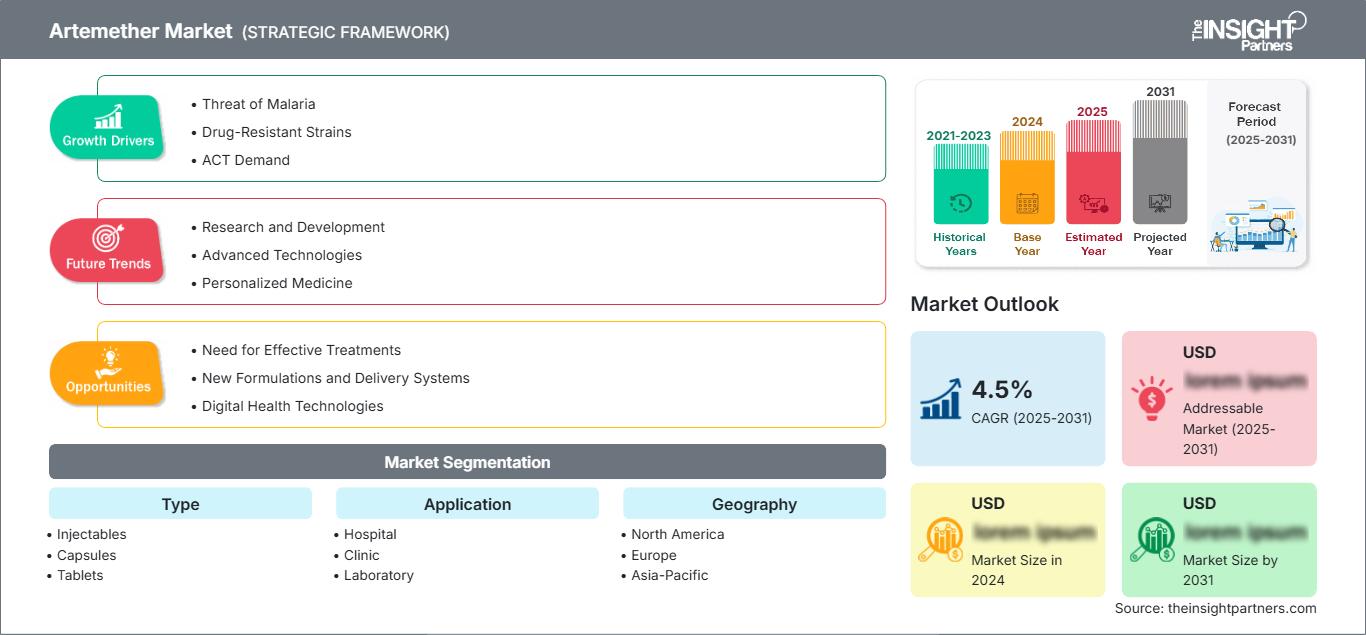
The artemether market is positioned within the global antimalarial medicines landscape, supported by continued use of artemisinin-based therapies and demand for quality-assured formulations. The market is valued at US$ 556.46 Million in 2025 and is projected to reach US$ 683.57 Million by 2034, expanding at a CAGR of 2.61% during 2026–2034. Demand remains closely linked to malaria treatment protocols, procurement programs, formulation availability, and manufacturing capacity across endemic regions.
North America represents a smaller but strategically relevant market, with the artemether market size influenced by imported antimalarial medicines, travel-associated malaria, specialized infectious-disease care, and pharmaceutical supply requirements. The region is estimated to expand at a 1.8–2.4% CAGR between 2026–2034. Regulatory quality expectations, hospital preparedness, and access to combination therapies are expected to support measured demand despite the region's comparatively limited endemic disease burden.
Artemether Market Assessment and Insights
- North America: North America is expected to hold a 7–10% artemether market share in 2025 and expand at a 1.8–2.4% CAGR between 2026–2034, supported by imported antimalarial demand, infectious-disease preparedness, and specialist treatment capacity.
- US: The US is estimated to represent 78–83% of North America's 2025 market, with a 1.7–2.3% CAGR between 2026–2034, reflecting travel-associated cases and hospital procurement.
- Europe: Europe is projected to account for a 14–18% share in 2025 and grow at a 2.0–2.7% CAGR through 2034, with the UK, France, Germany, Italy, and Spain supporting regional pharmaceutical access.
- Asia Pacific: Asia Pacific is estimated at a 31–35% share in 2025 and a 3.0–3.7% CAGR through 2034, led by China, India, Indonesia, and Southeast Asian malaria-endemic markets.
- Largest Segment: Injectables are estimated to command a 42–47% market share in 2025 and expand at a 2.4–3.0% CAGR, reflecting their clinical role in severe malaria.
- High Growth Segment: Capsules are expected to represent a 18–22% market share in 2025 and grow at a 3.1–3.8% CAGR, supported by convenient oral administration and outpatient use.
- Key companies analyzed in detail: AKos Consulting and Solutions, Clearsynth, Guangzhou Hanfang Pharmaceutical, Kivipharm, KPC Pharmaceuticals, Novartis Pharmaceuticals Corporation, Race Chemical, Shanghai Natural Bio-engineering Co., Ltd., SUDA Pharmaceuticals, TargetMol.
Source: The Insight Partners' analysis based on proprietary research, government publications, company annual reports, investor presentations, industry databases, and expert interviews.
The artemether market has shifted from traditional artemisinin-based preparations towards standardized API and formulated products. There is increased focus on contamination control, process control, stability and documentation. The production of injectables is still difficult because the quality and sterility of the formulation impacts treatment of severe cases of malaria. Combination products are becoming more common among oral formulations, indicating the significance of API combination, source and finished dose formulation.
In terms of future developments, there will be high concentration of demand within regions where malaria exists, and there will be more demand for quality assured procurement. Emerging markets within Africa, South Asia and selected Southeast Asian countries will continue to represent key consumers of the product. Prequalification by the WHO, national treatment guidelines, procurement funded by donors and drug resistance surveillance will impact the choice of suppliers. The WHO recommends artemisinin-based combination therapy for uncomplicated malaria, and artemether injection for severe malaria in the absence of artesunate injection.
Artemether Market Report Scope
| Report Attribute | Details |
|---|---|
| Market size in 2025 | US$ 556.46 Million |
| Market Size by 2034 | US$ 683.57 Million |
| Global CAGR (2026 - 2034) | 2.61% |
| Historical Data | 2021-2024 |
| Forecast period | 2026-2034 |
Artemether Market Analysis
The growth potential of the artemether market will be primarily determined by the need for malaria treatment, namely the need to manage severe malaria and the prevalence of artemisinin combination therapies. The supply chain includes starting material from Artemisia species, artemisinin chemical transformation into artemether, API isolation, formulation development, packaging, approval, and institutional distribution. Public tender programs will affect purchase volumes, while private clinics and pharmacies will increase demand where there are facilities for malaria treatment.
Factors that shape the artemether supply are manufacturers in China and India with API and finished dose capabilities for international supply. The competitive factors will be quality certification, production economics, availability of raw materials, and regulatory compliance. WHO recommendations discourage the use of monotherapy with artemisinin since the improper application of this drug may be the cause of developing resistance. Manufacturers will have to incorporate artemether into the right combination and the injectable supply will be important for cases requiring parenteral administration before moving to oral medication.
Analysis of the artemether market reveals a fragmented supplier landscape including API producers, finished dose producers, and specialized antimalarial companies. A prominent supplier in this market is KPC Pharmaceuticals due to its artemether injection and artemether-lumefantrine products. Another relevant competitor is Novartis Pharmaceuticals Corporation related to Coartem malaria treatment. Clearlysynth and TargetMol specialize in pharmaceutical and research reagents, while Guangzhou Hanfang Pharmaceutical and Shanghai Natural Bio-engineering Co., Ltd. develop Asian manufacturers.
Differentiation is provided by regulatory compliance, production capacity, product portfolio, and access to procurement programs rather than new products. Additional suppliers of the artemether are Kivipharm, Race Chemical, SUDA Pharmaceuticals, and AKos Consulting and Solutions. The investment in artemether market will include GMP compliance, API process improvement, quality system implementation, and geographic registration.
● REPORT CUSTOMIZATION
Tailor This Report To Align With Your Specific Business Requirements
This report can be customized to align precisely with your business objectives, scope, and target markets. Customization options include tailored segmentation, geography, competitive analysis, and strategic insights to support informed decision-making.
Customize This Report →WHAT YOU CAN ADJUST
- ● Segmentations
- ● Geography
- ● Competitive Analysis
- ● Language Preferences
Artemether Market: Strategic Insights
Regional Insights
North America artemether market
North America is estimated to account for 7–10% of the global market in 2025 and expand at a 1.8–2.4% CAGR through 2034. US forms the major regional market due to the influx of international travelers, immigrants from malaria-endemic regions, specialized services on infectious diseases and hospital preparedness in case of imported malaria. Canada provides its share by way of travel-related and immigrant cases of malaria, but demand for the therapy is still relatively modest.
Purchasing in the region is driven by hospitals, specialty pharmacies, public health organizations and importers of the antimalarial drugs. Demand for injectable formulations corresponds to severe cases that need hospitalization, while the oral combinations serve as an adjuvant therapy. Regulatory approval and reliable supply chain are still the important aspects in the case of imported malaria which is not endemic to the vast majority of the region.
U.S. artemether market
The US is estimated to represent 78–83% of North America's 2025 market and grow at a 1.7–2.3% CAGR through 2034. The major factors driving the demand are malaria infections brought in from overseas, travel-related infection risk, military and humanitarian missions, and the management of foreign patients from endemic nations. While hospitals ensure availability of injectable antimalarial agents to manage the condition, there is greater dependence on suitable combinations of oral drugs in the case of outpatients.
Firms with international product lines can take part in the market via distributors, hospital procurement process, and product registration. The portfolio mix would be different from that of the endemic markets since the volume of demand created by malaria treatments would be much higher. Infection specialists, hospitals' pharmacies, and public health agencies continue to play an influential role in decision-making.
Europe artemether market
Europe is estimated to hold a 14–18% share in 2025 and expand at a 2.0–2.7% CAGR through 2034, with the UK serving as a leading market. Demand is concentrated around imported malaria, travel medicine, specialist hospitals, and public-health preparedness.
The United Kingdom possesses a relatively advanced travel medicine industry as well as a specialized policy on treatment of imported malaria. The German hospital environment is well-developed, while the country has significant relations with malaria-endemic regions. France has exposure through its overseas departments and imported malaria cases, while Italy and Spain participate in malaria through tourism and imported malaria treatment. In all these countries, the hospital supply and infectious disease specialists' channels will be more important than mass retail channels.
APAC artemether market
APAC is estimated to account for 31–35% of 2025 demand and expand at a 3.0–3.7% CAGR through 2034. China and India represent major manufacturing and consumption centers, while Indonesia, South Korea, Japan, and Australia contribute through distinct healthcare and travel-related channels.
Pharmaceutical production facilities already exist for China. India is using both domestic needs and export-oriented pharmaceutical production. The Southeast Asian countries will be key due to endemic transmission and resistance monitoring. Japan and Australia serve mostly travel-related demand and specialized procurement. Government malaria control efforts, hospital infrastructure development, domestic manufacturing, and international procurement will provide a positive outlook for the region. China is forecasted to stay the top market in the APAC region due to its manufacturing/pharmaceutical ecosystem.
Middle East & Africa artemether market
Middle East and Africa demand is concentrated in malaria-endemic African countries, with Saudi Arabia and the UAE contributing mainly through travel, expatriate populations, and specialist healthcare. South Africa represents a comparatively developed market, while the Rest of MEA accounts for substantial endemic treatment requirements.
The region is expected to expand at a 2.6–3.3% CAGR through 2034, with Sub-Saharan Africa remaining the leading demand center. Healthcare infrastructure investment, donor-supported procurement, disease-control programs, and improved diagnostic access influence treatment volumes. Energy revenues in Gulf markets support hospital modernization, whereas African markets remain more dependent on public procurement and international health programs. Product quality, affordability, logistics, and resistance surveillance are central supplier considerations.
Segmentation Analysis
Type
The Type segment covers Injectables, Capsules, and Tablets and is expected to expand at a 2.4–2.9% CAGR during 2026–2034. Product selection depends strongly on disease severity, treatment setting, patient condition, and national treatment protocols. Injectables retain strategic importance for severe malaria, while oral dosage forms support continued therapy and selected uncomplicated cases. The artemether market scope therefore extends across emergency treatment and routine pharmaceutical distribution.
- Injectables: Injectables remain strategically important for severe malaria management where rapid parenteral treatment is required. Hospital procurement, emergency preparedness, sterile manufacturing capability, and reliable cold-chain or controlled-storage logistics influence supplier selection.
- Capsules: Capsules offer an oral dosage option suited to outpatient treatment and markets with established pharmaceutical distribution. Their strategic role is supported by administration convenience, portability, and suitability for selected combination regimens.
- Tablets: Tablets represent a core oral formulation category, particularly within artemether-lumefantrine combinations. Demand is supported by standardized dosing, broad distribution networks, pediatric formulations, and public-sector procurement programs.
Application
The Application segment includes Hospital, Clinic, and Laboratory and is expected to grow at a 2.7–3.2% CAGR between 2026–2034. Hospitals remain central because severe malaria can require parenteral treatment and observation. Clinics support diagnosis and treatment closer to communities, while laboratories influence product utilization indirectly through confirmation, surveillance, and resistance monitoring.
- Hospital: Hospitals represent the most strategically important application because severe malaria treatment requires rapid clinical assessment, parenteral therapy when indicated, monitoring, and subsequent transition to appropriate oral treatment.
- Clinic: Clinics expand access to malaria diagnosis and treatment, particularly in endemic communities. Their importance increases where decentralized healthcare networks connect patients with rapid diagnostic testing and standardized treatment protocols.
- Laboratory: Laboratories support confirmation, treatment surveillance, and resistance monitoring rather than direct therapeutic administration. Their strategic importance is increasing as countries strengthen parasite testing and monitor artemisinin susceptibility.
Opportunity Snapshot
| Segment Name | Revenue Contribution (High/Medium/Low) | Trend Tag (MAX 2 words) | Adoption Stage |
|---|---|---|---|
| Hospital | High | Severe Care | Mature |
| Clinic | Medium | Decentralized Care | Scaling |
| Laboratory | Low | Resistance Testing | Scaling |
Artemether Market Growth Drivers and Impact Analysis
Persistent malaria treatment requirements in endemic regions
However, malaria still represents a health challenge especially in Africa, and consequently, there is still a need for antimalarials. WHO has set artemisinin-combination therapies as the best treatment regime for simple P. falciparum cases and injectable artemether as an alternative treatment of severe malaria in case of unavailability of artesunate. This creates a consistent market need among public hospitals, clinics, purchasing bodies, and drug suppliers. Commercial success is realized in areas that have malaria control interventions with consistent supply of medicines and enhanced case finding. Manufacturers benefit from assured institutional demand although purchases are price sensitive. Suppliers who are able to provide assurance on quality, scaleable production, and reliable supply can take advantage of the tenders and government procurement programs.
Expansion of quality-assured pharmaceutical procurement
The role of quality assurance in purchasing decisions is gaining importance with the tightening of governmental and international procurement authorities in their control over antimalarial drugs. Quality assurance through WHO prequalification offers one such mechanism, whereas national drug authorities are becoming more strict in terms of GMP compliance, validated manufacturing processes, and controlled chain of custody. While these entry barriers may affect small players, at the same time, there are many opportunities for those API and finished product manufacturers who are able to meet the requirements. The implications go beyond merely securing the necessary approval, as the procurement organizations prefer suppliers who are able to provide consistent specifications through several manufacturing cycles.
Growing emphasis on resistance surveillance and treatment stewardship
Artemisinin partial resistance becomes a key strategic aspect since slower clearance of parasites can affect the efficacy of the therapy and complicates malaria control. WHO has confirmed cases or suspected artemisinin partial resistance in various countries in Africa as well as endemic regions. The impact on business is dual. First, the demand for combined treatments has risen, instead of using monotherapy incorrectly. Second, companies have to take into account quality and consistent formulation of the products as treatment management elements. The involvement of laboratories and health organizations becomes an important factor of the ecosystem. Thus, the alignment of product development, submission, and market access to resistance management policy could limit any risks associated with regulatory change and shifting national treatment policy.
Artemether Market Future Trends
Greater formulation precision for vulnerable patient groups
Future product development is likely to emphasize dosage precision for newborns, infants, and other vulnerable populations. Pediatric malaria treatment has historically faced challenges involving weight-based dosing, formulation suitability, and administration accuracy. The April 2026 WHO prequalification of a dedicated artemether-lumefantrine formulation for newborns and young infants demonstrates how product design can address these gaps. Similar formulation strategies may encourage manufacturers to pursue dispersible, age-appropriate, and easier-to-administer dosage forms. This direction could expand the commercial relevance of artemether-related technologies beyond conventional adult presentations. Suppliers with formulation development capabilities, pediatric stability expertise, and regulatory experience will be better positioned to respond as procurement agencies prioritize products that reduce dosing complexity and improve treatment accessibility.
Integration of treatment supply with resistance intelligence
The artemether market trends are likely to increasingly connect pharmaceutical procurement with epidemiological and resistance data. National malaria programs are strengthening parasite surveillance, diagnostic confirmation, and treatment-efficacy monitoring as artemisinin partial resistance spreads geographically. Over time, procurement decisions may become more responsive to localized resistance patterns, partner-drug performance, and treatment-policy revisions. Manufacturers will consequently need stronger regulatory intelligence and demand-planning capabilities. Data integration can improve inventory allocation by directing suitable products toward regions with the greatest clinical need. It may also reduce the risk of inappropriate monotherapy use by reinforcing combination-treatment policies. This transition favors suppliers that can coordinate regulatory, medical, commercial, and supply-chain functions rather than treating product sales as an isolated pharmaceutical activity.
Artemether Market Opportunities
Expansion of quality-assured supply partnerships in Africa
The artemether market Forecasts indicate an opportunity for manufacturers to build structured supply partnerships with African procurement agencies, distributors, hospitals, and malaria-control programs. The strongest prospects are likely to emerge where treatment access is expanding but local pharmaceutical manufacturing remains limited. Suppliers can differentiate through regulatory support, predictable lead times, batch traceability, technical documentation, and flexible packaging suited to public-sector requirements. Strategic partnerships may also include local warehousing, demand forecasting, and pharmacovigilance support. Investment decisions should prioritize countries where malaria burden, healthcare infrastructure development, procurement capacity, and regulatory pathways align. Companies that establish reliable regional distribution before competitors may gain stronger institutional relationships while reducing exposure to fragmented spot-market purchasing.
API and formulation partnerships across emerging manufacturing hubs
Manufacturers can pursue partnerships connecting API production, formulation development, and regional finished-dose manufacturing in Asia and Africa. Such arrangements can improve supply resilience while reducing dependence on individual production sites. Indian and Chinese pharmaceutical ecosystems provide established technical capabilities, whereas African markets offer opportunities for localized packaging and selected downstream activities. Investment should focus on GMP compliance, process efficiency, analytical capabilities, and regulatory registration rather than capacity expansion alone. Contract manufacturing and technology-transfer models can allow companies to enter additional markets without duplicating complete production infrastructure. For strategic decision-makers, the most attractive targets are partnerships that combine reliable API access with established procurement channels and regulatory knowledge in malaria-endemic countries.
Recent Developments
- April 2026: Novartis Pharmaceuticals Corporation announced that Coartem Baby, an artemether-lumefantrine formulation developed specifically for newborns and young infants weighing 2–5 kg, received WHO prequalification. The milestone enables eligibility for donor-funded and public-sector procurement and addresses a longstanding dosing gap among young infants in malaria-endemic regions.
- April 2026: Ipca Laboratories Limited updated its WHO prequalified artemether API documentation, with amendments to its active pharmaceutical ingredient master file recorded in April 2026. The update supports continued regulatory maintenance for standardized artemether production and demonstrates the importance of maintaining current technical documentation for international pharmaceutical supply.
- September 2025: Ipca Laboratories Limited published a revised domestic formulation price list that included multiple artemether-lumefantrine tablet presentations under its Lumerax portfolio. The listing covered 20/120 mg, 40/240 mg, and 80/480 mg strengths, demonstrating continued commercial availability of combination formulations across different dosing requirements.
Frequently Asked Questions

- Comprehensive Market Sizing and Forecast Analysis
- Detailed Segmentation Analysis
- In-Depth Market Dynamics Assessment
- Regional and Country-Level Insights
- Competitive Landscape and Company Benchmarking
- Strategic Business Intelligence
Recent Reports
Testimonials

The Insight Partners' SCADA System Market report is comprehensive, with valuable insights on current trends and future forecasts. The team was highly professional, responsive, and supportive throughout. We are very satisfied and highly recommend their services.
RAN KEDEM Partner, Reali Technologies LTDs
I requested a report on a very specific software market and the team produced the report in a few days. The information was very relevant and well presented. I then requested some changes and additions to the report. The team was again very responsive and I got the final report in less than a week.
JEAN-HERVE JENN Chairman, Future Analytica
We worked with The Insight Partners for an important market study and forecast. They gave us clear insights into opportunities and risks, which helped shape our plans. Their research was easy to use and based on solid data. It helped us make smart, confident decisions. We highly recommend them.
PIYUSH NAGPAL Sr. Vice President, High Beam Global
The Insight Partners delivered insightful, well-structured market research with strong domain expertise. Their team was professional and responsive throughout. The user-friendly website made accessing industry reports seamless. We highly recommend them for reliable, high-quality research services
YUKIHIKO ADACHI CEO, Deep Blue, LLC.
This is the first time I have purchased a market report from The Insight Partners.While I was unsure at first, I visited their web site and felt more comfortable to take the risk and purchase a market report.I am completely satisfied with the quality of the report and customer service. I had several questions and comments with the initial report, but after a couple of dialogs over email with their analyst I believe I have a report that I can use as input to our strategic planning process.Thank you so much for taking the extra time and making this a positive experience.I will definitely recommend your service to others and you will be my first call when we need further market data.
JOHN SUZUKI President and Chief Executive Officer, Board Director, BK Technologies
I wish to appreciate your support and the professionalism you displayed in the course of attending to my request for information regarding to infectious disease IVD market in Nigeria. I appreciate your patience, your guidance, and the fact that you were willing to offer a discount, which eventually made it possible for us to close a deal. I look forward to engaging The Insight Partners in the future, all thanks to the impression you have created in me as a result of this first encounter.
DR CHIJIOKE ONYIA MANAGING DIRECTOR, PineCrest Healthcare Ltd.Reason to Buy
- Informed Decision-Making
- Understanding Market Dynamics
- Competitive Analysis
- Identifying Emerging Markets
- Customer Insights
- Market Forecasts
- Risk Mitigation
- Boosting Operational Efficiency
- Strategic Planning
- Investment Justification
- Tracking Industry Innovations
- Aligning with Regulatory Trends





 Get Free Sample for