
Arthroscopy Simulator Market Size, Growth & Demand by 2034
Coverage: By Product Type (Foot and Ankle Arthroscopy Simulator, Hand and Wrist Arthroscopy Simulator, Hip Arthroscopy Simulator, Knee Arthroscopy Simulator, Shoulder Arthroscopy Simulator); End-User (Academic Institutes, Hospitals, Military Organizations, Others (Research centers, Ambulatory care services)), and Geography (North America, Europe, Asia Pacific, and South and Central America)
- Status : Data Released
- Report Code : TIPRE00020214
- Category : Life Sciences
- No. of Pages : 150
- Available Report Formats :


- Last update date : September 01, 2026


2025 Market Size
US$ 963.2 Mn
Base year value
2034 Forecast
US$ 2,193.5 Mn
Projected by 2034
CAGR 2026-2034
9.58 %
Growth rate
Addressable Market
US$ 14,081.95 Mn
(2026-2034)
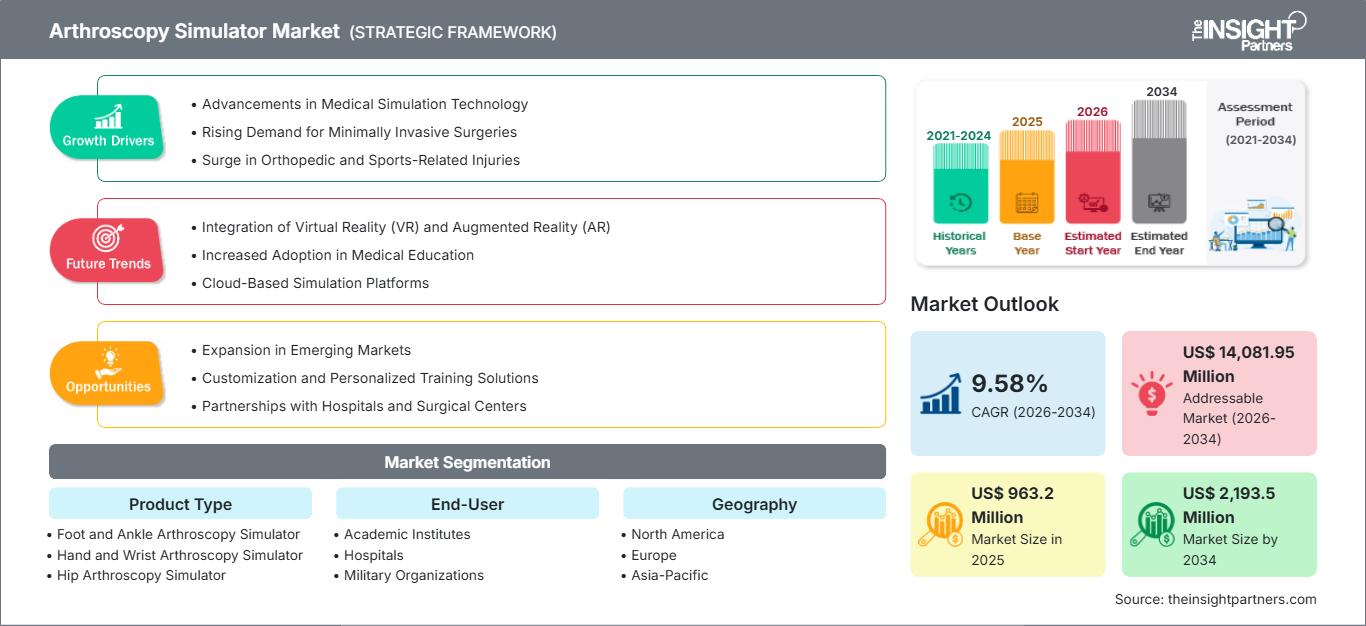
The arthroscopy simulator market was valued at US$ 963.2 Million in 2025 and is projected to reach US$ 2,193.5 Million by 2034, representing a 9.58% CAGR during 2026–2034. There is growth in the market due to increased incorporation of high-fidelity virtual reality and mixed reality simulations in orthopedics training programs. Market growth is attributed to the rising focus on competency-based education, assessments, repeated learning, and use of technology to improve surgical skills development in orthopedic residency training and continuing medical education.
Arthroscopy Simulator Market Size in North America will be driven by the existing orthopedic residency training setup, simulation facilities, and skill assessment programs. The market size for arthroscopy simulators is estimated to grow at an annual rate of 9.2–9.8% between 2026 and 2034.
Arthroscopy Simulator Market Assessment and Insights
- North America: North America is expected to command a 35–39% share in 2025 and grow at a 9.1–9.7% CAGR during 2026–2034, supported by simulation-based residency education, academic centers, and structured orthopedic skills assessment.
- US: The US is estimated to represent 79–83% of North American revenue in 2025, expanding at a 9.0–9.6% CAGR during 2026–2034 through academic and hospital simulation programs.
- Europe: Europe is projected to hold a 27–31% share in 2025 and expand at a 9.4–10.0% CAGR during 2026–2034, led by Germany, the UK, France, Italy, and Switzerland, where specialist training infrastructure supports adoption.
- Asia Pacific: Asia Pacific is estimated at 22–26% share in 2025, with a 10.2–10.8% CAGR during 2026–2034, led by China, Japan, South Korea, India, and Australia as simulation infrastructure expands.
- Largest Segment: Knee Arthroscopy Simulator is modeled at a 38–43% market share in 2025, with a 9.3–9.9% CAGR during 2026–2034, reflecting broad training applicability.
- High Growth Segment: Military Organizations are modeled at an 8–12% market share in 2025, with a 10.4–11.2% CAGR during 2026–2034, driven by controlled skills training requirements.
- Key companies analyzed in detail: Adam Rouilly, Simbionix, Coburger Lehrmittelanstalt, VirtaMed, Marui, Touch of Life Technologies, Simendo, Surgical Science Sweden AB, Swemac Innovation AB, and GMV.
Source: The Insight Partners' analysis based on proprietary research, government publications, company annual reports, investor presentations, industry databases, and expert interviews.
The technology development in Arthroscopy Simulator Market has seen a change from tangible mannequins to highly immersive systems that include realistic anatomy, real instruments, haptic response, case databases, and performance metrics. Commercial products have begun to offer training of multiple joints using modular platforms, thus eliminating the need for different hardware systems. Therefore, production is moving towards platforms that include software-based learning content, while institutions will be concerned about curriculum integration and quantifiable learner outcomes.
The future of the market is going to see new training centers in addition to those in North America and Europe in the Asia Pacific region and in certain Middle Eastern countries. The market investments will be inclined towards modular products, cloud-based assessments, multilingual content, and small-sized systems. The focus on demonstrable competence and academic collaborations should aid in acquisition.
Arthroscopy Simulator Market Report Scope
| Report Attribute | Details |
|---|---|
| Market size in 2025 | US$ 963.2 Million |
| Market Size by 2034 | US$ 2,193.5 Million |
| Global CAGR (2026 - 2034) | 9.58% |
| Historical Data | 2021-2024 |
| Forecast period | 2026-2034 |
Arthroscopy Simulator Market Analysis
The demand for the arthroscopy simulator market solutions is currently being determined by the very high learning curve associated with minimally invasive orthopedic procedures and lack of repeatable live-patient practices. Through simulation, the trainees can gain practice in camera navigation, triangulation, visualization, probing, and procedural sequencing without any risk of training being posed on the patients. The environment consists of the simulator providers, software providers, orthopedic societies, academic institutions, hospitals, training facilities, and instruments providers. Supply is becoming more and more integrated and consists of hardware along with procedure modules, assessment software, services, and curriculum content.
Value creation is moving towards the platform that could serve at different learner levels and different anatomical regions. Knee procedures are often the basis of usage as they provide foundation for diagnostic and therapeutic knowledge, while shoulder, hip, ankle, and wrist procedures provide additional value. The procurement process is now increasingly taking into account interoperability, faculty supervision, performance analysis, ergonomic aspects of the equipment, service and total cost of ownership considerations.
Competitive landscape of the arthroscopy simulator market report is characterized by the presence of specialist simulation manufacturers as well as medical technology companies with diverse portfolios. Differentiation achieved by VirtaMed is through high-fidelity mixed-reality systems as well as modular joint-specific training, while Simbionix benefits from the heritage of virtual simulations in Surgical Science. Physical and virtual simulation solutions for arthroscopy are available through Touch of Life Technologies, Adam Rouilly and Coburger Lehrmittelanstalt specializes in educational simulation solutions.
More strategic investments are being made into software content, assessment algorithms, anatomy fidelity and curriculum collaborations. In this regard, the competitive edge will be less about having hardware and more about having a complete training workflow. Established partnerships with orthopedic societies, resident programs and academic centers help companies gain adoption through education validity.
● REPORT CUSTOMIZATION
Tailor This Report To Align With Your Specific Business Requirements
This report can be customized to align precisely with your business objectives, scope, and target markets. Customization options include tailored segmentation, geography, competitive analysis, and strategic insights to support informed decision-making.
Customize This Report →WHAT YOU CAN ADJUST
- ● Segmentations
- ● Geography
- ● Competitive Analysis
- ● Language Preferences
Arthroscopy Simulator Market: Strategic Insights
Regional Insights
North America arthroscopy simulator market
North America represents a 35–39% Arthroscopy Simulator Market share forecasted for 2025, exhibiting a CAGR of 9.1–9.7% for 2026-2034. The US will be leading the regional purchase owing to the presence of robust infrastructure in terms of the availability of orthopedic residency programs, medical institutes, and simulation labs.
The Canadian market presents a slightly smaller yet technically advanced purchasing audience especially in university-affiliated hospitals and specialized training institutes. The region's adoption is backed by well-developed orthopedic societies, professional development courses, and availability of simulation labs. More and more purchases are being made for platforms that can perform on various joints as well as on different levels of learners.
U.S. arthroscopy simulator market
US contributes to 79–83% of North American revenues in 2025 and is projected to have a CAGR of 9.0–9.6% for 2026–2034. The demand is driven by academic hospitals, orthopedics residency training, simulation centers, and specialty education associations. VirtaMed and Simbionix have gained visibility in the orthopedics simulation market, and Touch of Life Technologies offers applications for arthroscopy training.
Knee and shoulder modules play a key role since they cater to popular orthopedics training routes and help with diagnostics and procedures. Educational institutes rely increasingly on objective parameters of progress instead of observation by the faculty members alone. Simulation training programs can offer standardized experience in case there is a lack of operating room cases available; digital technologies are especially helpful for ealents and structured skills assessment.
Europe arthroscopy simulator market
Europe is forecasted to account for 27-31% market share in 2025 and exhibit a CAGR of 9.4-10.0% between 2026 and 2034. Germany is the dominant market, driven by expert orthopedic educational programs and advanced medical technologies. The UK and France contribute heavily due to institutional needs in universities and their hospitals and surgical training programs.
Germany enjoys advantages related to high skill sets in simulators design and clinical education, while the UK focuses on competency-based graduate training. France, Italy, and Spain represent other growth areas since orthopedic centers are increasingly adopting technology-assisted skills laboratories. Switzerland is highly influential in developing specialist simulation training. Increasing procurement needs include validated assessment, realistic handling of instruments, and multi-procedure platforms for residents, fellows, and skilled surgeons.
APAC arthroscopy simulator market
APAC has been developed on the basis of a 22% to 26% market share forecasted for 2025, with a growth rate of 10.2% to 10.8% during the period of 2026 to 2034. China and Japan dominate adoption, followed by South Korea, India, and Australia. Increased procedures and modernization of healthcare education are factors driving adoption.
While China is rich in institutional opportunity, Japan and South Korea have mature technology-oriented training environments. India has the potential through medical colleges and specialized hospitals, whereas Australia has a well-established infrastructure for surgical education. Industrial investment in medical technologies and healthcare education modernization should promote simulation-based training programs.
Middle East & Africa arthroscopy simulator market
While MEA and Africa have a small installed base, the regions hold promise for developing opportunities, including tertiary hospitals and specialist centers. Saudi Arabia and UAE are the main adopters in the region, whereas South Africa is the key market for Africa. It is forecasted that the region will experience growth at a CAGR of 9.8–10.5% for 2026–2034.
Healthcare infrastructure development, specialist workforce, and advanced tertiary healthcare contribute to growing demands. Saudi Arabia and UAE are especially important markets due to the fact that new medical education institutions can include simulation laboratories when being developed from scratch. South Africa and the other markets of MEA have limited options, where buying decision depends on capital, local conditions, training, and usage rate of equipment.
Segmentation Analysis
Product Type
Product Type is projected to expand at a 9.2–9.8% CAGR during 2026–2034. Demand is shifting toward modular platforms that combine physical realism, virtual anatomy, procedure libraries, and objective assessment. Knee and shoulder systems anchor utilization, while hip, hand, wrist, foot, and ankle capabilities broaden institutional training coverage.
- Foot and Ankle Arthroscopy Simulator: Supports specialized training in constrained anatomical spaces and improves familiarity with positioning, portal navigation, visualization, and instrument manipulation for increasingly complex lower-extremity procedures.
- Hand and Wrist Arthroscopy Simulator: Addresses fine-motor requirements and compact joint anatomy, offering specialist programs a controlled environment for practicing visualization, triangulation, and instrument handling.
- Hip Arthroscopy Simulator: Provides structured practice for technically demanding procedures requiring precise positioning, navigation, and spatial orientation, making it strategically important for advanced orthopedic fellowship programs.
- Knee Arthroscopy Simulator: Represents the principal training application because knee procedures provide broad foundational exposure to diagnostic navigation, probing, meniscal work, and ligament-related techniques.
- Shoulder Arthroscopy Simulator: Supports high-value training for complex spatial orientation and portal management, with applications spanning diagnostic procedures, instability treatment, and rotator cuff interventions.
End-User
End-User demand is forecast to rise at a 9.7–10.3% CAGR during 2026–2034. Academic Institutes remain central because simulation can be embedded into residency curricula, while hospitals increasingly use systems for onboarding, skills assessment, and fellowship education. Military Organizations provide an additional specialized opportunity.
- Academic Institutes: Serve as foundational buyers because structured curricula require repeatable practice, faculty assessment, and standardized learner progression before clinical exposure.
- Hospitals: Increasingly deploy simulation for residency education, fellowship programs, credentialing support, continuing education, and assessment of technical skills within institutional training pathways.
- Military Organizations: Use simulation to provide controlled, repeatable training where standardized procedural readiness, resource efficiency, and uninterrupted practice can be strategically important.
- Others: Additional users include specialist training centers and professional education organizations seeking flexible platforms for workshops, continuing education, and skills verification.
Opportunity Snapshot
| End-User | Revenue Contribution | Trend Tag | Adoption Stage |
|---|---|---|---|
| Academic Institutes | High | Residency Training | Mature |
| Hospitals | High | Skills Assessment | Scaling |
| Military Organizations | Medium | Readiness Training | Scaling |
| Others | Low | Workshop Training | Emerging |
Arthroscopy Simulator Market Growth Drivers and Impact Analysis
Competency-based orthopedic education increases simulation utilization
Orthopedic education is increasingly moving toward demonstrable technical competency rather than exposure measured solely by procedure counts. Simulation supports this shift because learners can repeat standardized tasks while educators record completion time, navigation quality, errors, and procedural performance. A 2025 systematic review of shoulder simulation studies found that training commonly assessed time to completion and visualization or probing performance, demonstrating the importance of measurable outcomes. The commercial implication is significant because institutions can justify simulator procurement as an educational infrastructure investment rather than an optional technology purchase. Platforms that provide structured scoring, instructor dashboards, and repeatable modules are therefore positioned to secure stronger utilization across residency and fellowship programs.
High-fidelity practice addresses limited live-patient training opportunities
Arthroscopy requires precise camera orientation, triangulation, tissue handling, and spatial judgment that are difficult to acquire through observation alone. Simulation creates an environment where trainees can practice repeatedly without consuming operating-room resources or introducing unnecessary patient exposure. Recent clinical research comparing simulator-based and conventional training reported better visualization scores, shorter task completion times, and fewer technical errors among residents receiving simulator training. These findings strengthen the educational rationale for institutional investment and encourage programs to introduce simulation earlier in residency. The commercial impact extends beyond initial hardware sales because recurring demand can arise from procedure modules, maintenance, curriculum services, faculty training, and upgrades. Vendors able to demonstrate measurable learner improvement can therefore compete on educational outcomes rather than equipment specifications alone.
Digital assessment expands the value of simulation platforms
Performance analytics are becoming an increasingly important component of surgical education because faculty capacity is limited and learner progress must be documented consistently. Modern simulators can capture navigation patterns, procedural time, errors, instrument movements, and task completion, creating structured information for formative assessment. This capability allows institutions to compare learner progression over time and identify specific technical weaknesses. It also creates opportunities for software-based recurring revenue through content updates, assessment modules, and curriculum management. Vendors can strengthen their position by integrating analytics with institutional learning systems and competency frameworks. As simulation moves from occasional workshops toward continuous training, the value proposition increasingly depends on data quality, usability, interoperability, and evidence supporting educational validity.
Arthroscopy Simulator Market Future Trends
AI-enabled performance feedback becomes a core training layer
AI-enabled assessment is likely to become a major differentiator as simulator manufacturers seek to transform raw motion and procedural data into actionable feedback. Future platforms could identify inefficient camera movements, repeated visualization errors, unnecessary instrument travel, and deviations from expert-defined technique. Such systems may provide individualized training recommendations and automatically adjust task difficulty according to learner performance. The arthroscopy simulator market trends therefore point toward adaptive education rather than fixed exercise sequences. Institutions could use longitudinal performance records to determine readiness for increasingly complex procedures. Integration with digital learning environments may further allow educators to combine simulator scores with curriculum milestones. Commercial opportunities will favor companies capable of validating algorithms clinically while maintaining transparent assessment criteria and reliable data governance.
Expanded mixed-reality modules broaden anatomical and procedural coverage
Mixed-reality platforms are expected to broaden their value by combining physical positioning and authentic instruments with digital anatomy and pathology. This approach can create realistic procedural environments without requiring separate physical models for every condition. Future content is likely to include more advanced pathology, patient-specific scenarios, complex repairs, and decision-making exercises. The arthroscopy simulator market trends also indicate increasing demand for modular systems that allow institutions to purchase additional applications without replacing the core platform. Such architectures can lower lifecycle costs and improve utilization across multiple specialties. As educational programs become more sophisticated, vendors may increasingly collaborate with orthopedic societies and teaching hospitals to develop proficiency-based curricula, standardized assessment pathways, and validated progression thresholds.
Arthroscopy Simulator Market Opportunities
Regional simulation-center expansion in Asia Pacific
Asia Pacific presents an attractive expansion opportunity because medical education systems are investing in specialist capacity while orthopedic services become more technologically sophisticated. Vendors can target teaching hospitals, university medical colleges, national training centers, and specialty institutes with modular platforms that require less infrastructure than full-scale simulation laboratories. The arthroscopy simulator market Forecasts support a stronger role for regional distribution, localized content, remote technical support, and faculty certification programs. India and China are particularly relevant for scalable institutional models, while Japan, South Korea, and Australia offer mature reference markets. Strategic partnerships with orthopedic societies and academic institutions can reduce adoption barriers by embedding simulation into formal curricula. Suppliers should prioritize joint-specific modules, multilingual interfaces, utilization analytics, and service packages aligned with local procurement structures.
Hospital-based competency platforms create recurring revenue potential
Hospitals represent an opportunity to extend simulation beyond residency education into fellowship training, credentialing support, onboarding, continuing professional development, and procedural readiness. Vendors can develop enterprise packages combining hardware, software, service, content updates, and performance dashboards. This approach changes purchasing from a one-time equipment transaction into a broader institutional training relationship. The market Forecasts indicate that platforms capable of supporting multiple learner categories should have stronger utilization economics than single-purpose systems. Hospitals may also value portable or modular configurations that can move between education rooms. Suppliers can strengthen commercial positioning by offering utilization reporting, faculty development, preventative maintenance, and curriculum design. Demonstrating improvements in efficiency and technical performance can support procurement committees evaluating capital expenditure against broader workforce-development objectives.
Recent Developments
- June 2026: VirtaMed AG supported the National Knee Preservation Alliance launch and academic conference in Beijing, where its latest-generation ArthroS simulator was used for hands-on orthopedic training. The program emphasized knee-preservation education, minimally invasive techniques, standardized training, camera navigation, anatomical recognition, spatial orientation, and procedural precision. The development illustrates expanding simulator use within specialist orthopedic education in China.
- January 2026: VirtaMed AG introduced a new shoulder arthroscopy training course through its ArthroS simulator platform, focusing on triangulation and diagnostics. The course was designed for different learner levels and emphasized camera orientation, diagnostic accuracy, and lateral-position training, alongside preparation for advanced shoulder procedures. The release demonstrates the industry's movement toward continuously refreshed, procedure-specific digital curricula.
- October 2025: VirtaMed AG hosted the ESSKA Residents’ Simulator Training Course in Zurich, bringing together 22 participants from 10 nationalities. Residents practiced periscoping, telescoping, image centering, triangulation, diagnostic knee arthroscopy, meniscal repair, and complex pathology management using VirtaMed simulators. The event highlights continuing adoption of simulation within structured international orthopedic training and professional education.
Frequently Asked Questions

- Comprehensive Market Sizing and Forecast Analysis
- Detailed Segmentation Analysis
- In-Depth Market Dynamics Assessment
- Regional and Country-Level Insights
- Competitive Landscape and Company Benchmarking
- Strategic Business Intelligence
Recent Reports
Testimonials

The Insight Partners' SCADA System Market report is comprehensive, with valuable insights on current trends and future forecasts. The team was highly professional, responsive, and supportive throughout. We are very satisfied and highly recommend their services.
RAN KEDEM Partner, Reali Technologies LTDs
I requested a report on a very specific software market and the team produced the report in a few days. The information was very relevant and well presented. I then requested some changes and additions to the report. The team was again very responsive and I got the final report in less than a week.
JEAN-HERVE JENN Chairman, Future Analytica
We worked with The Insight Partners for an important market study and forecast. They gave us clear insights into opportunities and risks, which helped shape our plans. Their research was easy to use and based on solid data. It helped us make smart, confident decisions. We highly recommend them.
PIYUSH NAGPAL Sr. Vice President, High Beam Global
The Insight Partners delivered insightful, well-structured market research with strong domain expertise. Their team was professional and responsive throughout. The user-friendly website made accessing industry reports seamless. We highly recommend them for reliable, high-quality research services
YUKIHIKO ADACHI CEO, Deep Blue, LLC.
This is the first time I have purchased a market report from The Insight Partners.While I was unsure at first, I visited their web site and felt more comfortable to take the risk and purchase a market report.I am completely satisfied with the quality of the report and customer service. I had several questions and comments with the initial report, but after a couple of dialogs over email with their analyst I believe I have a report that I can use as input to our strategic planning process.Thank you so much for taking the extra time and making this a positive experience.I will definitely recommend your service to others and you will be my first call when we need further market data.
JOHN SUZUKI President and Chief Executive Officer, Board Director, BK Technologies
I wish to appreciate your support and the professionalism you displayed in the course of attending to my request for information regarding to infectious disease IVD market in Nigeria. I appreciate your patience, your guidance, and the fact that you were willing to offer a discount, which eventually made it possible for us to close a deal. I look forward to engaging The Insight Partners in the future, all thanks to the impression you have created in me as a result of this first encounter.
DR CHIJIOKE ONYIA MANAGING DIRECTOR, PineCrest Healthcare Ltd.Reason to Buy
- Informed Decision-Making
- Understanding Market Dynamics
- Competitive Analysis
- Identifying Emerging Markets
- Customer Insights
- Market Forecasts
- Risk Mitigation
- Boosting Operational Efficiency
- Strategic Planning
- Investment Justification
- Tracking Industry Innovations
- Aligning with Regulatory Trends





 Get Free Sample for