
Artificial Conversational Entity Market Size, Trends & Growth by 2034
Coverage: By Type (Software, Service); Enterprise Size (Small and Medium Enterprise, Large Enterprise); Application (Website, Mobile Platform, Social Media, Others); Industry Verticals (Retail, BFSI, Healthcare, Media and Entertainment, Others) , and Geography (North America, Europe, Asia Pacific, and South and Central America)
- Status : Data Released
- Report Code : TIPRE00009542
- Category : Technology, Media and Telecommunications
- No. of Pages : 150
- Available Report Formats :


- Last update date : September 01, 2026


2025 Market Size
US$ 3.89 Bn
Base year value
2034 Forecast
US$ 176.49 Bn
Projected by 2034
CAGR 2026-2034
52.79 %
Growth rate
Addressable Market
US$ 499.65 Bn
(2026-2034)
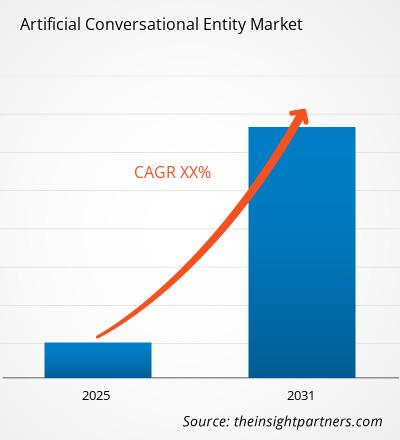
The artificial conversational entity market is projected to grow from US$ 3.89 Billion in 2025 to US$ 176.49 Billion by 2034, registering a CAGR of 52.79% during 2026–2034. The expansion reflects rapid enterprise adoption of conversational agents, generative language interfaces, and automated customer engagement systems across digital-first sectors seeking scalable, measurable, and always-available interaction models.
Across North America, rising cloud maturity, high contact center automation budgets, and broader deployment of responsible AI governance are expected to support a CAGR range of 50–53% through 2026–2034. The artificial conversational entity market size in the region is shaped by healthcare triage, banking assistance, retail self-service, and enterprise knowledge automation, where buyers increasingly demand secure, auditable, and multilingual conversation orchestration.
Artificial Conversational Entity Market Assessment and Insights
- North America accounted for a 38–40% share in 2025 and is expected to grow at a CAGR between 2026–2034 of 50–53%, supported by enterprise cloud adoption, mature CX budgets, and regulated-sector automation in healthcare and financial services.
- US represented 77–80% of North America in 2025 and is forecast to expand at a CAGR between 2026–2034 of 49–52%, led by contact center modernization and healthcare AI agents.
- Europe held a 25–27% share in 2025 and is projected to grow at a CAGR between 2026–2034 of 49–52%, with the UK, Germany, France, Italy, and Spain leading compliance-oriented deployments.
- Asia Pacific captured a 22–24% share in 2025 and is set to grow at a CAGR between 2026–2034 of 55–58%, driven by China, Japan, South Korea, India, and Australia.
- Largest Segment: Software accounted for a market share range of 63–66% in 2025 and is projected to grow at a CAGR range of 51–54% during 2026–2034 as enterprises prioritize reusable AI platforms.
- High Growth Segment: Mobile Platform held a market share range of 26–29% in 2025 and is expected to grow at a CAGR range of 55–58% during 2026–2034 due to app-based service adoption.
- Key companies analyzed in detail: Aivo LLC, Anboto Group, Teneo AI AB, Creative Virtual Ltd., The CX Company, eGain Corporation, IBM Corporation, Inbenta Technologies Inc., Verint Systems Inc. (Next IT), Nuance Communications, Inc.
Source: The Insight Partners' analysis based on proprietary research, government publications, company annual reports, investor presentations, industry databases, and expert interviews.
The market has evolved from scripted chatbot implementations to language-aware orchestration layers that include natural language understanding, retrieval-augmented generation, workflow automation, and compliance management. The current production models focus on reusable knowledge graphs, secure data connectors, agent handoff, multilingual support, and quality metrics for containment. Vendors have transitioned from building standalone assistants to configuring platforms that can connect with CRM, contact center, banking, healthcare, and retail applications.
Future growth will pick up pace in developing geographies as the availability of digital infrastructure, mobile-first e-commerce, and cloud migration by enterprises will open new application scenarios. Tailwinds on explainability, data sovereignty, safe AI, and consumer rights will benefit vendors with good governance practices. Investment will be made in industry-specific assistants, voice automation, low-code configuration, and reliable knowledge systems.
Artificial Conversational Entity Market Report Scope
| Report Attribute | Details |
|---|---|
| Market size in 2025 | US$ 3.89 Billion |
| Market Size by 2034 | US$ 176.49 Billion |
| Global CAGR (2026 - 2034) | 52.79% |
| Historical Data | 2021-2024 |
| Forecast period | 2026-2034 |
Artificial Conversational Entity Market Analysis
Demand in the artificial conversational entity market growth cycle is being fueled by the need to reduce service friction, automate repetitive inquiries, and extend enterprise knowledge to customers and employees through natural language. Value Chain
The value chain comprises providers of models, cloud services, software for conversational AI, system integrators, data governance tools, and contact center players. Buyers favor systems that are configurable, open, and secure as opposed to proprietary chatbot implementations.
Buyers are increasingly considering outcome-oriented solutions where they evaluate resolution accuracy, containment capability, compliance management, and integration capabilities of the solution before making a choice of vendor.
BFSI customers are concerned about audit capabilities and security of identities, healthcare providers want clinical safety limits, retailers consider scaling capacity seasonally, and media companies need engagement continuity.
The artificial conversational entity market analysis shows a fragmented but increasingly specialized competitive landscape. IBM Corporation and Nuance Communications, Inc. maintain strong enterprise credibility, while eGain Corporation, Creative Virtual Ltd., Inbenta Technologies Inc., Aivo LLC, Anboto Group, Teneo AI AB, The CX Company, and Verint Systems Inc. compete through domain knowledge, orchestration control, and deployment flexibility.
Investments are focusing on agentic workflows, voice-based user interfaces, reliable sources of knowledge, and vertical deployments. Strategic positioning has ceased being solely about how quickly vendors can build chatbots. Governance, deterministic workflow management, omnichannel persistence, multilingual support, and the combination of generative AI with corporate constraints are all means of differentiation for vendors.
● REPORT CUSTOMIZATION
Tailor This Report To Align With Your Specific Business Requirements
This report can be customized to align precisely with your business objectives, scope, and target markets. Customization options include tailored segmentation, geography, competitive analysis, and strategic insights to support informed decision-making.
Customize This Report →WHAT YOU CAN ADJUST
- ● Segmentations
- ● Geography
- ● Competitive Analysis
- ● Language Preferences
Artificial Conversational Entity Market: Strategic Insights

Regional Insights
North America artificial conversational entity market
North America held a 38–40% share in 2025 and is projected to expand at a CAGR of 50–53% during 2026–2034. The artificial conversational entity market share reflects high cloud penetration, early AI governance adoption, and sustained investment in digital service transformation across healthcare, banking, insurance, and retail. Customers in this region demand orchestration, escalation by humans, omnichannel analytics, and sources of auditable knowledge.
This region enjoys healthy enterprise software spending as well as a very dense vendor ecosystem that spans both the United States and Canada. Use cases in the healthcare sector involve appointment management, clinical documentation, and patient interaction, while BFSI use cases involve fraud awareness assistance and compliance in services. Retailers deploy assistants on mobile and websites in order to handle volume without sacrificing personalization.
U.S. artificial conversational entity Market
The U.S. represented 77–80% of North America artificial conversational entity market in 2025 and is expected to grow at a CAGR of 49–52% during 2026–2034. It is more prevalent within large organizations, payer-provider health care networks, banks, insurance providers, telecommunications providers, and electronic commerce portals. Corporate presence is ensured by IBM Corporation, Nuance Communications, Inc., eGain Corporation, Verint Systems Inc., and other vendors who provide solutions that automate customer services.
Trends in applications in the USA include website assistants, mobile service agents, voice-powered automation, and internal employee assistance tools. Health care organizations are deploying secure AI agents for triaging and documentation processes, while banks are focusing on secure conversations and knowledge delivery. Enterprises require more flexible models, secure handling of data, and performance improvements.
Europe artificial conversational entity Market
Europe accounted for a 25–27% share of the artificial conversational entity market in 2025 and is forecast to grow at a CAGR of 49–52% during 2026–2034. The UK is the leading country, supported by advanced contact center outsourcing, digital banking, public service modernization, and strong adoption of AI-enabled customer support. Buyers emphasize privacy, explainability, and controlled deployment.
Germany’s market consists of industrial services automation, insurance digitization, and enterprise preference for security and on-premises or hybrid infrastructures. German companies apply conversational entities for service desks, dealership support, and multilingual experiences of their customers. France, Italy, and Spain are developing within retail banking, telecommunication, healthcare accessibility, and government digital channels.
Procurement in Europe is impacted by AI governance, the expectation of data protection, and multilingual issues. Vendors that offer auditable knowledge processes, human monitoring, and performance in local languages have a stronger position. Creative Virtual Ltd., Teneo AI AB, Inbenta Technologies Inc., and Anboto Group are more competitive due to their regional presence, whereas other vendors operate globally.
APAC artificial conversational entity Market
APAC held a 22–24% share in 2025 and is projected to record a CAGR of 55–58% during 2026–2034. China is the leading country, supported by mobile commerce, digital payments, super-app ecosystems, and large-scale enterprise automation. Japan and South Korea prioritize service quality, multilingual tourism support, and telecom automation.
India and Australia add momentum through BFSI digitization, cloud contact centers, healthcare access platforms, and government-backed digital identity systems. Industrial and policy drivers include mobile-first populations, expanding data centers, AI skilling initiatives, and enterprise demand for lower-cost customer engagement at a regional scale.
Middle East & Africa artificial conversational entity Market
The Middle East & Africa artificial conversational entity market is expected to grow at a CAGR of 50–53% during 2026–2034, led by Saudi Arabia and the UAE. National digital transformation programs, smart city initiatives, banking modernization, and energy-sector service digitization are increasing interest in Arabic-capable and multilingual conversational agents.
South Africa leads adoption across insurance, telecom, and banking, while the rest of MEA remains at an emerging stage. Infrastructure investment, cloud region expansion, and customer service modernization are creating opportunities, although language coverage, integration readiness, and data residency requirements remain decisive procurement factors.
Segmentation Analysis
Type
Type is expected to grow at a CAGR range of 52–55% during 2026–2034. The segment reflects enterprise movement from basic chatbot pilots toward configurable software platforms and managed services. The artificial conversational entity market scope is widening as buyers combine conversational design, integration services, knowledge engineering, analytics, compliance controls, and post-deployment optimization.
- Software remains the largest sub-segment because enterprises need reusable platforms for web chat, voice, mobile, workflow orchestration, analytics, multilingual management, and integration with CRM or contact center systems.
- Service demand is rising as enterprises require implementation support, prompt governance, data preparation, conversation design, compliance testing, model monitoring, and continuous optimization after deployment.
Enterprise Size
Enterprise Size is projected to grow at a CAGR range of 51–54% during 2026–2034. Large enterprises currently dominate adoption because they operate complex service journeys, higher inquiry volumes, and stricter compliance requirements. SME adoption is increasing as cloud-based subscriptions, low-code tools, and packaged integrations reduce deployment barriers.
- Small and Medium Enterprise buyers prioritize cost-effective automation, faster response handling, simple website deployment, and ready connectors that reduce reliance on large internal technical teams.
- Large Enterprise users require scale, governance, multilingual support, identity integration, analytics, human escalation, and secure deployment across departments, regions, and customer-facing channels.
Application
Application is forecast to advance at a CAGR range of 53–56% during 2026–2034. Website deployments remain important for customer service, sales support, and lead qualification, while mobile and social channels are gaining strategic relevance. Enterprises increasingly want a consistent conversation layer that follows users across channels without losing context.
- Website applications support product discovery, service routing, FAQ automation, lead capture, and complaint resolution, making them a priority for retailers, banks, healthcare providers, and media platforms.
- Mobile Platform adoption is accelerating as consumers prefer app-based banking, healthcare access, retail support, personalization, notifications, and secure identity-linked service interactions.
- Social Media applications help brands respond to public inquiries, campaign traffic, service complaints, and community engagement while maintaining a consistent tone and escalation workflows.
Industry Verticals
Industry Verticals are anticipated to grow at a CAGR range of 51–54% during 2026–2034. Adoption varies by workflow complexity, regulatory exposure, and customer interaction intensity. Retail and BFSI lead broader deployment, while healthcare and media companies are prioritizing domain safeguards, contextual recommendations, and scalable engagement models.
- Retail uses conversational entities for order tracking, product search, returns, loyalty support, personalization, and seasonal inquiry management across websites, apps, and messaging channels.
- BFSI adoption centers on account assistance, onboarding, claims, fraud-aware support, compliant disclosures, branch deflection, and secure knowledge delivery across authenticated customer journeys.
- Healthcare use cases include appointment scheduling, patient triage routing, clinical documentation support, benefits navigation, prescription inquiries, and communication workflows with safety controls.
- Media and Entertainment organizations deploy assistants for subscriptions, content discovery, campaign engagement, audience support, billing issues, and personalized recommendations across mobile and social channels.
Opportunity Snapshot
| Application | Revenue Contribution | Trend Tag | Adoption Stage |
| Website | High | Service Routing | Mature |
| Mobile Platform | High | App Agents | Scaling |
| Social Media | Medium | Social Care | Scaling |
Artificial Conversational Entity Market Growth Drivers and Impact Analysis
Enterprise Pressure to Automate High-Volume Service Workflows
Firms are facing the problem of managing their increasing digital engagements with little increase in staffing for services. Conversational entities tackle this problem through the absorption of repetitive queries, handling complicated cases, and delivering approved knowledge to the human agents. The effect will be felt mainly in industries like retail, BFSI, healthcare, and media as there will be peaks that might overwhelm contact centers. Consumers have moved from mere deflections to completion of workflows such as payments, claims processing, making appointments, and performing any other transactions on approved accounts. This is because the value of using the technology is no longer limited to one department alone, but to many departments.
Generative AI Embedded into Controlled Enterprise Knowledge Systems
The generative AI is increasing the utility of conversational agents by providing a better capacity for natural responses, summaries, intent detection, and real-time knowledge retrieval. There is an increasing resistance to ungoverned use cases on the side of enterprise customers due to the risk of reputation, revenue, and regulatory harm posed by hallucination and inconsistency in responses. Market implications include increased interest in reliable knowledge stores, retrieval management, determinism in workflow design, and the evaluation layer of the response. The vendors who balance the language-based flexibility with business rules will be more successful in regulated industries. This driver influences platform requirements in terms of explaining, auditing, and maintaining consistency in the answers provided.
Rising Omnichannel Expectations Across Digital Customer Journeys
Continuity of services is expected by customers when using websites, mobile applications, communication channels, and voice-enabled channels. Inconsistencies in the support process result in the loss of information, duplicated authentication, increased problem-solving time, and decreased brand trust. Conversational entities assist in aggregating interaction information and guiding users through various channels without losing context and intent. It has a great impact on the process since the company can consolidate its processes for customer service and avoid duplication of efforts between various departments. For example, retailers use agents for order support, banks for account journey services, healthcare organizations for access services, and media companies for subscriptions.
Artificial Conversational Entity Market Future Trends
Agentic Orchestration Replacing Static Chatbot Flows
Agentic orchestration will be one of the defining artificial conversational entity market trends as enterprises move from fixed decision trees to goal-driven assistants that can reason across tools, policies, and knowledge sources. Future systems will select workflows, invoke APIs, summarize context, and coordinate with human agents while staying within approved boundaries. This will change vendor evaluation because buyers will test task completion, not only recognition accuracy. The strongest demand will come from sectors where service cases involve multiple steps, identity checks, eligibility rules, and compliance language. Over time, agentic orchestration will support broader process automation, but conservative rollout will remain essential.
Voice-First and Multilingual AI Expanding Enterprise Reach
Strategic value will emerge as conversational entities based on voice become the choice for automation by contact centers, healthcare, banking, and public sector organizations, in addition to text channels. Advances in speech-to-text, sentiment detection, and multilingual language models will allow for more fluid interaction with those who would rather speak or live in areas where languages abound. Opportunities in the future will go beyond deflecting calls. The voice-based agents will be used for purposes such as authentication, guided troubleshooting, appointment scheduling, and assistance for agents. Those vendors capable of handling accents, industry terms, interruptions, and disclosure will have an edge.
Artificial Conversational Entity Market Opportunities
Verticalized Solutions for Healthcare, BFSI, and Retail
The strongest investment opportunity lies in verticalized agent libraries that combine domain terminology, approved workflows, regulatory safeguards, and prebuilt integrations. Generic assistants often require extensive customization before they can support claims, triage, loan servicing, prescription inquiries, or returns. Vendors that offer packaged healthcare, BFSI, and retail modules can shorten deployment cycles and improve buyer confidence. The artificial conversational entity market Forecasts indicate that adoption will increasingly depend on practical business outcomes, including faster case resolution, safer knowledge delivery, and lower service friction. Investors and vendors should prioritize repeatable vertical templates, compliance testing, analytics dashboards, and partnerships with system integrators.
SME Adoption Through Low-Code Platforms and Managed Services
This is a relatively untapped market as most small and medium-sized enterprises do not have an AI engineering team, yet their customer service expectations are growing higher. Easy low-code configuration, managed conversation design, hosted knowledge management, and reasonable subscription rates can help bring enterprise-level AI to smaller businesses. It is especially relevant for website services, mobile commerce, healthcare by appointment, local financial services, and online retailers. Vendors need to make onboarding easy, build ready-to-use templates, and ensure clear analytics of performance. Partnering with CRMs, payment platforms, and cloud marketplaces through channels can help reach more SMEs.
Frequently Asked Questions

- Comprehensive Market Sizing and Forecast Analysis
- Detailed Segmentation Analysis
- In-Depth Market Dynamics Assessment
- Regional and Country-Level Insights
- Competitive Landscape and Company Benchmarking
- Strategic Business Intelligence
Recent Reports
Testimonials

The Insight Partners' SCADA System Market report is comprehensive, with valuable insights on current trends and future forecasts. The team was highly professional, responsive, and supportive throughout. We are very satisfied and highly recommend their services.
RAN KEDEM Partner, Reali Technologies LTDs
I requested a report on a very specific software market and the team produced the report in a few days. The information was very relevant and well presented. I then requested some changes and additions to the report. The team was again very responsive and I got the final report in less than a week.
JEAN-HERVE JENN Chairman, Future Analytica
We worked with The Insight Partners for an important market study and forecast. They gave us clear insights into opportunities and risks, which helped shape our plans. Their research was easy to use and based on solid data. It helped us make smart, confident decisions. We highly recommend them.
PIYUSH NAGPAL Sr. Vice President, High Beam Global
The Insight Partners delivered insightful, well-structured market research with strong domain expertise. Their team was professional and responsive throughout. The user-friendly website made accessing industry reports seamless. We highly recommend them for reliable, high-quality research services
YUKIHIKO ADACHI CEO, Deep Blue, LLC.
This is the first time I have purchased a market report from The Insight Partners.While I was unsure at first, I visited their web site and felt more comfortable to take the risk and purchase a market report.I am completely satisfied with the quality of the report and customer service. I had several questions and comments with the initial report, but after a couple of dialogs over email with their analyst I believe I have a report that I can use as input to our strategic planning process.Thank you so much for taking the extra time and making this a positive experience.I will definitely recommend your service to others and you will be my first call when we need further market data.
JOHN SUZUKI President and Chief Executive Officer, Board Director, BK Technologies
I wish to appreciate your support and the professionalism you displayed in the course of attending to my request for information regarding to infectious disease IVD market in Nigeria. I appreciate your patience, your guidance, and the fact that you were willing to offer a discount, which eventually made it possible for us to close a deal. I look forward to engaging The Insight Partners in the future, all thanks to the impression you have created in me as a result of this first encounter.
DR CHIJIOKE ONYIA MANAGING DIRECTOR, PineCrest Healthcare Ltd.Reason to Buy
- Informed Decision-Making
- Understanding Market Dynamics
- Competitive Analysis
- Identifying Emerging Markets
- Customer Insights
- Market Forecasts
- Risk Mitigation
- Boosting Operational Efficiency
- Strategic Planning
- Investment Justification
- Tracking Industry Innovations
- Aligning with Regulatory Trends





 Get Free Sample for