
Infrastructure Cybersecurity Market Size, Share, and Emerging Opportunities Forecast to 2031
Coverage: By Component (Solution and Services), Organization Size (Large Enterprises and SMEs), Industry Vertical (BFSI, IT and Telecom, Government, Healthcare, Manufacturing, Retail and Ecommerce, and Others), and Geography (North America, Europe, Asia Pacific, Middle East and Africa, and South and Central America)
- Status : Published
- Report Code : TIPRE00042189
- Category : Technology, Media and Telecommunications
- No. of Pages : 293
- Available Report Formats :


- Last update date : January 27, 2026


2024 Market Size
US$ 20.08 Bn
Base year value
2031 Forecast
US$ 43.11 Bn
Projected by 2031
CAGR 2025-2031
11.8 %
Growth rate
Addressable Market
US$ 225.10 Bn
(2025-2031)
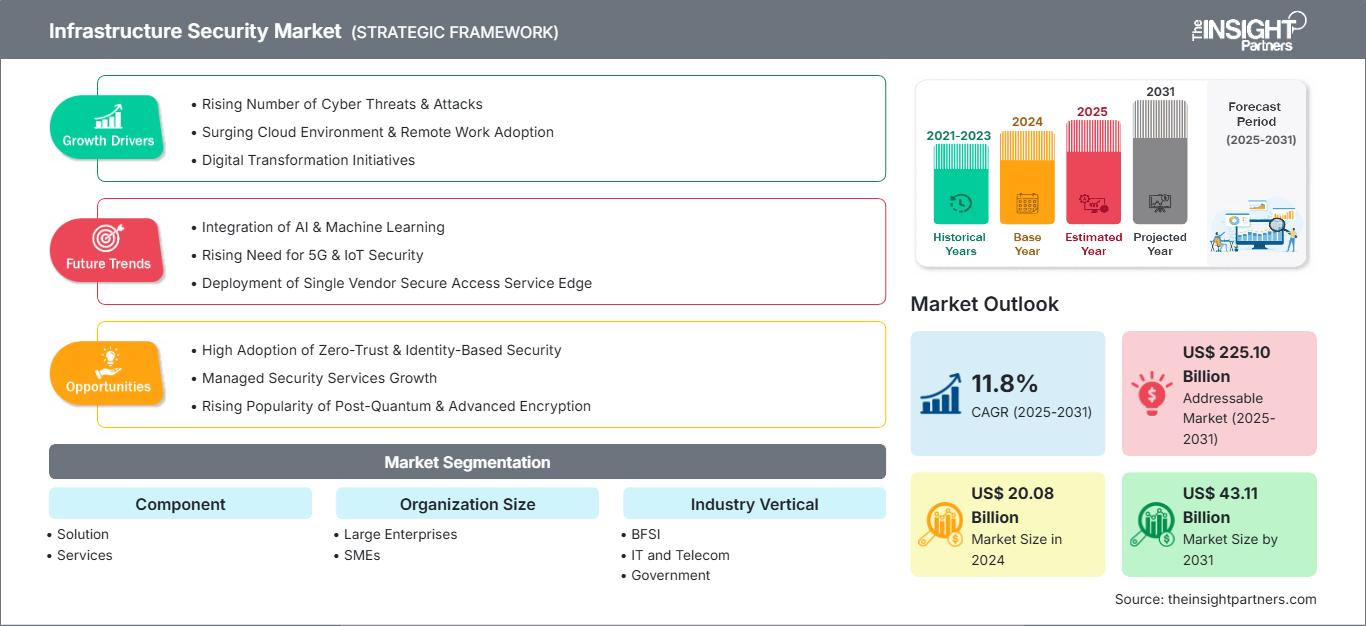
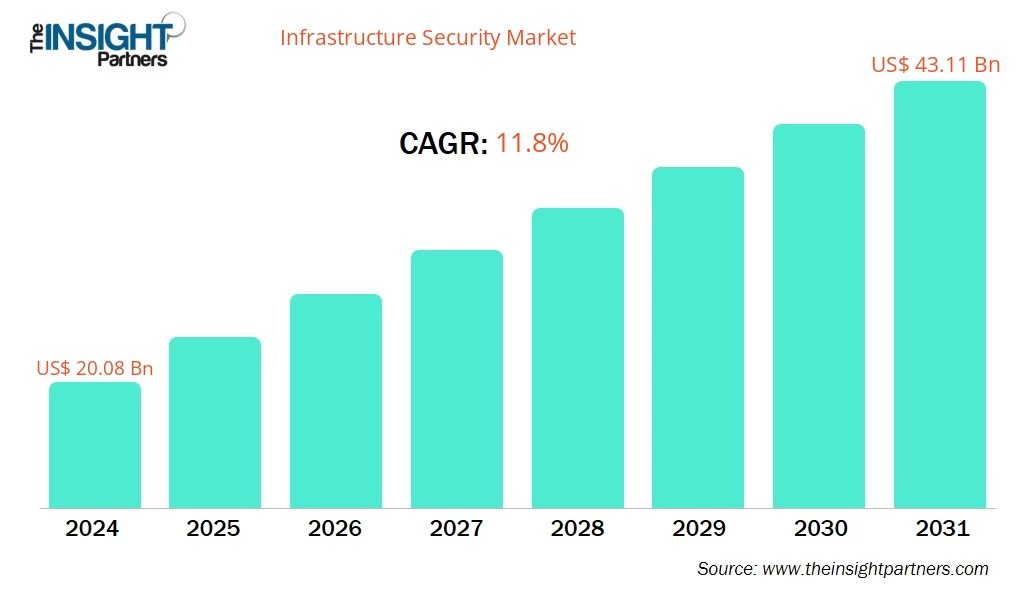
The Infrastructure Security Market size is expected to reach US$ 43.11 billion by 2031 from US$ 20.08 billion in 2024. The market is anticipated to register a CAGR of 11.8% during 2025–2031.
Infrastructure Security Market Analysis
The infrastructure security market is growing rapidly, driven by rising cyber threats, cloud adoption, IoT expansion, and regulatory pressure. Governments and enterprises invest heavily in network, data, and critical infrastructure protection solutions. Operators are prioritizing proactive risk management through advanced surveillance, threat detection, and cyber defense technologies. Integration of AI, analytics, and real-time monitoring is improving response capabilities, while government mandates and public–private investments are accelerating adoption.
Infrastructure Security Market Overview
The infrastructure security market focuses on protecting networks, systems, and critical assets from cyber threats, driven by digital transformation, increasing attacks, regulatory requirements, and growing cloud and IoT adoption. Critical assets—including transportation networks, energy infrastructure, telecommunications, and public utilities—require protection against both physical and cyber threats. Increasing urbanization, digital transformation, and the adoption of smart infrastructure are fueling demand for advanced security solutions, spanning physical security, cybersecurity, and integrated command-and-control systems.
Market Assessment and Insights
- North America dominated the market with 37.1% share in 2024.
- Asia Pacific is poised to grow at a CAGR of 13.4% over the forecast period.
- United States market is projected to grow at a CAGR of 11% over the forecast period.
- By Component, the Solutions segment accounted for the largest market share of 69.3% in 2024.
- By Organization Size, the Large Enterprises segment is anticipated to witness the fastest growth, registering a CAGR of 12.5% over the forecast period
- By Industry Vertical, the BFSI segment accounted for the largest market share of 31.1% in 2024.
- The report profiles key industry players such as International Business Machines Corp, Microsoft Corp, Oracle Corp, SAP SE, Broadcom Inc, Cisco Systems Inc, Palo Alto Networks Inc, Fortinet Inc, CrowdStrike Holdings Inc, Open Text Corp, while also analyzing key developments in novel ideas, disruptive products, and innovative services that could reshape the future market and reveal emerging themes across the industry.
Source: The Insight Partners' analysis based on proprietary research, government publications, company annual reports, investor presentations, industry databases, and expert interviews.
● REPORT CUSTOMIZATION
Tailor This Report To Align With Your Specific Business Requirements
This report can be customized to align precisely with your business objectives, scope, and target markets. Customization options include tailored segmentation, geography, competitive analysis, and strategic insights to support informed decision-making.
Customize This Report →WHAT YOU CAN ADJUST
- ● Segmentations
- ● Geography
- ● Competitive Analysis
- ● Language Preferences
Infrastructure Cybersecurity Market: Strategic Insights
-
Get Top Key Market Trends of this report.This FREE sample will include data analysis, ranging from market trends to estimates and forecasts.
Infrastructure Security Market Drivers and Opportunities
Market Drivers:
- Rising cyberattacks: Increasing frequency and sophistication of cyber threats drive organizations to strengthen infrastructure security.
- Digital transformation: Rapid adoption of cloud, IoT, and AI expands attack surfaces, driving demand for security solutions.
- Regulatory compliance: Strict government regulations require enterprises to invest in robust security frameworks.
- Critical infrastructure protection: Growing threats to energy, transport, and utilities increase security spending.
- Remote workforce growth: Work-from-anywhere models require secure networks and endpoints.
Market Opportunities:
- Cloud security solutions: Expanding cloud usage creates demand for scalable and flexible security tools.
- AI-driven security: Advanced analytics and AI improve threat detection and response capabilities.
- SME adoption: Small and medium enterprises are increasingly investing in affordable security solutions.
- Managed security services: Organizations outsource security to reduce cost and complexity.
- Smart city initiatives: Rising smart infrastructure projects create new security solution requirements.
Infrastructure Security Market Report Segmentation Analysis
The infrastructure security market is categorized into distinct segments to understand its structure, growth prospects, and emerging trends. Below is the standard segmentation approach used in industry reports:
By Component:
- Solution: The solution segment in the infrastructure security market includes physical security, cybersecurity, and integrated security platforms. Key solutions comprise video surveillance, access control, perimeter protection, network security, and threat management systems. Growing digitalization and interconnected infrastructure are driving demand for intelligent, AI-enabled, and real-time security solutions to enhance resilience and operational continuity.
- Services: The services segment of the infrastructure security market includes consulting, system integration, maintenance, and managed security services. These services help organizations design, deploy, and manage complex security infrastructures effectively. The growing use of integrated and cloud-based security solutions is driving higher demand for continuous monitoring, updates, and technical support services.
By Organization Size:
- Large Enterprises: Large enterprises manage extensive and complex critical assets and invest heavily in advanced physical and cybersecurity solutions, such as integrated monitoring platforms, AI-based surveillance, and network protection. Strict regulatory requirements and higher exposure to security threats continue to drive strong demand from these organizations.
- SMEs: Small and medium-sized enterprises (SMEs) are driven by increasing digital adoption and growing awareness of security risks. SMEs seek cost-effective, scalable solutions such as cloud-based surveillance, managed security services, and cybersecurity platforms. Flexible deployment models and regulatory pressures are encouraging wider adoption among SMEs.
By Industry Vertical:
- BFSI
- IT and Telecom
- Government
- Healthcare
- Manufacturing
- Retail and E-commerce
- Others
By Geography:
- North America
- Europe
- Asia Pacific
- South & Central America
- Middle East & Africa
Infrastructure Cybersecurity Market Report Scope
| Report Attribute | Details |
|---|---|
| Market size in 2024 | US$ 20.08 Billion |
| Market Size by 2031 | US$ 43.11 Billion |
| Global CAGR (2025 - 2031) | 11.8% |
| Historical Data | 2021-2023 |
| Forecast period | 2025-2031 |
| Segments Covered |
By Component
|
| Regions and Countries Covered |
North America
|
| Market leaders and key company profiles |
|
Infrastructure Cybersecurity Market Players Density: Understanding Its Impact on Business Dynamics
The Infrastructure Cybersecurity Market is growing rapidly, driven by increasing end-user demand due to factors such as evolving consumer preferences, technological advancements, and greater awareness of the product's benefits. As demand rises, businesses are expanding their offerings, innovating to meet consumer needs, and capitalizing on emerging trends, which further fuels market growth.
Infrastructure Security Market Share Analysis by Geography
The infrastructure security market in North America is experiencing rapid growth driven by rising cyber threats, advanced digital infrastructure, strong regulatory frameworks, and high adoption of cloud and emerging technologies. Emerging markets in South and Central America, the Middle East, and Africa present untapped opportunities for infrastructure security, enabling increased adoption of modern security solutions.
The infrastructure security market growth differs in each region due to variations in digital maturity, regulatory policies, cyber threat intensity, economic conditions, and technology adoption levels. Below is a summary of market share and trends by region:
1. North America
- Market Share: Holds a significant portion of the global market
- Key Drivers:
- Increasing cyberattacks: Frequent and sophisticated cyberattacks drive organizations to invest heavily in infrastructure security.
- Strict regulatory compliance
- Widespread cloud adoption
- Trends: Expansion of zero-trust architecture and AI-powered security solutions.
2. Europe
- Market Share: Holds a substantial share owing to early, stringent EU regulations
- Key Drivers:
- Strong data protection laws: Regulations such as GDPR mandate enhanced protection of digital infrastructure and data.
- Critical infrastructure upgrades
- Rising IoT deployment
- Trends: Growth of integrated security and privacy-focused solutions.
3. Asia Pacific
- Market Share: Fastest-growing region with dominant market share
- Key Drivers:
- Rapid digital transformation: Accelerated digitalization increases vulnerabilities, driving demand for infrastructure security.
- Smart city development
- Expanding enterprise IT infrastructure
- Trends: Adoption of scalable cloud-native and automation-based security platforms.
4. Middle East and Africa
- Market Share: Holds a small market share, growing at a rapid pace
- Key Drivers:
- Smart infrastructure investments: Large government-led digital and infrastructure projects require robust security systems.
- Increasing cyber threats
- Government digitization initiatives
- Trends: Rising demand for managed and outsourced security services.
5. South & Central America
- Market Share: The market share is growing steadily
- Key Drivers:
- Growing cybercrime: Increased cybercrime targeting financial and public sectors boosts security spending.
- Digital banking expansion
- Improving connectivity infrastructure.
- Trends: Growth of affordable, cloud-based infrastructure security solutions.
Infrastructure Security Market Players Density: Understanding Its Impact on Business Dynamics
High Market Density and Competition
Competition is intense due to the presence of major global players such as Oracle Corp; International Business Machines Corp; Open Text Corp; SAP SE; Cisco Systems Inc; Microsoft Corp; Broadcom Inc; Palo Alto Networks Inc; CrowdStrike Holdings Inc; and Fortinet Inc.
A high level of competition drives companies to differentiate themselves by offering innovative products and services, advanced and AI-driven threat detection, seamless integration, and cost-effective, scalable solutions.
Opportunities and Strategic Moves
Opportunities and strategic moves in the infrastructure security market include integrating AI and ML to develop predictive and automated threat detection solutions, as well as expanding cloud security offerings to address the growing adoption of cloud technologies and provide advanced protection solutions.
Other companies analyzed during the course of research:
- Qualys, Inc.
- OPSWAT, Inc.
- Tenable Holdings, Inc.
- Rapid7, Inc.
- Proofpoint, Inc.
- F5 Networks, Inc.
- Symantec / Gen Digital
- Check Point Software Technologies
- Akamai Technologies, Inc.
- Secureworks
Disclaimer: The companies listed above are not ranked in any particular order.
Infrastructure Security Market News and Recent Developments
- January 2025, SAP announces the delivery of 20 new patterns for SAP Enterprise Threat Detection – SAP announced the delivery of 20 new patterns for SAP Enterprise Threat Detection, cloud edition, extending its library to nearly 100 patterns and use cases.
- November 2025, Cisco announces a significant platform advancement designed to empower managed service providers - Cisco, a global leader in networking and security, announced a major platform update aimed at helping managed service providers (MSPs) deliver security services more efficiently and profitably. The update introduces core multicustomer management features within Security Cloud Control, Cisco’s unified, AI-powered management platform.
Infrastructure Security Market Report Coverage and Deliverables
The "Infrastructure Security Market Size and Forecast (2021–2031)" report provides a detailed analysis of the market covering below areas:
- Infrastructure Security Market size and forecast at global, regional, and country levels for all the key market segments covered under the scope
- Infrastructure Security Market trends, as well as market dynamics such as drivers, restraints, and key opportunities
- Detailed PEST and SWOT analysis
- Infrastructure Security Market for Healthcare analysis covering key market trends, global and regional framework, major players, regulations, and recent market developments
- Industry landscape and competition analysis covering market concentration, heat map analysis, prominent players, and recent developments for the infrastructure security market
- Detailed company profiles
Frequently Asked Questions

- Comprehensive Market Sizing and Forecast Analysis
- Detailed Segmentation Analysis
- In-Depth Market Dynamics Assessment
- Regional and Country-Level Insights
- Competitive Landscape and Company Benchmarking
- Strategic Business Intelligence
Recent Reports
Testimonials

The Insight Partners' SCADA System Market report is comprehensive, with valuable insights on current trends and future forecasts. The team was highly professional, responsive, and supportive throughout. We are very satisfied and highly recommend their services.
RAN KEDEM Partner, Reali Technologies LTDs
I requested a report on a very specific software market and the team produced the report in a few days. The information was very relevant and well presented. I then requested some changes and additions to the report. The team was again very responsive and I got the final report in less than a week.
JEAN-HERVE JENN Chairman, Future Analytica
We worked with The Insight Partners for an important market study and forecast. They gave us clear insights into opportunities and risks, which helped shape our plans. Their research was easy to use and based on solid data. It helped us make smart, confident decisions. We highly recommend them.
PIYUSH NAGPAL Sr. Vice President, High Beam Global
The Insight Partners delivered insightful, well-structured market research with strong domain expertise. Their team was professional and responsive throughout. The user-friendly website made accessing industry reports seamless. We highly recommend them for reliable, high-quality research services
YUKIHIKO ADACHI CEO, Deep Blue, LLC.
This is the first time I have purchased a market report from The Insight Partners.While I was unsure at first, I visited their web site and felt more comfortable to take the risk and purchase a market report.I am completely satisfied with the quality of the report and customer service. I had several questions and comments with the initial report, but after a couple of dialogs over email with their analyst I believe I have a report that I can use as input to our strategic planning process.Thank you so much for taking the extra time and making this a positive experience.I will definitely recommend your service to others and you will be my first call when we need further market data.
JOHN SUZUKI President and Chief Executive Officer, Board Director, BK Technologies
I wish to appreciate your support and the professionalism you displayed in the course of attending to my request for information regarding to infectious disease IVD market in Nigeria. I appreciate your patience, your guidance, and the fact that you were willing to offer a discount, which eventually made it possible for us to close a deal. I look forward to engaging The Insight Partners in the future, all thanks to the impression you have created in me as a result of this first encounter.
DR CHIJIOKE ONYIA MANAGING DIRECTOR, PineCrest Healthcare Ltd.Reason to Buy
- Informed Decision-Making
- Understanding Market Dynamics
- Competitive Analysis
- Identifying Emerging Markets
- Customer Insights
- Market Forecasts
- Risk Mitigation
- Boosting Operational Efficiency
- Strategic Planning
- Investment Justification
- Tracking Industry Innovations
- Aligning with Regulatory Trends





 Get Free Sample for