
Artificial Flowers Market Demand, Share & Growth by 2034
Coverage: By Material (Polyester, Paper, Nylon, Others); Distribution Channel (Supermarkets and Hypermarkets, Specialty Stores, Online Retail, Others) , and Geography (North America, Europe, Asia Pacific, and South and Central America)
- Status : Data Released
- Report Code : TIPRE00028345
- Category : Consumer Goods
- No. of Pages : 150
- Available Report Formats :


- Last update date : September 01, 2026


2025 Market Size
US$ 3.46 Bn
Base year value
2034 Forecast
US$ 5.91 Bn
Projected by 2034
CAGR 2026-2034
6.12 %
Growth rate
Addressable Market
US$ 42.40 Bn
(2026-2034)
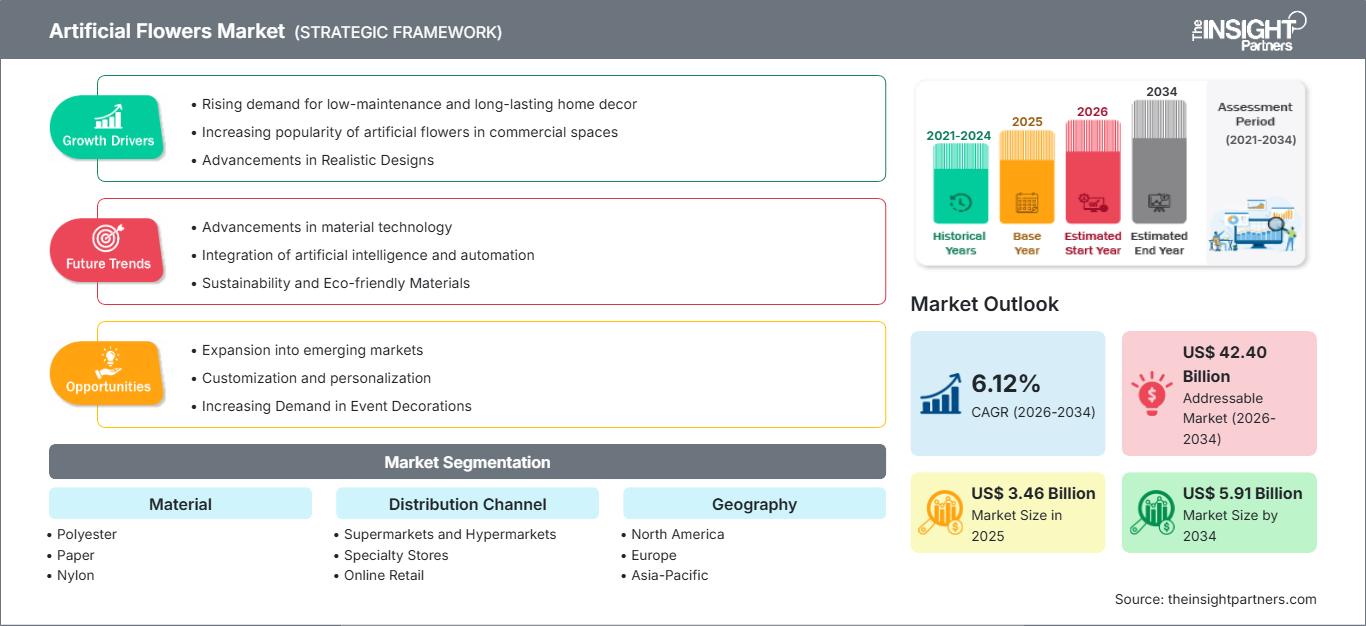
The artificial flowers market is projected to grow from US$ 3.46 Billion in 2025 to US$ 5.91 Billion by 2034; it is expected to register a CAGR of 6.12% from 2026 to 2034. Demand is supported by durable décor requirements in homes, hospitality, events, retail merchandising, and commercial interiors, where buyers prioritize realistic appearance, low maintenance, and year-round product availability.
Across North America, the artificial flowers market size is supported by mature home décor spending, high wedding and event consumption, and stronger adoption of allergy-free floral alternatives. The region is estimated to grow at a CAGR of 5.5–6.0% during 2026–2034, with online retail, craft-led personalization, and premium real-touch designs helping suppliers protect margins despite raw material cost variability.
Artificial Flowers Market Assessment and Insights
- North America: Share in 2025 is estimated at 32–35%, growing at a CAGR of 5.5–6.0% between 2026–2034. Demand is anchored by residential redecorating, event rentals, hospitality refurbishments, and higher acceptance of premium synthetic botanicals.
- US: Share of North America in 2025 is estimated at 78–82%, growing at a CAGR of 5.4–5.9% between 2026–2034. E-commerce, wedding décor, and commercial landscaping sustain repeat purchases.
- Europe: Share in 2025 is estimated at 26–29%, growing at a CAGR of 5.2–5.8% between 2026–2034. The UK, Germany, France, Italy, and Spain lead demand through retail décor, floristry supplies, and hospitality styling.
- Asia Pacific: Share in 2025 is estimated at 27–30%, growing at a CAGR of 7.0–7.6% between 2026–2034. China, India, Japan, South Korea, and Australia benefit from manufacturing scale and rising urban décor spending.
- Largest Segment: Polyester held a market share of 52–56% in 2025, with a CAGR of 5.8–6.4% between 2026–2034, reflecting durability, color retention, and high-volume production suitability.
- High Growth Segment: Online Retail held a market share of 20–24% in 2025, with a CAGR of 8.2–8.8% between 2026–2034, driven by visual merchandising, reviews, personalization, and cross-border access.
- Key companies analyzed in detail: Oriental Fine Art Co., Ltd., Kusal, Fantastic Florals, Artificial Flower Factory, Silk Flowers Decoflora, Dongguan Fusheng Arts Products Co., Ltd., Plantscape, Inc., FRS Holding S.r.l.u., Tied Ribbons Private Limited, ENDECOR.
Source: The Insight Partners' analysis based on proprietary research, government publications, company annual reports, investor presentations, industry databases, and expert interviews.
Production has shifted from basic silk-look stems toward engineered polyester, molded nylon, paper-blend accents, and mixed-material assemblies that replicate botanical texture more closely. In the artificial flowers market, suppliers increasingly combine hand finishing with automated cutting, dyeing, and packaging to improve consistency across large runs. China continues to be important for contract manufacturing, whereas specialty retailers in Europe and North America compete with curatorial abilities, customized solutions, fire-resistant plants, and speedy restocking systems.
In terms of the forecast period, there is an increasing demand from not only the seasonal decorations but also interior decorations, commercial fit-outs, and rental inventories of events. There will be an increased usage of artificial flowers due to the growing population in apartments and organized retail formats in emerging regions. There is also a regulatory tailwind of reduced allergies, fire safety documentation, and maintenance in public spaces.
Artificial Flowers Market Report Scope
| Report Attribute | Details |
|---|---|
| Market size in 2025 | US$ 3.46 Billion |
| Market Size by 2034 | US$ 5.91 Billion |
| Global CAGR (2026 - 2034) | 6.12% |
| Historical Data | 2021-2024 |
| Forecast period | 2026-2034 |
Artificial Flowers Market Analysis
The artificial flowers market growth is being shaped by practical décor economics. These industries are all seeking solutions whereby the flowers will not only survive multiple displays without the need for water but will also withstand any cold-chain transportation or loss of replacements. In domestic settings, these artificial flowers are used to decorate balconies, tables, and festivals where concerns over pollens or pets limit the use of fresh flowers.
The value chain encompasses fiber, paper, wire, pigment, glue, molding, assembling, packing, wholesaling, and merchandising. Competition is fragmented since the high-production manufacturers are competing with design specialists. Polyester still dominates as the key raw material, with paper and nylon providing the solution for premium, hand-made, and lightweight products. The reliability of lead time, color stability, and packing is more significant than price competition alone.
The competitive activity is gradually changing its direction from general catalog sales to positioning according to application, consumer type, and services. Oriental Fine Art Co., Ltd. and Dongguan Fusheng Arts Products Co., Ltd. have relevance to export-oriented production, whereas Silk Flowers Decoflora and Fantastic Florals focus on assortment for décor purchasers. The competition of Plantscape, Inc. is based on artificial landscaping systems, where code compliance and design are important.
The conducted market analysis reveals the tendency towards investment in e-commerce, professional photos of products, eco-friendly packaging, and modular designs for reuse in commercial settings. FRS Holding S.r.l.u., Tied Ribbons Private Limited, ENDECOR, Kusal, and Artificial Flower Factory are positioned according to wholesale and online retailing, and décor with value added. The differentiation would depend on design reliability, availability, and materials used.
● REPORT CUSTOMIZATION
Tailor This Report To Align With Your Specific Business Requirements
This report can be customized to align precisely with your business objectives, scope, and target markets. Customization options include tailored segmentation, geography, competitive analysis, and strategic insights to support informed decision-making.
Customize This Report →WHAT YOU CAN ADJUST
- ● Segmentations
- ● Geography
- ● Competitive Analysis
- ● Language Preferences
Artificial Flowers Market: Strategic Insights
Regional Insights
North America artificial flowers market
North America accounted for a 32–35% share in 2025 and is expected to grow at a CAGR of 5.5–6.0% during 2026–2034. The region benefits from a mature home improvement culture, high digital retail penetration, and recurring demand from weddings, corporate events, hotels, restaurants, and healthcare spaces that prefer low-maintenance, pollen-free decoration.
The artificial flowers market share in North America is also supported by commercial interiors that demand consistent visual quality across multi-site rollouts. Retailers use faux botanicals for seasonal displays, while hospitality operators value reusable arrangements that reduce labor. Premium suppliers are strengthening SKU depth in real-touch petals, UV-treated stems, and fire-rated foliage for public venues.
U.S. artificial flowers Market
The U.S. represented 78–82% of North America in 2025 and is projected to grow at a CAGR of 5.4–5.9% from 2026 to 2034. The demand for the product lies within the home décor retailers, marketplace platforms, wedding planning services, interior designers, and landscaping companies using artificial floral products within office spaces, hotels, restaurants, churches, and healthcare interiors.
The presence of the company is extensive since Plantscape, Inc. caters to the commercial greenery system and also has online stores and specialist importers that provide better access to consumers. The market is well-supported by visual commerce since buyers analyze factors like colors, sizes, density of arrangements, and even reviews before making the decision to buy.
Europe artificial flowers Market
Europe held a 26–29% share in 2025 and is anticipated to expand at a CAGR of 5.2–5.8% through 2034. The UK is a leading country, supported by strong online décor demand, event styling, garden-center merchandising, and specialty floristry suppliers that position faux blooms as reusable, practical, and premium interior accents.
There are benefits of organized retail, trade shows, and commercial interiors that appreciate durable decoration and the predictability of availability. FRS Holding S.r.l.u provides artificial flowers, plants and seasonal catalogs to cater to wholesale demand in Europe. Hospitality, boutiques, weddings, and tourism decorations drive demand in France, Italy, and Spain.
France appreciates refined floral decor; Italy promotes design-driven displays, while Spain applies UV-stable decorations for the heat. There is continuous growth despite the need to balance between cheap imports and high-quality natural appearances.
APAC artificial flowers Market
APAC accounted for a 27–30% share in 2025 and is forecast to record a CAGR of 7.0–7.6% during 2026–2034. China leads through manufacturing scale, tooling expertise, and export networks, while India expands through online décor, festival use, and value retail.
Japan, South Korea, and Australia support premium, minimalist, and home-styling demand. Industrial drivers include polymer processing, packaging capacity, and efficient small parcel logistics. Policy focuses on manufacturing competitiveness, digital commerce, and urban infrastructure, which indirectly supports the market by expanding retail reach and commercial interior investments.
Middle East & Africa artificial flowers Market
The Middle East & Africa is expected to grow at a CAGR of 5.8–6.4% between 2026 and 2034. Saudi Arabia and the UAE lead regional demand as hospitality, airport, retail, and entertainment infrastructure projects require reliable decorative products that tolerate heat, dust, and frequent public use.
South Africa and the Rest of MEA show selective adoption through malls, hotels, events, and household décor. Energy-led construction cycles and tourism investment influence procurement. Artificial floral installations are favored in climate-controlled interiors where maintenance costs, water conservation, and consistent appearance are key purchasing considerations.
Segmentation Analysis
Material
The Material segment is projected to grow at a CAGR of 5.9–6.5% during 2026–2034. The market scope across materials is defined by durability, finish, flexibility, price, and environmental positioning. Polyester is the mass-market standard, paper supports craft and sustainable aesthetics, and nylon is used where lightweight texture and form retention are needed.
- Polyester: Polyester dominates due to strength, colorfastness, affordable scalability, and compatibility with mass dyeing, cutting, and molding processes across bouquets, garlands, wreaths, event displays, and retail décor.
- Paper: Paper appeals to craft-led, recyclable, and handmade décor categories where texture, custom color, and artisanal presentation matter, especially for events, gifting, displays, and seasonal visual merchandising.
- Nylon: Nylon supports lightweight petals, flexible shaping, and soft visual effects, making it useful in premium stems, decorative sprays, and arrangements requiring movement, translucence, and fine detailing.
Distribution Channel
The Distribution Channel segment is forecast to grow at a CAGR of 6.3–6.9% from 2026 to 2034. Channel performance depends on buyer intent, urgency, visual evaluation, and assortment breadth. Supermarkets and hypermarkets serve impulse and seasonal shoppers, specialty stores provide design guidance, and online retail expands choice, comparison, and direct-to-consumer customization.
- Supermarkets and Hypermarkets: Supermarkets and Hypermarkets capture seasonal, festival, and household impulse purchases, supported by visible displays, bundled décor themes, and affordable, ready-made arrangements for value-conscious consumers.
- Specialty Stores: Specialty Stores remain important for curated designs, floristry supplies, premium stems, and professional guidance, serving interior designers, event planners, and customers seeking realistic arrangements.
- Online Retail: Online Retail is scaling rapidly because shoppers can compare styles, read reviews, access niche designs, and purchase customized combinations beyond local store inventory.
Opportunity Snapshot
| Material | Revenue Contribution | Trend Tag | Adoption Stage |
| Polyester | High | Real Touch | Mature |
| Paper | Medium | Eco Craft | Scaling |
| Nylon | Medium | Soft Finish | Scaling |
| Supermarkets and Hypermarkets | Medium | Seasonal Bundles | Mature |
| Specialty Stores | High | Curated Design | Mature |
| Online Retail | High | Visual Commerce | Scaling |
Artificial Flowers Market Growth Drivers and Impact Analysis
Commercial Interiors Seeking Durable Decorative Assets
Hotels, restaurants, malls, clinics, airport lounges, and offices increasingly treat floral décor as a repeat-use asset rather than a disposable purchase. This changes procurement priorities toward durability, cleanability, fire documentation, and consistent replacement availability. The artificial flowers market benefits because synthetic arrangements help facilities reduce plant care labor, avoid pollen-related complaints, and maintain consistent aesthetics across locations. Commercial buyers also favor modular installations that can be refreshed seasonally by replacing selected stems rather than full arrangements. As facility managers align décor budgets with operational efficiency, suppliers offering specification sheets, project support, and design consistency are likely to win larger contracts.
Expansion of Online Visual Merchandising
Digital retail is reshaping how buyers evaluate synthetic florals. High-resolution images, lifestyle photography, video demonstrations, user reviews, and size comparison tools reduce uncertainty around petal texture, color, and arrangement volume. This improves conversion for higher-value bouquets and decorative installations that were previously purchased mainly through stores. The shift also allows smaller specialists to reach national and cross-border customers without heavy physical retail footprints. In the artificial flowers market, online visibility supports long-tail assortments, wedding color matching, seasonal launches, and bundle selling. Sellers who invest in accurate photography and packaging protection can reduce returns and improve buyer trust.
Preference for Allergy-Free and Low-Maintenance Décor
Manmade floral solutions respond to the practical challenges that arise in cases where live flowers generate allergies, odors, water problems, pests, or maintenance difficulties. Places such as hospitals, homes for elderly people, schools, workplaces, and the hospitality industry require decoration options that can withstand time without requiring daily care. Families require decoration options where the presence of pets, travel, or poor lighting conditions may pose challenges when using fresh plant options. This creates an opportunity for the ongoing demand of high-quality artificial decorations that are easy to clean and rearrange.
Artificial Flowers Market Future Trends
Material Innovation and Bio-Based Finishes
Artificial flowers market trends are expected to move toward recyclable substrates, lower-odor adhesives, bio-based coatings, and mixed-material designs that improve realism while reducing environmental concerns. There is an increasing sensitivity among buyers regarding product life cycle, packaging wastage, and disposal of products, especially in Europe and high-end retail stores. Future product development is expected to concentrate on detachable stems, recyclable packaging, botanical-like fibers, and water-based color technology. These changes will not make polyester disappear from the market straightaway, but will give rise to premium levels for brands that can combine durability, botanical, and sustainable claims with specific materials.
Design-Led Customization for Events and Interiors
There will be greater emphasis on custom flower styling as customers and businesses require arrangements that complement color schemes, interior designs, wedding ideas, and branded interiors. Configurators, themed collections, and stem systems will provide buyers the flexibility to choose sizes, colors, vases, and seasonal substitutes. This particular trend will work well for companies that have high-quality photography skills and good design sense. In view of the experience-driven nature of modern interiors, there is potential for artificial flower products to be employed not just as decorations but also as a flexible visual layer.
Artificial Flowers Market Opportunities
Premium Hospitality and Retail Fit-Out Programs
Large-scale refurbishment programs in hotels, restaurants, luxury stores, airports, and mixed-use developments create opportunities for specification-grade artificial floral systems. Buyers in these environments need predictable appearance, replacement continuity, and safety documentation across multiple sites. The artificial flowers market Forecasts indicate that vendors offering design consultation, sampling, installation guidance, and maintenance manuals can move beyond transactional sales into project-based revenue. Manufacturers should build collections around lobbies, table settings, exterior planters, retail windows, and event zones. Partnerships with architects, facility managers, and procurement agencies can improve access to recurring commercial budgets.
Cross-Border Online Retail and Regional Localization
Cross-border e-commerce offers the possibility for producers and specialty retailers to gauge demand in a region without having to establish numerous stores there. The most lucrative option is to have a product range that is suited to the climatic conditions, festivities, housing, and decoration preferences. While warmer regions might like colors that are UV-resistant, more urban buyers living in apartments might go for small arrangements and wall decorations. Producers can increase their profit margins by using local language, timely deliveries, packaging, and return policies. For the floral business, artificial flowers brands will use data on how customers behave during searches, ratings, and repeat buys.
Frequently Asked Questions

- Comprehensive Market Sizing and Forecast Analysis
- Detailed Segmentation Analysis
- In-Depth Market Dynamics Assessment
- Regional and Country-Level Insights
- Competitive Landscape and Company Benchmarking
- Strategic Business Intelligence
Recent Reports
Testimonials

The Insight Partners provided valuable market intelligence that supported our global go-to-market strategy. Their team was professional, responsive, and attentive to our feedback, providing thoughtful analysis and helpful methodological clarifications throughout the project.
Junmo Kim Chief Financial Officer (CFO), Enertech Co., Ltd.
The Insight Partners' SCADA System Market report is comprehensive, with valuable insights on current trends and future forecasts. The team was highly professional, responsive, and supportive throughout. We are very satisfied and highly recommend their services.
RAN KEDEM Partner, Reali Technologies LTDs
I requested a report on a very specific software market and the team produced the report in a few days. The information was very relevant and well presented. I then requested some changes and additions to the report. The team was again very responsive and I got the final report in less than a week.
JEAN-HERVE JENN Chairman, Future Analytica
We worked with The Insight Partners for an important market study and forecast. They gave us clear insights into opportunities and risks, which helped shape our plans. Their research was easy to use and based on solid data. It helped us make smart, confident decisions. We highly recommend them.
PIYUSH NAGPAL Sr. Vice President, High Beam Global
The Insight Partners delivered insightful, well-structured market research with strong domain expertise. Their team was professional and responsive throughout. The user-friendly website made accessing industry reports seamless. We highly recommend them for reliable, high-quality research services
YUKIHIKO ADACHI CEO, Deep Blue, LLC.
This is the first time I have purchased a market report from The Insight Partners.While I was unsure at first, I visited their web site and felt more comfortable to take the risk and purchase a market report.I am completely satisfied with the quality of the report and customer service. I had several questions and comments with the initial report, but after a couple of dialogs over email with their analyst I believe I have a report that I can use as input to our strategic planning process.Thank you so much for taking the extra time and making this a positive experience.I will definitely recommend your service to others and you will be my first call when we need further market data.
JOHN SUZUKI President and Chief Executive Officer, Board Director, BK Technologies
I wish to appreciate your support and the professionalism you displayed in the course of attending to my request for information regarding to infectious disease IVD market in Nigeria. I appreciate your patience, your guidance, and the fact that you were willing to offer a discount, which eventually made it possible for us to close a deal. I look forward to engaging The Insight Partners in the future, all thanks to the impression you have created in me as a result of this first encounter.
DR CHIJIOKE ONYIA MANAGING DIRECTOR, PineCrest Healthcare Ltd.Reason to Buy
- Informed Decision-Making
- Understanding Market Dynamics
- Competitive Analysis
- Identifying Emerging Markets
- Customer Insights
- Market Forecasts
- Risk Mitigation
- Boosting Operational Efficiency
- Strategic Planning
- Investment Justification
- Tracking Industry Innovations
- Aligning with Regulatory Trends





 Get Free Sample for