
Asia Pacific Courier Express and Parcel Market Analysis and Forecast by Size, Share, Growth, Trends 2034
Coverage: By Business Type (B2C, B2B, and C2C), Destination (Domestic and International), and End User (BFSI, Retail, Manufacturing and Construction, Agriculture, and Others)
- Status : Published
- Report Code : TIPRE00043725
- Category : Automotive and Transportation
- No. of Pages : 172
- Available Report Formats :


- Last update date : July 23, 2026


2025 Market Size
US$ 358.2 Bn
Base year value
2034 Forecast
US$ 713.5 Bn
Projected by 2034
CAGR 2026-2034
8.2 %
Growth rate
Addressable Market
US$ 4,880.43 Bn
(2026-2034)
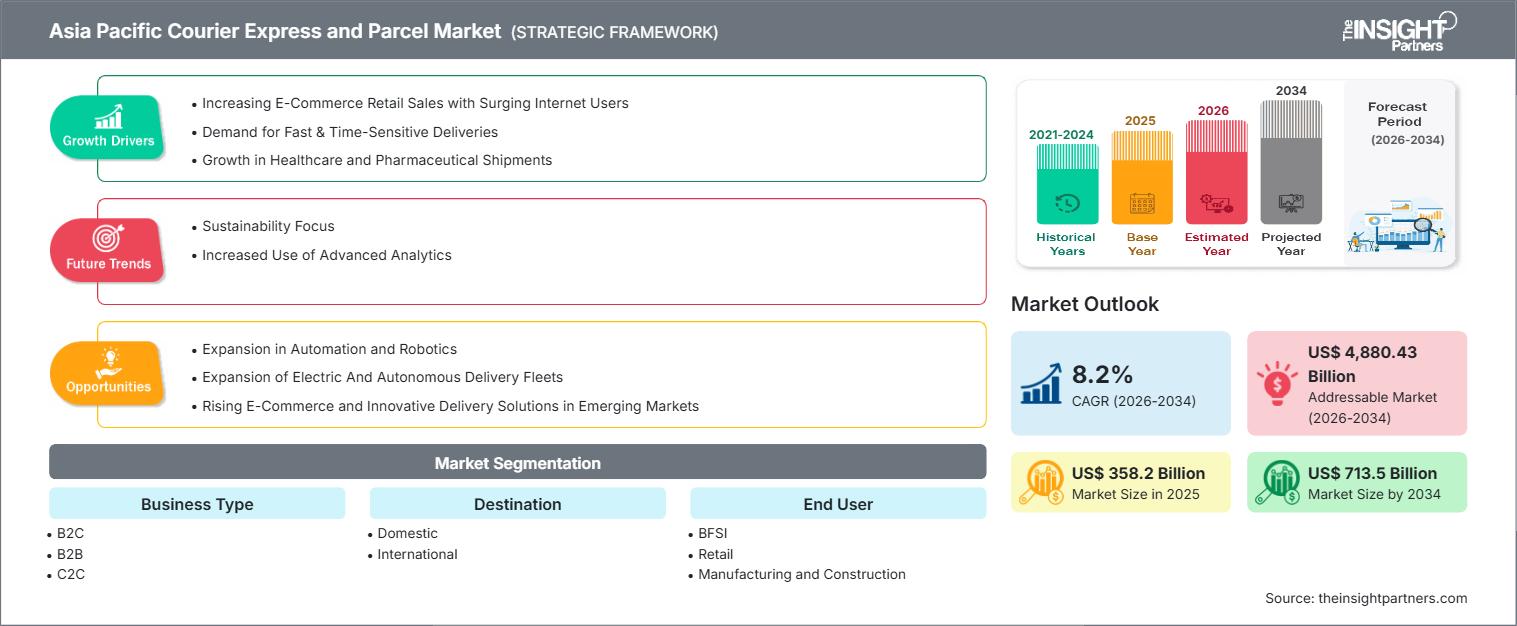
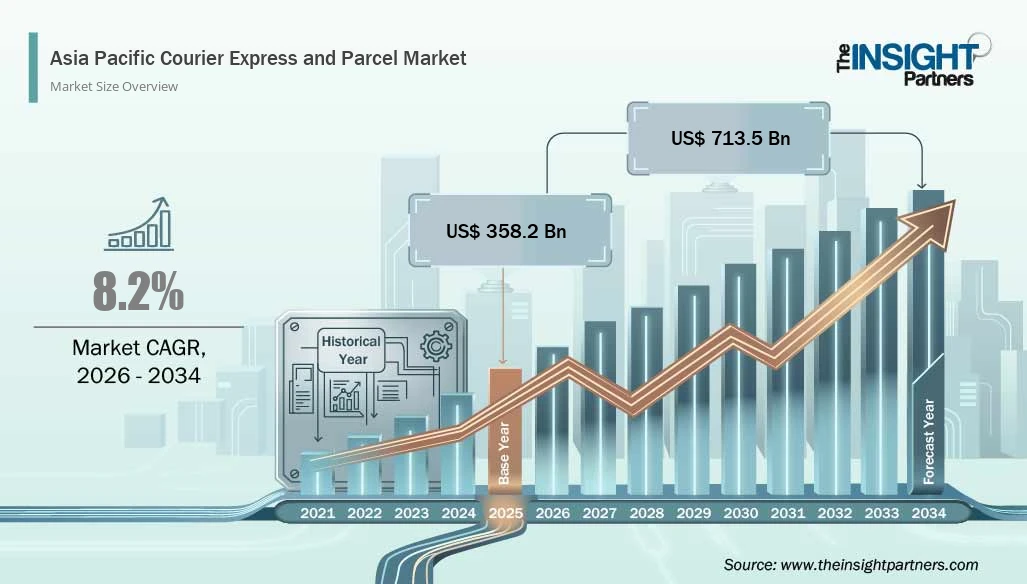
The Asia Pacific Courier Express and Parcel Market size is expected to reach US$ 713.5 Billion by 2034 from US$ 358.2 Billion in 2025. The market is estimated to record a CAGR of 8.2% from 2026 to 2034.
Executive Summary and Asia Pacific Courier Express and Parcel Market Analysis:
The CEP sector in Asia Pacific experiences booming growth, particularly in China and India, driven by e-commerce and global shipping strategies during 2023-2026. In China, rapid parcel volume increases prompt investments in route planning and cybersecurity, paralleling global trends of optimization. Companies adopt AI for dynamic networks, reducing empty runs and enhancing transshipment efficiency.
India is observing a rising demand for courier dispatch, with process flows emphasizing packaging, tracking, and last-mile visibility via software such as Mojro's AI tools for address resolution and vehicle utilization. Japan, South Korea, Australia, and the Rest of Asia Pacific leverage tech for parcel management, focusing on cost-efficient bulk deliveries amid industry expansion. Beumer's outlook applies here, with operators balancing speed and sustainability through data-connected operations.
Recent pointers include China's 2024 reports on parcel surges requiring resilient networks, and India's push for automation in delivery phases to handle e-commerce peaks. PTV aids in real-time ETAs and ePOD for customer trust across the region. Global strategies stress international reach, with AI forecasting stabilizing volatile small parcel flows. The rest of Asia Pacific benefits from shared data models for adaptive routing and hence drives the market growth in the coming years.
● REPORT CUSTOMIZATION
Tailor This Report To Align With Your Specific Business Requirements
This report can be customized to align precisely with your business objectives, scope, and target markets. Customization options include tailored segmentation, geography, competitive analysis, and strategic insights to support informed decision-making.
Customize This Report →WHAT YOU CAN ADJUST
- ● Segmentations
- ● Geography
- ● Competitive Analysis
- ● Language Preferences
Asia Pacific Courier Express and Parcel Market: Strategic Insights
-
Get Top Key Market Trends of this report.This FREE sample will include data analysis, ranging from market trends to estimates and forecasts.
Asia Pacific Courier Express and Parcel Market Segmentation Analysis:
- By Business Type, the Asia Pacific Courier Express and Parcel Market is segmented into B2C, B2B, and C2C. The B2C segment dominated the market in 2025.
- By Destination, the Asia Pacific Courier Express and Parcel Market is segmented into Domestic and International. The Domestic segment dominated the market in 2025.
- By End User, the Asia Pacific Courier Express and Parcel Market is segmented into BFSI, Retail, Manufacturing and Construction, Agriculture, and Others. The Retail segment dominated the market in 2025.
Asia Pacific Courier Express and Parcel Market Report Scope
| Report Attribute | Details |
|---|---|
| Market size in 2025 | US$ 358.2 Billion |
| Market Size by 2034 | US$ 713.5 Billion |
| CAGR (2026 - 2034) | 8.2% |
| Historical Data | 2021-2024 |
| Forecast period | 2026-2034 |
| Segments Covered |
By Business Type
|
| Regions and Countries Covered |
Asia Pacific
|
| Market leaders and key company profiles |
|
Asia Pacific Courier Express and Parcel Market Players Density: Understanding Its Impact on Business Dynamics
The Asia Pacific Courier Express and Parcel Market is growing rapidly, driven by increasing end-user demand due to factors such as evolving consumer preferences, technological advancements, and greater awareness of the product's benefits. As demand rises, businesses are expanding their offerings, innovating to meet consumer needs, and capitalizing on emerging trends, which further fuels market growth.
Asia Pacific Courier Express and Parcel Market Outlook
With increasing parcel volumes driven by e-commerce and the growing demand for fast, time-sensitive deliveries, logistics companies are exploring innovative technologies to enhance efficiency, reduce costs, and support sustainability initiatives. Electric vehicles (EVs), drones, and autonomous delivery vehicles are at the forefront of this transformation, particularly for last-mile operations in densely populated urban areas.
Adoption of electric delivery vehicles helps CEP companies address environmental impact and rising fuel costs. EVs produce lower emissions compared to traditional diesel or petrol vehicles, aligning with global regulations and corporate sustainability goals. Leading logistics providers are investing in EV fleets to reduce their carbon footprint while maintaining reliable delivery schedules. Urban delivery routes with frequent stops are well-suited for electric vans, which are quieter, cleaner, and cheaper to operate over time.
Autonomous delivery technologies, including self-driving vans and drones, offer additional efficiency gains. Drones can bypass traffic congestion, delivering small parcels quickly in dense city environments. Autonomous ground vehicles can operate continuously, reducing dependency on human drivers. These technologies improve delivery speed and help CEP companies overcome challenges such as labor shortages and rising wage costs.
Electric and autonomous fleets provide opportunities for cost optimization. Reduced fuel consumption, lower maintenance requirements, and automated operations help companies manage operational expenses while meeting growing consumer expectations for same-day and next-day delivery.
The expansion of electric and autonomous delivery fleets is reshaping last-mile logistics by combining speed, efficiency, and sustainability. As technology continues to mature, these innovations are expected to become a standard component of modern CEP operations, thereby minimizing environmental impact and enhancing delivery reliability in urban markets.
Asia Pacific Courier Express and Parcel Market Country Insights
By country, the Asia Pacific Courier Express and Parcel Market is segmented into Australia, China, India, Japan, South Korea, and the Rest of APAC. China held the largest share in 2025.
China's comprehensive courier, express, and parcel ecosystem achieved unprecedented scale throughout 2024-2025, fundamentally supporting national e-commerce platforms representing the world's largest consumer marketplace. Ministry of Industry and Information Technology authoritative postal administration reports documented Beijing and Shanghai mega-distribution complexes sorting 152 billion individual parcels annually through sophisticated 41,000-kilometer high-speed rail integration, facilitating just-in-time inventory replenishment. Rural express fulfillment penetration expanded dramatically to 52 billion packages supported by the strategic opening of 5,100 regional airports, bridging urban-rural logistics disparities.
Singular Double 11 promotional campaign generated record-breaking 2.1 billion daily parcel processing peaks throughout 2025, rigorously testing national fulfillment capacity limits while validating sophisticated demand forecasting capabilities. Nationwide tracking penetration attained 92% coverage across a 1.4 billion population base through integrated Cainiao Network coordination platform dominance.
Asia Pacific Courier Express and Parcel Market Company Profiles
Some of the key players operating in the market include United Parcel Service Inc., FedEx Corp., Koninklijke PostNL B.V., Amazon.com Inc., Deutsche Post AG, Dragonfly (Intelcom), General Logistics Systems BV, Purolator Inc., Lone Star Overnight LLC, and Canpar Express Inc.
These players are adopting various strategies such as expansion, product innovation, and mergers and acquisitions to provide innovative products to their consumers and increase their market share.
Asia Pacific Courier Express and Parcel Market Research Methodology
The following methodology has been followed for the collection and analysis of data presented in this report:
Secondary Research
The research process begins with comprehensive secondary research, utilizing internal and external sources to gather qualitative and quantitative data for each market. Commonly referenced secondary research sources include, but are not limited to:
- Company websites, annual reports, financial statements, broker analyses, and investor presentations
- Industry trade journals and other relevant publications
- Government documents, statistical databases, and market reports
- News articles, press releases, and webcasts specific to companies operating in the market
Note: All financial data included in the Company Profiles section has been standardized to US$. For companies reporting in other currencies, figures have been converted to US$ using the relevant exchange rates for the corresponding year.
Primary Research
The Insight Partners conducts a significant number of primary interviews each year with industry stakeholders and experts to validate its data analysis and gain valuable insights. These research interviews are designed to:
- Validate and refine findings from secondary research
- Enhance the expertise and market understanding of the analysis team
- Gain insights into market size, trends, growth patterns, competitive dynamics, and future prospects
Primary research is conducted via email interactions and telephone interviews, encompassing various markets, categories, segments, and sub-segments across different regions. Participants typically include:
- Industry stakeholders: Vice Presidents, Business Development Managers, Market Intelligence Managers, and National Sales Managers
- External experts: Valuation specialists, research analysts, and key opinion leaders with industry-specific expertise

- Comprehensive Market Sizing and Forecast Analysis
- Detailed Segmentation Analysis
- In-Depth Market Dynamics Assessment
- Regional and Country-Level Insights
- Competitive Landscape and Company Benchmarking
- Strategic Business Intelligence
Recent Reports
Testimonials

The Insight Partners' SCADA System Market report is comprehensive, with valuable insights on current trends and future forecasts. The team was highly professional, responsive, and supportive throughout. We are very satisfied and highly recommend their services.
RAN KEDEM Partner, Reali Technologies LTDs
I requested a report on a very specific software market and the team produced the report in a few days. The information was very relevant and well presented. I then requested some changes and additions to the report. The team was again very responsive and I got the final report in less than a week.
JEAN-HERVE JENN Chairman, Future Analytica
We worked with The Insight Partners for an important market study and forecast. They gave us clear insights into opportunities and risks, which helped shape our plans. Their research was easy to use and based on solid data. It helped us make smart, confident decisions. We highly recommend them.
PIYUSH NAGPAL Sr. Vice President, High Beam Global
The Insight Partners delivered insightful, well-structured market research with strong domain expertise. Their team was professional and responsive throughout. The user-friendly website made accessing industry reports seamless. We highly recommend them for reliable, high-quality research services
YUKIHIKO ADACHI CEO, Deep Blue, LLC.
This is the first time I have purchased a market report from The Insight Partners.While I was unsure at first, I visited their web site and felt more comfortable to take the risk and purchase a market report.I am completely satisfied with the quality of the report and customer service. I had several questions and comments with the initial report, but after a couple of dialogs over email with their analyst I believe I have a report that I can use as input to our strategic planning process.Thank you so much for taking the extra time and making this a positive experience.I will definitely recommend your service to others and you will be my first call when we need further market data.
JOHN SUZUKI President and Chief Executive Officer, Board Director, BK Technologies
I wish to appreciate your support and the professionalism you displayed in the course of attending to my request for information regarding to infectious disease IVD market in Nigeria. I appreciate your patience, your guidance, and the fact that you were willing to offer a discount, which eventually made it possible for us to close a deal. I look forward to engaging The Insight Partners in the future, all thanks to the impression you have created in me as a result of this first encounter.
DR CHIJIOKE ONYIA MANAGING DIRECTOR, PineCrest Healthcare Ltd.Reason to Buy
- Informed Decision-Making
- Understanding Market Dynamics
- Competitive Analysis
- Identifying Emerging Markets
- Customer Insights
- Market Forecasts
- Risk Mitigation
- Boosting Operational Efficiency
- Strategic Planning
- Investment Justification
- Tracking Industry Innovations
- Aligning with Regulatory Trends





 Get Free Sample for