
Asia Pacific Medical Aesthetics Market Overview and Growth by 2028
Asia Pacific Medical Aesthetics Market Forecast to 2028 - Regional Analysis By Product Type (Facial Aesthetic Products, Cosmetic Implants, Body Contouring Devices, Skin Aesthetic Devices, Hair Removal Devices, Tattoo Removal Devices, and Others), Application (Facial and Body Contouring, Facial and Skin Rejuvenation, Breast Augmentation, Hair Removal, Reconstructive Surgery, Tattoo Removal, and Others), and End User (Hospitals, Dermatology Clinics, Medical Spas and Beauty Centers, and Home Care)
- Status : Published
- Report Code : TIPRE00025332
- Category : Life Sciences
- No. of Pages : 318
- Available Report Formats :


- Last update date : April 17, 2023


2022 Market Size
US$ 7,058.31 Mn
Base year value
2028 Forecast
US$ 15,729.12 Mn
Projected by 2028
CAGR 2023-2028
14.3 %
Growth rate
Addressable Market
US$ 69,385.10 Mn
(2023-2028)
The asia pacific medical aesthetics market was valued at US$ 7,058.31 million in 2022 and projected to reach US$ 15,729.12 million by 2028; it is estimated to record a CAGR of 14.3% from 2022 to 2028.
Growing adoption of minimally invasive and non-invasive aesthetic procedures and increasing use of dermal fillers and botulinum toxin for enhancing facial aesthetics are a few factors driving the medical aesthetics market growth.
Increasing use of dermal fillers and botulinum toxin for enhancing facial aesthetics drives the overall market growth. Over the past two decades, there has been an unprecedented surge in the popularity of elective aesthetic procedures. Moreover, there is an increasing demand for less invasive aesthetic procedures such as dermal fillings and botulinum toxin A (BoNTA) in Japan, India, South Korea, China, and other Asian countries. Increased awareness about good looks and wellness, a rise in economic instability, and a surge in the demographic of people seeking plastic surgery are a few factors attributing to the demand for medical aesthetics in emerging Asian countries.
The correction of facial rhythm and loss of volume is the basic principle of aesthetic rejuvenation of the face. Botulinum toxin injections are primarily indicated to correct dynamic rhytides, while dermal fillers aim to increase volume and improve static rhytides. Botulinum toxin, a powerful neurotoxin, causes chemodenervation of muscles. Dermal fillers are a non-energy-based procedure that adds volume and fullness to a person's skin. Cost-effectiveness and rise in the aging population are the key factors driving the demand for dermal fillers across Asia Pacific.
Further, the surge in demand for superior materials and techniques required for dental aesthetics procedures has increased research activities. However, nonsurgical facial aesthetic procedures received less attention from the dental community until chemicals such as hyaluronic acid fillers and botulinum toxin were requested by patients, which led dental manufacturers to add these materials to their catalogs and advertisements. Facial rejuvenation has become a major issue of psychosocial well-being in this era of fashion, beauty, and trends. Thus, the increasing use of dermal fillers and botulinum toxin for enhancing facial aesthetics is fueling the medical aesthetics market growth.
Customize This Report To Suit Your Requirement
You will get customization on any report - free of charge - including parts of this report, or country-level analysis, Excel Data pack, as well as avail great offers and discounts for start-ups & universities
Asia Pacific Medical Aesthetics Market: Strategic Insights
-
Market Size 2022
US$ 7,058.31 Million -
Market Size 2023-2028
US$ 15,729.12 Million

Market Dynamics
- XXXXXXX
- XXXXXXX
- XXXXXXX
- XXXXXXX
- XXXXXXX
- XXXXXXX
- XXXXXXX
- XXXXXXX
- XXXXXXX
Regional Overview
- Asia-Pacific
Market Segmentation
 Product Type
- Facial Aesthetic Products
- Cosmetic Implants
- Body Contouring Devices
- Skin Aesthetic Devices
- Hair Removal Devices
- Tattoo Removal Devices
 Application
- Facial and Body Contouring
- Facial and Skin Rejuvenation
- Breast Augmentation
- Hair Removal
- Reconstructive Surgery
- Tattoo Removal
 End User
- Hospitals
- Dermatology Clinics
- Medical Spas and Beauty Centers
- Home Care
-
Get Top Key Market Trends of this report.This FREE sample will include data analysis, ranging from market trends to estimates and forecasts.
Application Segment Insight
Based on application, the medical aesthetics market is segmented into oncology, inflammatory & infectious disease, autoimmune disorders, metabolic disorders, hormonal disorders & growth failure, cardiovascular diseases, neurological diseases, and others. The oncology segment held the largest share of the market in 2022. However, the inflammatory and infectious diseases segment is expected to register the highest CAGR during the forecast period. According to the National Institute of Health (NIH) report, cancer is a complex invasive genetic disease-causing significant mortality globally. For example, protein-based medical aesthetics have significantly extended the lives of millions of cancer patients. Further, various top companies entered a research collaboration for developing novel therapeutics-based targeted protein-based technology for cancer treatment. For instance, in April 2022, Ubix Therapeutics announced a collaboration with SK medical aesthetics to develop new compounds and medicines through Ubix's Degraducer technology for cancer treatment. Such aforementioned factors are responsible for the segment growth, thereby contributing to the market growth of medical aesthetics during the forecast period.
Market Opportunity
Significant Growth Opportunities in Developing Countries
Health systems in developing economies are focusing on introducing various advanced medical aesthetic technologies into their service portfolios. Many of these countries are at the center of medical tourism. Patients from developed regions travel to emerging countries in Asia Pacific for various medical aesthetic procedures. Health facilities, medical spas, and wellness centers are increasingly offering a comprehensive range of inexpensive but high-quality medical aesthetic procedures. The rising spending on cosmetic and rejuvenation procedures to improve aesthetics is rapidly increasing among the population of Asia Pacific.
Developing countries such as Bhutan, Nepal, Sri Lanka, Taiwan, and Mongolia are likely to offer vital growth opportunities for the medical aesthetic market. The factors that are likely to serve as growth opportunities for these countries are increasing awareness of minimally invasive treatments and acceptance of aesthetic procedures in the population, growing awareness of physical appearance, increasing incidence of skin diseases, growing geriatric population, and rising availability and acceptance of technologically advanced medical devices.
Further, growing healthcare spending in developing economies in Asia Pacific enables healthcare professionals to adopt advanced technologies for performing cosmetic procedures. Apart from the above-mentioned factors, rapid urbanization, increasing investments by healthcare providers in improving infrastructure, growing awareness among the population, and a wide range of advanced products and technologies are a few factors that are acting as growth opportunities for the medical aesthetic market in developing Asian countries.
End User Insights
Based on end user, the medical aesthetics market is segmented into hospitals, dermatology clinics, medical spas and beauty centers, and home care. The hospitals segment held the largest market share in 2022 and is anticipated to register a significant CAGR during the forecast period. The beauty & aesthetic industry has grown significantly in the recent past. Cosmetic procedures carried out in aesthetic clinics and hospitals are likely to become the main contributors to the wellness industry worldwide. Exposure to global trends, increasing disposable incomes, and changing lifestyles are among the common factors that are resulting in the increasing number of visits to these institutes, followed by the growing number of procedures being performed. Cosmetic treatments are known to have a major impact on the confidence and self-image of the people seeking those treatments, and this factor can continue to boost the popularity of various cosmetic enhancement procedures, such as nose jobs and breast enhancements, in the coming years. These procedures are safely conducted and do not require long waiting as well as recovery time. Moreover, the procedures can easily be performed multiple times in the outpatient facilities to discover ways to increase their product's effectiveness and efficiency with the new concept that will shape the market. Such aforementioned factors are responsible for the segment growth, thereby fueling the medical aesthetics market.
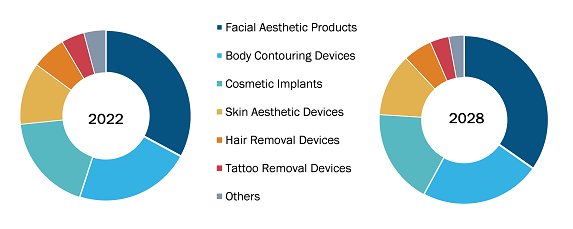
Medical Aesthetics Market, by Product Type – 2022 and 2028
- This FREE sample will include data analysis, ranging from market trends to estimates and forecasts.
Medical Aesthetics Market – Segmentation
Based on product type, the medical aesthetics market is segmented into monoclonal antibodies, recombinant vaccines, conventional vaccines, recombinant growth factors, purified proteins, recombinant proteins, recombinant hormones, recombinant enzymes, cell & gene therapies, cytokines/interferon/interleukins, and others. Based on application, the medical aesthetics market is segmented into facial and body contouring, facial and skin rejuvenation, breast augmentation, hair removal, reconstructive surgery, tattoo removal and others. Based on end user, the market is segmented as hospitals, dermatology clinics, medical spas and beauty centers and home care. Based on country, the medical aesthetics market in Asia Pacific is segmented into China, India, Japan, Australia, South Korea, Indonesia, Singapore, Thailand, the Philippines, Vietnam, and the Rest of APAC.
A few of the leading companies operating in the medical aesthetics market are AbbVie Inc, Bausch Health Co Inc, Lumenis Be Ltd, ARC Laser Gmbh, Alma Lasers Ltd, El.En. SPA, Crown Laboratories Inc, Merz Pharma GmbH & Co KgaA, Quanta System SpA, Galderma SA, Venus Concept Inc, PharmaResearch Co Ltd, andNeoasia (S) Pte Ltd.
Asia Pacific Medical Aesthetics Market Report Scope
| Report Attribute | Details |
|---|---|
| Market size in 2022 | US$ 7,058.31 Million |
| Market Size by 2028 | US$ 15,729.12 Million |
| CAGR (2022 - 2028) | 14.3% |
| Historical Data | 2020-2021 |
| Forecast period | 2023-2028 |
| Segments Covered |
By Product Type
|
| Regions and Countries Covered |
Asia-Pacific
|
| Market leaders and key company profiles |
|
Frequently Asked Questions

- Comprehensive Market Sizing and Forecast Analysis
- Detailed Segmentation Analysis
- In-Depth Market Dynamics Assessment
- Regional and Country-Level Insights
- Competitive Landscape and Company Benchmarking
- Strategic Business Intelligence
Recent Reports
Testimonials

The Insight Partners' SCADA System Market report is comprehensive, with valuable insights on current trends and future forecasts. The team was highly professional, responsive, and supportive throughout. We are very satisfied and highly recommend their services.
RAN KEDEM Partner, Reali Technologies LTDs
I requested a report on a very specific software market and the team produced the report in a few days. The information was very relevant and well presented. I then requested some changes and additions to the report. The team was again very responsive and I got the final report in less than a week.
JEAN-HERVE JENN Chairman, Future Analytica
We worked with The Insight Partners for an important market study and forecast. They gave us clear insights into opportunities and risks, which helped shape our plans. Their research was easy to use and based on solid data. It helped us make smart, confident decisions. We highly recommend them.
PIYUSH NAGPAL Sr. Vice President, High Beam Global
The Insight Partners delivered insightful, well-structured market research with strong domain expertise. Their team was professional and responsive throughout. The user-friendly website made accessing industry reports seamless. We highly recommend them for reliable, high-quality research services
YUKIHIKO ADACHI CEO, Deep Blue, LLC.
This is the first time I have purchased a market report from The Insight Partners.While I was unsure at first, I visited their web site and felt more comfortable to take the risk and purchase a market report.I am completely satisfied with the quality of the report and customer service. I had several questions and comments with the initial report, but after a couple of dialogs over email with their analyst I believe I have a report that I can use as input to our strategic planning process.Thank you so much for taking the extra time and making this a positive experience.I will definitely recommend your service to others and you will be my first call when we need further market data.
JOHN SUZUKI President and Chief Executive Officer, Board Director, BK Technologies
I wish to appreciate your support and the professionalism you displayed in the course of attending to my request for information regarding to infectious disease IVD market in Nigeria. I appreciate your patience, your guidance, and the fact that you were willing to offer a discount, which eventually made it possible for us to close a deal. I look forward to engaging The Insight Partners in the future, all thanks to the impression you have created in me as a result of this first encounter.
DR CHIJIOKE ONYIA MANAGING DIRECTOR, PineCrest Healthcare Ltd.Reason to Buy
- Informed Decision-Making
- Understanding Market Dynamics
- Competitive Analysis
- Identifying Emerging Markets
- Customer Insights
- Market Forecasts
- Risk Mitigation
- Boosting Operational Efficiency
- Strategic Planning
- Investment Justification
- Tracking Industry Innovations
- Aligning with Regulatory Trends





 Get Free Sample for