
Spinal Cord Stimulation Devices Market Trends, Size & Growth by 2034
Coverage: By Product Type (Rechargeable And Non-Rechargeable), Application (Failed Back Surgery Syndrome, Complex Regional Pain Syndrome, Degenerative Disk Diseases, and Others), End User (Hospitals, Ambulatory Surgery Centers, and Others), and Geography (North America, Europe, Asia Pacific, Middle East and Africa, and South and Central America)
- Status : Published
- Report Code : TIPRE00043149
- Category : Life Sciences
- No. of Pages : 244
- Available Report Formats :


- Last update date : May 29, 2026


2025 Market Size
US$ 3.43 Bn
Base year value
2034 Forecast
US$ 6.73 Bn
Projected by 2034
CAGR 2026-2034
7.8 %
Growth rate
Addressable Market
US$ 45.79 Bn
(2026-2034)
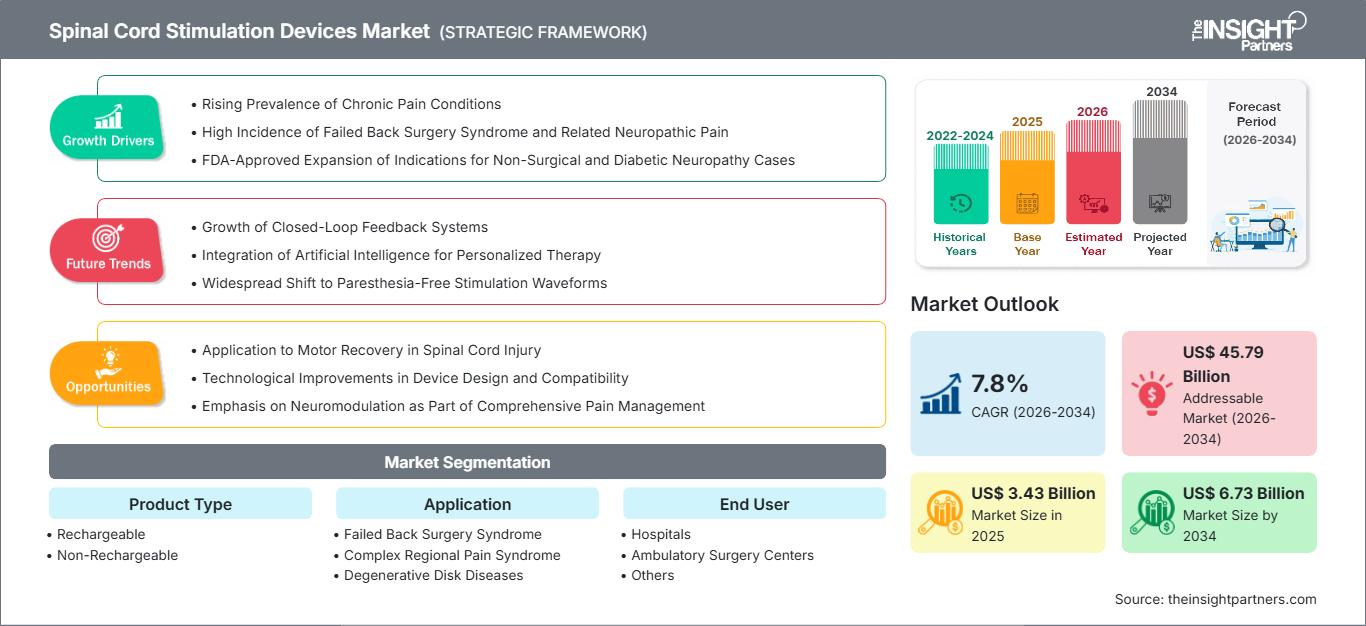
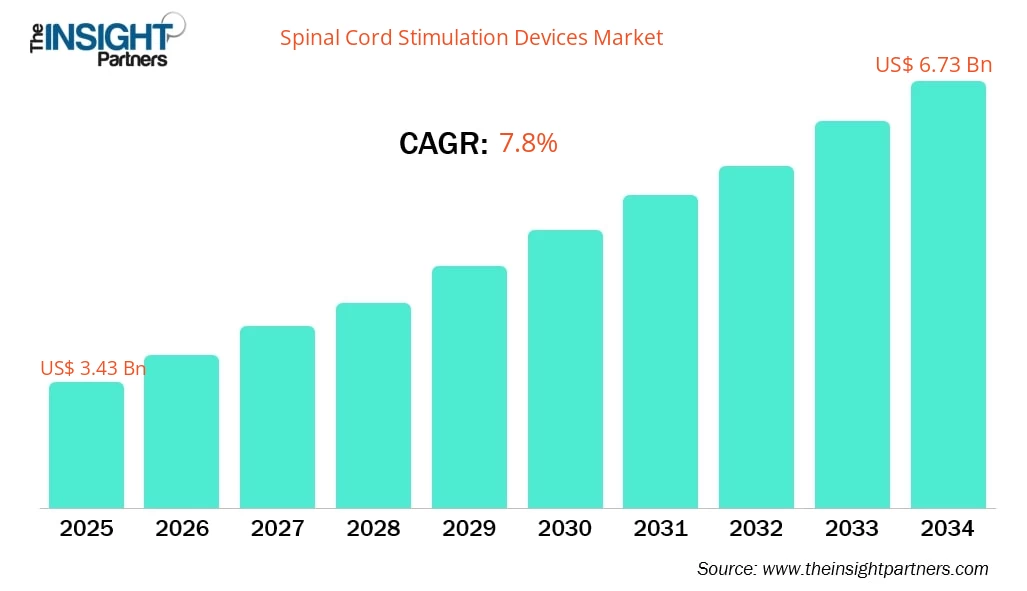
The spinal cord stimulation devices market size is projected to reach US$ 6.73 billion by 2034 from US$ 3.43 billion in 2025. The market is expected to register a CAGR of 7.8% during 2026–2034.
Spinal Cord Stimulation Devices Market Analysis
The global spinal cord stimulation devices market is driven by the rising prevalence of chronic pain disorders, increasing geriatric population, and growing demand for non-opioid pain management solutions. Technological advancements enable better device performance through less invasive treatment methods and better clinical evidence and reimbursement frameworks.
Spinal Cord Stimulation Devices Market Overview
The global spinal cord stimulation devices market is witnessing steady expansion due to increasing cases of failed back surgery syndrome and neuropathic conditions requiring long-term pain relief solutions. The market receives support from healthcare facilities development in developing nations and patients' growing preference for less invasive medical procedures. The market undergoes transformation because of rising healthcare make advanced neuromodulation therapies more accessible and research partnerships between organizations. Market players are focusing on device miniaturization, extended battery life, and personalized therapy features to improve patient outcomes. Chronic pain management holds a stronger presence because healthcare professionals and patients better understand effective pain management methods.
Market Assessment and Insights
- North America dominated the market with 39.6% share in 2025.
- Asia Pacific is poised to grow at a CAGR of 8% over the forecast period.
- United States market is projected to grow at a CAGR of 7.9% over the forecast period.
- By Product Type, the Rechargeable segment accounted for the largest market share of 72.8% in 2025.
- By Application, the Failed Back Surgery Syndrome segment is anticipated to witness the fastest growth, registering a CAGR of 8.1% over the forecast period
- By End Users, the Hospitals segment accounted for the largest market share of 68% in 2025.
- The report profiles key industry players such as Abbott Laboratories, Boston Scientific Corporation, Medtronic Plc, Biotronik SE & Co KG, Nevro Corp, Beijing PINS Medical Co Ltd, Nalu Medical Inc, Curonix LLC, GIMER MEDICAL, Saluda Medical Pty Ltd., while also analyzing key developments in novel ideas, disruptive products, and innovative services that could reshape the future market and reveal emerging themes across the industry.
Source: The Insight Partners' analysis based on proprietary research, government publications, company annual reports, investor presentations, industry databases, and expert interviews.
● REPORT CUSTOMIZATION
Tailor This Report To Align With Your Specific Business Requirements
This report can be customized to align precisely with your business objectives, scope, and target markets. Customization options include tailored segmentation, geography, competitive analysis, and strategic insights to support informed decision-making.
Customize This Report →WHAT YOU CAN ADJUST
- ● Segmentations
- ● Geography
- ● Competitive Analysis
- ● Language Preferences
Spinal Cord Stimulation Devices Market: Strategic Insights
-
Get Top Key Market Trends of this report.This FREE sample will include data analysis, ranging from market trends to estimates and forecasts.
Spinal Cord Stimulation Devices Market Drivers and Opportunities
Market Drivers:
- Increasing Prevalence of Chronic Pain Conditions: The increasing prevalence of chronic pain conditions, which include back pain and nerve-related disorders, has created a need for permanent non-drug therapies that include spinal cord stimulation devices.
- High Incidence of Failed Back Surgery Syndrome and Related Neuropathic Pain: The number of patients who develop permanent pain after spinal surgery procedures has increased, and has led to greater acceptance of spinal cord stimulation as an effective method to treat persistent neuropathic pain.
- FDA-Approved Expansion of Indications for Non-Surgical and Diabetic Neuropathy Cases: The FDA has granted approval for healthcare providers to use non-surgical treatments and diabetic neuropathy solutions for a wider range of patient cases. The new regulatory approvals, which enable providers to treat non-surgical back pain and diabetic neuropathy, will enhance patient access to treatment while driving clinical adoption and increasing potential across therapeutic fields.
Market Opportunities:
- Application to Motor Recovery in Spinal Cord Injury: The development of spinal cord stimulation research shows potential to create new treatment options for spinal cord injury patients because it enables motor function restoration, which goes beyond current treatment options for pain relief.
- Technological Improvements in Device Design and Compatibility: Device miniaturization and wireless programming development, MRI compatibility progress, and battery life extension have created multiple ways to enhance patient experience and safety and medical results, which lead to significant market growth possibilities.
- Emphasis on Neuromodulation as Part of Comprehensive Pain Management: The increasing use of neuromodulation therapies together with other pain management methods creates new possibilities for spinal cord stimulation devices to become essential elements of complete treatment systems.
Spinal Cord Stimulation Devices Market Report Segmentation Analysis
The spinal cord stimulation devices market is segmented into distinct categories to provide a clearer understanding of its operations, growth potential, and current trends. Below is the standard segmentation approach used in industry reports:
By Product Type:
- Rechargeable: Rechargeable spinal cord stimulation devices provide extended device life, which leads to fewer replacement operations and their economic benefits, which extend throughout their usage period. The devices are appropriate for younger users and patients who require extended medical treatment.
- Non-Rechargeable: Non-rechargeable devices continue to grow due to ease of use, minimal maintenance, and suitability for elderly patients or those preferring simpler systems without the need for regular charging or device management.
By Application:
- Failed Back Surgery Syndrome
- Complex Regional Pain Syndrome
- Degenerative Disk Diseases
- Others
By End User:
- Hospitals
- Ambulatory Surgery Centers
- Others
By Geography:
- North America
- Europe
- Asia Pacific
- South and Central America
- Middle East and Africa
Spinal Cord Stimulation Devices Market Report Scope
| Report Attribute | Details |
|---|---|
| Market size in 2025 | US$ 3.43 Billion |
| Market Size by 2034 | US$ 6.73 Billion |
| Global CAGR (2026 - 2034) | 7.8% |
| Historical Data | 2021-2024 |
| Forecast period | 2026-2034 |
| Segments Covered |
By Product Type
|
| Regions and Countries Covered |
North America
|
| Market leaders and key company profiles |
|
Spinal Cord Stimulation Devices Market Players Density: Understanding Its Impact on Business Dynamics
The Spinal Cord Stimulation Devices Market is growing rapidly, driven by increasing end-user demand due to factors such as evolving consumer preferences, technological advancements, and greater awareness of the product's benefits. As demand rises, businesses are expanding their offerings, innovating to meet consumer needs, and capitalizing on emerging trends, which further fuels market growth.
Spinal Cord Stimulation Devices Market Share Analysis by Geography
The market is expected to grow at the fastest rate in the Asia Pacific over the coming years. Emerging markets in South America and the Middle East and Africa have untapped opportunities for spinal cord stimulation devices providers to expand.
The growth of the spinal cord stimulation devices market varies across regions due to improving healthcare infrastructure, rising chronic pain cases, expanding medical tourism, and increasing awareness of advanced pain management therapies. Below is a summary of market share and trends by region:
1. North America
- Market Share: Holds a significant portion of the global market
- Key Drivers: Advanced healthcare infrastructure, high chronic pain prevalence, strong reimbursement systems, and rapid adoption of minimally invasive neuromodulation technologies.
- Trends: Growing shift toward personalized neuromodulation therapies and integration of AI-based programming for precise pain management.
2. Europe
- Market Share: Substantial market share
- Key Drivers: Rising aging population, increasing neuropathic disorders, supportive regulatory frameworks, and strong collaboration in medical device innovation.
- Trends: Expansion of next-generation stimulation devices with improved efficacy driven by research partnerships and faster regulatory approvals.
3. Asia Pacific
- Market Share: Fastest-growing region with an annually increasing market share
- Key Drivers: Expanding healthcare infrastructure, aging population, rising chronic pain burden, and increasing medical tourism in emerging economies.
- Trends: Rising adoption of cost-effective and portable stimulation devices to cater to large patient populations in developing countries.
4. South and Central America
- Market Share: Steadily growing market share
- Key Drivers: Improving healthcare access, increasing awareness of pain therapies, and gradual adoption of advanced neuromodulation technologies.
- Trends: Growing focus on public-private healthcare investments to expand access to advanced pain management treatments.
5. Middle East and Africa
- Market Share: Small market share, growing at a rapid pace
- Key Drivers: Rising healthcare investments, improving infrastructure, and increasing focus on chronic pain management services.
- Trends: Emergence of specialized pain clinics and neuromodulation centers supported by government initiatives and healthcare modernization efforts.
High Market Density and Competition
Competition is strong due to the presence of established players such as Boston Scientific Corp and Medtronic Plc. Regional and niche providers add to the competitive landscape across regions.
The high level of competition urges companies to stand out by offering:
- Advanced products and services
- Compliance with regulatory guidelines
Opportunities and Strategic Moves
- The increasing need for non-opioid pain treatment, together with expanded treatment applications and new use cases in neurological disorders, has created major business possibilities for spinal cord stimulation devices.
- Companies boost their competitive edge by pursuing device miniaturization and research partnerships, together with their efforts to obtain regulatory approvals and enter new market territories.
Other companies analyzed during the course of research:
- Axonics Inc.
- Medtronic plc
- Boston Scientific Corporation
- Abbott Laboratories
- Nevro Corp.
- Saluda Medical Pty Ltd.
- Biotronik SE & Co. KG
- Stimwave Technologies Inc.
- Synapse Biomedical Inc.
- NeuroSigma Inc.
Spinal Cord Stimulation Devices Market News and Recent Developments
- In April 2024, Medtronic plc, a global leader in healthcare technology, announced that the US FDA granted approval for its Inceptiv closed-loop rechargeable spinal cord stimulator (SCS), which treats chronic pain. The Inceptiv system marks Medtronic's first spinal cord stimulation device to offer a closed-loop system that detects spinal cord biological signals and automatically modifies stimulation in response to ongoing daily activities.
- In February 2024, Boston Scientific Corporation announced that the US Food and Drug Administration (FDA) had approved an expanded indication of the WaveWriter SCS Systems for the treatment of chronic low back and leg pain in people without prior back surgery, commonly referred to as non-surgical back pain.
Spinal Cord Stimulation Devices Market Report Coverage and Deliverables
The "Spinal Cord Stimulation Devices Market Size and Forecast (2026–2034)" report provides a detailed analysis of the market covering below areas:
- Spinal cord stimulation devices market size and forecast at global, regional, and country levels for all the key market segments covered under the scope
- Spinal cord stimulation devices market trends, as well as market dynamics such as drivers, restraints, and opportunities
- Detailed PEST and SWOT analysis
- Spinal cord stimulation devices market analysis covering key trends, global and regional framework, major players, regulations, and recent market developments
- Industry landscape and competition analysis covering market concentration, heat map analysis, prominent players, and recent developments for the spinal cord stimulation devices market
- Detailed company profiles
Frequently Asked Questions

- Comprehensive Market Sizing and Forecast Analysis
- Detailed Segmentation Analysis
- In-Depth Market Dynamics Assessment
- Regional and Country-Level Insights
- Competitive Landscape and Company Benchmarking
- Strategic Business Intelligence
Recent Reports
Testimonials

The Insight Partners provided valuable market intelligence that supported our global go-to-market strategy. Their team was professional, responsive, and attentive to our feedback, providing thoughtful analysis and helpful methodological clarifications throughout the project.
Junmo Kim Chief Financial Officer (CFO), Enertech Co., Ltd.
The Insight Partners' SCADA System Market report is comprehensive, with valuable insights on current trends and future forecasts. The team was highly professional, responsive, and supportive throughout. We are very satisfied and highly recommend their services.
RAN KEDEM Partner, Reali Technologies LTDs
I requested a report on a very specific software market and the team produced the report in a few days. The information was very relevant and well presented. I then requested some changes and additions to the report. The team was again very responsive and I got the final report in less than a week.
JEAN-HERVE JENN Chairman, Future Analytica
We worked with The Insight Partners for an important market study and forecast. They gave us clear insights into opportunities and risks, which helped shape our plans. Their research was easy to use and based on solid data. It helped us make smart, confident decisions. We highly recommend them.
PIYUSH NAGPAL Sr. Vice President, High Beam Global
The Insight Partners delivered insightful, well-structured market research with strong domain expertise. Their team was professional and responsive throughout. The user-friendly website made accessing industry reports seamless. We highly recommend them for reliable, high-quality research services
YUKIHIKO ADACHI CEO, Deep Blue, LLC.
This is the first time I have purchased a market report from The Insight Partners.While I was unsure at first, I visited their web site and felt more comfortable to take the risk and purchase a market report.I am completely satisfied with the quality of the report and customer service. I had several questions and comments with the initial report, but after a couple of dialogs over email with their analyst I believe I have a report that I can use as input to our strategic planning process.Thank you so much for taking the extra time and making this a positive experience.I will definitely recommend your service to others and you will be my first call when we need further market data.
JOHN SUZUKI President and Chief Executive Officer, Board Director, BK Technologies
I wish to appreciate your support and the professionalism you displayed in the course of attending to my request for information regarding to infectious disease IVD market in Nigeria. I appreciate your patience, your guidance, and the fact that you were willing to offer a discount, which eventually made it possible for us to close a deal. I look forward to engaging The Insight Partners in the future, all thanks to the impression you have created in me as a result of this first encounter.
DR CHIJIOKE ONYIA MANAGING DIRECTOR, PineCrest Healthcare Ltd.Reason to Buy
- Informed Decision-Making
- Understanding Market Dynamics
- Competitive Analysis
- Identifying Emerging Markets
- Customer Insights
- Market Forecasts
- Risk Mitigation
- Boosting Operational Efficiency
- Strategic Planning
- Investment Justification
- Tracking Industry Innovations
- Aligning with Regulatory Trends





 Get Free Sample for