
In-Vitro Diagnostic Instruments Market Demand, Trends & Forecast by 2034
Coverage: By Instruments (Clinical Chemistry Analyzers, Immunoassay Instruments, Hematology and Coagulation Analyzers, Molecular Diagnostics Platforms, Microbiology and Infectious Disease Instruments, Blood Gas and Electrolyte Analyzers, Flow Cytometers, Urinalysis Instruments, Blood Bank and Transfusion Medicine Instruments, Specimen Prep and Ancillary Instruments, Specialty and Research-Grade Instruments), Technology (Immunoassay or Immunochemistry, Immunochromatography, Cellular analysis, Proteomic or metabolomic, Sensor Technology, Miniaturized Systems, Multiplex technology, Optical detection, Electrochemical Analysis, Separation technology, Molecular Diagnosis, Analytical chemistry, Molecular amplification, Molecular genomics, High-throughput Molecular, and Genetic Analysis), Application (Infectious Diseases, Oncology, Cardiology, Nephrology, Diabetes, Genetic Diseases, Blood Grouping and Testing, Allergy Diagnostics, Gastrointestinal Diseases, Immune System Disorders, and Others), Usability (Disposable Devices and Reusable Equipment), Site Of Testing (Laboratory Tests and Point of Care Tests), Specimen (Blood Serum and Plasma, Saliva Specimens, Urine Specimens, and Others), End User (Hospital-Based Dialysis Units and Home Care Settings), and Geography (North America, Europe, Asia Pacific, Middle East and Africa, and South and Central America)
- Status : Published
- Report Code : TIPRE00043454
- Category : Life Sciences
- No. of Pages : 389
- Available Report Formats :


- Last update date : June 05, 2026


2025 Market Size
US$ 26.30 Bn
Base year value
2034 Forecast
US$ 49.15 Bn
Projected by 2034
CAGR 2026-2034
7.2 %
Growth rate
Addressable Market
US$ 340.52 Bn
(2026-2034)
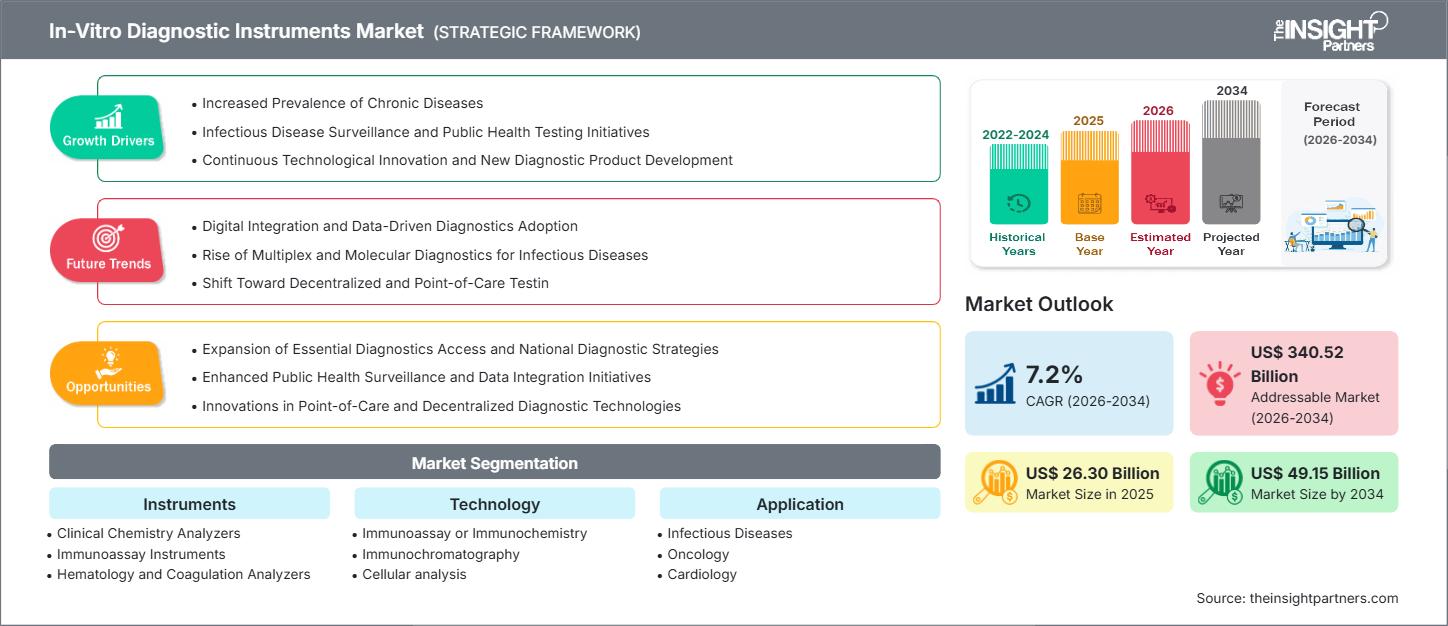
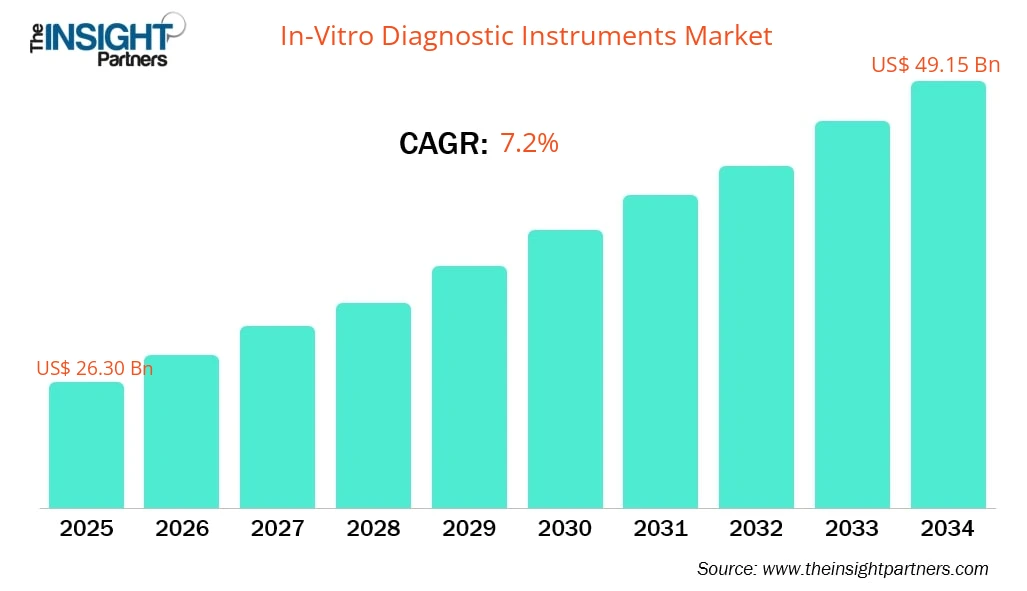
The In-Vitro Diagnostic Instruments market size is projected to reach US$ 49.15 billion by 2034 from US$ 26.30 billion in 2025. The market is expected to register a CAGR of 7.2% during 2026–2034.
In-Vitro Diagnostic Instruments Market Analysis
The global In-Vitro Diagnostic (IVD) instruments market encompasses a broad portfolio of diagnostic systems designed to support accurate disease detection, monitoring, and clinical decision-making across healthcare settings. The market scope includes instruments such as clinical chemistry analyzers, immunoassay systems, hematology and coagulation analyzers, molecular diagnostic platforms, microbiology and infectious disease instruments, flow cytometers, urinalysis devices, blood gas analyzers, blood bank systems, and specialty research-grade instruments. Technological segmentation covers immunochemistry, immunochromatography, molecular diagnostics, proteomics, genomics, multiplex and miniaturized systems, sensor technologies, electrochemical analysis, optical detection, and high-throughput molecular analysis.
Applications span infectious diseases, oncology, cardiology, nephrology, diabetes, genetic disorders, allergy testing, gastrointestinal diseases, immune disorders, and transfusion medicine. The market also differentiates between disposable devices and reusable equipment, while testing environments include centralized laboratories and point-of-care settings. Common specimen types include blood serum and plasma, saliva, urine, and other biological samples. Key end users comprise hospitals, diagnostic laboratories, dialysis units, research institutes, and expanding home-care settings driven by decentralized healthcare trends and rising demand for rapid diagnostics.
In-Vitro Diagnostic Instruments Market Overview
The In-Vitro Diagnostic (IVD) instruments market is witnessing significant growth due to the increasing prevalence of chronic and infectious diseases, rising demand for early disease detection, and continuous advancements in diagnostic technologies. IVD instruments play a crucial role in analyzing biological samples such as blood, urine, and saliva to support accurate clinical diagnosis and treatment decisions. The market includes a wide range of systems, including clinical chemistry analyzers, molecular diagnostic platforms, immunoassay analyzers, hematology instruments, and point-of-care testing devices.
Technological innovations such as automation, artificial intelligence integration, multiplex testing, and high-throughput molecular diagnostics are improving efficiency, speed, and accuracy in laboratory testing. Growing adoption of personalized medicine and decentralized healthcare models is further driving demand for portable and rapid diagnostic solutions. Hospitals, diagnostic laboratories, research institutes, and home-care settings are major end users of these instruments. Additionally, increasing healthcare expenditure, expanding laboratory infrastructure, and rising awareness regarding preventive healthcare continue to support market expansion globally.
Market Research Highlights
- North America dominated the market with 42.2% share in 2025.
- Asia Pacific is poised to grow at a CAGR of 7.8% over the forecast period.
- United States market is projected to grow at a CAGR of 7.1% over the forecast period.
- By Instrument Type, the Immunoassay Instruments segment accounted for the largest market share of 24% in 2025.
- By Clinical Chemistry Analyzers, the Automated clinical chemistry analyzers segment is anticipated to witness the fastest growth, registering a CAGR of 8.5% over the forecast period
- By Immunoassay Instruments, the ELISA Systems segment accounted for the largest market share of 56.1% in 2025.
- By Urinalysis Instruments, the Fully Automated segment is anticipated to witness the fastest growth, registering a CAGR of 6.1% over the forecast period
- By Technology, the Immunoassay or Immunochemistry segment accounted for the largest market share of 27.2% in 2025.
- By Application, the Infectious Diseases segment is anticipated to witness the fastest growth, registering a CAGR of 8.1% over the forecast period
- By Usability, the Disposable Devices segment accounted for the largest market share of 71% in 2025.
- By Site Of Testing, the Point of Care Tests segment is anticipated to witness the fastest growth, registering a CAGR of 9.4% over the forecast period
- By Specimen, the Blood Serum and Plasma segment accounted for the largest market share of 54.3% in 2025.
- By End User, the Clinical Laboratories segment is anticipated to witness the fastest growth, registering a CAGR of 7.8% over the forecast period
- The report profiles key industry players such as Siemens AG, F. Hoffmann-La Roche Ltd, Sysmex Corp, bioMerieux SA, Bio-Rad Laboratories Inc, Becton Dickinson and Co, Danaher Corp, Shenzhen Mindray Bio-Medical Electronics Co Ltd, Thermo Fisher Scientific Inc., Abbott, while also analyzing key developments in novel ideas, disruptive products, and innovative services that could reshape the future market and reveal emerging themes across the industry.
Source: The Insight Partners' analysis based on proprietary research, government publications, company annual reports, investor presentations, industry databases, and expert interviews.
● REPORT CUSTOMIZATION
Tailor This Report To Align With Your Specific Business Requirements
This report can be customized to align precisely with your business objectives, scope, and target markets. Customization options include tailored segmentation, geography, competitive analysis, and strategic insights to support informed decision-making.
Customize This Report →WHAT YOU CAN ADJUST
- ● Segmentations
- ● Geography
- ● Competitive Analysis
- ● Language Preferences
In-Vitro Diagnostic Instruments Market: Strategic Insights
-
Get Top Key Market Trends of this report.This FREE sample will include data analysis, ranging from market trends to estimates and forecasts.
In-Vitro Diagnostic Instruments Market Drivers and Opportunities
Market Drivers:
- Rising Prevalence of Chronic and Infectious Diseases: The rising prevalence of Diabetes and Cancer and COVID-19 creates urgent requirements for precise diagnostic tests that can provide immediate results that help detect diseases early, track their progress, and treat them effectively.
- Growing Demand for Early and Preventive Diagnostics: People who become more knowledgeable about preventive healthcare practices and their benefits for routine health checkups will begin to identify health issues at earlier stages, which results in hospitals and laboratories and decentralized testing centers adopting advanced diagnostic systems.
- Technological Advancements in Diagnostic Instruments: The healthcare sector benefits from ongoing progress in automation and molecular diagnostics. Artificial intelligence research contributes to better testing methods, which enable medical professionals to provide quicker patient diagnoses and enhance their care results.
Market Opportunities:
- Expansion in Emerging Healthcare Markets: The rising healthcare infrastructure of India and Brazil allows better access to diagnostic services for their entire population base.
- Growth of Point-of-Care Testing Solutions: The demand for rapid portable diagnostic devices that people can use without difficulty creates business opportunities for point-of-care testing because it delivers speedier test results outside traditional laboratory settings while making testing available in remote areas with limited resources.
- Adoption of Personalized and Precision Medicine: The growing interest in personalized medicine drives healthcare professionals to seek diagnostic solutions that can process genetic data along with molecular information and biomarker results to enhance diagnosis accuracy and develop personalized treatment plans.
In-Vitro Diagnostic Instruments Market Report Segmentation Analysis
The In-Vitro Diagnostic Instruments market is divided into different segments to give a clearer view of how it works, its growth potential, and the latest trends. Below is the standard segmentation approach used in most industry reports:
By Instruments:
- Clinical Chemistry Analyzers – The need for routine blood testing, which helps detect diabetes and liver disorders, has created demand for health monitoring solutions that support early disease detection.
- Immunoassay Instruments – There is an increasing requirement for precise identification of biological markers and hormonal levels. This need exists in hospitals, laboratories, and point-of-care testing environments.
- Hematology and Coagulation Analyzers – The rising demand for complete blood count testing, which helps identify blood disorders, leads to increased adoption of the testing. The test provides efficient support for diagnosing anemia and infections, together with clotting abnormalities.
- Molecular Diagnostics Platforms – There is a rising demand for precise genetic testing and infectious disease detection since COVID-19. It enables healthcare professionals to make accurate diagnosis reports together with personalized treatment choices at an accelerated pace.
- Microbiology and Infectious Disease Instruments – The rising frequency of infectious diseases has created a greater need for pathogen identification services and testing of antimicrobial resistance and infection control solutions, which are used by healthcare facilities.
- Blood Gas and Electrolyte Analyzers – Critical care settings use the system to monitor patients because it tracks their oxygen and carbon dioxide and electrolyte levels, which helps doctors make essential decisions during emergency situations and in intensive care.
- Flow Cytometers – There is an increasing usage of detailed cell analysis, disease diagnosis, immune system disorders, and cancer monitoring tools in immunology, oncology, and research applications.
- Urinalysis Instruments – The adoption of noninvasive diagnostic tests for kidney diseases, urinary tract infections, and metabolic conditions has increased because clinical and screening applications require rapid testing solutions.
- Blood Bank and Transfusion Medicine Instruments – Blood donation activities have grown, driving the need to establish safe transfusion practices, which include compatibility testing and screening procedures, as well as proper blood component management.
- Specimen Prep and Ancillary Instruments – The increasing demand for efficient sample preparation and handling processes drives the need for automated workflows, which decrease manual errors and improve diagnostic testing accuracy.
- Specialty and Research-Grade Instruments – Biotechnology and life sciences organizations are investing more money into advanced research, drug development, and precision medicine programs.
By Technology:
- Immunoassay or Immunochemistry
- Immunochromatography
- Cellular analysis
- Proteomic or metabolomic
- Sensor technology
- Miniaturized systems
- Multiplex technology
- Optical detection
- Electrochemical analysis
- Separation technology
- Molecular Diagnosis
- Analytical chemistry
- Molecular amplification
- Molecular genomics
- High-throughput molecular
- Genetic Analysis
By Application:
- Infectious Diseases
- Oncology
- Cardiology
- Nephrology
- Diabetes
- Genetic Diseases
- Blood Grouping and Testing
- Allergy Diagnostics
- Gastrointestinal Diseases
- Immune System Disorders
- Others
By Site Of Testing:
- Laboratory Tests
- Point of Care Tests
By Usability:
- Disposable Devices and Reusable Equipment)
- Site Of Testing (Laboratory Tests and Point of Care Tests)
By Specimen:
- Blood Serum and Plasma
- Saliva Specimens
- Urine Specimens
- Others
By End User:
- Hospitals
- Clinical Laboratories
- Home Care
- Others
By Geography:
- North America
- Europe
- Asia Pacific
- Latin America
- Middle East and Africa
In-Vitro Diagnostic Instruments Market Report Scope
| Report Attribute | Details |
|---|---|
| Market size in 2025 | US$ 26.30 Billion |
| Market Size by 2034 | US$ 49.15 Billion |
| Global CAGR (2026 - 2034) | 7.2% |
| Historical Data | 2021-2024 |
| Forecast period | 2026-2034 |
| Segments Covered |
By Instruments
|
| Regions and Countries Covered |
North America
|
| Market leaders and key company profiles |
|
In-Vitro Diagnostic Instruments Market Players Density: Understanding Its Impact on Business Dynamics
The In-Vitro Diagnostic Instruments Market is growing rapidly, driven by increasing end-user demand due to factors such as evolving consumer preferences, technological advancements, and greater awareness of the product's benefits. As demand rises, businesses are expanding their offerings, innovating to meet consumer needs, and capitalizing on emerging trends, which further fuels market growth.
In-Vitro Diagnostic Instruments Market Share Analysis by Geography
Differences in healthcare systems, disease prevalence, and diagnostic technology adoption lead to various growth rates for the in-vitro diagnostic instruments market across different regions. Asia Pacific is experiencing the fastest development because of its increasing rates of chronic and infectious diseases, growing healthcare spending, and rising public knowledge about early disease detection. Latin American and the MEA represent emerging markets that possess significant untapped market potential because their diagnostic services become more accessible and their laboratory infrastructure continues to develop.
The in-vitro diagnostic instruments market grows differently across regions, influenced by disease prevalence, regulatory frameworks, and technological advancements. Below is a summary of market share and trends by region:
1. North America
- Market Share: Holds a significant portion of the global market
- Key Drivers:
- High prevalence of chronic diseases such as cancer and diabetes, along with strong reimbursement systems supporting diagnostic testing
- Trends: Increasing adoption of advanced automated diagnostic systems, integration of artificial intelligence, and expansion of point-of-care testing solutions
2. Europe
- Market Share: Substantial share due to early adoption of in-vitro diagnostic instrument models
- Key Drivers:
- Supportive government initiatives, strong healthcare systems, and emphasis on preventive care and early diagnosis
- Trends: Growth in laboratory automation, digital health integration, and expansion of personalized diagnostic approaches across healthcare facilities.
3. Asia Pacific
- Market Share: Fastest-growing region with an annually rising market share
- Key Drivers:
- Large population base, rising disease burden, and improving access to healthcare services.
- Trends: Increasing investments in healthcare infrastructure, expansion of diagnostic laboratories, and growing demand for cost-effective and rapid diagnostic solutions.
4. South and Central America
- Market Share: Steadily progressing market share
- Key Drivers:
- Improving healthcare access, increasing awareness of diagnostic testing, and expanding laboratory networks
- Trends: Rising adoption of automated diagnostic instruments and gradual shift toward decentralized and point-of-care testing solutions
5. Middle East and Africa
- Market Share: Small market share, growing at a rapid pace
- Key Drivers:
- Increasing disease prevalence and improving healthcare infrastructure
- Trends: Growing focus on expanding diagnostic capabilities, adoption of cost-effective technologies, and gradual integration of modern diagnostic systems
High Market Density and Competition
Competition is strong due to the presence of established players, such as Roche Diagnostics, Abbott Laboratories, and Siemens Healthineers.
This high level of competition urges companies to stand out by offering:
- Advanced and automated in-vitro diagnostic instruments with improved accuracy, speed, and integration of digital and artificial intelligence technologies
- Competitive pricing strategies and strong regulatory compliance to expand market presence
- Comprehensive customer support services, training programs, and seamless integration with laboratory and hospital information systems.
Opportunities and Strategic Moves
- To align with evolving healthcare needs and increasing demand for early diagnosis, manufacturers are focusing on developing portable, automated, and digitally connected in-vitro diagnostic instruments that enhance efficiency and enable real-time data access. Companies are expanding production capabilities and strengthening global distribution networks to meet growing demand across developed and emerging markets.
- Industry players are investing in artificial intelligence integration and data-driven diagnostic platforms, enabling faster and more accurate clinical decision-making.
- In Asia Pacific, Latin America, and the Middle East & Africa, improving healthcare infrastructure and rising disease burden are driving demand for affordable diagnostic solutions. Manufacturers are focusing on innovations in assay development and personalized diagnostics to improve testing outcomes and patient care.
Other companies analyzed during the course of research:
- QIAGEN
- Hologic
- Illumina
- Agilent Technologies
- DiaSorin
- QuidelOrtho
- Randox Laboratories
- PerkinElmer
- Sysmex Europe
- Ortho Clinical Diagnostics
- Mindray
In-Vitro Diagnostic Instruments Market News and Recent Developments
- In April 2026, Bruker announced the launch of MyGenius PRO, a fully automated, sample-to-answer molecular diagnostics system, during the European Society of Clinical Microbiology and Infectious Diseases Global 2026 meeting.
- In March 2026, IDT launched its first in vitro diagnostic NGS assays, Archer FUSION Plex‑HT Dx and VARIANT Plex‑HT Dx, marking its entry into the clinical diagnostics market with standardized, IVD‑grade solutions for oncology workflows.
In-Vitro Diagnostic Instruments Market Report Coverage and Deliverables
The "In-Vitro Diagnostic Instruments Market Size and Forecast (2021–2034)" report provides a detailed analysis of the market covering below areas:
- In-Vitro Diagnostic Instruments Market size and forecast at global, regional, and country levels for all the key market segments covered under the scope
- In-Vitro Diagnostic Instruments Market trends, as well as market dynamics such as drivers, restraints, and key opportunities
- Detailed PEST and SWOT analysis
- In-Vitro Diagnostic Instruments Market analysis covering key market trends, global and regional framework, major players, regulations, and recent market developments
- Industry landscape and competition analysis covering market concentration, heat map analysis, prominent players, and recent developments for the In-Vitro Diagnostic Instruments Market
- Detailed company profiles
Frequently Asked Questions

- Comprehensive Market Sizing and Forecast Analysis
- Detailed Segmentation Analysis
- In-Depth Market Dynamics Assessment
- Regional and Country-Level Insights
- Competitive Landscape and Company Benchmarking
- Strategic Business Intelligence
Recent Reports
Testimonials

The Insight Partners provided valuable market intelligence that supported our global go-to-market strategy. Their team was professional, responsive, and attentive to our feedback, providing thoughtful analysis and helpful methodological clarifications throughout the project.
Junmo Kim Chief Financial Officer (CFO), Enertech Co., Ltd.
The Insight Partners' SCADA System Market report is comprehensive, with valuable insights on current trends and future forecasts. The team was highly professional, responsive, and supportive throughout. We are very satisfied and highly recommend their services.
RAN KEDEM Partner, Reali Technologies LTDs
I requested a report on a very specific software market and the team produced the report in a few days. The information was very relevant and well presented. I then requested some changes and additions to the report. The team was again very responsive and I got the final report in less than a week.
JEAN-HERVE JENN Chairman, Future Analytica
We worked with The Insight Partners for an important market study and forecast. They gave us clear insights into opportunities and risks, which helped shape our plans. Their research was easy to use and based on solid data. It helped us make smart, confident decisions. We highly recommend them.
PIYUSH NAGPAL Sr. Vice President, High Beam Global
The Insight Partners delivered insightful, well-structured market research with strong domain expertise. Their team was professional and responsive throughout. The user-friendly website made accessing industry reports seamless. We highly recommend them for reliable, high-quality research services
YUKIHIKO ADACHI CEO, Deep Blue, LLC.
This is the first time I have purchased a market report from The Insight Partners.While I was unsure at first, I visited their web site and felt more comfortable to take the risk and purchase a market report.I am completely satisfied with the quality of the report and customer service. I had several questions and comments with the initial report, but after a couple of dialogs over email with their analyst I believe I have a report that I can use as input to our strategic planning process.Thank you so much for taking the extra time and making this a positive experience.I will definitely recommend your service to others and you will be my first call when we need further market data.
JOHN SUZUKI President and Chief Executive Officer, Board Director, BK Technologies
I wish to appreciate your support and the professionalism you displayed in the course of attending to my request for information regarding to infectious disease IVD market in Nigeria. I appreciate your patience, your guidance, and the fact that you were willing to offer a discount, which eventually made it possible for us to close a deal. I look forward to engaging The Insight Partners in the future, all thanks to the impression you have created in me as a result of this first encounter.
DR CHIJIOKE ONYIA MANAGING DIRECTOR, PineCrest Healthcare Ltd.Reason to Buy
- Informed Decision-Making
- Understanding Market Dynamics
- Competitive Analysis
- Identifying Emerging Markets
- Customer Insights
- Market Forecasts
- Risk Mitigation
- Boosting Operational Efficiency
- Strategic Planning
- Investment Justification
- Tracking Industry Innovations
- Aligning with Regulatory Trends





 Get Free Sample for