
Asia Pacific Prenatal Testing Services Market Analysis and Forecast by Size, Share, Growth, Trends 2031
Asia Pacific Prenatal Testing Services Market Size and Forecast (2021 - 2031), Regional Share, Trend, and Growth Opportunity Analysis Report Coverage: By Diagnostic Type (Non Invasive and Invasive), Disease (Aneuploidy, Microdeletions, Structural Chromosomal Abnormalities, and Others), and End User (Hospitals, Diagnostic Laboratories, Specialty Clinics, and Other End Users)
Historic Data: 2021-2023 | Base Year: 2024 | Forecast Period: 2025-2031- Status : Published
- Report Code : TIPRE00043673
- Category : Life Sciences
- No. of Pages : 150
- Available Report Formats :




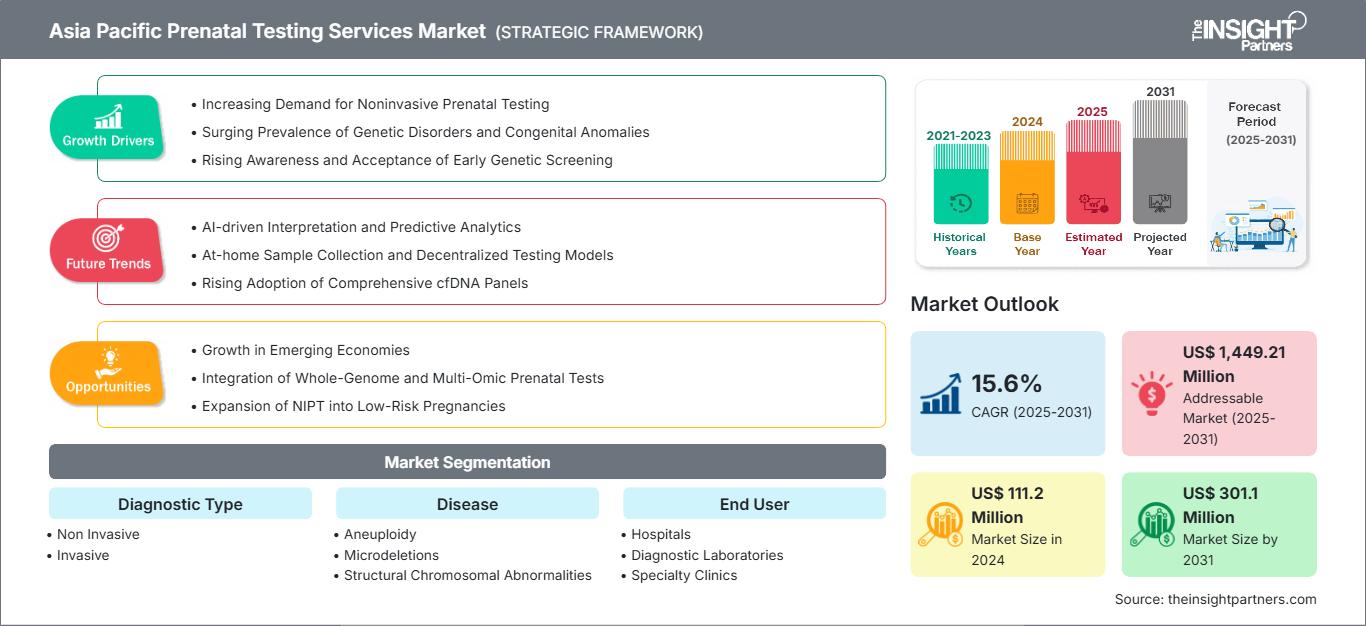
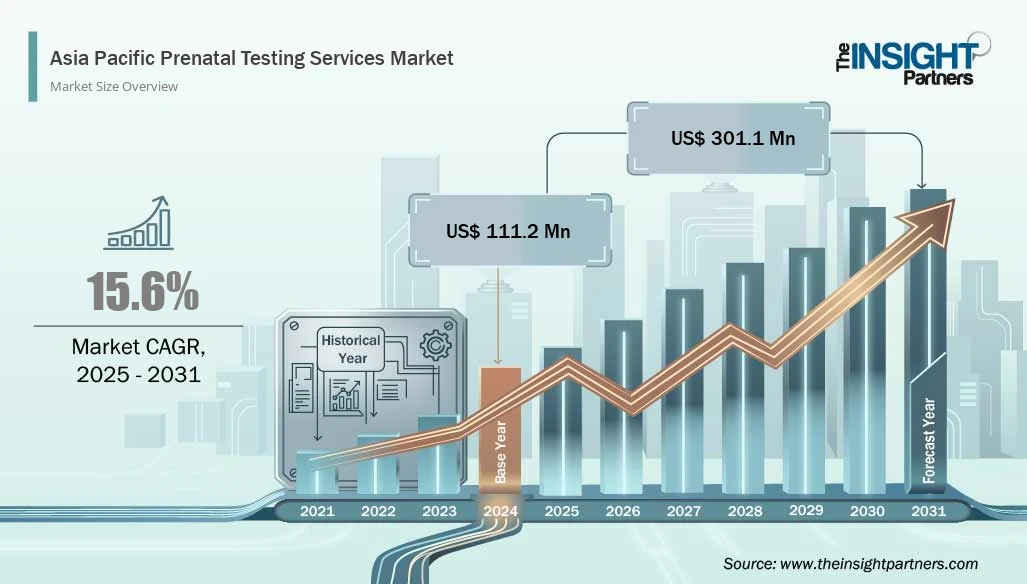
The Asia Pacific Prenatal Testing Services Market size is expected to reach US$ 301.1 Million by 2031 from US$ 111.2 Million in 2024. The market is estimated to record a CAGR of 15.6% from 2025 to 2031.
Executive Summary and Asia Pacific Prenatal Testing Services Market Analysis:
The Asia Pacific prenatal testing services market is segmented into China, Japan, India, South Korea, Australia, and the Rest of the Pacific. In the region, the clinical use of NIPT is on the rise, particularly in countries with more developed healthcare systems. A review of the research reveals that in Southeast Asia (e.g., Thailand, Malaysia, Singapore), NIPT is provided by the private sector, as governments have not yet fully established public funding or established regulations. Enhancements in next-generation sequencing and bioinformatics are making tests quicker, more accurate, and less expensive. Nevertheless, the knowledge of pregnant women varies in level, and the usage rate differs significantly. One research pointed out that only 36 % of the questioned women in various parts of the region fully understood the available options for prenatal screening. In some areas, the price for NIPT remains very high without universal reimbursement; therefore, only affluent or urban individuals can afford it.
Customize This Report To Suit Your Requirement
Get FREE CUSTOMIZATIONAsia Pacific Prenatal Testing Services Market: Strategic Insights
-
Get Top Key Market Trends of this report.This FREE sample will include data analysis, ranging from market trends to estimates and forecasts.
Asia Pacific Prenatal Testing Services Market Segmentation Analysis:
- By Diagnostic Type, the Asia Pacific Prenatal Testing Services Market is segmented into Non Invasive and Invasive. The Non Invasive segment dominated the market in 2024.
- By Disease, the Asia Pacific Prenatal Testing Services Market is segmented into Aneuploidy, Microdeletions, Structural Chromosomal Abnormalities, and Others. The Aneuploidy segment dominated the market in 2024.
- By End User, the Asia Pacific Prenatal Testing Services Market is segmented into Hospitals, Diagnostic Laboratories, Specialty Clinics, and Other End Users. The Hospitals segment dominated the market in 2024.
Asia Pacific Prenatal Testing Services Market Report Scope
| Report Attribute | Details |
|---|---|
| Market size in 2024 | US$ 111.2 Million |
| Market Size by 2031 | US$ 301.1 Million |
| CAGR (2025 - 2031) | 15.6% |
| Historical Data | 2021-2023 |
| Forecast period | 2025-2031 |
| Segments Covered |
By Diagnostic Type
|
| Regions and Countries Covered |
Asia Pacific
|
| Market leaders and key company profiles |
|
Asia Pacific Prenatal Testing Services Market Players Density: Understanding Its Impact on Business Dynamics
The Asia Pacific Prenatal Testing Services Market is growing rapidly, driven by increasing end-user demand due to factors such as evolving consumer preferences, technological advancements, and greater awareness of the product's benefits. As demand rises, businesses are expanding their offerings, innovating to meet consumer needs, and capitalizing on emerging trends, which further fuels market growth.
Asia Pacific Prenatal Testing Services Market Outlook
Recent wide-ranging clinical trials have demonstrated the feasibility of genome-wide NIPT. Whole-genome NIPT in a single group of 12,700 pregnancies was able to identify the common aneuploidies, rare autosomal trisomies, and clinically significant copy-number variations (CNVs) with high sensitivity and low false-positive rates, report published in PLOS (a nonprofit organization. Alongside these developments, genomic labs are no longer limited to standard chromosomal screening and are looking ahead to new diagnostic methods. The PrenatalGenome test sequences the fetal cell-free DNA in maternal blood at an intense level, aiming to detect chromosomal and single-gene pathogenic variants. This process enables the noninvasive identification of inherited or de novo monogenic disorders, with an analytical sensitivity exceeding 99%.
The progress made in machine learning and artificial intelligence is of great help for the integration of genomic, epigenomic, and fragmentomics data. A fully automated neural network model was recently demonstrated to be able to infer single-nucleotide variants (SNVs) in the fetal genome from deep whole-genome cfDNA sequencing with high precision, by utilizing read-depth, fetal fraction, and parental genome information. As for epigenetics, methods such as enzymatic methyl-sequencing (EM-seq) and whole-genome bisulfite sequencing are advancing rapidly, allowing researchers to define fetal DNA methylation at the single-base level currently.
By leveraging whole-genome sequencing, epigenomic profiling, and AI-driven multi-omics analysis, modern prenatal diagnostics move beyond simple risk assessment to deliver a comprehensive, multidimensional view of fetal health. Apart from increasing the diagnostic yield, the potential exists to open up areas in developmental biology, epigenetic regulation, and long-term disease risk, making new clinical applications and personalized prenatal care routes available.
Asia Pacific Prenatal Testing Services Market Country Insights
By country, the Asia Pacific Prenatal Testing Services Market is segmented into China, Japan, India, Australia, South Korea, and the Rest of APAC. Japan held the largest share in 2024.
In Japan, the NIPT provision has evolved to a higher level of sophistication and has become more established clinically, including the use of genome-wide screening. A recent extensive study of 46,082 pregnant women (2015-2021) revealed that genome-wide NIPT identified fetal copy number variations (CNVs) in approximately 0.2% of the cases, which also included microdeletion syndromes. However, determining the clinical risk of these findings is still difficult since most of the CNV-positive fetuses turned out to have a good short-term prognosis. This factor implies that a heavy counseling load is involved since even in the case of pathogenic CNVs, the outcome may not necessarily be negative. Typically, clinics insist on detailed pre-test education for patients, and private centers may offer "lectures" on chromosomal anomalies before blood is drawn. Unlike publicly funded programs, the majority of NIPT tests in Japan are paid for by the patients themselves. The reason for self-pay is partially that the national health insurance does not provide complete subsidies for broad NIPT for all pregnancies. Laboratories are considering more advanced or expanded panels. Still, clinical guidelines remain cautious, primarily due to the interpretive challenges of genome-wide results and the ethical implications of disclosing rare microdeletions. NIPT in Japan is at the cutting edge of technology and can be accessed through private clinics, where proper patient education is the norm. However, the decision to use the service is still influenced by factors such as price, insurance policies, and the challenges in interpreting more complex genomic data.
Asia Pacific Prenatal Testing Services Market Company Profiles
Some of the key players operating in the market include F. Hoffmann-La Roche Ltd, Illumina Inc, Quest Diagnostics Inc, Exact Sciences Corp, Eurofins Scientific SE, Myriad Genetics Inc, Revvity Inc, Laboratory Corp of America Holdings, MedGenome Inc, and Fulgent Genetics, Inc.
These players are adopting various strategies such as expansion, product innovation, and mergers and acquisitions to provide innovative products to their consumers and increase their market share.
Asia Pacific Prenatal Testing Services Market Research Methodology
The following methodology has been followed for the collection and analysis of data presented in this report:
Secondary Research
The research process begins with comprehensive secondary research, utilizing internal and external sources to gather qualitative and quantitative data for each market. Commonly referenced secondary research sources include, but are not limited to:
- Company websites, annual reports, financial statements, broker analyses, and investor presentations
- Industry trade journals and other relevant publications
- Government documents, statistical databases, and market reports
- News articles, press releases, and webcasts specific to companies operating in the market
Note: All financial data included in the Company Profiles section has been standardized to US$. For companies reporting in other currencies, figures have been converted to US$ using the relevant exchange rates for the corresponding year.
Primary Research
The Insight Partners conducts a significant number of primary interviews each year with industry stakeholders and experts to validate its data analysis and gain valuable insights. These research interviews are designed to:
- Validate and refine findings from secondary research
- Enhance the expertise and market understanding of the analysis team
- Gain insights into market size, trends, growth patterns, competitive dynamics, and future prospects
Primary research is conducted via email interactions and telephone interviews, encompassing various markets, categories, segments, and sub-segments across different regions. Participants typically include:
- Industry stakeholders: Vice Presidents, Business Development Managers, Market Intelligence Managers, and National Sales Managers
- External experts: Valuation specialists, research analysts, and key opinion leaders with industry-specific expertise

- Historical Analysis (2 Years), Base Year, Forecast (7 Years) with CAGR
- PEST and SWOT Analysis
- Market Size Value / Volume - Regional, Country
- Industry and Competitive Landscape
- Excel Dataset
Recent Reports
Testimonials

The Insight Partners' SCADA System Market report is comprehensive, with valuable insights on current trends and future forecasts. The team was highly professional, responsive, and supportive throughout. We are very satisfied and highly recommend their services.
RAN KEDEM Partner, Reali Technologies LTDs
I requested a report on a very specific software market and the team produced the report in a few days. The information was very relevant and well presented. I then requested some changes and additions to the report. The team was again very responsive and I got the final report in less than a week.
JEAN-HERVE JENN Chairman, Future Analytica
We worked with The Insight Partners for an important market study and forecast. They gave us clear insights into opportunities and risks, which helped shape our plans. Their research was easy to use and based on solid data. It helped us make smart, confident decisions. We highly recommend them.
PIYUSH NAGPAL Sr. Vice President, High Beam Global
The Insight Partners delivered insightful, well-structured market research with strong domain expertise. Their team was professional and responsive throughout. The user-friendly website made accessing industry reports seamless. We highly recommend them for reliable, high-quality research services
YUKIHIKO ADACHI CEO, Deep Blue, LLC.
This is the first time I have purchased a market report from The Insight Partners.While I was unsure at first, I visited their web site and felt more comfortable to take the risk and purchase a market report.I am completely satisfied with the quality of the report and customer service. I had several questions and comments with the initial report, but after a couple of dialogs over email with their analyst I believe I have a report that I can use as input to our strategic planning process.Thank you so much for taking the extra time and making this a positive experience.I will definitely recommend your service to others and you will be my first call when we need further market data.
JOHN SUZUKI President and Chief Executive Officer, Board Director, BK Technologies
I wish to appreciate your support and the professionalism you displayed in the course of attending to my request for information regarding to infectious disease IVD market in Nigeria. I appreciate your patience, your guidance, and the fact that you were willing to offer a discount, which eventually made it possible for us to close a deal. I look forward to engaging The Insight Partners in the future, all thanks to the impression you have created in me as a result of this first encounter.
DR CHIJIOKE ONYIA MANAGING DIRECTOR, PineCrest Healthcare Ltd.Reason to Buy
- Informed Decision-Making
- Understanding Market Dynamics
- Competitive Analysis
- Identifying Emerging Markets
- Customer Insights
- Market Forecasts
- Risk Mitigation
- Boosting Operational Efficiency
- Strategic Planning
- Investment Justification
- Tracking Industry Innovations
- Aligning with Regulatory Trends
Unlock Exclusive Report Discounts
Enquire Now




 Get Free Sample For