
Asset Tracking Solution Market Trends, Demand & Growth by 2034
Coverage: by Component (Hardware, Software, Services); Deployment Type (On-Premises, Cloud); End-user (Transportation and Logistics, Aviation, Healthcare, Manufacturing, Others) , and Geography (North America, Europe, Asia Pacific, and South and Central America)
- Status : Data Released
- Report Code : TIPRE00009708
- Category : Technology, Media and Telecommunications
- No. of Pages : 150
- Available Report Formats :


- Last update date : August 28, 2026


2025 Market Size
US$ 28.07 Bn
Base year value
2034 Forecast
US$ 92.17 Bn
Projected by 2034
CAGR 2026-2034
14.12 %
Growth rate
Addressable Market
US$ 517.91 Bn
(2026-2034)
The asset tracking solution market is projected to grow from US$ 28.07 Billion in 2025 to US$ 92.17 Billion by 2034, registering a CAGR of 14.12% during 2026–2034. Adoption is rising as enterprises use RFID, GPS, barcode, BLE, cellular, and IoT-enabled systems to monitor movable assets, improve utilization, reduce theft, and connect field operations with enterprise planning systems.
North America remains the largest revenue base, with the asset tracking solution market size supported by logistics modernization, healthcare equipment visibility, aviation maintenance controls, and manufacturing digitalization. The region is expected to grow at a CAGR of 13.5–14.2% during 2026–2034 as cloud dashboards, edge devices, and connected sensors become standard operating tools for asset-intensive organizations.
Asset Tracking Solution Market Assessment and Insights
- North America accounted for 37–40% share in 2025 and is expected to grow at a CAGR of 13.5–14.2% during 2026–2034, led by logistics, healthcare, manufacturing, and field-service digitization.
- US represented 83–87% of North America revenue in 2025 and is projected to grow at 13.7–14.5%, supported by supply chain visibility and connected fleet investments.
- Europe held 24–27% share in 2025 and is forecast to grow at 12.8–13.6%, with Germany, the UK, France, Italy, and Spain leading adoption.
- Asia Pacific captured 25–28% share in 2025 and is projected to grow at 15.1–16.0%, driven by China, Japan, South Korea, India, and Australia.
- Largest Segment: Hardware held 44–48% market share in 2025 and is expected to grow at 13.4–14.1% as tags, scanners, gateways, and sensors remain foundational.
- High Growth Segment: Cloud held 62–66% share in 2025 and is projected to grow at 15.0–15.8% through 2034 as enterprises scale remote visibility platforms.
- Key companies analyzed in detail: Actsoft, Inc.; ASAP Systems; Asset Panda, LLC; AT&T Intellectual Property; Datalogic S.p.A.; EZ Web Enterprises, Inc.; Honeywell International Inc.; Trimble Inc.; Verizon Communications Inc.; Zebra Technologies Corporation.
Source: The Insight Partners' analysis based on proprietary research, government publications, company annual reports, investor presentations, industry databases, and expert interviews.
Asset visibility has evolved from a periodic barcode scanning process into one of continuous monitoring driven by sensors. Previous implementations have been centered on inventory management and compliance logging, while contemporary solutions offer integration between location, condition, maintenance, custody, and utilization. The current state-of-the-art includes tagging, hand-held devices, gateway technology, cloud-based software, and APIs to provide insights into the whereabouts of the assets, who has used them, which ones sit idle, and when service is needed.
Future investments will be driven by industrial automation, logistics resilience, cold chain, airport throughput, and hospital asset management. Emerging markets embrace cloud-native solutions due to their lack of significant internal infrastructure. Regulatory considerations such as pharmaceutical traceability, airline documentation, food safety, and employee accountability drive the demand for accurate and auditable asset information.
Asset Tracking Solution Market Report Scope
| Report Attribute | Details |
|---|---|
| Market size in 2025 | US$ 28.07 Billion |
| Market Size by 2034 | US$ 92.17 Billion |
| Global CAGR (2026 - 2034) | 14.12% |
| Historical Data | 2021-2024 |
| Forecast period | 2026-2034 |
Asset Tracking Solution Market Analysis
The asset tracking solution market growth is linked to the rising cost of misplaced equipment, poor asset utilization, shipment delays, and manual reconciliation. Transportation and logistics companies require shipment-level visibility, manufacturers require work-in-process control, hospitals require rapid access to critical medical equipment, and airline operators require traceable tooling and components. These application requirements create demand for connected tags, scanners, mobile apps, cloud dashboards, and integration with ERP, WMS, EAM, and fleet management software.
There are hardware providers, connectivity providers, platform providers, system integrators, cloud hosting services, analytics providers, and managed service partners within the value chain. Supply dynamics are being improved by falling sensor costs and by increasing availability of various types of connectivity like LPWAN, LTE-M, NB-IoT, Wi-Fi, UWB, and 5G. Buyers are increasingly focused on total cost of ownership, battery life, accuracy, robustness, security, and interoperability rather than individual devices.
The market analysis shows a competitive field combining device makers, telecom providers, fleet platforms, and specialist software vendors. Zebra Technologies Corporation, Honeywell International Inc., Datalogic S.p.A., Trimble Inc., Verizon Communications Inc., AT&T Intellectual Property, Actsoft, Inc., Asset Panda, LLC, ASAP Systems, and EZ Web Enterprises, Inc. compete through hardware depth, network reach, implementation support, and workflow-specific software.
Investment will be directed to the areas of subscription-based software, AI alert services, predictive maintenance and location intelligence solutions. The strategic positioning is different based on customer requirements, with telecom vendors stressing connectivity and managed services; industrial players offering tough equipment and scanning accuracy; and software firms offering custom workflows, mobile inspections and audit reports.
● REPORT CUSTOMIZATION
Tailor This Report To Align With Your Specific Business Requirements
This report can be customized to align precisely with your business objectives, scope, and target markets. Customization options include tailored segmentation, geography, competitive analysis, and strategic insights to support informed decision-making.
Customize This Report →WHAT YOU CAN ADJUST
- ● Segmentations
- ● Geography
- ● Competitive Analysis
- ● Language Preferences
Asset Tracking Solution Market: Strategic Insights
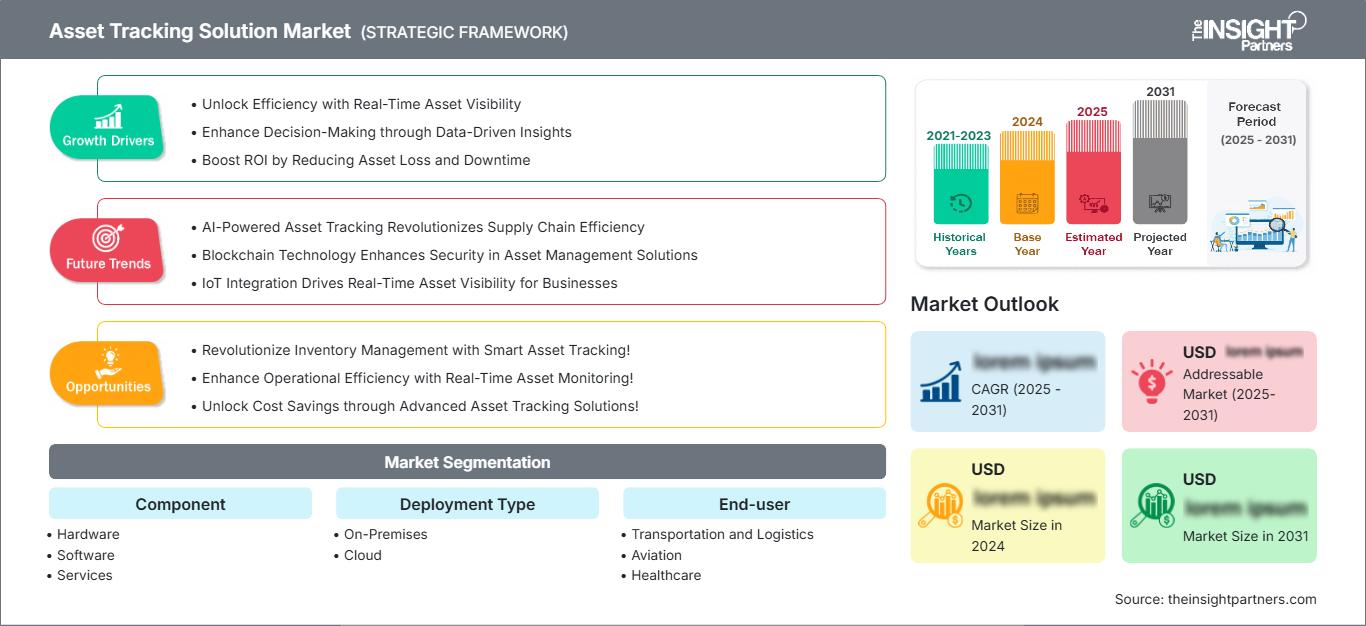
Regional Insights
North America asset tracking solution market
North America held 37–40% share in 2025 and is projected to grow at a CAGR of 13.5–14.2% during 2026–2034. The asset tracking solution market share is reinforced by warehouse automation, healthcare equipment management, fleet visibility, and regulatory compliance. Buyers prioritize reliable connectivity, connected handhelds, and integrations that reduce operator workload while improving inventory accuracy.
Regional demand is also driven by equipment theft prevention, cold-chain monitoring, and field-service productivity. Retail distribution centers, hospitals, aerospace facilities, and manufacturing plants are shifting from manual logs to real-time alerts. Strong channel ecosystems help enterprises deploy scanners, RFID labels, gateways, GPS devices, and software without rebuilding internal IT capabilities.
U.S. asset tracking solution Market
The US represented 83–87% of North America's revenue in 2025 and is expected to expand at 13.7–14.5% through 2034. Demand is based on transportation corridors, hospital networks, aircraft maintenance schedules, and advanced manufacturing environments where there is a need for tracking asset locations, status, and management throughout various locations.
Company reach is widespread, as Zebra Technologies Corporation, Honeywell International Inc., Verizon Communications Inc., AT&T Intellectual Property, Trimble Inc., Asset Panda, LLC, ASAP Systems, Actsoft, Inc., and EZ Web Enterprises, Inc. provide their services for different sizes of deployments. Enterprises are now focusing on cloud dashboards, connectivity, managed devices, and analytics-based operations.
Europe asset tracking solution Market
Europe accounted for 24–27% share in 2025 and is projected to grow at 12.8–13.6% during 2026–2034. Adoption is led by Germany in manufacturing automation, automotive supply chain, and industrial maintenance. In the UK, applications include logistics, retail distribution, aviation, and healthcare applications aimed at operational resiliency.
In France, Italy, and Spain, investments are increasing in systems for warehouse visibility, cold chain integrity, and government assets tracking. European customers value data governance, traceability, energy efficiency, and equipment utilization. RFID, bar code, and IoT solutions are becoming integrated into compliance processes as companies track custody, maintenance, and asset conditions.
APAC asset tracking solution Market
APAC held 25–28% share in 2025 and is expected to grow at 15.1–16.0% through 2034. China takes the lead by leveraging the scale of manufacturing, logistics digitization, and an export-oriented supply chain. Japan and South Korea leverage advanced manufacturing systems, whereas India makes use of cloud and mobile-enabled technology to track warehouse, hospital and fleet assets.
Australia contributes through demand for mining, healthcare, transportation and utility. The regional growth is driven by e-logistics, intelligent manufacturing initiatives and declining prices of sensors. Buyers tend to favor scalable cloud software due to the simplicity involved in deployment.
Middle East & Africa asset tracking solution Market
The Middle East & Africa is forecast to grow at 12.9–13.8% during 2026–2034. Saudi Arabia and the UAE lead adoption through airport expansion, logistics parks, healthcare modernization, energy assets, and smart-city infrastructure. South Africa contributes to demand from mining, transport, retail distribution, and medical equipment management.
The rest of MEA remains earlier in adoption, but high-value equipment, remote sites, and infrastructure projects create a practical need for tracking tools. Cellular and GPS-based systems are attractive where fixed infrastructure is limited, while cloud platforms help organizations centralize visibility across dispersed and contractor-heavy operations.
Segmentation Analysis
Component
Component defines the market scope because performance depends on the combination of devices, applications, connectivity, and implementation support. This segment is expected to grow at 13.8–14.6% through 2034 as buyers move from isolated tagging toward integrated lifecycle visibility.
- Hardware includes RFID tags, barcode labels, scanners, GPS units, BLE beacons, gateways, and rugged handhelds that capture location, identity, and condition data at operational touchpoints.
- Software provides dashboards, alerts, workflows, reporting, mobile access, APIs, and analytics that convert raw asset signals into decisions for utilization, maintenance, compliance, and loss control.
- Services cover consulting, installation, tagging strategy, integration, training, support, and managed operations, helping organizations deploy technology correctly and maintain data quality over time.
Deployment Type
Deployment Type is projected to grow at 14.0–14.8% during 2026–2034 as enterprises balance control, scalability, security, and remote access. Cloud adoption is strongest among distributed operations, while on-premises remains relevant for highly controlled IT environments.
- On-Premises deployments support organizations with strict data control, legacy systems, or restricted connectivity, though upgrade cycles and infrastructure costs can slow adoption.
- Cloud deployment enables faster rollout, multi-site visibility, app access, automatic updates, and analytics at scale, making it the preferred option for logistics and healthcare users.
End-user
End-user demand is forecast to grow at 14.1–15.0% as asset-intensive industries digitize operational control. Transportation, aviation, healthcare, and manufacturing each use tracking differently, but all seek lower loss, better utilization, and auditable workflows.
- Transportation and Logistics users track vehicles, containers, pallets, parcels, returnable transport items, and high-value shipments to improve route visibility, chain-of-custody, and exception response.
- Aviation relies on tool control, part traceability, ground support equipment visibility, and maintenance documentation to reduce delays, safety risk, and compliance exposure.
- Healthcare tracks infusion pumps, wheelchairs, beds, diagnostic devices, and temperature-sensitive medical assets so staff can reduce search time and improve equipment availability.
- Manufacturing uses asset tracking for work-in-progress, tools, molds, raw materials, finished goods, and maintenance parts, supporting lean operations and smart-factory initiatives.
Opportunity Snapshot
| End-user | Revenue Contribution | Trend Tag | Adoption Stage |
| Transportation and Logistics | High | Fleet Visibility | Mature |
| Aviation | Medium | Tool Control | Scaling |
| Healthcare | Medium | Equipment Access | Scaling |
| Manufacturing | High | Smart Factory | Scaling |
Asset Tracking Solution Market Growth Drivers and Impact Analysis
Real-Time Visibility Across Complex Supply Chains
Real-time asset visibility is becoming an essential operating requirement due to globalized purchasing, e-commerce demands, and just-in-time inventory strategies. Logistics companies and manufacturers track containers, pallets, tools, trailers, and reusable assets that move through warehouses, ports, retail channels, and customer facilities using tracking technologies. These effects can be quantified by the reduced number of missing assets, improved ability to respond to exceptions, increased reliability of shipments, and decreased safety stock requirements. With increasing supply chain dispersion, management is able to respond to potential delays, temperature variations, or routing problems proactively using integrated dashboards and automated alerts.
IoT Connectivity and Sensor Cost Improvements
More affordable sensors coupled with more connectivity options have opened up possibilities. Companies now have the option to use RFID technology for high-quantity identification, BLE or UWB for indoor positioning, GPS for outdoor movement, LPWAN for extended battery life, and cellular for mobile assets. All of this increases cost-effectiveness since companies will not have to over-engineer things. As a result, the effect of this development on the market will be the increased adoption of these technologies by middle-tier customers who earlier saw tracking as too expensive.
Compliance, Safety, and Equipment Utilization Pressures
Asset-intensive and regulated sectors are faced with the challenge of proving that they have custody of their assets, that maintenance was performed on them, that they have been calibrated, and that their temperatures were maintained. For aviation maintenance operations, the accountability of tools is necessary, while for health care providers, having access to equipment is vital. For food or pharmaceutical logistics, asset condition data is important. It helps mitigate the risks of audits through time-stamping and exception tracking, but also through better asset utilization identification.
Asset Tracking Solution Market Future Trends
AI-Led Utilization and Predictive Intervention
The asset tracking solution market trends will increasingly center on analytics that convert location and condition streams into recommended actions. The next generation of these platforms will detect anomalies in dwell time, perform maintenance predictions, identify unused equipment, and recommend redeployment before any purchase decision is made. AI will be used to prioritize exceptions in such a way that only those assets that have an impact on service, safety, and revenue will be considered by the team. This will require good master data management and integration.
Unified Tracking Across Indoor and Outdoor Environments
Enterprises will move toward systems that hand off seamlessly between indoor RFID, BLE, UWB, Wi-Fi, and outdoor GPS or cellular signals. This unified approach matters because assets rarely stay in one environment. A medical device may move from storage to the ward, while logistics equipment shifts from the warehouse to the highway. Future competitive advantage will come from platforms that normalize different signal types into one operational view with consistent alerts, maps, and reports.
Asset Tracking Solution Market Opportunities
Cloud-Based Platforms for Mid-Market Enterprises
asset tracking solution market Forecasts show strong opportunity in cloud platforms designed for mid-market businesses that need visibility but lack large IT teams. Vendors can win these buyers by offering fast onboarding, preconfigured workflows, mobile scanning, subscription pricing, and packaged integrations. Transportation firms, regional manufacturers, clinics, and service contractors need practical tools that reduce search time and improve asset accountability quickly. Providers that combine hardware bundles, connectivity, and implementation support can shorten payback periods.
Healthcare and Aviation Compliance Workflows
Healthcare and aviation offer high-value opportunities because asset availability and traceability directly affect safety and service continuity. Hospitals can reduce equipment search time and avoid unnecessary purchases by tracking mobile devices and clinical assets. Aviation operators can strengthen tool control, ground support tracking, and component accountability. Vendors that build industry-specific templates, audit reports, and integration pathways with maintenance or hospital systems can command premium positioning over generic inventory platforms.
Frequently Asked Questions

- Comprehensive Market Sizing and Forecast Analysis
- Detailed Segmentation Analysis
- In-Depth Market Dynamics Assessment
- Regional and Country-Level Insights
- Competitive Landscape and Company Benchmarking
- Strategic Business Intelligence
Recent Reports
Testimonials

The Insight Partners' SCADA System Market report is comprehensive, with valuable insights on current trends and future forecasts. The team was highly professional, responsive, and supportive throughout. We are very satisfied and highly recommend their services.
RAN KEDEM Partner, Reali Technologies LTDs
I requested a report on a very specific software market and the team produced the report in a few days. The information was very relevant and well presented. I then requested some changes and additions to the report. The team was again very responsive and I got the final report in less than a week.
JEAN-HERVE JENN Chairman, Future Analytica
We worked with The Insight Partners for an important market study and forecast. They gave us clear insights into opportunities and risks, which helped shape our plans. Their research was easy to use and based on solid data. It helped us make smart, confident decisions. We highly recommend them.
PIYUSH NAGPAL Sr. Vice President, High Beam Global
The Insight Partners delivered insightful, well-structured market research with strong domain expertise. Their team was professional and responsive throughout. The user-friendly website made accessing industry reports seamless. We highly recommend them for reliable, high-quality research services
YUKIHIKO ADACHI CEO, Deep Blue, LLC.
This is the first time I have purchased a market report from The Insight Partners.While I was unsure at first, I visited their web site and felt more comfortable to take the risk and purchase a market report.I am completely satisfied with the quality of the report and customer service. I had several questions and comments with the initial report, but after a couple of dialogs over email with their analyst I believe I have a report that I can use as input to our strategic planning process.Thank you so much for taking the extra time and making this a positive experience.I will definitely recommend your service to others and you will be my first call when we need further market data.
JOHN SUZUKI President and Chief Executive Officer, Board Director, BK Technologies
I wish to appreciate your support and the professionalism you displayed in the course of attending to my request for information regarding to infectious disease IVD market in Nigeria. I appreciate your patience, your guidance, and the fact that you were willing to offer a discount, which eventually made it possible for us to close a deal. I look forward to engaging The Insight Partners in the future, all thanks to the impression you have created in me as a result of this first encounter.
DR CHIJIOKE ONYIA MANAGING DIRECTOR, PineCrest Healthcare Ltd.Reason to Buy
- Informed Decision-Making
- Understanding Market Dynamics
- Competitive Analysis
- Identifying Emerging Markets
- Customer Insights
- Market Forecasts
- Risk Mitigation
- Boosting Operational Efficiency
- Strategic Planning
- Investment Justification
- Tracking Industry Innovations
- Aligning with Regulatory Trends





 Get Free Sample for