
At-Home Drug of Abuse (DOA) Testing Market Trends, Demand & Growth by 2034
At-Home Drug of Abuse (DOA) Testing Market Size and Forecasts (2021–2034), Global and Regional Share, Trends, and Growth Opportunity Analysis Report Coverage : by Type (Test Cups, Test Strips); Sample Type (Saliva, Urine, Blood); and Geography (North America, Europe, Asia Pacific, and South and Central America)
- Status : Data Released
- Report Code : TIPRE00040869
- Category : Life Sciences
- No. of Pages : 150
- Available Report Formats :


- Last update date : September 07, 2026


2025 Market Size
US$ 3.13 Bn
Base year value
2034 Forecast
US$ 5.51 Bn
Projected by 2034
CAGR 2026-2034
6.49 %
Growth rate
Addressable Market
US$ 39.09 Bn
(2026-2034)
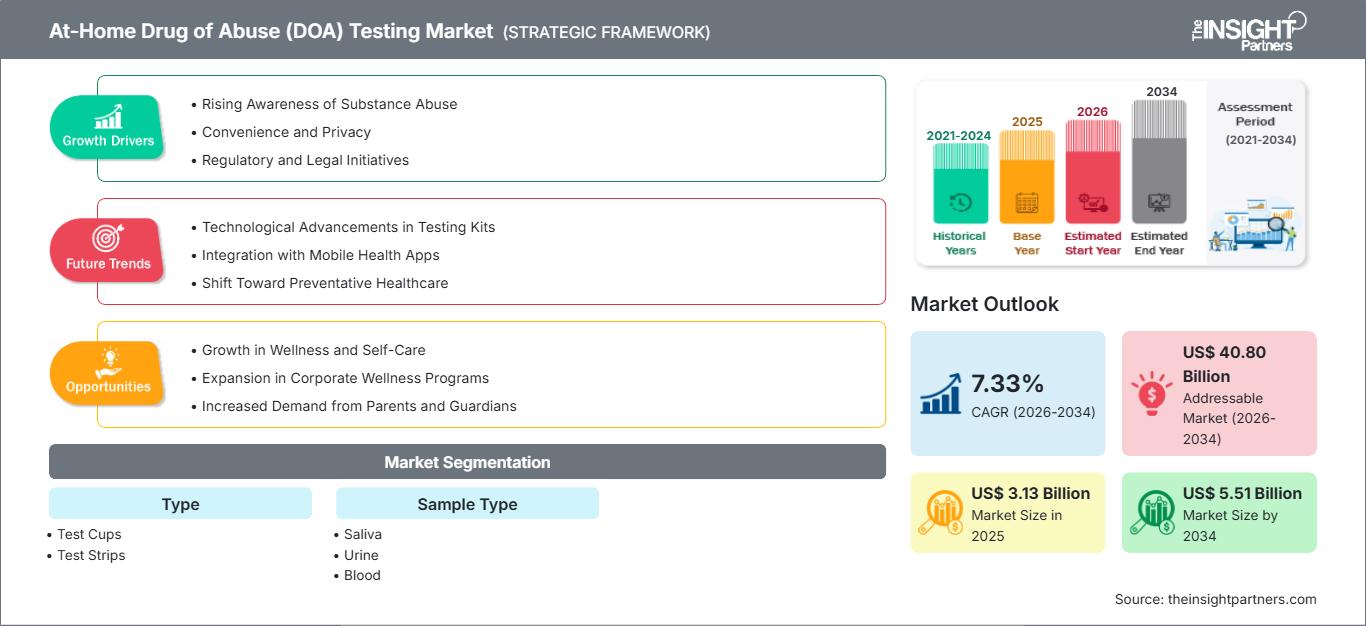
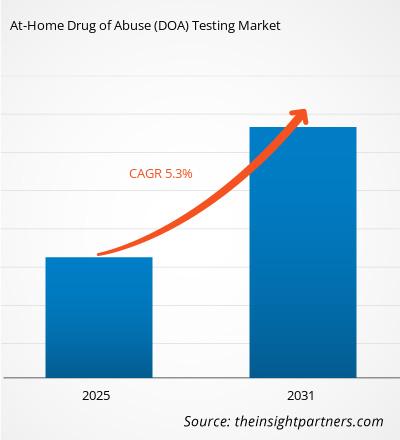
The At-Home Drug of Abuse (DOA) Testing market was valued at US$ 3.13 billion in 2025 and is expected to reach US$ 5.51 billion by 2034; it is estimated to record a CAGR of 6.49% during 2026-2034.
At-Home Drug of Abuse (DOA) Testing Market Assessment and Insights
- North America: North America represented a 38–42% share in 2025 and is expected to expand at a 7.6–8.2% CAGR between 2026–2034, supported by established screening practices, workplace programs, retail availability, and technology adoption.
- US: The US accounted for 31–34% of the global market in 2025, within the North American base, and is projected to grow at a 7.7–8.3% CAGR through 2034.
- Europe: Europe held a 25–29% share in 2025 and is expected to grow at a 6.8–7.5% CAGR between 2026–2034, with Germany, the UK, France, Italy, and Spain supporting demand through occupational and community screening.
- Asia Pacific: Asia Pacific captured a 19–23% share in 2025 and is projected to record a 7.9–8.7% CAGR, led by China, Japan, South Korea, India, and Australia as access to decentralized testing improves.
- Largest Segment: Test Cups held a 54–58% market share in 2025 and are expected to register a 6.9–7.5% CAGR between 2026–2034, benefiting from multi-analyte screening and simplified handling.
- High Growth Segment: Saliva held a 17–21% market share in 2025 and is expected to grow at an 8.5–9.3% CAGR through 2034, supported by non-invasive collection and rapid screening.
- Key companies analyzed in detail: Abbott Laboratories, Drägerwerk AG & Co. KGaA, UCP Biosciences Inc., Orient New Life Medical Co. Ltd., Assure Tech. (Hangzhou) Co., Ltd., Psychemedics Corporation, Confirm BioSciences, Phamatech Inc., Atlas Medical GmbH, OraSure Technologies, Inc.
Source: The Insight Partners' analysis based on proprietary research, government publications, company annual reports, investor presentations, industry databases, and expert interviews.
Product development trends have been moving towards miniaturized immunoassay devices, wider analyte panel capability, simpler sample collection process and easier result interpretation. Economies of manufacturing scale will continue to benefit from standardization of lateral flow components, injection-molded housing, integrated collection device and high-volume reagent preparation.
Over the forecast period, the market adoption should expand from traditional workforce and law enforcement drug screening applications to family screening, addiction recovery support, community programs and distributed care. The regulatory focus on chain of custody, confirmatory analysis, consumer labeling and data privacy concerns will impact the market positioning. Volume growth potential exists in developing countries where diagnostics retail infrastructure, e-commerce logistics capabilities and awareness of substance use risks grow.
At-Home Drug of Abuse (DOA) Testing Market Report Scope
| Report Attribute | Details |
|---|---|
| Market size in 2025 | US$ 3.13 Billion |
| Market Size by 2034 | US$ 5.51 Billion |
| Global CAGR (2026 - 2034) | 6.49% |
| Historical Data | 2021-2024 |
| Forecast period | 2026-2034 |
At-Home Drug of Abuse (DOA) Testing Market Analysis
at-home drug of abuse testing market has seen positive developments due to an increased public-health problem created by substance abuse. According to WHO, 296 million people aged 15-64 abused psychoactive substances in 2021, while 39.5 million people were dealing with drug use disorder. The mentioned disorders have contributed to the creation of demand for reliable screening options.
In terms of the value chain, the industry includes antibody and reagents suppliers, membranes manufacturers, plastic component manufacturers, test kit assemblers, distributors, pharmacies, internet-based retailers, labs, and health professionals. The urine test has been preferred from an operational perspective as the procedure is already known, whereas saliva test provides convenient and private option. This implies that supply competition is evolving in the direction of manufacturing reliability, test panel diversity, shelf-life and packaging efficiency.
The competitive environment in the at-home drug of abuse testing market report consists of diversified diagnostics companies and specialized toxicology and rapid-testing manufacturers. In the case of Abbott Laboratories, the diversified diagnostics infrastructure provides the competitive advantage, while for Drägerwerk AG & Co. KGaA, it is related to the portable oral fluid drug testing solutions. UCP Biosciences Inc., Orient New Life Medical Co. Ltd., Assure Tech. (Hangzhou) Co., Ltd., and Phamatech Inc. have the competitive advantage based on the capability of producing rapid-tests.
The competitive advantage of Psychemedics Corporation and Confirm BioSciences is their specialized toxicology knowledge base, whereas that of Atlas Medical GmbH is European diagnostics channels. OraSure Technologies, Inc. can leverage its oral fluid testings expertise. The investment strategies of competitors are gradually shifting to multiplex testing, easy sample collection, digital results processing, and new channels.
● REPORT CUSTOMIZATION
Tailor This Report To Align With Your Specific Business Requirements
This report can be customized to align precisely with your business objectives, scope, and target markets. Customization options include tailored segmentation, geography, competitive analysis, and strategic insights to support informed decision-making.
Customize This Report →WHAT YOU CAN ADJUST
- ● Segmentations
- ● Geography
- ● Competitive Analysis
- ● Language Preferences
At-Home Drug of Abuse (DOA) Testing Market: Strategic Insights
Regional Insights
North America At-home drug of abuse testing market
North America held a share of 38–42% in 2025 and is expected to grow at a CAGR of 7.6–8.2% up to 2034. The USA forms the leading regional market due to the presence of workplace testing, occupational safety testing, family screening, and direct consumer channels. In addition, Canada provides demand via occupational and clinical screening uses, and Mexico appears as a promising region due to decentralized diagnostics.
Familiarity with the testing method in regard to tests that use urine and oral fluids is also a contributing factor for adoption. Urine and oral fluid are known as approved specimens in the federal workplace testing programs in the US, hence creating a good technical environment for rapid testing kits. Increased emphasis on opioid abuse, driving impairment, and safety in the workplace have increased the applications of these tests.
U.S. At-home drug of abuse testing Market
The United States is estimated to make up about 79–82% of the North American market and is expected to grow at a CAGR of 7.7–8.3% from 2025 to 2034. Factors driving demand include workplace screenings, parent-controlled tests, detoxification treatments, and an increase in preliminary testing. The US companies Abbott Laboratories and specialized toxicology providers have strong presence in the overall screening market.
The use of urine is favored due to the nature of the process and also the many substances that can be tested for. Saliva is the choice for a faster and non-painful method. The government considers both urine and saliva as appropriate choices for drug testing in the workplace, but in the consumer market, there are only preliminary results.
Europe At-home drug of abuse testing Market
In Europe, the at-home drug of abuse testing market share amounted to 25-29% in 2025, and CAGR growth was estimated at 6.8-7.5%. Dominance belongs to Germany owing to workplace safety, road safety screening, and diagnostics distribution system. Great Britain and France represent large markets because of occupational and health care requirements, whereas Italy and Spain make a contribution in retail diagnostics and testing awareness.
Germany finds it beneficial that portable oral fluid screening will be helpful for quick initial evaluation in workplace and roadside settings. The advantage of Great Britain lies in developed private healthcare and retail distribution, whereas in France there is a combination of occupational and community screening requirements. There are possibilities in Italy and Spain owing to pharmacy availability, e-commerce, and family testing.
APAC At-home drug of abuse testing Market
APAC represented a 19–23% share in 2025 and is expected to register a 7.9–8.7% CAGR. China is the leading country, followed by Japan, South Korea, India, and Australia. Expanding healthcare access, manufacturing capacity, and digital commerce are improving product availability across the region.
The demand is driven by policy focus on drug abuse, occupational health and safety, and traffic safety, whereas local manufacturing could reduce cost of procurement. While China and India provide volume potential, Japan focuses on reliability and quality of products, and Australia already has occupational and roadside screening procedures in place. The saliva-based test kits could capitalize on their non-invasive nature.
Middle East & Africa At-home drug of abuse testing Market
Middle East and Africa is projected to record a 6.2–7.0% CAGR through 2034. Saudi Arabia represents a leading market within the region, followed by the UAE and South Africa. Demand is associated with occupational safety, healthcare screening, border-control environments, and growing awareness of substance-use risks.
Infrastructural spending, increasing private health care networks, and diversification of economies are making access to diagnostic products easier. Gulf regions have the potential to accommodate premium rapid test format owing to centralized procurement and modern health care facilities, whereas South Africa is better placed to offer a wider market for applications in occupational and community settings.
Segmentation Analysis
Type
Type segmentation defines the principal product formats used for decentralized screening. Test cups benefit from integrated collection and multi-panel testing, while test strips provide lower-cost options suited to high-volume screening. The type segment is expected to expand at a 6.9–7.5% CAGR from 2026–2034. Product differentiation increasingly depends on panel configuration, ease of interpretation, packaging, and stability.
- Test Cups: Test cups maintain the strongest market position because collection and testing occur within one container, reducing handling steps and supporting multi-analyte screening in household, workplace, and rehabilitation applications.
- Test Strips: Test strips provide a flexible, cost-efficient format for users seeking straightforward screening, particularly where distributors and retailers prioritize compact packaging, low shipping requirements, and broad product variety.
Sample Type
Sample Type segmentation is becoming increasingly important as users prioritize convenience, privacy, and speed. The segment is projected to grow at an 8.0–8.8% CAGR during 2026–2034. Urine remains the principal specimen because of established screening protocols, while saliva is gaining strategic importance through non-invasive collection and faster usability. Blood remains comparatively specialized.
- Saliva: Saliva testing offers non-invasive collection and rapid handling, making it strategically relevant for recent-use screening, family monitoring, workplace applications, and situations where users seek simpler specimen collection.
- Urine: Urine remains the dominant specimen because established analytical procedures, broad drug panels, and extensive consumer familiarity support recurring purchases across households, employers, rehabilitation programs, and diagnostic channels.
- Blood: Blood-based testing occupies a specialized position where physiological measurement or confirmatory assessment is required, but collection complexity and invasive sampling constrain routine consumer adoption.
Opportunity Snapshot
| Sample Type | Revenue Contribution | Trend Tag | Adoption Stage |
| Saliva | Medium | Oral Fluid | Scaling |
| Urine | High | Urine Panels | Mature |
| Blood | Low | Micro Sampling | Emerging |
At-Home Drug of Abuse (DOA) Testing Market Growth Drivers and Impact Analysis
Expansion of decentralized screening and rapid-result expectations
Consumers, employers, caregivers, and community organizations increasingly value testing that can be performed without immediate laboratory access. Portable screening reduces logistical barriers and can provide preliminary results within minutes, supporting faster decisions about follow-up testing or professional intervention. The impact is particularly relevant where users prioritize privacy or where transportation to laboratories creates delays. Rapid formats also enable repeated screening because collection procedures are simpler and products can be distributed through pharmacies and online channels. For manufacturers, this shift favors compact packaging, intuitive instructions, stable reagents, and multi-panel configurations. Suppliers capable of combining reliable analytical performance with simple workflows can capture demand from both individual consumers and institutional buyers seeking decentralized screening capacity.
Rising public-health focus on substance-use detection and intervention
Substance use remains a significant public-health concern, strengthening the rationale for accessible screening technologies. WHO estimates that drug use contributes to approximately 0.6 million deaths annually, while drug use disorders affect tens of millions of people globally. These figures reinforce the need for prevention, early identification, and treatment referral rather than relying solely on downstream clinical intervention. At-home testing can contribute to the preliminary identification stage when used appropriately and followed by professional assessment. Market impact is strongest in settings where families, caregivers, employers, and community programs require convenient screening. Manufacturers can respond by improving educational materials, clearly communicating limitations, and developing panels aligned with region-specific patterns of substance use.
Broader use of oral-fluid testing in safety-sensitive environments
Oral-fluid testing is gaining strategic importance because specimen collection is non-invasive and can reduce some practical barriers associated with urine collection. US federal workplace guidance permits oral-fluid testing alongside urine testing under applicable programs, reinforcing its institutional legitimacy. The same collection characteristics can support roadside, occupational, and family applications where rapid handling is important. Market impact extends beyond the test itself because oral-fluid workflows can encourage demand for collection devices, cassettes, confirmatory laboratory services, and digital documentation. Suppliers therefore have an opportunity to build integrated solutions rather than compete solely on per-test pricing. Product developers that improve collection reliability, analyte coverage, and interpretation should be better positioned for adoption in decentralized screening environments.
At-Home Drug of Abuse (DOA) Testing Market Future Trends
Connected screening and digital interpretation
Future products in the at-home drug of abuse testing market trends are likely to incorporate smartphone-assisted interpretation, digital result storage, and structured reporting to reduce ambiguity in consumer testing. Connectivity can help users document serial results, support caregiver oversight, and facilitate communication with healthcare professionals when follow-up is appropriate. Manufacturers may increasingly design test cassettes around machine-readable visual outputs rather than relying solely on manual interpretation. Digital integration can also support inventory monitoring for institutional buyers and improve traceability across distributed screening programs. The commercial opportunity will depend on privacy safeguards, clear consent mechanisms, and appropriate separation between preliminary screening and clinical confirmation. Vendors that combine simple physical testing with responsible digital workflows could differentiate their portfolios without materially increasing collection complexity.
Higher multiplexing and emerging analyte coverage
Product development is expected to move toward broader multiplex panels capable of identifying several substance classes from a single specimen. The objective is to improve information obtained per test while keeping collection and interpretation simple. Demand for expanded panels will be influenced by changing patterns of prescription misuse, synthetic substances, and regional drug prevalence. Manufacturers may also introduce configurable panels that allow distributors or institutional customers to select analytes according to application. However, broader detection creates technical requirements involving antibody specificity, cross-reactivity, cutoff selection, and confirmatory testing. Future competition will therefore depend on analytical performance as much as price. Suppliers with strong reagent development and validation capabilities should have greater scope to introduce differentiated multiplex products.
At-Home Drug of Abuse (DOA) Testing Market Opportunities
Retail and e-commerce expansion in emerging markets
Emerging markets offer an opportunity to expand access through pharmacy chains, diagnostic distributors, and e-commerce platforms that can reach consumers outside major healthcare centers. India, Southeast Asia, Latin America, and selected Middle Eastern markets provide attractive conditions where mobile commerce and private healthcare infrastructure are expanding. Manufacturers can prioritize compact products with simple instructions, multilingual labeling, and shelf-stable packaging suited to varied distribution conditions. Partnerships with established distributors can reduce regulatory and channel-entry friction while improving product availability. A tiered portfolio covering basic strips, multi-panel cups, and premium saliva formats could address different purchasing capacities. The at-home drug of abuse testing market forecast participants should also invest in education because consumer understanding of preliminary results and confirmatory testing directly affects responsible product adoption.
Integrated screening-to-confirmation service models
A second opportunity lies in connecting rapid screening products with laboratory confirmation and referral services. Preliminary tests can identify samples requiring additional evaluation, creating a pathway toward confirmatory analytical testing when legally or clinically appropriate. Suppliers can partner with accredited laboratories, telehealth providers, occupational-health organizations, and rehabilitation networks to create structured workflows. Such models can increase recurring revenue beyond the initial test sale while improving the practical value of screening. The approach is particularly relevant for employers and organizations that need documented processes rather than standalone consumer products. Investment should prioritize secure data transfer, chain-of-custody procedures where applicable, transparent reporting, and clear differentiation between screening and definitive laboratory results.
Recent Developments
- June 2026: Abbott Laboratories reported continued investment in operational and supply-chain expansion, including US manufacturing capacity and broader supply resilience. Its rapid diagnostics portfolio includes toxicology solutions and consumer-oriented testing, supporting continued positioning across decentralized and point-of-care screening channels.
- July 2026: Drägerwerk AG & Co. KGaA highlighted the Dräger add digital documentation solution within its alcohol and drug testing portfolio, enabling test-result recording, reporting, and data management. The development strengthens the digital workflow surrounding portable oral-fluid screening and supports applications requiring structured documentation.
- June 2025: Psychemedics Corporation detailed its laboratory workflow for hair-based drug testing, covering extraction, washing, screening, confirmation, recording, and certification. The company’s documentation emphasizes the role of advanced analytical confirmation following initial screening, reinforcing the broader ecosystem connecting rapid identification with laboratory-grade toxicology analysis.
Frequently Asked Questions

- Comprehensive Market Sizing and Forecast Analysis
- Detailed Segmentation Analysis
- In-Depth Market Dynamics Assessment
- Regional and Country-Level Insights
- Competitive Landscape and Company Benchmarking
- Strategic Business Intelligence
Recent Reports
Testimonials

The Insight Partners provided valuable market intelligence that supported our global go-to-market strategy. Their team was professional, responsive, and attentive to our feedback, providing thoughtful analysis and helpful methodological clarifications throughout the project.
Junmo Kim Chief Financial Officer (CFO), Enertech Co., Ltd.
The Insight Partners' SCADA System Market report is comprehensive, with valuable insights on current trends and future forecasts. The team was highly professional, responsive, and supportive throughout. We are very satisfied and highly recommend their services.
RAN KEDEM Partner, Reali Technologies LTDs
I requested a report on a very specific software market and the team produced the report in a few days. The information was very relevant and well presented. I then requested some changes and additions to the report. The team was again very responsive and I got the final report in less than a week.
JEAN-HERVE JENN Chairman, Future Analytica
We worked with The Insight Partners for an important market study and forecast. They gave us clear insights into opportunities and risks, which helped shape our plans. Their research was easy to use and based on solid data. It helped us make smart, confident decisions. We highly recommend them.
PIYUSH NAGPAL Sr. Vice President, High Beam Global
The Insight Partners delivered insightful, well-structured market research with strong domain expertise. Their team was professional and responsive throughout. The user-friendly website made accessing industry reports seamless. We highly recommend them for reliable, high-quality research services
YUKIHIKO ADACHI CEO, Deep Blue, LLC.
This is the first time I have purchased a market report from The Insight Partners.While I was unsure at first, I visited their web site and felt more comfortable to take the risk and purchase a market report.I am completely satisfied with the quality of the report and customer service. I had several questions and comments with the initial report, but after a couple of dialogs over email with their analyst I believe I have a report that I can use as input to our strategic planning process.Thank you so much for taking the extra time and making this a positive experience.I will definitely recommend your service to others and you will be my first call when we need further market data.
JOHN SUZUKI President and Chief Executive Officer, Board Director, BK Technologies
I wish to appreciate your support and the professionalism you displayed in the course of attending to my request for information regarding to infectious disease IVD market in Nigeria. I appreciate your patience, your guidance, and the fact that you were willing to offer a discount, which eventually made it possible for us to close a deal. I look forward to engaging The Insight Partners in the future, all thanks to the impression you have created in me as a result of this first encounter.
DR CHIJIOKE ONYIA MANAGING DIRECTOR, PineCrest Healthcare Ltd.Reason to Buy
- Informed Decision-Making
- Understanding Market Dynamics
- Competitive Analysis
- Identifying Emerging Markets
- Customer Insights
- Market Forecasts
- Risk Mitigation
- Boosting Operational Efficiency
- Strategic Planning
- Investment Justification
- Tracking Industry Innovations
- Aligning with Regulatory Trends





 Get Free Sample for