
Atopic Dermatitis Treatment Market Share, Growth & Demand by 2034
Coverage: By Drug Class ( Corticosteroids, Calcineurin Inhibitors, Immunosuppressant, Biologic Therapy, PDE-4 Inhibitor, Antibiotics, Antihistamines, Emollients ); Route of Administration ( Topical, Oral, Injectable ); Distribution Channel ( Hospital Pharmacies, Retail Pharmacies, Online Pharmacies, Drug Stores, Mail Order Pharmacies, Dermatology Clinics ) , and Geography (North America, Europe, Asia Pacific, and South and Central America)
- Status : Data Released
- Report Code : TIPRE00006854
- Category : Life Sciences
- No. of Pages : 150
- Available Report Formats :


- Last update date : September 08, 2026


2025 Market Size
US$ 17.64 Bn
Base year value
2034 Forecast
US$ 46.20 Bn
Projected by 2034
CAGR 2026-2034
11.29 %
Growth rate
Addressable Market
US$ 281.49 Bn
(2026-2034)
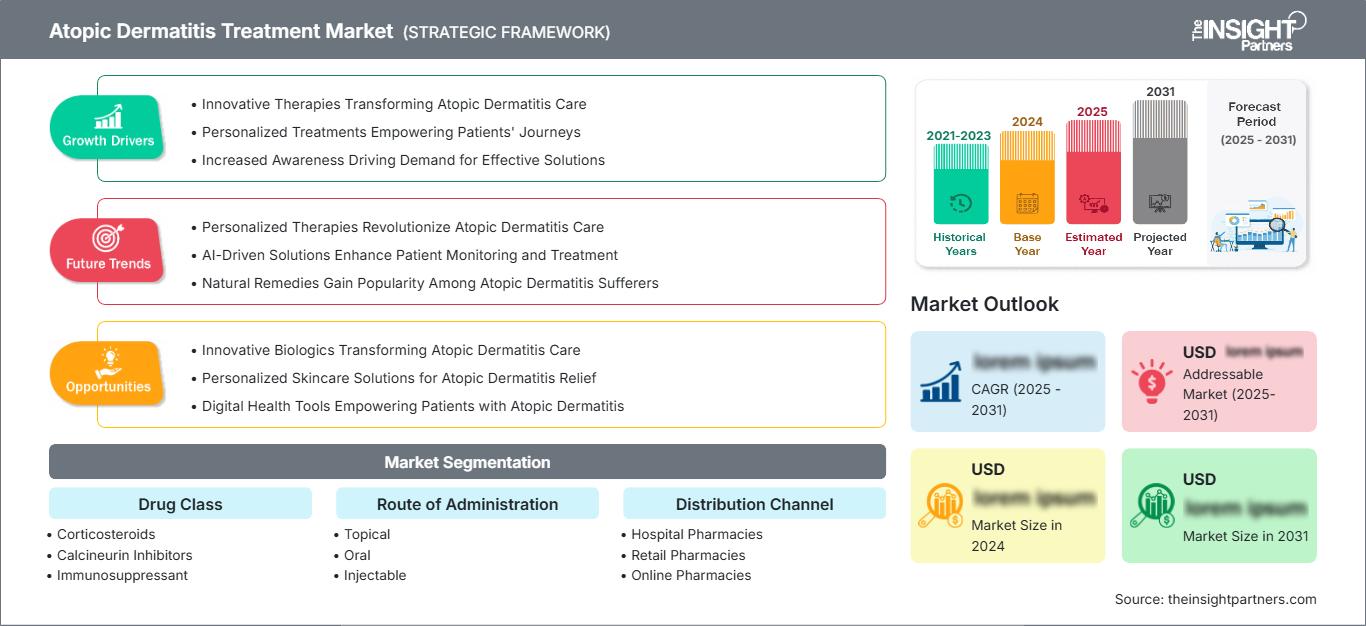
The atopic dermatitis treatment market is undergoing a transition from conventional topical management toward targeted systemic and biologic therapies, supported by increasing treatment intensity for moderate-to-severe disease. The market was valued at US$ 17.64 Billion in 2025 and is projected to reach US$ 46.20 Billion by 2034, expanding at a CAGR of 11.29% during 2026–2034. The expansion reflects increasing adoption of advanced immunomodulatory therapies and broader treatment eligibility.
North America is expected to remain the largest regional atopic dermatitis treatment market size, supported by established dermatology infrastructure, high biologic penetration, favorable reimbursement for specialty medicines, and strong clinical development activity. Its growth is expected to remain within an 8.5–10.5% CAGR range during 2026–2034, with demand increasingly shaped by treatment persistence, pediatric eligibility, and differentiated dosing schedules.
Atopic Dermatitis Treatment Market Assessment and Insights
- North America: North America is projected to account for a 40–44% share in 2025, growing at a CAGR of 9.0–10.5% between 2026–2034, supported by specialty-care access, biologic reimbursement, and established treatment pathways.
- US: The US is estimated to represent 82–86% of North America's 2025 share, expanding at a CAGR of 9.0–10.5% between 2026–2034, led by advanced systemic therapies.
- Europe: Europe is expected to hold a 28–32% share in 2025, growing at a CAGR of 9.0–10.5% between 2026–2034, with Germany, France, the UK, Italy, and Spain supporting demand through specialist dermatology services.
- Asia Pacific: Asia Pacific is estimated at a 20–24% share in 2025, expanding at a CAGR of 12.0–14.0% between 2026–2034, led by China, Japan, South Korea, India, and Australia.
- Largest Segment: Biologic Therapy is estimated at a 24–28% market share in 2025, with a CAGR of 14.0–16.0% during 2026–2034, reflecting increasing systemic treatment adoption.
- High Growth Segment: Injectable administration is estimated at an 18–22% market share in 2025, with a CAGR of 15.0–17.0% during 2026–2034, supported by biologic uptake.
- Key companies analyzed in detail: Sanofi S.A., Allergan plc, Novartis International AG, Bristol-Myers Squibb, Bayer AG, Meda Pharmaceuticals, Anacor Pharmaceutical Inc., Pfizer, Astellas Pharma Inc., Regeneron Pharmaceuticals.
Source: The Insight Partners' analysis based on proprietary research, government publications, company annual reports, investor presentations, industry databases, and expert interviews.
From an approach focused on symptoms through topical application to pathway-based targeting, especially IL-4, IL-13, PDE-4, and other immune-mediated pathologies, treatment strategies have evolved. Biologics and target-specific oral treatments have increased the options on the ladder of treatments available to patients for moderate to severe conditions, while topical corticosteroids, calcineurin inhibitors, antibiotics, antihistamines, and emollients continue to be used irrespective of the severity of disease. The manufacturing process thus involves complex biological manufacturing, cold chain handling, sterile injectables, and advanced delivery methods.
In the coming years, increasing treatment volume from Asia's emerging markets will result from improved specialist diagnosis and evolving reimbursement systems. Regulatory authorities are increasingly concerned about pediatric data, safety, efficacy, and patient-specific dosing. Investments in future years will thus be made in mechanisms that differentiate themselves from competitors, extend dosing intervals, use combinations, and are able to reduce reliance on conventional topical steroids.
Atopic Dermatitis Treatment Market Report Scope
| Report Attribute | Details |
|---|---|
| Market size in 2025 | US$ 17.64 Billion |
| Market Size by 2034 | US$ 46.20 Billion |
| Global CAGR (2026 - 2034) | 11.29% |
| Historical Data | 2021-2024 |
| Forecast period | 2026-2034 |
Atopic Dermatitis Treatment Market Analysis
The drivers of demand include chronic burden of disease, frequent flares, cessation of therapy, and need for better control in moderate/severe cases. The growth of the atopic dermatitis treatment market is tied to an increased understanding of disease severity and referrals to dermatologists from primary care physicians. Supply chain includes active pharmaceutical ingredient manufacturers, biologics manufacturing, formulations, specialty distribution, dermatologists' offices, pharmacies, payers, and patient support services.
Supply trends become progressively focused on companies that can handle biologics manufacturing, aseptic fill, submission, and specialized distribution simultaneously. The special treatments are relatively expensive to create than normal topicals, however, their commercialization will depend on payers, doctors, persistency, and differentiation. While generics and existing topicals have their volumes to deliver, their strategic importance becomes increasingly a complementary part to the advanced treatments.
Differences in competitive intensity are being driven by differentiated mechanisms, more frequent dosing, expanded age groups, and proving that the disease can be managed effectively over the long term. According to the atopic dermatitis treatment market report, Sanofi S.A. and Regeneron Pharmaceuticals enjoy strong strategic positioning thanks to Dupixent, while Novartis International AG continues to pursue investigational drugs for the condition. Pfizer enjoys strengths in inflammation and immunology, and Bristol-Myers Squibb has strengths in targeted immunomodulation.
Strong strategic positioning increasingly requires a broad portfolio of products rather than just one mechanism. Sanofi S.A. and Regeneron Pharmaceuticals benefit from their established biologics franchise, while competitors who are entering the field look to differentiate by selectively inhibiting certain pathways and offering more infrequent dosing regimens. Money is increasingly flowing into product lifecycle management, expanded use of drugs among children, better devices, real-world evidence, and early intervention strategies.
● REPORT CUSTOMIZATION
Tailor This Report To Align With Your Specific Business Requirements
This report can be customized to align precisely with your business objectives, scope, and target markets. Customization options include tailored segmentation, geography, competitive analysis, and strategic insights to support informed decision-making.
Customize This Report →WHAT YOU CAN ADJUST
- ● Segmentations
- ● Geography
- ● Competitive Analysis
- ● Language Preferences
Atopic Dermatitis Treatment Market: Strategic Insights
Regional Insights
North America Atopic dermatitis treatment market
North America is expected to retain the leading regional position, representing a 40–44% share in 2025 and expanding at a CAGR of 9.0–10.5% during 2026–2034. High specialist density, broad biologic reimbursement, established treatment guidelines, and strong pharmaceutical infrastructure support adoption across moderate-to-severe patients.
North America leads in regional demand due to the widespread availability of specialty drugs and quick adoption of new drug approvals. The country's position is supported by Canada's contributions from public healthcare systems and the rising number of diagnoses by specialists. There is a growing emphasis in commercial interests on treatment persistence, pediatrics suitability, ease of administration, and payer segmentation.
U.S. Atopic dermatitis treatment Market
The United States comprises about 82-86% of the total market potential in North America for the year 2025, with anticipated growth rate for the region of 9.0-10.5% during 2026-2034. The United States offers several advantages like dermatology network, specialty pharmacy, biologics reimbursement, and fast adoption of new treatments among eligible patient populations.
Sanofi S.A., Regeneron Pharmaceuticals, Pfizer, Bristol-Myers Squibb, Novartis International AG, and many others have commercial or developmental presence. Increasing applications from adult conditions to adolescent and young patients is being seen, along with the use of biologics and targeted therapy through injections and orally. Payer negotiations and formulary positioning continue to be influential factors.
Europe Atopic dermatitis treatment Market
Europe is expected to have a 28-32% of the atopic dermatitis treatment market share in 2025 and grow at a CAGR of 9.0-10.5% for 2026-2034. Germany will continue to be the largest market because of specialist access, a good reimbursement system, and high pharmaceutical use. The UK, France, Italy, and Spain contribute to demand due to well-established dermatology systems.
The United Kingdom relies on central health technology assessment and clinical pathways, Germany relies on the availability of specialists and drugs, France persists with demand due to hospital and specialist prescribing, while Italy and Spain have expanded access to newer treatment modalities. Biologics penetration and drug sequencing will continue to be important considerations for the European market.
APAC Atopic dermatitis treatment Market
It is estimated that APAC accounts for a 20-24% market share in 2025 and will grow at a rate of 12.0-14.0% in 2026-2034. It will be driven by the increasing demand from countries such as China, Japan, South Korea, India, and Australia. Growing specialized care and diagnostics will drive adoption.
Increasing accessibility of advanced treatment options and drug development in China, advanced infrastructure for dermatological care in Japan, increasing willingness towards novel treatments in South Korea, and long-term volume growth potential in India owing to specialist diagnostics and well-established reimbursement and specialist care in Australia will drive growth in the region.
Middle East & Africa Atopic dermatitis treatment Market
Middle East and Africa is expected to remain a smaller regional market but should benefit from improving specialist infrastructure and private healthcare investment. Saudi Arabia and the UAE lead advanced-therapy adoption, while South Africa represents an important gateway market for the broader region.
Growth in this market will be facilitated by healthcare development, higher levels of specialized care availability, and investments in hospital infrastructure. The Saudi Arabia Healthcare Reform initiative and the growing private sector healthcare facilities in the UAE offer conducive conditions for developing dermatology therapy. South Africa makes an input through specialist clinics, whereas the Rest of MEA faces affordability challenges.
Segmentation Analysis
Drug Class
Drug Class is expected to expand at a CAGR of 10.5–12.5% during 2026–2034. The segment reflects the continued coexistence of conventional therapies and rapidly expanding targeted treatments. Biologic Therapy and PDE-4 Inhibitor products are strengthening the advanced-treatment pathway, while corticosteroids and emollients remain foundational because of broad prescribing familiarity.
- Corticosteroids: Remain central to flare management because of established efficacy, physician familiarity, broad formulation availability, and suitability across different disease severities when appropriately prescribed.
- Calcineurin Inhibitors: Maintain an important steroid-sparing position, particularly for sensitive skin areas and patients requiring longer-term topical management.
- Immunosuppressant: Continue serving selected moderate-to-severe patients where conventional systemic treatment remains clinically appropriate, although safety monitoring can influence utilization.
- Biologic Therapy: Represents the most strategically important, advanced class, supported by pathway-specific mechanisms, durable disease-control objectives, and increasing eligibility across age groups.
- PDE-4 Inhibitor: Benefits from nonsteroidal positioning and topical or systemic development approaches, creating opportunities for patients seeking alternatives to corticosteroid-centered management.
- Antibiotics: Remain relevant when bacterial complications accompany active dermatitis, although their role is increasingly focused on clinically justified infection management.
- Antihistamines: Support selected symptomatic-management strategies, particularly where itch and sleep disruption require adjunctive treatment considerations.
- Emollients: Remain foundational for barrier maintenance and supportive care, frequently used alongside prescription therapies throughout the treatment journey.
Route of Administration
Route of Administration is projected to grow at a CAGR of 11.0–13.0% during 2026–2034. The atopic dermatitis treatment market scope increasingly reflects the shift toward targeted systemic therapy while maintaining a substantial topical base. Administration convenience, adherence, disease severity, and treatment setting influence route selection.
- Topical: Remains the broadest-access route because it supports first-line treatment, maintenance, flare control, and combination use across disease severity levels.
- Oral: Gains strategic importance through targeted small-molecule therapies offering systemic exposure without injection requirements, particularly where rapid treatment initiation and administration convenience matter.
- Injectable: Expands rapidly through biologic adoption, specialist prescribing, self-administration devices, and longer maintenance intervals that can reduce treatment frequency.
Distribution Channel
Distribution Channel segment in the atopic dermatitis treatment market is expected to grow at a CAGR of 9.0–11.0% during 2026–2034. Specialty treatment adoption is increasing the importance of channels capable of managing prescription verification, reimbursement, cold-chain logistics, patient support, and refill continuity.
- Hospital Pharmacies: Remain important for specialist initiation, complex systemic therapies, institutional prescribing, and patients requiring monitored treatment pathways.
- Retail Pharmacies: Continue supporting high-volume topical and oral prescriptions, particularly for routine maintenance and established therapies.
- Online Pharmacies: Gain relevance through digital prescription fulfillment, home delivery, refill reminders, and greater consumer convenience.
- Drug Stores: Remain important for accessible prescription and supportive dermatology products, especially in markets with fragmented pharmacy networks.
- Mail Order Pharmacies: Support recurring treatment requirements through scheduled delivery and refill management, particularly for long-duration therapies.
- Dermatology Clinics: Play a growing role in treatment initiation, biologic administration, monitoring, and specialist decision-making for moderate-to-severe disease.
Opportunity Snapshot
| Distribution Channel | Revenue Contribution | Trend Tag | Adoption Stage |
|---|---|---|---|
| Hospital Pharmacies | High | Specialty Access | Mature |
| Retail Pharmacies | High | Chronic Refills | Mature |
| Online Pharmacies | Medium | Digital Fulfillment | Scaling |
| Drug Stores | Medium | Local Access | Mature |
| Mail Order Pharmacies | Medium | Refill Delivery | Scaling |
| Dermatology Clinics | High | Specialist Care | Scaling |
Atopic Dermatitis Treatment Market Growth Drivers and Impact Analysis
Expansion of Targeted Therapies Across Eligible Patient Populations
Availability of increased biologics and targeted drug options will change the treatment sequence since these drugs will allow physicians to take patients that can be considered moderate-to-severe beyond standard topical options. An increase in age suitability will help to expand the addressable population, whereas better dosing schedule will aid in persistence and administration ease. The commercial success of the product does not lie solely in its medical benefits because now companies can utilize specialty pharmacy services, diagnostics and other tools for the delivery of their products. The companies with different mechanism of action can consider life cycle expansion into pediatric and related inflammation indications.
The end result of these actions will be the trend towards greater value systemic options.
Improving Diagnosis and Specialist Referral Pathways
Increasing awareness of the severity of the condition results in more patients being referred to specialists and no longer solely dependent on self-care or intermittent topicals. Patients that have recurrent flare-ups, insomnia, extensive lesions, and non-responsiveness to usual treatments are those referred to dermatology clinics for further diagnosis and treatment. This presents a business opportunity from diagnosis to increased prescription of medication and monitoring of the condition. This is especially significant in emerging markets where the scope of specialty care is growing not only in big cities but also in smaller ones. For pharmaceutical companies, this means the opportunity to contribute to physician training, treatment protocols, adherence programs, and patient identification schemes without impacting the clinical decision-making process.
Rising Importance of Treatment Persistence and Quality-of-Life Outcomes
Treatment decisions increasingly consider sustained disease control, itch reduction, sleep quality, skin clearance, and convenience rather than short-term lesion improvement alone. These factors influence persistence and can affect the economic value attributed to advanced therapies by patients, physicians, and payers. Products offering less frequent administration or reduced dependence on concomitant topical treatment may gain differentiation when supported by appropriate clinical evidence. This dynamic also increases the importance of real-world evidence, patient-reported outcomes, and long-term safety data. Commercial strategies are consequently shifting toward demonstrating durable value across the treatment journey. Companies that can connect efficacy with adherence and quality-of-life outcomes may achieve stronger positioning in competitive formularies.
Atopic Dermatitis Treatment Market Future Trends
Longer-Interval Maintenance Dosing
Future product development is likely to emphasize extended maintenance intervals that reduce treatment frequency while preserving disease control. The direction is already visible in targeted biologic development, where companies are testing monthly, every-eight-week, quarterly, or similarly differentiated schedules. Such approaches could alter patient preferences, administration settings, specialty pharmacy workflows, and healthcare-provider follow-up patterns. Device design will also become increasingly important because self-administration can determine whether an injectable therapy delivers its intended convenience advantage. Longer intervals may strengthen persistence by reducing the operational burden associated with chronic treatment. Competitive differentiation will therefore increasingly depend not only on efficacy but also on the practical frequency, simplicity, and reliability of treatment delivery.
Precision Immunology and Mechanism-Specific Treatment Selection
Future competition is expected to move toward more precise selection of immune pathways and patient populations. Advances in understanding type 2 inflammation, epithelial signaling, cytokine networks, and immune-cell interactions may generate therapies designed around narrower biological targets. This atopic dermatitis treatment market trends create differentiated treatment algorithms based on phenotype, previous response, disease severity, comorbidities, and treatment history. Biomarker research may gradually support more structured patient segmentation, although widespread clinical adoption will depend on validated tests, reproducible evidence, and economic feasibility. The resulting landscape could become less centered on a single preferred mechanism and more focused on matching therapeutic biology with patient characteristics, creating opportunities for multiple differentiated treatment classes.
Atopic Dermatitis Treatment Market Opportunities
Localized Commercial Expansion in Emerging Asian Markets
Investment opportunities are emerging in Asian markets where specialist diagnosis and access to advanced therapies remain below developed-market levels. Companies can build localized strategies through partnerships with dermatology networks, specialty distributors, and healthcare institutions while adapting pricing and reimbursement approaches to national conditions. China, India, South Korea, and selected Southeast Asian markets offer different combinations of patient volume, pharmaceutical infrastructure, and regulatory maturity. A scalable approach should prioritize evidence generation, physician engagement, local regulatory expertise, and reliable supply rather than relying solely on broad promotional activity. Local manufacturing or regional packaging may further improve supply resilience and affordability. These actions can expand treatment access while creating sustainable commercial platforms for innovative therapies.
Lifecycle Expansion Through Pediatric and Adjacent Indications
Lifecycle management in the atopic dermatitis treatment market forecast represents an important investment opportunity because established mechanisms can potentially address additional age groups, disease severities, or related inflammatory conditions. Pediatric expansion can increase the treated population while strengthening long-term patient relationships, provided safety and efficacy evidence supports regulatory requirements. Companies can also evaluate formulation changes, autoinjectors, dose optimization, and maintenance schedules to improve convenience without requiring an entirely new mechanism. Adjacent indications offer another route for maximizing development infrastructure, particularly when shared inflammatory pathways are clinically established. Strategic investment should therefore focus on evidence quality, regulatory sequencing, manufacturing scalability, and payer value rather than simply expanding labels. Successful lifecycle strategies can extend asset relevance and improve returns on development investment.
Recent Developments
- July 2026: Sanofi S.A. announced that it would discontinue development of amlitelimab in moderate-to-severe atopic dermatitis and would not submit the medicine for global regulatory review. The company stated that the totality of efficacy and safety evidence did not support further development and that the asset was not expected to provide a meaningful improvement over the existing standard of care.
- June 2026: Eli Lilly and Company received US FDA approval for an every-eight-week maintenance regimen of Ebglyss for eligible patients with moderate-to-severe atopic dermatitis. The decision expands dosing flexibility after the initial treatment period and provides a maintenance option involving as few as six injections annually, strengthening convenience-based differentiation within injectable targeted therapies.
- August 2026: Novartis International AG updated its clinical development activity for atopic dermatitis, including a first-in-human Phase I study of DCY636 involving healthy volunteers and participants with moderate-to-severe disease. The study began in June 2026 and is designed to evaluate safety, tolerability, pharmacokinetics, immunogenicity, and pharmacodynamic effects, illustrating continued investment in differentiated immunology mechanisms.
Frequently Asked Questions

- Comprehensive Market Sizing and Forecast Analysis
- Detailed Segmentation Analysis
- In-Depth Market Dynamics Assessment
- Regional and Country-Level Insights
- Competitive Landscape and Company Benchmarking
- Strategic Business Intelligence
Recent Reports
Testimonials

The Insight Partners provided valuable market intelligence that supported our global go-to-market strategy. Their team was professional, responsive, and attentive to our feedback, providing thoughtful analysis and helpful methodological clarifications throughout the project.
Junmo Kim Chief Financial Officer (CFO), Enertech Co., Ltd.
The Insight Partners' SCADA System Market report is comprehensive, with valuable insights on current trends and future forecasts. The team was highly professional, responsive, and supportive throughout. We are very satisfied and highly recommend their services.
RAN KEDEM Partner, Reali Technologies LTDs
I requested a report on a very specific software market and the team produced the report in a few days. The information was very relevant and well presented. I then requested some changes and additions to the report. The team was again very responsive and I got the final report in less than a week.
JEAN-HERVE JENN Chairman, Future Analytica
We worked with The Insight Partners for an important market study and forecast. They gave us clear insights into opportunities and risks, which helped shape our plans. Their research was easy to use and based on solid data. It helped us make smart, confident decisions. We highly recommend them.
PIYUSH NAGPAL Sr. Vice President, High Beam Global
The Insight Partners delivered insightful, well-structured market research with strong domain expertise. Their team was professional and responsive throughout. The user-friendly website made accessing industry reports seamless. We highly recommend them for reliable, high-quality research services
YUKIHIKO ADACHI CEO, Deep Blue, LLC.
This is the first time I have purchased a market report from The Insight Partners.While I was unsure at first, I visited their web site and felt more comfortable to take the risk and purchase a market report.I am completely satisfied with the quality of the report and customer service. I had several questions and comments with the initial report, but after a couple of dialogs over email with their analyst I believe I have a report that I can use as input to our strategic planning process.Thank you so much for taking the extra time and making this a positive experience.I will definitely recommend your service to others and you will be my first call when we need further market data.
JOHN SUZUKI President and Chief Executive Officer, Board Director, BK Technologies
I wish to appreciate your support and the professionalism you displayed in the course of attending to my request for information regarding to infectious disease IVD market in Nigeria. I appreciate your patience, your guidance, and the fact that you were willing to offer a discount, which eventually made it possible for us to close a deal. I look forward to engaging The Insight Partners in the future, all thanks to the impression you have created in me as a result of this first encounter.
DR CHIJIOKE ONYIA MANAGING DIRECTOR, PineCrest Healthcare Ltd.Reason to Buy
- Informed Decision-Making
- Understanding Market Dynamics
- Competitive Analysis
- Identifying Emerging Markets
- Customer Insights
- Market Forecasts
- Risk Mitigation
- Boosting Operational Efficiency
- Strategic Planning
- Investment Justification
- Tracking Industry Innovations
- Aligning with Regulatory Trends





 Get Free Sample for