
Atrial Fibrillation Drugs Market Size, Share & Demand by 2034
Coverage: By Product (Anticoagulant Drugs, Antiarrhythmic Drugs); Type (Permanent, Persistent, Paroxysmal); Application (Heart Rate Control, Heart Rhythm Control); End User (Hospitals, Cardiac Centers, Ambulatory Surgical Centers) , and Geography (North America, Europe, Asia Pacific, and South and Central America)
- Status : Data Released
- Report Code : TIPRE00005207
- Category : Life Sciences
- No. of Pages : 150
- Available Report Formats :


- Last update date : September 08, 2026


2025 Market Size
US$ 18.06 Bn
Base year value
2034 Forecast
US$ 26.14 Bn
Projected by 2034
CAGR 2026-2034
4.19 %
Growth rate
Addressable Market
US$ 200.69 Bn
(2026-2034)
The atrial fibrillation drugs market is projected to expand from US$ 18.06 Billion in 2025 to US$ 26.14 Billion by 2034, registering a CAGR of 4.19% during 2026–2034. The market comprises of anticoagulant and antiarrhythmic medicines that are used in the treatment of permanent, persistent, and paroxysmal diseases. The growth driver includes the rising number of patients diagnosed with the disease, increased focus on stroke prevention, and improvement in pharmacologic management of heart rate and rhythm.
In North America, the atrial fibrillation drugs market size benefits from the presence of well-established infrastructure for treating cardiovascular diseases, high diagnosis rate, and extensive availability of direct oral anticoagulants. The regional market will register a CAGR of 4.4-5.0% till 2034. Growth will be driven by the adoption of guidelines-driven anticoagulation and personalized treatment options.
Atrial Fibrillation Drugs Market Assessment and Insights
- North America: North America is expected to represent a 39–43% share in 2025, supported by mature diagnosis, established reimbursement, and extensive use of oral anticoagulation. The region is projected to grow at a CAGR of 4.4–5.0% between 2026–2034.
- US: The US is expected to account for 83–87% of North American revenue in 2025, with growth of 4.5–5.1% during 2026–2034, reflecting broad access to anticoagulants and cardiovascular specialists.
- Europe: Europe is projected to hold a 27–31% share in 2025 and grow at 3.8–4.4% through 2034. Germany, the UK, France, Italy, and Spain remain important markets because of aging populations and established AF treatment pathways.
- Asia Pacific: Asia Pacific is estimated to command a 19–23% share in 2025 and expand at 5.0–5.7% through 2034. China, Japan, South Korea, India, and Australia provide the principal demand base.
- Largest Segment: Anticoagulant Drugs are expected to hold a 63–68% market share in 2025, growing at a CAGR of 3.8–4.4% as stroke prevention remains central to treatment.
- High Growth Segment: Antiarrhythmic Drugs are expected to represent a 32–37% share in 2025 and grow at 4.8–5.5%, supported by individualized rhythm-control strategies.
- Key companies analyzed in detail: Pfizer; AstraZeneca; Boehringer Ingelheim International GmbH; Sanofi; Bristol-Myers Squibb Company; Mitsubishi Tanabe Pharma Corporation; Johnson & Johnson; Daiichi Sankyo Company, Limited; GlaxoSmithKline plc; Portola Pharmaceuticals; and additional active market participants including Bayer AG.
Source: The Insight Partners' analysis based on proprietary research, government publications, company annual reports, investor presentations, industry databases, and expert interviews.
The trend in treatment strategies has moved towards risk-based approaches to stroke prevention, simplification of oral administration, and personalized management of the rhythm. Oral direct anticoagulants have become more relevant compared to vitamin K antagonists due to decreased need for monitoring and suitability for use in an outpatient setting. The 2024 ESC strategy covers the issues of comorbid conditions management, stroke prevention, control of rate and rhythm, and ongoing assessment.
As far as future trends, it is expected that the relevance of emerging markets will grow with improved diagnostic capabilities and availability of cardiovascular services. Drug companies should focus on building evidence among the elderly, patients with kidney diseases, cardiovascular comorbidities, and post-procedural population. Comparative effectiveness and safety will become a growing factor in drug positioning and prescribers' decisions.
Atrial Fibrillation Drugs Market Report Scope
| Report Attribute | Details |
|---|---|
| Market size in 2025 | US$ 18.06 Billion |
| Market Size by 2034 | US$ 26.14 Billion |
| Global CAGR (2026 - 2034) | 4.19% |
| Historical Data | 2021-2024 |
| Forecast period | 2026-2034 |
Atrial Fibrillation Drugs Market Analysis
The growth of the atrial fibrillation drugs market will be linked more to the treatment of chronic disease and not to the treatment of episodic disease due to the growing prevalence of atrial fibrillation, an aging population, high blood pressure, obesity, diabetes, and comorbidity in the cardiovascular system. The value chain covers the production of the active pharmaceutical ingredients, formulation, regulatory approvals, distribution, payment, prescription by specialist doctors, and compliance.
Anticoagulants form the main pharmaceutical path since the prevention of thromboembolism is important for people at clinical risk of stroke. The ecosystem is also affected by laboratory facilities, assessment of kidney function, drug interactions, and post-prescription services. Companies that have robust supply chains and a differentiated dosing schedule can benefit from this while dealing with pressure on prices due to mature drugs and competition.
Competitiveness is influenced by the portfolio size, clinical data, geographic coverage, manufacturing capacity, and life cycle management. Pfizer and Bristol-Myers Squibb stay important owing to apixaban, and Daiichi Sankyo is highly competitive owing to edoxaban. Boehringer Ingelheim and Bayer are involved in anticoagulants, while Sanofi and Mitsubishi Tanabe Pharma Corporation have larger cardiovascular portfolios. The anticoagulants in atrial fibrillation drugs market report place more and more emphasis on comparative safety, compliance, stratification, and proof of use in special populations.
The investment approach is moving towards differentiation based on the evidence rather than increase in the number of molecules. Pharmaceutical companies depend on post-launch evidence, registry studies, dosing studies, and labeling activities in order to ensure franchise protection. Daiichi Sankyo conducts real world and clinical studies under EDOSURE, including the studies of patients from vulnerable groups and the elderly. AstraZeneca spent US$14.2 billion in its total R&D expenses budget for 2025, which shows what level of investments pharmaceutical companies can make, although across many treatments.
● REPORT CUSTOMIZATION
Tailor This Report To Align With Your Specific Business Requirements
This report can be customized to align precisely with your business objectives, scope, and target markets. Customization options include tailored segmentation, geography, competitive analysis, and strategic insights to support informed decision-making.
Customize This Report →WHAT YOU CAN ADJUST
- ● Segmentations
- ● Geography
- ● Competitive Analysis
- ● Language Preferences
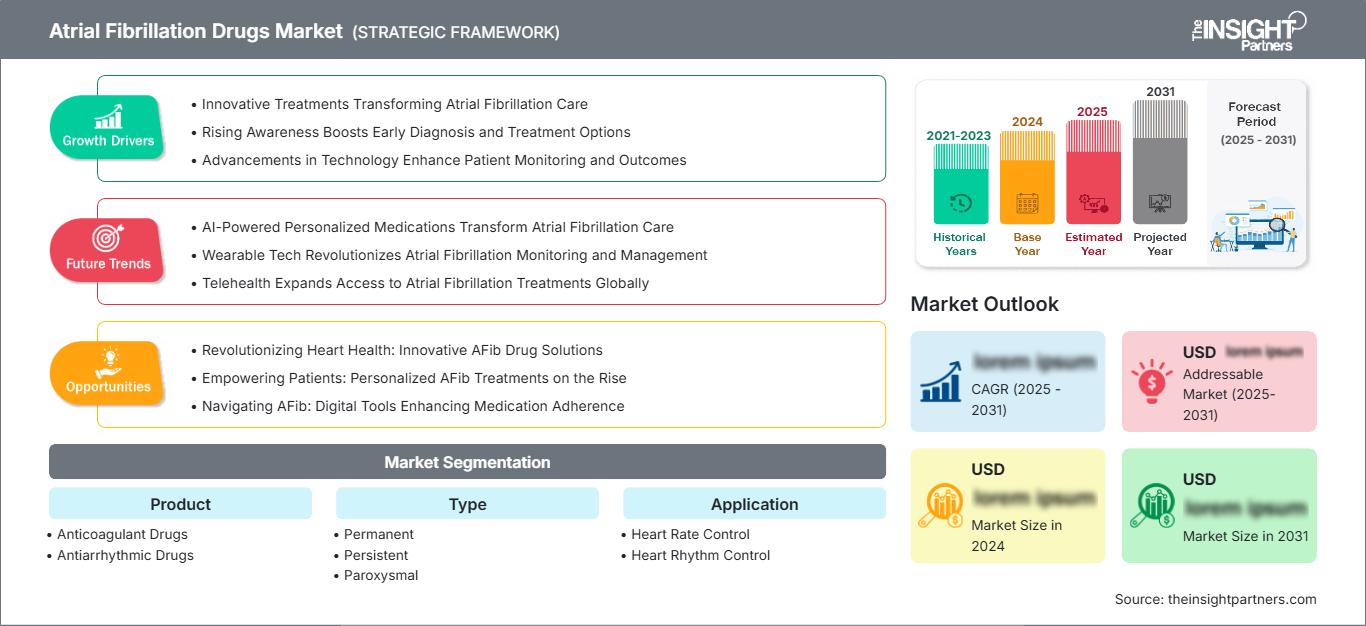
Atrial Fibrillation Drugs Market: Strategic Insights
Regional Insights
North America atrial fibrillation drugs market
North America will continue to hold the leading regional position, accounting for 39-43% of worldwide sales in 2025 and registering a CAGR of 4.4-5.0% up until 2034. The North American region has well-developed infrastructure in cardiology, physician awareness, mechanisms of reimbursement, and use of direct oral anticoagulants. The US accounts for the majority of this share, whereas Canada accounts for the rest, yet structurally more stable due to universal coverage and an aging population.
Decision making will revolve around assessing the risk of having a stroke, the risk of bleeding, kidney functionality, and the use of the preferred modality (rate or rhythm). Market success will be dependent on demonstrating superior compliance, safety, and cost-effectiveness for the manufacturers. The expansion of out-patient cardiology practices and technological monitoring could drive diagnosis and treatment uptake, but payer pressures and generics will restrain prices.
U.S. atrial fibrillation drugs Market
The US is expected to account for 83–87% of North American revenue in 2025 and grow at 4.5–5.1% through 2034. Its position reflects high diagnostic capacity, extensive cardiology networks, broad availability of anticoagulants, and substantial prescription volumes across hospitals and outpatient practices. Pfizer, Bristol-Myers Squibb Company, Daiichi Sankyo Company, Limited, Boehringer Ingelheim International GmbH, and Bayer AG have important commercial relevance.
Application trends are becoming more influenced by risk-based anticoagulation and personalized rhythm control. Drug prescriptions take into account factors such as age, kidney function, past strokes, bleeding risk, co-morbidity conditions, and drug compliance. Revenue growth may be hampered by generic penetration and payer negotiations, but there are counter-balancing prospects in better compliance, combination therapies, and early diagnosis. Hence, the US market is valuable for commercial operations and research.
Europe atrial fibrillation drugs Market
The region is forecasted to account for 27–31% of worldwide revenues in 2025 and grow at 3.8–4.4% between 2025 and 2034. Germany will be the major national market, followed by the UK, France, Italy, and Spain. Aging demographics and availability of cardiology services ensure consistent treatment demand despite reimbursement limitations creating country-specific differences.
In Germany, the size of the treated patient population coupled with a highly-developed structure of specialists and organized reimbursement system plays an important role. In the UK, the country has a guideline-driven prescription pattern and national health-system purchases. France features wide availability of cardiovascular products, while Italy and Spain will develop chronic disease management programs. Integrated treatment approaches involving comorbidities control, stroke prevention, and treatment reevaluation become more popular throughout Europe. The 2024 ESC approach clearly identifies the importance of comorbidities control in AF treatment ahead of stroke prevention and symptom-based rate/rhythm treatment.
APAC atrial fibrillation drugs Market
APAC is estimated to hold 19–23% of the atrial fibrillation drugs market share in 2025 and grow at 5.0–5.7% through 2034. China is expected to lead, followed by Japan, South Korea, India, and Australia. Expanding diagnosis, cardiovascular investment, and aging populations support regional demand.
China combines a large addressable population with expanding specialist capacity, while Japan has mature anticoagulation utilization and an aging demographic. South Korea and Australia benefit from established cardiology networks, whereas India offers substantial long-term potential as diagnosis and access improve. Policy emphasis on cardiovascular disease management, generic availability, and hospital modernization should support wider treatment adoption.
Middle East & Africa atrial fibrillation drugs Market
The Middle East and Africa market is expected to grow at 4.0–4.8% through 2034, with Saudi Arabia leading the region, followed by the UAE and South Africa. Improving specialist infrastructure and private healthcare investment are expanding treatment access.
Saudi Arabia and the UAE are strengthening tertiary cardiovascular capabilities, while South Africa provides the region's more established pharmaceutical and specialist ecosystem. The wider MEA market remains constrained by uneven diagnosis, reimbursement, and medicine availability. Healthcare infrastructure investment, import capacity, and public-sector cardiovascular programs should gradually expand access, particularly in metropolitan centers and higher-income markets.
Segmentation Analysis
Product
The Product segment in the atrial fibrillation drugs market is divided into Anticoagulant Drugs and Antiarrhythmic Drugs. The segment is expected to grow at a CAGR of 4.0–4.5% during 2026–2034. Product selection depends on stroke risk, symptom burden, disease persistence, comorbidities, renal function, and the intended balance between rate control and rhythm restoration.
- Anticoagulant Drugs: These therapies occupy the core prevention pathway for patients at elevated thromboembolic risk. Direct oral anticoagulants remain strategically important because predictable dosing and reduced monitoring requirements support outpatient treatment.
- Antiarrhythmic Drugs: These therapies remain important when rhythm control is clinically appropriate. Selection is influenced by structural heart disease, adverse-event profiles, drug interactions, and the patient's tolerance for long-term pharmacological treatment.
Type
The Type segment in the atrial fibrillation drugs market covers Permanent, Persistent, and Paroxysmal disease. It is projected to expand at a CAGR of 3.9–4.4% during 2026–2034. Treatment intensity varies by disease pattern, symptom burden, progression risk, and the clinical feasibility of maintaining sinus rhythm.
- Permanent: Permanent disease generates sustained demand for chronic rate-control and stroke-prevention therapy because restoration of sinus rhythm is generally not pursued as the principal treatment objective.
- Persistent: Persistent disease requires more individualized treatment planning, with pharmacological rhythm control, rate control, and anticoagulation selected according to symptoms, duration, comorbidities, and treatment response.
- Paroxysmal: Paroxysmal disease creates demand for early diagnosis and risk-based prevention. Increasing recognition of intermittent AF burden can influence decisions concerning anticoagulation and rhythm-focused treatment.
Application
The Application segment in the atrial fibrillation drugs market comprises Heart Rate Control and Heart Rhythm Control and is projected to grow at a CAGR of 4.1–4.7% during 2026–2034. The choice depends on symptoms, disease progression, age, comorbidities, and treatment objectives. Current European guidance treats rate and rhythm management as complementary components of an individualized care pathway.
- Heart Rate Control: Rate control remains important for patients where symptom management and ventricular-rate stabilization are prioritized. Its simplicity and compatibility with chronic outpatient management support continued utilization.
- Heart Rhythm Control: Rhythm control is increasingly considered when symptoms, disease stage, patient characteristics, or clinical objectives justify restoration or maintenance of sinus rhythm through pharmacological strategies.
End User
The End User segment includes Hospitals, Cardiac Centers, and Ambulatory Surgical Centers and is expected to grow at a CAGR of 4.2–4.8% during 2026–2034. Hospitals remain central to complex cases, while specialized cardiac centers increasingly support longitudinal medication optimization and coordinated care.
- Hospitals: Hospitals manage newly diagnosed, unstable, and highly comorbid patients, making them important initiation points for anticoagulation and rhythm-control therapy.
- Cardiac Centers: Cardiac centers provide specialist assessment, medication optimization, and coordinated management for patients requiring repeated cardiovascular evaluation.
- Ambulatory Surgical Centers: Ambulatory settings increasingly support lower-acuity cardiovascular interventions and follow-up, creating opportunities for streamlined medication pathways and post-procedure treatment management.
Opportunity Snapshot
| End User | Revenue Contribution | Trend Tag | Adoption Stage |
|---|---|---|---|
| Hospitals | High | Acute Care | Mature |
| Cardiac Centers | High | Specialist Care | Mature |
| Ambulatory Surgical Centers | Low | Outpatient Care | Scaling |
Atrial Fibrillation Drugs Market Growth Drivers and Impact Analysis
Expansion of the diagnosed cardiovascular patient population
Population aging and the increasing prevalence of hypertension, obesity, diabetes, and other cardiovascular risk factors are expanding the number of patients requiring AF assessment. This driver affects pharmaceutical demand through both new treatment initiation and longer treatment duration among patients managed chronically. Greater awareness of irregular pulse patterns and wider availability of cardiac diagnostics can identify patients who previously remained undiagnosed. For manufacturers, the commercial implication is a larger pool of candidates for anticoagulation and rate or rhythm management. The effect is particularly significant in emerging economies where specialist capacity is increasing from a relatively low base. Pharmaceutical companies can capture this opportunity through physician education, adherence programs, evidence generation, and distribution strategies designed for sustained treatment rather than short-term episodic use.
Increasing emphasis on stroke prevention and individualized anticoagulation
Clinical management increasingly evaluates thromboembolic risk alongside bleeding risk, renal function, age, comorbidities, and patient preferences. The 2024 ESC framework places avoidance of stroke and thromboembolism immediately after assessment and management of comorbidities, reinforcing anticoagulation as a central treatment consideration. This approach supports sustained demand for oral anticoagulants while increasing the importance of patient-specific dosing and monitoring. For manufacturers, differentiation increasingly depends on evidence addressing vulnerable populations, adherence, safety, and use during procedures. Real-world evidence can influence treatment confidence and reimbursement decisions. The commercial impact is therefore broader than prescription volume alone, extending into patient persistence, formulary positioning, clinical pathway inclusion, and post-market evidence generation.
Greater adoption of structured rhythm-management pathways
Treatment strategies are becoming more structured around symptom burden, disease progression, comorbidities, and patient-specific objectives rather than a single universal approach. This supports continued use of antiarrhythmic therapies among patients for whom rhythm control provides meaningful clinical value. The 2025 European Heart Rhythm Association compendium highlights practical considerations surrounding antiarrhythmic drugs, including treatment complexity and procedural context. Manufacturers can benefit when therapies offer predictable dosing, manageable interactions, and evidence across clinically relevant subgroups. The impact also extends to specialist prescribing, because cardiologists increasingly evaluate pharmacological options within broader treatment pathways. Consequently, companies with strong cardiovascular evidence-generation capabilities can defend mature products through differentiated positioning, lifecycle management, and targeted clinical development.
Atrial Fibrillation Drugs Market Future Trends
Greater use of quantitative AF burden in treatment decisions
Future management is likely to move beyond a simple present-or-absent classification of atrial fibrillation toward more quantitative assessment of episode frequency, duration, and overall burden. The European Society of Cardiology has identified AF burden as increasingly relevant to risk assessment, treatment efficacy, and anticoagulation decisions. This evolution could influence drug utilization by enabling more refined identification of patients who require sustained prevention or intensified rhythm management. Pharmaceutical developers may increasingly design studies around burden-defined populations rather than broad diagnostic categories. Integration with wearable monitoring, ambulatory electrocardiography, and longitudinal clinical records could further strengthen treatment personalization and create new evidence requirements for reimbursement and regulatory submissions.
Evidence-led lifecycle management for established anticoagulants
As leading anticoagulant therapies mature, manufacturers are likely to emphasize new evidence rather than rely solely on initial registration data. Studies addressing elderly populations, renal impairment, cardioversion, ablation, concomitant coronary disease, and post-procedural management can strengthen clinical positioning. Daiichi Sankyo's continuing EDOSURE program illustrates this direction through registries and studies across diverse AF populations. Similar strategies can support differentiated use cases, improve physician confidence, and defend established products against generic competition. The future competitive environment will therefore favor companies capable of converting real-world evidence into practical treatment guidance, optimized dosing strategies, and stronger health-economic arguments across different healthcare systems.
Atrial Fibrillation Drugs Market Opportunities
Targeted expansion in underdiagnosed emerging markets
Pharmaceutical companies can pursue expansion by strengthening cardiovascular diagnosis and treatment access in countries where specialist capacity remains concentrated in major cities. India, China, Southeast Asia, Latin America, and selected Middle Eastern markets offer opportunities to build demand through physician education, local distribution, affordability programs, and partnerships with healthcare providers. The in the atrial fibrillation drugs market trends is not simply geographic expansion. Companies can tailor portfolios to local reimbursement conditions, generic competition, prescribing behavior, and diagnostic availability. Establishing reliable supply and differentiated patient-support services can improve treatment continuity. Local evidence generation may also strengthen reimbursement discussions where international clinical data do not fully reflect regional populations, healthcare pathways, or economic constraints.
Development of differentiated therapies for complex patient populations
A significant opportunity lies in therapies and evidence programs addressing patients who are difficult to manage because of advanced age, renal impairment, multiple medications, prior bleeding, or concurrent cardiovascular disease. These populations create clinical uncertainty and require careful balancing of stroke prevention, bleeding risk, and treatment adherence. Companies can invest in dose-optimization studies, comparative effectiveness research, registries, and digital adherence tools to establish clearer treatment pathways. The atrial fibrillation drugs market Forecasts increasingly favor differentiated clinical value over undifferentiated product availability. Manufacturers that demonstrate practical benefits in complex populations may improve formulary access, strengthen specialist preference, and create defensible lifecycle extensions even as mature molecules face pricing pressure.
Recent Developments
- July 2025: AstraZeneca PLC announced a planned US$50 billion investment in the US through 2030 covering medicines manufacturing and research and development. The company stated that the investment includes a proposed multi-billion-dollar drug-substance manufacturing facility focused on chronic diseases, strengthening its broader pharmaceutical manufacturing footprint.
- March 2025: European Society of Cardiology published its practical compendium on antiarrhythmic drugs, addressing clinical use of pharmacological rhythm-management strategies and highlighting treatment constraints, procedural considerations, and the complexity of arrhythmia management. The document provides contemporary practical context for antiarrhythmic prescribing.
- 2025: Daiichi Sankyo Company, Limited continued its EDOSURE clinical research program for edoxaban, including studies and registries covering vulnerable AF populations and real-world treatment settings. The program includes evidence generation across elderly patients, prior stroke, intracranial hemorrhage, ablation, and routine clinical practice.
Frequently Asked Questions

- Comprehensive Market Sizing and Forecast Analysis
- Detailed Segmentation Analysis
- In-Depth Market Dynamics Assessment
- Regional and Country-Level Insights
- Competitive Landscape and Company Benchmarking
- Strategic Business Intelligence
Recent Reports
Testimonials

The Insight Partners provided valuable market intelligence that supported our global go-to-market strategy. Their team was professional, responsive, and attentive to our feedback, providing thoughtful analysis and helpful methodological clarifications throughout the project.
Junmo Kim Chief Financial Officer (CFO), Enertech Co., Ltd.
The Insight Partners' SCADA System Market report is comprehensive, with valuable insights on current trends and future forecasts. The team was highly professional, responsive, and supportive throughout. We are very satisfied and highly recommend their services.
RAN KEDEM Partner, Reali Technologies LTDs
I requested a report on a very specific software market and the team produced the report in a few days. The information was very relevant and well presented. I then requested some changes and additions to the report. The team was again very responsive and I got the final report in less than a week.
JEAN-HERVE JENN Chairman, Future Analytica
We worked with The Insight Partners for an important market study and forecast. They gave us clear insights into opportunities and risks, which helped shape our plans. Their research was easy to use and based on solid data. It helped us make smart, confident decisions. We highly recommend them.
PIYUSH NAGPAL Sr. Vice President, High Beam Global
The Insight Partners delivered insightful, well-structured market research with strong domain expertise. Their team was professional and responsive throughout. The user-friendly website made accessing industry reports seamless. We highly recommend them for reliable, high-quality research services
YUKIHIKO ADACHI CEO, Deep Blue, LLC.
This is the first time I have purchased a market report from The Insight Partners.While I was unsure at first, I visited their web site and felt more comfortable to take the risk and purchase a market report.I am completely satisfied with the quality of the report and customer service. I had several questions and comments with the initial report, but after a couple of dialogs over email with their analyst I believe I have a report that I can use as input to our strategic planning process.Thank you so much for taking the extra time and making this a positive experience.I will definitely recommend your service to others and you will be my first call when we need further market data.
JOHN SUZUKI President and Chief Executive Officer, Board Director, BK Technologies
I wish to appreciate your support and the professionalism you displayed in the course of attending to my request for information regarding to infectious disease IVD market in Nigeria. I appreciate your patience, your guidance, and the fact that you were willing to offer a discount, which eventually made it possible for us to close a deal. I look forward to engaging The Insight Partners in the future, all thanks to the impression you have created in me as a result of this first encounter.
DR CHIJIOKE ONYIA MANAGING DIRECTOR, PineCrest Healthcare Ltd.Reason to Buy
- Informed Decision-Making
- Understanding Market Dynamics
- Competitive Analysis
- Identifying Emerging Markets
- Customer Insights
- Market Forecasts
- Risk Mitigation
- Boosting Operational Efficiency
- Strategic Planning
- Investment Justification
- Tracking Industry Innovations
- Aligning with Regulatory Trends





 Get Free Sample for