
Augmented Shopping Market Size, Growth & Demand by 2034
Coverage: By Component (Solutions, Services); Application (Furniture and Lighting, Beauty and Cosmetics, Apparel Fitting, Grocery Shopping, Footwear, Others), and Geography (North America, Europe, Asia Pacific, and South and Central America)
- Status : Data Released
- Report Code : TIPRE00014105
- Category : Technology, Media and Telecommunications
- No. of Pages : 150
- Available Report Formats :


- Last update date : August 19, 2026


2025 Market Size
US$ 19.12 Bn
Base year value
2034 Forecast
US$ 60.55 Bn
Projected by 2034
CAGR 2026-2034
13.66 %
Growth rate
Addressable Market
US$ 344.54 Bn
(2026-2034)
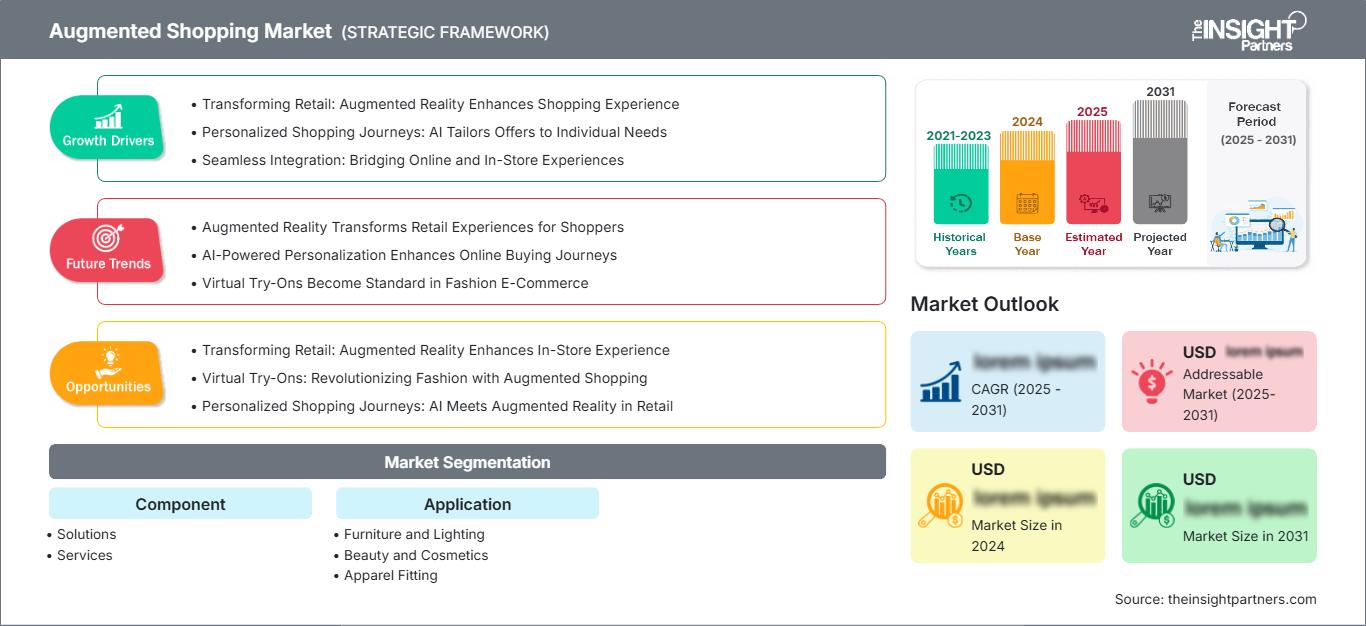
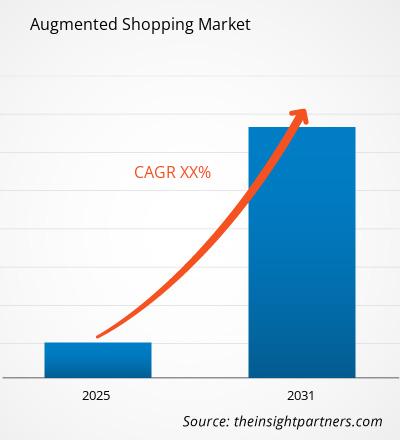
The augmented shopping market was valued at US$ 19.12 billion in 2025 and is projected to reach US$ 60.55 billion by 2034, expanding at a CAGR of 13.66% during 2026–2034. The market continues to gain momentum as retailers increasingly adopt immersive digital technologies to enhance customer engagement, improve purchase confidence, and reduce product returns. Rapid advancements in augmented reality, artificial intelligence, and mobile commerce are accelerating the integration of interactive shopping experiences across online and physical retail channels.
Across North America, retailers continue investing in immersive commerce technologies to strengthen omnichannel customer experiences and improve conversion rates. The augmented shopping market size in the region is supported by widespread smartphone adoption, mature e-commerce infrastructure, and increasing deployment of augmented reality applications by leading retail brands. Continuous innovation in spatial computing, cloud-based visualization platforms, and AI-powered product personalization further strengthens long-term regional market expansion.
Augmented Shopping Market Assessment and Insights
- North America: North America accounted for 36–40% share in 2025 and is anticipated to expand at a CAGR of 12.8–13.4% during 2026–2034. Strong digital retail infrastructure, widespread smartphone penetration, and significant investments in immersive commerce technologies continue driving regional leadership.
- U.S.: The U.S. represented 78–82% of the North American market in 2025 and is projected to register a CAGR of 12.9–13.5% during 2026–2034, supported by leading technology companies, advanced retail ecosystems, and high consumer adoption of augmented reality shopping applications.
- Europe: Europe captured 24–28% share in 2025 and is expected to grow at a CAGR of 12.5–13.1% during 2026–2034. Germany, the United Kingdom, and France lead regional adoption owing to expanding omnichannel retail strategies and increasing investment in digital customer engagement technologies.
- Asia Pacific: Asia Pacific accounted for 27–31% share in 2025 and is forecast to record the fastest growth with a CAGR of 14.8–15.4% during 2026–2034. China, Japan, South Korea, India, and Australia continue accelerating adoption through expanding mobile commerce, digital payments, and retail technology innovation.
- Largest Segment: Solutions accounted for 65–69% market share in 2025 and is projected to grow at a CAGR of 13.8–14.4% during 2026–2034, supported by increasing deployment of augmented reality software platforms across global retail networks.
- High Growth Segment: Beauty and Cosmetics represented 20–24% market share in 2025 and is expected to register a CAGR of 15.6–16.2% during 2026–2034, driven by rapid adoption of virtual try-on applications and AI-powered product visualization.
- Key companies analyzed in detail: Apple Inc., Augment, Blippar Ltd, Google LLC, Holition Ltd., Imaginate, Marxent Labs LLC, Microsoft Corporation, PTC Inc., ViewAR GmbH.
Source: The Insight Partners' analysis based on proprietary research, government publications, company annual reports, investor presentations, industry databases, and expert interviews.
In addition, the retail environment keeps on changing due to the incorporation of AR, artificial intelligence, computer vision, and spatial computing technologies that revolutionize traditional online shopping by making it highly interactive experience. Augmented shopping systems are gaining popularity for the provision of the visualization of the products, customizations in real time and an enhanced customer engagement on smartphones, tablets and wearable devices. In addition, advancements in the cloud computing, 5G connectivity, and graphics processing technologies keep on increasing the availability and feasibility of immersive shopping solutions for different kinds of products.
Future market growth will be driven by growing investments in mixed reality ecosystem, spatial commerce and AI personalization. Retailers will continue integrating the features of augmented shopping into their omnichannel strategies with better visualization of inventory, improved customer engagement and decision-making process. Digital transformation efforts in emerging economies and innovations by technology vendors are expected to provide a number of long-term opportunities within the retail industry value chain.
Augmented Shopping Market Report Scope
| Report Attribute | Details |
|---|---|
| Market size in 2025 | US$ 19.12 Billion |
| Market Size by 2034 | US$ 60.55 Billion |
| Global CAGR (2026 - 2034) | 13.66% |
| Historical Data | 2021-2024 |
| Forecast period | 2026-2034 |
Augmented Shopping Market Analysis
The augmented shopping market growth is primarily driven by increasing consumer preference for immersive digital shopping experiences that reduce uncertainty before purchase while improving engagement and customer satisfaction. It is evident that retailers are increasingly adopting AR technologies to demonstrate virtual products and provide interactive visualization and recommendation services through mobile apps and e-commerce portals. The growing trend of smartphone adoption, fast mobile network connectivity, and growth of the digital commerce ecosystem is continuously driving the need for AR shopping technologies. Artificial intelligence technologies are also helping improve these portals through intelligent product recommendations, object recognition, and personalized shopping experience.
Augmented Shopping Ecosystem encompasses augmented reality technology developers, cloud computing technology providers, smartphone manufacturers, e-commerce portals, retail solutions providers, artificial intelligence technology developers, and content creators. Strategic collaboration among these participants enables retailers to deploy scalable immersive commerce solutions while improving operational efficiency and customer experience across multiple digital channels.
The augmented shopping market analysis reflects increasing competition as technology providers continue expanding immersive commerce capabilities through artificial intelligence, spatial computing, and cloud-native augmented reality platforms. Apple Inc., Google LLC, Microsoft Corporation, PTC Inc., Blippar Ltd, Marxent Labs LLC, ViewAR GmbH, Holition Ltd., Augment, and Imaginate continue investing in advanced visualization technologies, enterprise partnerships, and developer ecosystems to strengthen competitive positioning across retail and consumer commerce applications.
Modern investing trends favor generative AI, digital twins, 3D product visualization, and real-time rendering technologies. The vendors have been enhancing their integration with various e-commerce platforms, customer analysis systems, and retail management software, as well as developing capabilities for working with wearables and mixed reality devices. Such technologies are believed to support the use of immersive shopping systems in the future.
● REPORT CUSTOMIZATION
Tailor This Report To Align With Your Specific Business Requirements
This report can be customized to align precisely with your business objectives, scope, and target markets. Customization options include tailored segmentation, geography, competitive analysis, and strategic insights to support informed decision-making.
Customize This Report →WHAT YOU CAN ADJUST
- ● Segmentations
- ● Geography
- ● Competitive Analysis
- ● Language Preferences
Augmented Shopping Market: Strategic Insights
Regional Insights
North America Augmented Shopping Market
North America accounted for 36–40% of the augmented shopping market share in 2025 and is expected to register a CAGR of 12.8–13.4% during 2026–2034. Continued leadership in adoption is seen due to a robust digital retailing ecosystem, high adoption of smartphones, cloud computing capability, and high acceptance among consumers for immersive shopping experiences. Major retailers have been increasingly adopting AR solutions in mobile applications and e-commerce sites to enhance customer experience and purchase decision making.
The other important aspect is that the region enjoys the presence of top players who are making continuous investments in AI, spatial computing, and mixed reality solutions. Retailers in North America are adopting omni-channel retailing where customers can visualize the products through digital technologies in addition to the traditional channels, and thus reduce return and increase engagement with the brand.
U.S. Augmented Shopping Market
The U.S. represented 78–82% of the North American market in 2025 and is projected to grow at a CAGR of 12.9–13.5% during 2026–2034. Retail chain stores, ecommerce businesses, and tech companies keep investing significantly in AR-powered shopping apps to improve digital shopping experience in fashion, furniture, cosmetics, and home improvement. The consumer preference for personalized shopping experience drives the fast adoption of immersive retail technologies.
This nation is home to many top platform makers of AR, AI, and cloud technologies used in developing scalable immersive commerce solutions. It is common to find retailers leveraging try-on apps, product visualization, and spatial commerce in engaging customers. Large investments made in the digitalization of retail and constant technology innovations are expected to help drive market growth through the forecast period.
Europe Augmented Shopping Market
Europe accounted for 24–28% of the global market in 2025 and is expected to expand at a CAGR of 12.5–13.1% during 2026–2034. Germany remains the regional leader due to advanced retail digitalization, widespread enterprise adoption of augmented reality technologies, and continuous investment in omnichannel commerce platforms. The United Kingdom demonstrates strong demand driven by expanding e-commerce penetration and increasing retailer investment in customer experience technologies.
Germany continues integrating augmented shopping technologies across furniture, automotive accessories, and consumer electronics retailing, while the United Kingdom emphasizes virtual product demonstrations and personalized online shopping experiences through advanced mobile commerce platforms. Strong digital infrastructure supports further deployment across both markets.
France, Italy, and Spain continue strengthening digital commerce through increasing adoption of augmented reality applications in luxury retail, apparel, cosmetics, and home furnishing sectors. Retailers across Southern Europe are investing in interactive shopping solutions that improve customer engagement, reduce purchasing uncertainty, and enhance omnichannel retail performance while supporting broader digital transformation initiatives.
APAC Augmented Shopping Market
Asia Pacific represented 27–31% of the global market in 2025 and is projected to achieve the highest regional growth with a CAGR of 14.8–15.4% during 2026–2034. Rapid expansion of mobile commerce, digital payments, and online retail ecosystems continues driving immersive shopping technology adoption throughout the region.
China leads regional deployment through large-scale e-commerce innovation, while Japan and South Korea continue investing in advanced retail technologies and spatial computing. India and Australia are witnessing growing implementation of augmented shopping platforms supported by expanding internet penetration, smartphone adoption, and digital retail modernization.
Middle East & Africa Augmented Shopping Market
The Middle East & Africa market is expected to expand at a CAGR of 11.7–12.3% during 2026–2034, supported by increasing investment in digital retail infrastructure, mobile commerce, and smart city initiatives. Retailers are gradually integrating immersive shopping technologies to improve customer engagement and differentiate digital commerce offerings.
Saudi Arabia continues leading regional adoption through rapid retail modernization under Vision 2030, while the United Arab Emirates strengthens digital commerce through investments in innovation and consumer technology. South Africa remains an important emerging market, with retailers increasingly adopting augmented shopping applications alongside broader digital transformation initiatives across the regional retail sector.
Segmentation Analysis
Component
The component segment forms the technological foundation of immersive retail ecosystems by combining software platforms with professional implementation and support capabilities. Retailers continue investing in scalable augmented reality infrastructures that integrate seamlessly with e-commerce platforms, mobile applications, and cloud environments. This segment is anticipated to register a CAGR of 13.9–14.5% during 2026–2034. The augmented shopping market scope continues expanding as enterprises prioritize end-to-end augmented commerce platforms that improve customer engagement, streamline deployment, and accelerate digital retail transformation.
- Solutions: Solutions account for the majority of deployments by providing virtual product visualization, real-time object recognition, 3D rendering, and interactive customer experiences. Retailers increasingly integrate these capabilities with mobile commerce platforms to improve purchasing confidence and customer engagement.
- Services: Services support implementation, customization, cloud integration, content development, employee training, and ongoing platform optimization. Growing retailer demand for managed deployment and technical consulting continues strengthening the importance of professional service offerings.
Application
Application diversity continues expanding as retailers adopt augmented shopping technologies across multiple product categories where visualization significantly influences purchasing decisions. Consumer preference for interactive shopping experiences and increasing smartphone capabilities continue supporting adoption across digital commerce ecosystems. This segment is projected to grow at a CAGR of 14.2–14.8% during 2026–2034, driven by continuous innovation in augmented reality software, artificial intelligence, and spatial computing technologies.
- Furniture and Lighting: Retailers enable customers to visualize furniture dimensions, layouts, colors, and lighting arrangements within real-world environments, improving purchasing confidence while reducing product returns and post-purchase dissatisfaction.
- Beauty and Cosmetics: Beauty and cosmetics retailers increasingly deploy virtual makeup, skincare, and hair color simulations using facial recognition and artificial intelligence, enabling personalized product recommendations and highly engaging digital shopping experiences.
- Apparel Fitting: Virtual fitting technologies allow consumers to evaluate garment size, style, and appearance digitally before purchase, helping retailers improve conversion rates while minimizing returns related to sizing inaccuracies.
- Grocery Shopping: Grocery retailers leverage augmented shopping applications for interactive product information, nutritional guidance, promotional content, indoor navigation, and personalized recommendations, creating more informed and efficient shopping experiences.
- Footwear: Footwear brands increasingly implement virtual shoe fitting and three-dimensional product visualization technologies that improve purchase confidence, support product customization, and enhance digital customer engagement across online retail channels.
Opportunity Snapshot
| Segment Name | Revenue Contribution | Trend Tag | Adoption Stage |
|---|---|---|---|
| Furniture and Lighting | High | Virtual Placement | Mature |
| Beauty and Cosmetics | High | Virtual Try-On | Scaling |
| Apparel Fitting | High | Digital Fitting | Scaling |
| Grocery Shopping | Medium | Smart Navigation | Emerging |
| Footwear | Medium | 3D Fitting | Scaling |
Augmented Shopping Market Growth Drivers and Impact Analysis
Rising Adoption of Omnichannel Retail Strategies
Today’s retailers have started bridging the gap between brick-and-mortar stores and digital commerce by bringing augmented shopping into their omni-channel transition strategies. This technology helps shoppers see how products look like in their space, allows for the assessment of alternative products, and ultimately facilitates better buying decisions. Such an approach decreases uncertainty in shopping while increasing customer engagement and brand loyalty. The biggest retail chains still continue making investments in the cloud-based platform of augmented commerce which unifies the online and offline inventories and customer profiles. As consumers expect to be provided with interactive shopping experience, retailers are expected to roll out more immersive technologies.
Advancements in Smartphone Hardware and AR Development Platforms
Due to ongoing enhancements in processors, graphics processing, depth-sensing, and camera technologies on smartphones, the potential for commercial application of augmented shopping has been vastly improved. Contemporary mobile handsets provide high-quality 3D rendering, object recognition, and real-time environment mapping without need for specialized hardware. On the other hand, there has been tremendous progress in development of AR SDKs and cloud rendering services, which makes it easier for merchants from various sectors to implement augmented shopping features in their current apps. These technology advancements reduce the cost and time necessary for implementation of solutions, allowing companies to offer their products in an engaging way through current apps on mobile devices.
Increasing Focus on Reducing Product Returns Through Visualization
Product returns continue to be a serious operational problem for online merchants especially in fashion clothing, furniture, and interior design products. The augmented shopping experience is able to resolve this problem through offering shoppers the ability to assess size, look, fit, and suitability of the goods before purchase. Interaction with visualization will help boost confidence during purchases and reduce any dissatisfaction due to wrong expectations about the products. Merchants will also experience reduced cost of logistics operations, reverse logistics, and improved stock control. Artificial intelligence plays an important role in improving visualization through recommending personalized items as well as realistic visualization.
Augmented Shopping Market Future Trends
Artificial Intelligence Driving Hyper-Personalized Shopping Experiences
The augmented shopping market trends increasingly reflect convergence between artificial intelligence and augmented reality technologies. AI recommendation systems along with visualization technologies have been incorporated in retail to provide personalized recommendations for customers considering their preferences, search history, purchase history, and contextual factors. The use of computer vision and generative AI technology has enhanced the process of virtual rendering of products along with real-time customizations. Such developments are anticipated to revolutionize e-commerce as these innovations are bound to offer personalized shopping experiences resulting in higher engagement, conversion rates, and customer retention for retailers.
Spatial Computing Expanding Beyond Mobile Commerce
Spatial computing technology is forecasted to revolutionize digital retail by going beyond smartphone-based augmented shopping to include smart glasses, mixed reality devices, interactive kiosks, and connected retail spaces. Retail companies are gearing up for an immersive commerce ecosystem in which consumers will be able to interact seamlessly with digital goods through gestures, voice commands, and environment mapping. In addition, integration with digital twin technology, IoT framework, and real-time inventory systems will help retailers improve shopping experience while allowing for highly interactive in-store layout designs. Ongoing advancements in hardware and increased consumer acceptance of wearable tech are set to speed up adoption.
Augmented Shopping Market Opportunities
Expansion into Emerging Retail Markets
Growing digital infrastructure across emerging economies creates significant opportunities for retailers and technology providers to expand immersive commerce solutions. Augmented shopping market Forecasts indicate strong long-term demand as smartphone adoption, mobile payment ecosystems, and e-commerce participation continue increasing throughout Asia Pacific, Latin America, the Middle East, and Africa. Retailers entering these markets can leverage augmented shopping technologies to differentiate customer experiences while strengthening brand recognition. Continued investments in cloud computing, fifth-generation mobile connectivity, and digital retail transformation are expected to accelerate adoption of immersive shopping applications among regional retailers and international commerce platforms.
Enterprise Solutions for Small and Medium-Sized Retailers
While early adoption has mainly focused on large retail companies, there is an immense business opportunity in creating scalable and subscription-based augmented shopping platforms for small and medium-size retailers. The cloud-deployed approach not only cuts down the cost of deployment but also enables businesses to adopt cutting-edge visualization technology without the need for investing heavily in infrastructure. IT providers can generate more recurring revenue by providing configurable products, managed services, analytics platforms, and industry-specific applications, making it easier to deploy such solutions in different retail sectors.
Frequently Asked Questions

- Comprehensive Market Sizing and Forecast Analysis
- Detailed Segmentation Analysis
- In-Depth Market Dynamics Assessment
- Regional and Country-Level Insights
- Competitive Landscape and Company Benchmarking
- Strategic Business Intelligence
Recent Reports
Testimonials

The Insight Partners' SCADA System Market report is comprehensive, with valuable insights on current trends and future forecasts. The team was highly professional, responsive, and supportive throughout. We are very satisfied and highly recommend their services.
RAN KEDEM Partner, Reali Technologies LTDs
I requested a report on a very specific software market and the team produced the report in a few days. The information was very relevant and well presented. I then requested some changes and additions to the report. The team was again very responsive and I got the final report in less than a week.
JEAN-HERVE JENN Chairman, Future Analytica
We worked with The Insight Partners for an important market study and forecast. They gave us clear insights into opportunities and risks, which helped shape our plans. Their research was easy to use and based on solid data. It helped us make smart, confident decisions. We highly recommend them.
PIYUSH NAGPAL Sr. Vice President, High Beam Global
The Insight Partners delivered insightful, well-structured market research with strong domain expertise. Their team was professional and responsive throughout. The user-friendly website made accessing industry reports seamless. We highly recommend them for reliable, high-quality research services
YUKIHIKO ADACHI CEO, Deep Blue, LLC.
This is the first time I have purchased a market report from The Insight Partners.While I was unsure at first, I visited their web site and felt more comfortable to take the risk and purchase a market report.I am completely satisfied with the quality of the report and customer service. I had several questions and comments with the initial report, but after a couple of dialogs over email with their analyst I believe I have a report that I can use as input to our strategic planning process.Thank you so much for taking the extra time and making this a positive experience.I will definitely recommend your service to others and you will be my first call when we need further market data.
JOHN SUZUKI President and Chief Executive Officer, Board Director, BK Technologies
I wish to appreciate your support and the professionalism you displayed in the course of attending to my request for information regarding to infectious disease IVD market in Nigeria. I appreciate your patience, your guidance, and the fact that you were willing to offer a discount, which eventually made it possible for us to close a deal. I look forward to engaging The Insight Partners in the future, all thanks to the impression you have created in me as a result of this first encounter.
DR CHIJIOKE ONYIA MANAGING DIRECTOR, PineCrest Healthcare Ltd.Reason to Buy
- Informed Decision-Making
- Understanding Market Dynamics
- Competitive Analysis
- Identifying Emerging Markets
- Customer Insights
- Market Forecasts
- Risk Mitigation
- Boosting Operational Efficiency
- Strategic Planning
- Investment Justification
- Tracking Industry Innovations
- Aligning with Regulatory Trends





 Get Free Sample for