
Automated Content Moderation Market Share, Growth & Demand by 2034
Coverage: By Component (Software, Services); Application (Social Media, E-commerce Retailer, Others) , and Geography (North America, Europe, Asia Pacific, and South and Central America)
- Status : Data Released
- Report Code : TIPRE00019814
- Category : Technology, Media and Telecommunications
- No. of Pages : 150
- Available Report Formats :


- Last update date : August 19, 2026


2025 Market Size
US$ 1.78 Bn
Base year value
2034 Forecast
US$ 7.47 Bn
Projected by 2034
CAGR 2026-2034
17.24 %
Growth rate
Addressable Market
US$ 38.55 Bn
(2026-2034)
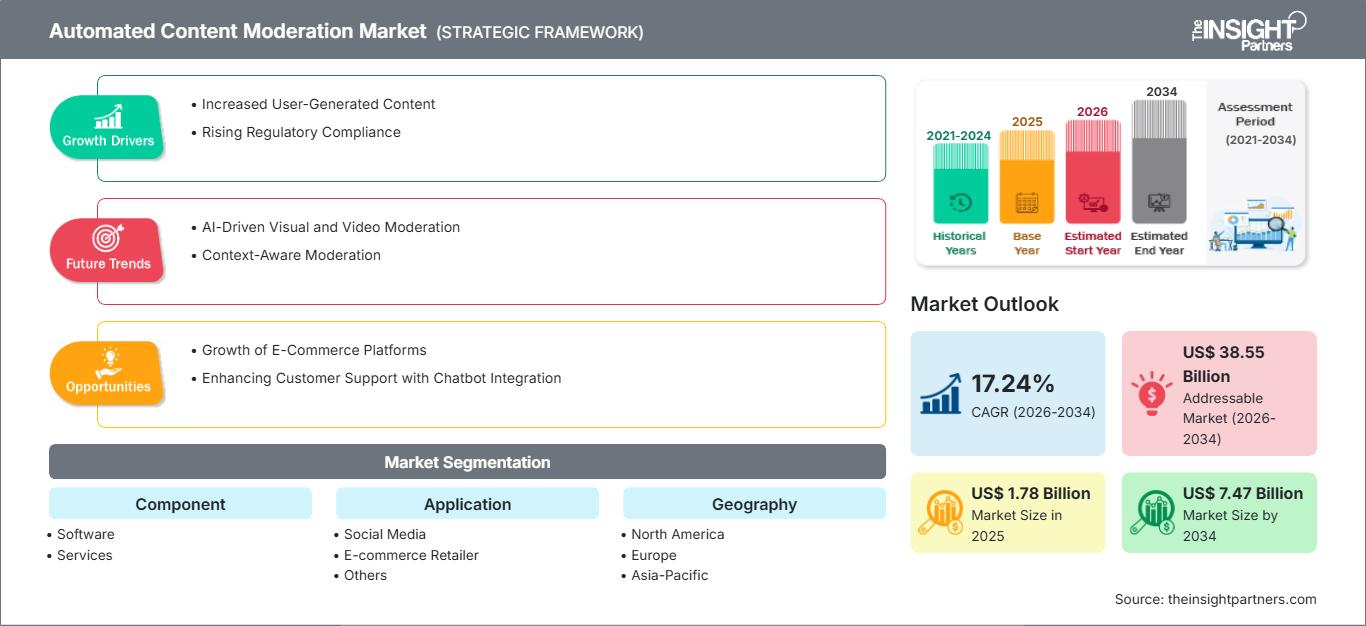
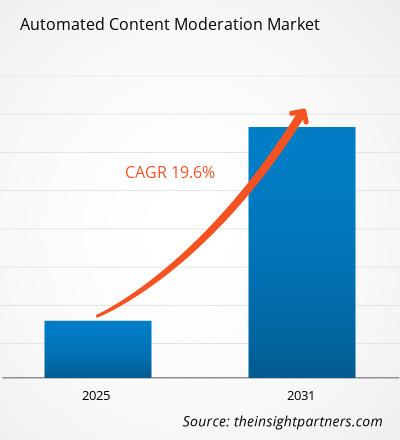
The automated content moderation market is valued at US$ 1.78 Billion in 2025 and is projected to reach US$ 7.47 Billion by 2034, expanding at a CAGR of 17.24% during 2026–2034. Growth is being shaped by expanding user-generated content, tighter platform governance, and rising enterprise investment in AI-led review systems that combine speed, policy consistency, and human escalation.
North America's automated content moderation market size is expected to expand at a CAGR of 16.4–17.0% during 2026–2034, supported by high digital platform concentration, regulatory scrutiny, and early adoption of multimodal AI. Social networks, marketplaces, gaming platforms, and media companies are prioritizing automated workflows to reduce review latency, protect users, and strengthen brand safety.
Automated Content Moderation Market Assessment and Insights
- North America accounted for 36–39% share in 2025 and is expected to grow at a CAGR of 16.4–17.0% during 2026–2034, supported by major platforms, AI infrastructure, and trust-and-safety investment.
- US represented 78–81% of North America share in 2025 and is projected to grow at a CAGR of 16.6–17.2% through 2034, led by social media and marketplace moderation.
- Europe held 25–28% share in 2025 and is forecast to grow at a CAGR of 15.6–16.2%, led by the UK, Germany, France, Italy, and Spain as platform accountability rules strengthen.
- Asia Pacific captured 26–29% share in 2025 and is expected to grow at a CAGR of 18.2–18.8%, driven by China, India, Japan, South Korea, and Australia.
- Largest Segment: Software held 58–61% market share in 2025 and is expected to grow at a CAGR of 17.6–18.2%, reflecting demand for scalable AI classification, policy engines, and analytics.
- High Growth Segment: Social Media held 49–52% market share in 2025 and is forecast to grow at a CAGR of 18.4–19.1%, supported by real-time moderation across text, image, video, and live content.
- Key companies analyzed in detail: Accenture plc, Besedo Global Services AB, Clarifai, Inc., Cogito Tech LLC, Cognizant Technology Solutions Corporation, Magellan Solutions Outsourcing Inc., Microsoft Corporation, Open Access BPO, TaskUs, Inc., and Viafoura Inc.
Source: The Insight Partners' analysis based on proprietary research, government publications, company annual reports, investor presentations, industry databases, and expert interviews.
Platform governance has moved from manual queue review toward automated, hybrid decisioning that screens content before users encounter policy violations. Advances in natural language processing, computer vision, speech recognition, and context-aware classification are improving detection across text, image, video, and livestream environments. The automated content moderation market is also shaped by demand for multilingual coverage, faster escalation, and consistent enforcement across communities with different legal and cultural expectations.
Adoption in the future is expected to be greatest when content volume, regulatory exposure, and user safety concerns meet. New geographies have become more interested in investing as e-commerce, short-form videos, and social communities grow in size. Tailwinds from regulations like transparency requirements from platforms and child safety regulations are motivating buyers to justify decisions and analyze model behavior.
Automated Content Moderation Market Report Scope
| Report Attribute | Details |
|---|---|
| Market size in 2025 | US$ 1.78 Billion |
| Market Size by 2034 | US$ 7.47 Billion |
| Global CAGR (2026 - 2034) | 17.24% |
| Historical Data | 2021-2024 |
| Forecast period | 2026-2034 |
Automated Content Moderation Market Analysis
Market growth will be driven by the increasing cost and complexity of moderating user-generated content. Digital platforms will need solutions to detect malicious posts, scams, harassment, disinformation, and policy infractions before they spread through their networks. The ecosystem consists of AI software vendors, cloud service providers, moderation services firms, trust-and-safety consulting agencies, data labeling services, and corporate clients requiring well-defined detection and escalation processes.
On the supply side, vendors able to provide multimodal analysis and flexible policy setup will gain an advantage. Platform software is taking more of the market as corporate clients need classifiers, dashboards, queue management, and compliance metrics. Services will still be necessary where nuance, language skills, appeals handling, and policy interpretation necessitate human expertise. Best practices involve a combination of automatic triage and dedicated reviewers.
Competition exists within this sector due to enterprise technology vendors, AI specialists, and outsourced moderation services. Microsoft Corporation and Clarifai, Inc. build their competencies based on software-based services, while Accenture plc, Cognizant Technology Solutions Corporation, TaskUs, Inc., Open Access BPO, Magellan Solutions Outsourcing Inc., and Cogito Tech LLC provide managed services and moderation workflows.
Strategic positioning is now focused on model governance, privacy concerns, and industry-specific competencies instead of basic content filtering. Besedo Global Services AB and Viafoura Inc. cover marketplace and media communities' requirements, while other general service providers aim at providing multilingual capabilities. The current trend includes investment in explainable AI and review well-being controls.
● REPORT CUSTOMIZATION
Tailor This Report To Align With Your Specific Business Requirements
This report can be customized to align precisely with your business objectives, scope, and target markets. Customization options include tailored segmentation, geography, competitive analysis, and strategic insights to support informed decision-making.
Customize This Report →WHAT YOU CAN ADJUST
- ● Segmentations
- ● Geography
- ● Competitive Analysis
- ● Language Preferences
Automated Content Moderation Market: Strategic Insights
Regional Insights
North America automated content moderation market
North America automated content moderation market share is estimated at 36–39% in 2025, with a CAGR of 16.4–17.0% during 2026–2034. Growth is supported by large social networks, online marketplaces, streaming platforms, gaming communities, and enterprise collaboration tools that require rapid review of high-volume user activity.
The region benefits from deep AI infrastructure, cloud adoption, venture funding, and established trust-and-safety teams. Buyers are upgrading from keyword filters to multimodal systems that detect harmful patterns across text, image, audio, and video. Regulatory attention to online safety, child protection, election integrity, and platform transparency further increases demand for auditable workflows.
U.S. automated content moderation Market
The U.S. represented 78–81% of North America share in 2025 and is projected to grow at a CAGR of 16.6–17.2% during 2026–2034. Demand is strongest among social media companies, e-commerce platforms, online marketplaces, dating platforms, and gaming networks that face constant content velocity.
Company presence is reinforced by Microsoft Corporation, Clarifai, Inc., TaskUs, Inc., Accenture plc, Cognizant Technology Solutions Corporation, and specialist service providers supporting review operations. Application trends include automated detection of abusive language, fraudulent reviews, counterfeit listings, unsafe livestreams, spam, and coordinated manipulation campaigns. Buyers also require appeal workflows and policy analytics.
Europe automated content moderation Market
Europe held 25–28% share in 2025 and is expected to grow at a CAGR of 15.6–16.2% during 2026–2034. The UK leads regional adoption through media, marketplace, gaming, and platform governance demand, while Germany emphasizes privacy, transparency, and regulated digital services.
France, Italy, and Spain are expanding adoption as online marketplaces, publishing communities, and public-facing platforms strengthen moderation controls. Regional growth is influenced by the Digital Services Act, national child safety measures, and multilingual content requirements. These conditions increase demand for documented decisioning, human escalation, language expertise, and moderation systems that align platform policy with regional legal obligations.
APAC automated content moderation Market
APAC accounted for 26–29% share in 2025 and is forecast to grow at a CAGR of 18.2–18.8% through 2034. China is the leading country, supported by major digital ecosystems, short-video platforms, e-commerce scale, and strong domestic governance requirements.
India, Japan, South Korea, and Australia are increasing adoption across social media, gaming, marketplaces, and media communities. Growth is supported by local-language content expansion, mobile-first consumption, creator economies, and policy pressure around harmful content. Vendors with multilingual models and region-specific escalation capacity are positioned strongly.
Middle East & Africa automated content moderation Market
The Middle East & Africa market is projected to grow at a CAGR of 14.8–15.5% during 2026–2034. The UAE leads adoption through media, e-commerce, gaming, and digital government services requiring safer user interaction.
Saudi Arabia, South Africa, and the Rest of MEA show growing demand as digital payments, online retail, and community platforms expand. Arabic-language moderation, cultural context, and local policy alignment are important adoption factors. Growth depends on cloud readiness, reviewer availability, and integration with regional compliance processes.
Segmentation Analysis
Component
Component is segmented into Software and Services. The market scope is led by software, with the main component segment expected to grow at a CAGR of 17.1–17.8% during 2026–2034. Buyers increasingly need configurable AI models, policy rules, moderation queues, audit logs, and analytics that can support large-scale review while preserving escalation paths for high-risk content.
- Software supports automated classification, image and video detection, language processing, workflow routing, reporting, and policy configuration, making it central to scalable platform governance.
- Services provide human review, appeals handling, multilingual moderation, policy consulting, training data support, and operational management, where automation alone cannot interpret sensitive or contextual content.
Application
The application is segmented into Social Media, E-commerce Retailer, and Others. The main application segment is projected to grow at a CAGR of 17.8–18.6% during 2026–2034 as platforms expand automated review across comments, listings, videos, reviews, profiles, and livestreams. Social media remains strategically dominant because content velocity, reputational exposure, and regulatory attention are highest in public community environments.
- Social Media requires real-time moderation of posts, comments, images, videos, and livestreams to reduce harassment, misinformation, unsafe content, and policy violations at scale.
- E-commerce Retailer platforms use moderation to identify counterfeit listings, fraudulent reviews, prohibited products, abusive seller behavior, unsafe images, and misleading claims that can damage trust.
Opportunity Snapshot
| Application | Revenue Contribution | Trend Tag | Adoption Stage |
| Social Media | High | Live Safety | Mature |
| E-commerce Retailer | High | Listing Trust | Scaling |
| Others | Medium | Community Rules | Emerging |
Automated Content Moderation Market Growth Drivers and Impact Analysis
User-Generated Content Volume Across Digital Platforms
Due to the fast growth of comments, reviews, video clips, streaming content, product pages, and community content, a manual-only review becomes unfeasible. Automatic tools help social media and e-commerce platforms manage high volumes of content, identify the most dangerous content pieces, and forward doubtful cases to humans for review. The effect on social media and e-commerce providers is that such harmful content may be rapidly spread, affecting brands' reputation and exposing platforms to legal issues.
Regulatory Pressure and Platform Accountability
There is an increased demand from the government on the issues of online safety, transparency, child protection, and speedy management of offensive content. The current expectation is for platforms to have systems of moderation that keep a record of decisions made, facilitate appeal processes, and enforce their policies. The automated moderation process not only lowers the time delay but also produces documentation. This effect has been observed more in Europe and North America, where there are major platforms under close watch, but it is a global trend now.
Advances in Multimodal AI Accuracy
The demand for moderation is not restricted to text anymore. The need now is for systems that can recognize images, video, audio, live-streaming, emojis, metadata, and context. Thanks to improvements in multimodal AI, there has been an increase in the ability to detect images of violence, explicit content, hate symbols, spamming, and manipulated listings. The effect of this driver is increased adoption by platforms that have rapidly changing content formats, such as social networking sites, gaming groups, marketplaces, and creators’ platforms.
Automated Content Moderation Market Future Trends
Context-Aware and Explainable Moderation Models
automated content moderation market trends point toward models that explain why content was flagged, allowed, escalated, or removed. Buyers will increasingly expect systems that account for context, sarcasm, regional language, repeat behavior, and policy thresholds rather than relying only on keyword or image matching. Explainable outputs will support appeals, regulator inquiries, and reviewer training. This trend is especially important for platforms managing sensitive speech, political content, creator monetization, and marketplace disputes where moderation decisions must be defensible.
Human-in-the-Loop Governance at Scale
Future deployment will involve a mix of automation and structured human supervision rather than the full autonomy approach for all content enforcement. The automation part will deal with the issues of triage, duplicate detections, and low-risk policy matches, while the human review side will take care of the more complex issues of context and the appeals processes. This will also facilitate increased investment in quality tools for reviewers, wellness systems for reviewers, and performance dashboards.
Automated Content Moderation Market Opportunities
Vertical-Specific Moderation Templates
Automated content moderation market Forecasts indicate a strong opportunity for templates tailored to social media, marketplaces, gaming, publishing, and enterprise communities. Each vertical faces different risks, including harassment, counterfeit listings, misinformation, age-sensitive content, or spam. Vendors can shorten deployment cycles by offering preconfigured policy libraries, escalation rules, dashboards, and reporting formats. Buyers benefit from faster implementation and lower policy design burden, while suppliers gain repeatable solutions that improve margins and support expansion into mid-market platforms.
Multilingual Review and Local Context Expansion
These new opportunities exist for platform operators in regions where local language, local dialects, local cultural meanings, and local legal requirements impact moderation accuracy. Platform vendors that integrate AI models with localized review networks will be able to increase moderation accuracy while minimizing false positives. Such an opportunity exists particularly in APAC, the Middle East, Africa, and multilingual Europe, which experience rapid growth in content volume. A good local context will be a key advantage amid global platform efforts at consistent governance.
Frequently Asked Questions

- Comprehensive Market Sizing and Forecast Analysis
- Detailed Segmentation Analysis
- In-Depth Market Dynamics Assessment
- Regional and Country-Level Insights
- Competitive Landscape and Company Benchmarking
- Strategic Business Intelligence
Recent Reports
Testimonials

The Insight Partners provided valuable market intelligence that supported our global go-to-market strategy. Their team was professional, responsive, and attentive to our feedback, providing thoughtful analysis and helpful methodological clarifications throughout the project.
Junmo Kim Chief Financial Officer (CFO), Enertech Co., Ltd.
The Insight Partners' SCADA System Market report is comprehensive, with valuable insights on current trends and future forecasts. The team was highly professional, responsive, and supportive throughout. We are very satisfied and highly recommend their services.
RAN KEDEM Partner, Reali Technologies LTDs
I requested a report on a very specific software market and the team produced the report in a few days. The information was very relevant and well presented. I then requested some changes and additions to the report. The team was again very responsive and I got the final report in less than a week.
JEAN-HERVE JENN Chairman, Future Analytica
We worked with The Insight Partners for an important market study and forecast. They gave us clear insights into opportunities and risks, which helped shape our plans. Their research was easy to use and based on solid data. It helped us make smart, confident decisions. We highly recommend them.
PIYUSH NAGPAL Sr. Vice President, High Beam Global
The Insight Partners delivered insightful, well-structured market research with strong domain expertise. Their team was professional and responsive throughout. The user-friendly website made accessing industry reports seamless. We highly recommend them for reliable, high-quality research services
YUKIHIKO ADACHI CEO, Deep Blue, LLC.
This is the first time I have purchased a market report from The Insight Partners.While I was unsure at first, I visited their web site and felt more comfortable to take the risk and purchase a market report.I am completely satisfied with the quality of the report and customer service. I had several questions and comments with the initial report, but after a couple of dialogs over email with their analyst I believe I have a report that I can use as input to our strategic planning process.Thank you so much for taking the extra time and making this a positive experience.I will definitely recommend your service to others and you will be my first call when we need further market data.
JOHN SUZUKI President and Chief Executive Officer, Board Director, BK Technologies
I wish to appreciate your support and the professionalism you displayed in the course of attending to my request for information regarding to infectious disease IVD market in Nigeria. I appreciate your patience, your guidance, and the fact that you were willing to offer a discount, which eventually made it possible for us to close a deal. I look forward to engaging The Insight Partners in the future, all thanks to the impression you have created in me as a result of this first encounter.
DR CHIJIOKE ONYIA MANAGING DIRECTOR, PineCrest Healthcare Ltd.Reason to Buy
- Informed Decision-Making
- Understanding Market Dynamics
- Competitive Analysis
- Identifying Emerging Markets
- Customer Insights
- Market Forecasts
- Risk Mitigation
- Boosting Operational Efficiency
- Strategic Planning
- Investment Justification
- Tracking Industry Innovations
- Aligning with Regulatory Trends





 Get Free Sample for