
Automated E-mail Marketing Market Size, Share & Demand by 2034
Coverage: By Component (Software, Services); Enterprise Size (SMEs, Large Enterprise); End-Use Industry (Retail/E- Commerce, IT and Telecom, Print/Publishing, BFSI, Others); By Deployment (On-Premise, Cloud), and Geography (North America, Europe, Asia Pacific, and South and Central America)
- Status : Data Released
- Report Code : TIPRE00015362
- Category : Technology, Media and Telecommunications
- No. of Pages : 150
- Available Report Formats :


- Last update date : August 19, 2026


2025 Market Size
US$ 38.18 Bn
Base year value
2034 Forecast
US$ 44.73 Bn
Projected by 2034
CAGR 2026-2034
1.77 %
Growth rate
Addressable Market
US$ 375.51 Bn
(2026-2034)
The automated e-mail marketing market is valued at US$ 38.18 Billion in 2025 and is projected to reach US$ 44.73 Billion by 2034, expanding at a CAGR of 1.77% during 2026–2034. The market is shaped by enterprise demand for automated campaign execution, lifecycle messaging, customer segmentation, and measurable engagement across retail, BFSI, IT and telecom, and publishing environments.
North America's automated e-mail marketing market size expansion is expected to remain steady, with a CAGR of 1.6–2.0% during 2026–2034. Growth is supported by mature digital marketing adoption, CRM integration, high e-commerce penetration, and stronger compliance-led demand for auditable customer communication workflows across large enterprises and growth-stage SMEs.
Automated E-mail Marketing Market Assessment and Insights
- North America accounted for 34–37% share in 2025 and is expected to grow at a CAGR of 1.6–2.0% during 2026–2034, supported by CRM-centered marketing operations and enterprise automation maturity.
- US represented 78–81% of North America share in 2025 and is projected to grow at a CAGR of 1.7–2.1% through 2034, led by retail, SaaS, and BFSI automation programs.
- Europe held 26–29% share in 2025 and is forecast to grow at a CAGR of 1.4–1.8%, with the UK, Germany, France, Italy, and Spain prioritizing privacy-compliant engagement platforms.
- Asia Pacific captured 25–28% share in 2025 and is expected to grow at a CAGR of 2.0–2.5%, driven by China, India, Japan, South Korea, and Australia.
- Largest Segment: Software held 63–66% market share in 2025 and is expected to grow at a CAGR of 1.8–2.2%, reflecting recurring demand for automation platforms, analytics, and workflow engines.
- High Growth Segment: Cloud held 58–61% market share in 2025 and is forecast to grow at a CAGR of 2.2–2.7%, supported by scalable deployment and lower implementation friction.
- Key companies analyzed in detail: Bitrix24, EngageBay Inc., Epsilon Data Management, LLC, IBM Corporation, Microsoft Corporation, Moosend Ltd., Omnisend, Oracle Corporation, SendX, and Zoho Corporation Pvt. Ltd.
Source: The Insight Partners' analysis based on proprietary research, government publications, company annual reports, investor presentations, industry databases, and expert interviews.
E-mail automation tools have developed from the early days of autoresponders into comprehensive engagement solutions that encompass data, content, segmentation, and performance analysis. While initial usage relied upon scheduled campaigns, new applications now focus more on triggering e-mails through user behavior, cart abandonment recovery, lead nurturing, and retention. There is a need in the market for software solutions that can integrate compliance, deliverability, template governance, and analytics without burdening marketers with increased effort.
The future uptake will be shaped by digital commerce platforms, cross-jurisdictional privacy legislation, and investment in customer data platforms. Small and medium-sized organizations will seek cloud-based platforms as they offer less expensive campaign automation, while large companies will seek governance and API integration. Favorable regulations in the area of consent management and auditable communications will benefit platforms that offer transparent work processes and permission controls.
Automated E-mail Marketing Market Report Scope
| Report Attribute | Details |
|---|---|
| Market size in 2025 | US$ 38.18 Billion |
| Market Size by 2034 | US$ 44.73 Billion |
| Global CAGR (2026 - 2034) | 1.77% |
| Historical Data | 2021-2024 |
| Forecast period | 2026-2034 |
Automated E-mail Marketing Market Analysis
The underlying reason for the market expansion stems from the demand for orchestrating customer journeys related to acquisition, onboarding, conversion, and retention. Workflows for replenishment and cart recovery are used by retailers, while BFSI players implement rule-based notifications and product education programs, whereas the IT and telecom verticals automate lifecycle communications. Players in the value chain include software vendors, implementation partners, CRM solution providers, data platforms, creative agencies, and enterprise marketing organizations.
Market dynamics for the supply side continue to favor modular platforms offering campaign building, segmentation, analytics, and compliance capabilities. The software is more resilient in terms of revenue than the services business unit because of the preference of customers towards self-service workflow tools; however, the services unit is still crucial for migration, deliverability, integrations, and campaigns.
Competing in the market are the enterprise-wide technology companies and the marketing automation firms. These include the likes of Microsoft Corporation, IBM Corporation, Oracle Corporation, and Epsilon Data Management, LLC, that offer a competitive advantage through their enterprise data, cloud, and customer experience ecosystems. The other companies competing in the market and making it stronger are Zoho Corporation Pvt. Ltd., Bitrix24, EngageBay Inc., Moosend Ltd., Omnisend, and SendX.
Investment priorities are moving toward AI-assisted content selection, predictive send-time optimization, privacy-compliant segmentation, and deeper CRM synchronization. Vendors are positioning around measurable return on marketing spend rather than simple campaign volume in the automated e-mail marketing market report. Platforms that reduce integration complexity, improve deliverability, and support omnichannel extensions are likely to defend share as buyers rationalize marketing technology stacks.
● REPORT CUSTOMIZATION
Tailor This Report To Align With Your Specific Business Requirements
This report can be customized to align precisely with your business objectives, scope, and target markets. Customization options include tailored segmentation, geography, competitive analysis, and strategic insights to support informed decision-making.
Customize This Report →WHAT YOU CAN ADJUST
- ● Segmentations
- ● Geography
- ● Competitive Analysis
- ● Language Preferences
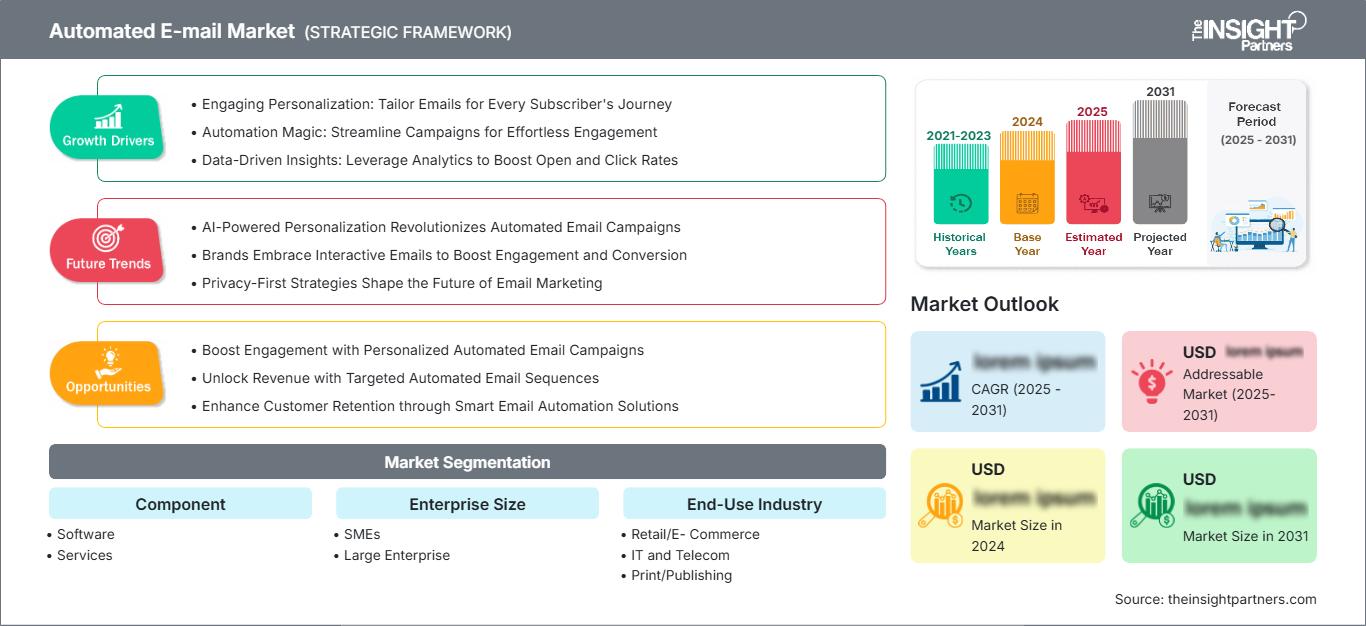
Automated E-mail Marketing Market: Strategic Insights
Regional Insights
North America automated e-mail marketing market
North America's automated e-mail marketing market share is estimated at 34–37% in 2025, with a CAGR of 1.6–2.0% during 2026–2034. Demand is strongest in the US and Canada, where marketers already use CRM, customer data platforms, and advanced analytics to manage personalized campaigns at scale.
Growth is steady rather than rapid because adoption is mature, but replacement demand remains important. Enterprises are upgrading from disconnected newsletter tools to systems that support consent tracking, segmentation, reporting, and workflow automation. Retail, SaaS, financial services, and telecom buyers are prioritizing deliverability and integration with sales and service data.
U.S. automated e-mail marketing market
The U.S. represented 78–81% of North America's share in 2025 and is expected to grow at a CAGR of 1.7–2.1% during 2026–2034. Large enterprise spending is concentrated around integrated customer engagement stacks, while SMEs continue to adopt simpler cloud platforms for repeatable campaigns.
Company presence is reinforced by Microsoft Corporation, Oracle Corporation, IBM Corporation, Epsilon Data Management, LLC, and several specialist vendors serving e-commerce and subscription businesses. Application trends include welcome series, churn prevention, account alerts, cart recovery, product recommendations, and event-triggered nurturing linked to CRM or web behavior data.
Europe automated e-mail marketing market
Europe held 26–29% share in 2025 and is projected to grow at a CAGR of 1.4–1.8% during 2026–2034. The UK leads regional adoption due to strong retail, financial services, and digital agency ecosystems, while Germany emphasizes data governance and enterprise integration.
France, Italy, and Spain are expanding adoption among retailers, banks, media firms, and telecom operators seeking structured customer communication. GDPR has made compliance functionality a purchasing priority, encouraging demand for consent records, preference centers, secure data handling, and campaign audit trails. These requirements favor vendors with mature privacy controls.
APAC automated e-mail marketing market
APAC accounted for 25–28% share in 2025 and is forecast to grow at a CAGR of 2.0–2.5% through 2034. China is the leading country, supported by digital commerce scale, mobile-first engagement, and expanding enterprise software adoption.
India, Japan, South Korea, and Australia are increasing demand for cloud automation, customer segmentation, and localized campaign management. Growth is supported by e-commerce, fintech, IT services, and telecom expansion, though channel preferences and data localization requirements influence platform configuration across markets.
Middle East & Africa automated e-mail marketing market
The Middle East & Africa market is projected to grow at a CAGR of 1.5–2.0% during 2026–2034. The UAE leads adoption through retail, hospitality, fintech, and government digital service communication.
Saudi Arabia, South Africa, and the Rest of MEA show selective growth as enterprises modernize marketing operations and customer notification systems. Infrastructure investment, cloud adoption, and expanding digital payments support demand, while budget sensitivity and localized compliance needs shape vendor selection.
Segmentation Analysis
Component
Component is segmented into Software and Services. The market scope is led by software because enterprises need campaign builders, workflow automation, analytics, segmentation, and deliverability management in one platform. The component segment is estimated to grow at a CAGR of 1.7–2.2% during 2026–2034 as services support migration and optimization.
- Software holds the largest position because recurring platforms manage templates, triggers, contact lists, analytics, and compliance controls, making them central to daily marketing operations.
- Services support deployment, integration, campaign strategy, deliverability audits, training, and managed execution, especially for enterprises moving from legacy systems to modern cloud-based platforms.
Enterprise Size
Enterprise-size demand is expected to grow at a CAGR of 1.6–2.1% during 2026–2034 as both SMEs and large enterprises automate communication workflows. SMEs value cost-efficient adoption and fast setup, while large enterprises emphasize governance, scale, security, and deeper customer data integration across departments.
- SMEs adopt automated e-mail tools to nurture leads, recover abandoned carts, and maintain customer contact without expanding marketing teams or relying on manual campaign execution.
- Large Enterprise users prioritize integration with CRM, analytics, identity, and compliance systems, making automation part of broader customer experience and revenue operations strategy.
End-Use Industry
End-Use Industry is projected to grow at a CAGR of 1.8–2.4% during 2026–2034. Retail and E-Commerce remain strategically important because automated messages directly influence conversion, retention, and repeat purchase behavior. BFSI, IT and telecom, and print or publishing use automation for account updates, subscriptions, education, and engagement.
- Retail/E-Commerce uses lifecycle automation for cart recovery, product recommendations, loyalty messages, replenishment reminders, and promotional journeys tied to browsing and purchase behavior.
- IT and Telecom applies automated campaigns for onboarding, renewal reminders, service notifications, upsell prompts, and technical education across subscription and account-based customer models.
- Print/Publishing relies on automated e-mail for subscriber engagement, renewal prompts, newsletter delivery, audience segmentation, and campaign performance tracking across digital and print audiences.
- BFSI uses rule-based communication for onboarding, product education, alerts, compliance reminders, and relationship nurturing while maintaining strict data security and approval workflows.
Deployment
Deployment is forecast to grow at a CAGR of 1.9–2.5% during 2026–2034. Cloud is the fastest-growing deployment mode as buyers prefer scalable subscription models, rapid updates, and easier integrations. On-Premise remains relevant for institutions with strict data control, customized infrastructure, or internal security requirements.
- On-Premise deployment appeals to organizations requiring internal hosting, strict data residency, custom security controls, and tighter governance over customer communication infrastructure.
- Cloud deployment supports faster implementation, elastic capacity, automated updates, remote access, and integration with CRM, e-commerce, analytics, and customer data platforms.
Opportunity Snapshot
| End-Use Industry | Revenue Contribution | Trend Tag | Adoption Stage |
| Retail/E-Commerce | High | Cart Recovery | Mature |
| IT and Telecom | Medium | Lifecycle Alerts | Scaling |
| Print/Publishing | Medium | Subscriber Renewal | Scaling |
| BFSI | High | Secure Alerts | Mature |
Automated E-mail Marketing Market Growth Drivers and Impact Analysis
Personalized Customer Engagement at Scale
The transition from batch messaging to a behavior-driven journey based on customer behavior, preference, and buying patterns is taking place within companies. An automated e-mail marketing marketing system assists marketers in sending messages like welcome mailings, loyalty programs, replenishment reminders, and win-back programs without having to coordinate them manually. This driver makes it easier for marketing campaigns to be consistent and for small teams to handle larger customer databases. It affects retail and e-commerce businesses more because they depend on timely messages.
CRM and Data Platform Integration
Integration with CRMs, commerce, analytics, and customer data platforms is making automated communications increasingly relevant to sales and service results. Businesses are looking for email automation that can react to lead scoring, renewals, product usage, account health, and support conversations. It enhances the importance of automation due to the incorporation of communications into customer lifecycle management metrics. In addition, it allows for more attribution, enabling marketers to track campaigns in terms of conversions, revenue, retention, and customer satisfaction.
Compliance and Deliverability Requirements
With privacy regulations, consent policies, and inbox management becoming a priority, governance has become an important purchase criterion for organizations. They require systems that will allow them to handle opt-in, suppression, preferences, domain verification, and tracking. Automating such processes will save time, minimize errors, and enable organizations to adhere to communication best practices across the organization. It is especially important for BFSI, telecommunication, and publishing industries, where compliance and deliverability matter a lot.
Automated E-mail Marketing Market Future Trends
AI-Assisted Campaign Optimization
Automated e-mail marketing market trends point toward AI-assisted optimization that refines subject lines, send times, audience segments, and content recommendations. As teams face pressure to improve conversion without increasing message frequency, predictive tools will help identify the right timing and offer for each contact. AI will also support testing, fatigue management, and deliverability monitoring. The trend will be most valuable where customer data is structured, permissioned, and connected across marketing and commerce systems.
Privacy-First Customer Data Workflows
Next-generation platforms will be built from the ground up using consent, preference management, and transparency in data handling, as opposed to compliance being an afterthought. It will become necessary for organizations to provide proof of how their contact data was acquired, segmented, used, and stored. This will fuel the need for solutions that integrate automation with governance features, access control, and auditing capabilities. Those who can make privacy operations simpler without sacrificing personalization will have an advantage.
Automated E-mail Marketing Market Opportunities
SME Automation Packages
A strong opportunity lies in packaged automation workflows for SMEs that need fast implementation and measurable outcomes. Automated e-mail marketing market Forecasts indicate that smaller businesses will favor prebuilt journeys for lead nurturing, cart recovery, onboarding, and reactivation because these reduce configuration time. Vendors can pair templates with pricing transparency, simple analytics, and integrations with commerce or CRM tools. This approach lowers adoption barriers and creates expansion paths as SMEs mature their marketing operations.
Vertical-Specific Compliance Templates
Vendors can differentiate by offering industry-specific templates for BFSI, telecom, publishing, and retail. These templates can embed approval flows, consent language, segmentation logic, suppression rules, and reporting formats aligned with sector needs. Buyers benefit from reduced implementation risk, while vendors gain repeatable deployment models. The opportunity is strongest where marketing teams must balance personalization with legal review, data governance, and brand control across multiple markets or business units.
Frequently Asked Questions

- Comprehensive Market Sizing and Forecast Analysis
- Detailed Segmentation Analysis
- In-Depth Market Dynamics Assessment
- Regional and Country-Level Insights
- Competitive Landscape and Company Benchmarking
- Strategic Business Intelligence
Recent Reports
Testimonials

The Insight Partners' SCADA System Market report is comprehensive, with valuable insights on current trends and future forecasts. The team was highly professional, responsive, and supportive throughout. We are very satisfied and highly recommend their services.
RAN KEDEM Partner, Reali Technologies LTDs
I requested a report on a very specific software market and the team produced the report in a few days. The information was very relevant and well presented. I then requested some changes and additions to the report. The team was again very responsive and I got the final report in less than a week.
JEAN-HERVE JENN Chairman, Future Analytica
We worked with The Insight Partners for an important market study and forecast. They gave us clear insights into opportunities and risks, which helped shape our plans. Their research was easy to use and based on solid data. It helped us make smart, confident decisions. We highly recommend them.
PIYUSH NAGPAL Sr. Vice President, High Beam Global
The Insight Partners delivered insightful, well-structured market research with strong domain expertise. Their team was professional and responsive throughout. The user-friendly website made accessing industry reports seamless. We highly recommend them for reliable, high-quality research services
YUKIHIKO ADACHI CEO, Deep Blue, LLC.
This is the first time I have purchased a market report from The Insight Partners.While I was unsure at first, I visited their web site and felt more comfortable to take the risk and purchase a market report.I am completely satisfied with the quality of the report and customer service. I had several questions and comments with the initial report, but after a couple of dialogs over email with their analyst I believe I have a report that I can use as input to our strategic planning process.Thank you so much for taking the extra time and making this a positive experience.I will definitely recommend your service to others and you will be my first call when we need further market data.
JOHN SUZUKI President and Chief Executive Officer, Board Director, BK Technologies
I wish to appreciate your support and the professionalism you displayed in the course of attending to my request for information regarding to infectious disease IVD market in Nigeria. I appreciate your patience, your guidance, and the fact that you were willing to offer a discount, which eventually made it possible for us to close a deal. I look forward to engaging The Insight Partners in the future, all thanks to the impression you have created in me as a result of this first encounter.
DR CHIJIOKE ONYIA MANAGING DIRECTOR, PineCrest Healthcare Ltd.Reason to Buy
- Informed Decision-Making
- Understanding Market Dynamics
- Competitive Analysis
- Identifying Emerging Markets
- Customer Insights
- Market Forecasts
- Risk Mitigation
- Boosting Operational Efficiency
- Strategic Planning
- Investment Justification
- Tracking Industry Innovations
- Aligning with Regulatory Trends





 Get Free Sample for