
Automated Retail Market Share, Demand & Growth by 2034
Coverage: By Type (Point-of-Sale (POS), Barcode and RFID, Electronic Shelf Label (ESL), Camera, Autonomous Guided Vehicle (AGV), Others); End User (Hypermarket, Supermarket, Single Item Store, Fuel Station, Retail Pharmacy) , and Geography (North America, Europe, Asia Pacific, and South and Central America)
- Status : Data Released
- Report Code : TIPRE00021359
- Category : Technology, Media and Telecommunications
- No. of Pages : 150
- Available Report Formats :


- Last update date : August 21, 2026


2025 Market Size
US$ 22.81 Bn
Base year value
2034 Forecast
US$ 48.43 Bn
Projected by 2034
CAGR 2026-2034
8.72 %
Growth rate
Addressable Market
US$ 319.14 Bn
(2026-2034)
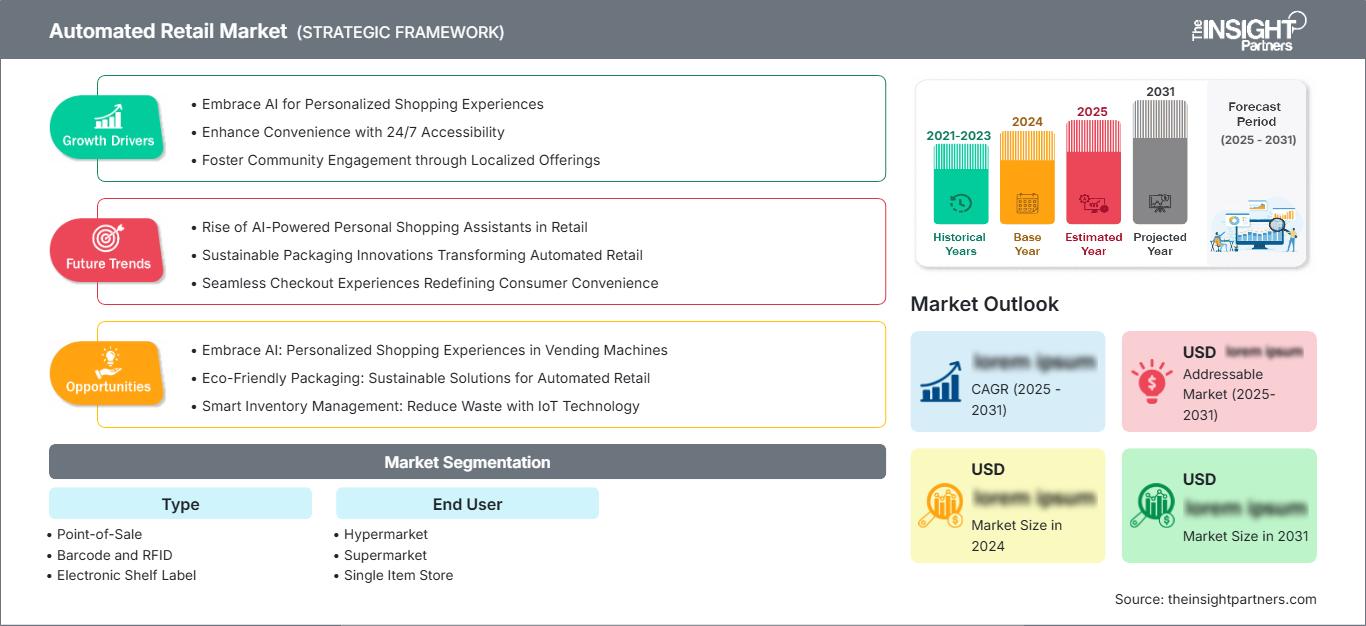
The Automated retail market was valued at US$ 22.81 billion in 2025 and is projected to reach US$ 48.43 billion by 2034, expanding at a CAGR of 8.72% during 2026–2034. Growing investments in digital retail infrastructure, intelligent checkout technologies, and contactless shopping experiences are accelerating adoption across supermarkets, convenience stores, fuel stations, and pharmacies. Retailers continue to modernize store operations through automation to improve inventory accuracy, reduce labor dependency, and enhance customer engagement.
Across North America, retailers continue to prioritize AI-enabled store operations, frictionless payment systems, and connected inventory management to improve operational productivity. The automated retail market size in the region benefits from high technology penetration, organized retail networks, and widespread deployment of electronic shelf labels and smart point-of-sale systems. Regional demand is expected to advance at an estimated CAGR of 8.3%–8.8% through 2034, supported by investments in omnichannel retailing and intelligent store modernization.
Automated Retail Market Assessment and Insights
- North America: Accounted for 34%–38% share in 2025 and is anticipated to expand at a CAGR of 8.3%–8.8% during 2026–2034, driven by rapid deployment of autonomous checkout, RFID-enabled inventory tracking, and digital payment infrastructure across organized retail chains.
- US: Represented nearly 76%–80% of North American revenue in 2025 and is forecast to grow at a CAGR of 8.4%–8.9%, supported by leading retail technology providers, widespread self-service adoption, and continuous investments in store automation.
- Europe: Held 27%–31% market share in 2025 while progressing at a CAGR of 8.1%–8.6%. Germany, the UK, France, Italy, and the Nordic countries continue investing in intelligent retail technologies and automated inventory management.
- Asia Pacific: Captured 24%–28% share in 2025 and is projected to record the fastest regional expansion with a CAGR of 9.4%–10.0%, led by China, Japan, South Korea, and India through large-scale digital retail transformation.
- Largest Segment: Point-of-Sale accounted for 31%–35% market share in 2025 and is expected to expand at a CAGR of 8.2%–8.7%, owing to continued upgrades toward integrated payment and inventory management platforms.
- High Growth Segment: Electronic Shelf Label is projected to grow at a CAGR of 10.1%–10.8% while representing 15%–19% market share in 2025, supported by dynamic pricing initiatives and real-time inventory synchronization.
- Key companies analyzed in detail: Automated Retail Systems, Datalogic S.p.A., Fujitsu Limited, Honeywell International Inc., Ingenico, KUKA AG, VeriFone, Inc., NCR Voyix Corporation, Pricer AB, Toshiba Tec Corporation, Zebra Technologies Corporation.
Source: The Insight Partners' analysis based on proprietary research, government publications, company annual reports, investor presentations, industry databases, and expert interviews.
The automated retail market has evolved from standalone self-service terminals toward interconnected retail ecosystems integrating AI, IoT, cloud analytics, and computer vision technologies. The retail industry is witnessing the increased use of smart checkouts, digital shelf management, barcode automation, RFID systems, and robotic material handling as tools to save on operational costs as well as enhance customer experience. Vendors of technology are continually developing scalable software solutions that can support inventory visibility, predictive replenishment, and omnichannel capabilities within various retail formats.
In the future, continued investments in the digital commerce ecosystem, digital payments through government programs, and increasing customer demand for a seamless shopping experience will aid market expansion. Intelligent technologies are anticipated to be increasingly deployed in emerging economies as organized retail adoption grows. Innovations in the fields of artificial intelligence, autonomous retail, and connected retail will provide good investment avenues during the forecast period.
Automated Retail Market Report Scope
| Report Attribute | Details |
|---|---|
| Market size in 2025 | US$ 22.81 Billion |
| Market Size by 2034 | US$ 48.43 Billion |
| Global CAGR (2026 - 2034) | 8.72% |
| Historical Data | 2021-2024 |
| Forecast period | 2026-2034 |
Automated Retail Market Analysis
Growing retailer emphasis on operational efficiency, reduced checkout time, and enhanced inventory visibility continues to stimulate automated retail market growth across developed and emerging economies. Integrated automation solutions improve pricing accuracy, minimize stock-outs, and enhance consumer convenience while reducing labor-intensive activities. Rising adoption of digital payment ecosystems, AI-powered inventory forecasting, and omnichannel retail strategies further strengthens demand throughout the value chain.
Technology providers, software developers, systems integrators, hardware manufacturers, and cloud service vendors collectively contribute to a rapidly evolving retail automation ecosystem. Advances in machine vision, IoT sensors, RFID infrastructure, and edge computing enable retailers to automate replenishment, pricing, customer analytics, and supply chain visibility, improving overall operational resilience and profitability.
The competitive environment within the automated retail market analysis is characterized by continuous product innovation, strategic collaborations, and acquisitions aimed at expanding intelligent retail portfolios. Examples of companies that have invested in AI-powered retail technologies include Honeywell International Inc., Zebra Technologies Corporation, Datalogic S.p.A., Fujitsu Limited, NCR Voyix Corporation, Toshiba Tec Corporation, Pricer AB, KUKA AG, Ingenico, VeriFone, Inc., and Automated Retail Systems.
The trend of investment in retail technology has moved to software-defined retail technology solutions, electronic shelf label systems, automated checkouts, robotics, and retail analytics on the cloud platform. Partnership among retailers and automation providers is making possible the rapid growth of solutions that help in enhancing inventory accuracy and reducing shrinkage, among other benefits.
● REPORT CUSTOMIZATION
Tailor This Report To Align With Your Specific Business Requirements
This report can be customized to align precisely with your business objectives, scope, and target markets. Customization options include tailored segmentation, geography, competitive analysis, and strategic insights to support informed decision-making.
Customize This Report →WHAT YOU CAN ADJUST
- ● Segmentations
- ● Geography
- ● Competitive Analysis
- ● Language Preferences
Automated Retail Market: Strategic Insights
Regional Insights
North America Automated Retail Market
North America accounted for an estimated 34–38% share of the automated retail market in 2025 and is projected to expand at a CAGR of 8.5–9.1% during 2026–2034. The region benefits from widespread deployment of self-service retail technologies, strong investment in digital payment infrastructure, and high consumer acceptance of cashier-less shopping formats. The automated retail market share remains the highest globally due to continuous modernization across supermarkets, convenience stores, airports, healthcare facilities, and transportation hubs.
There are further enhancements of the integration of analytics powered by artificial intelligence, electronic shelf tags, RFID-based inventories, and innovative point-of-sale technologies in order to enhance efficiency and solve the problem of a lack of labor force. The USA and Canada also enjoy their well-developed cloud technology base and positive attitude toward omni-channel retailing. Further developments of technology vendors and increased spending on self-shopping experiences will support the position of North America.
U.S. Automated Retail Market
The U.S. represented approximately 82–86% of the North American market in 2025 and is anticipated to record a CAGR of 8.6–9.2% through 2034. Large-scale investments by grocery chains, convenience retailers, pharmacies, and warehouse clubs continue supporting the adoption of intelligent checkout technologies. Strong penetration of contactless payment systems and AI-driven retail software further accelerates deployment across organized retail environments.
Technology companies such as Honeywell International Inc., NCR Voyix Corporation, Zebra Technologies Corporation, Toshiba Tec Corporation, and Datalogic S.p.A. have established a significant presence throughout the country, thus making product development possible at all times. More and more retailers use computer vision systems, RFID technologies, digital labels for shelves, and analytics to boost their inventory management and customer convenience. Investments in smart retailing and autonomous retailing further improve market prospects.
Europe Automated Retail Market
Europe captured approximately 28–32% of the global market in 2025 and is forecast to expand at a CAGR of 8.2–8.8% through 2034. Technology adoption is further enabled by strong digitalization programs, strict labor laws, and rising investments in retail automation technologies. Germany still leads the region due to its sophisticated manufacturing environment and the use of industrial automation technologies for retail modernization.
The United Kingdom sees continued fast adoption of autonomous checkout, AI-driven inventory management, and electronic shelf labels within supermarkets and convenience stores. Retail chains make more investments in digital transformation programs to increase operational efficiencies and engage consumers.
France, Italy, and Spain are making further advancements in automated retail installations within grocers, pharmacies, and transportation retailers. Cashless payments, RFID-based inventory management, and smart retail solutions enable continued regional growth along with improved retail efficiencies.
APAC Automated Retail Market
Asia Pacific represented an estimated 24–28% share in 2025 and is expected to register the highest CAGR of 9.6–10.3% during the forecast period. Leadership by China in terms of the adoption of such technologies is shown by rapid adoption of AI-enabled convenience stores and vending solutions. Japan and South Korea are continuously adopting retail technologies based on robots.
The development of organized retail technology, cloud-based store management, and digital payments solutions is being seen increasingly in India and Australia. The government's initiative to promote digital commerce, growth in urban populations, and the consumers' inclination toward contactless shopping are contributing to this trend.
Middle East & Africa Automated Retail Market
The Middle East & Africa market is projected to grow at a CAGR of 8.0–8.6% between 2026 and 2034. Both Saudi Arabia and the UAE contribute significantly to the growth of the region due to smart city projects, high-end retail projects, and digital commerce infrastructure for automated retail solutions.
Automation activities are continuing to grow in South Africa through the supermarkets and convenience stores, while other nations in the region are embracing self-service retailing systems in airports, healthcare centers, and fuel stations. Increased investments in infrastructure and digital transformation will bring sustainable growth opportunities in the region.
Segmentation Analysis
Type
The Type segment is projected to expand at a CAGR of 8.8–9.3% during 2026–2034. Increasing demand for frictionless shopping experiences, real-time inventory management, and automated checkout solutions continues driving investments across retail formats. The growing deployment of AI, computer vision, RFID, and digital payment technologies supports continuous innovation across retail automation solutions. The automated retail market scope continues expanding as retailers integrate multiple automation technologies to enhance operational efficiency, reduce labor dependency, and improve customer engagement.
- Point-of-Sale: Modern point-of-sale solutions integrate cloud connectivity, digital payments, analytics, and inventory management, enabling retailers to streamline checkout operations while supporting omnichannel commerce and personalized customer engagement.
- Barcode and RFID: Barcode and RFID technologies improve inventory visibility, reduce stock discrepancies, accelerate replenishment cycles, and enhance supply chain transparency across supermarkets, warehouses, and specialty retail stores.
- Electronic Shelf Label: Electronic shelf labels enable centralized pricing updates, dynamic promotions, and accurate product information while reducing manual labor requirements and improving operational efficiency in organized retail environments.
- Camera: AI-enabled camera systems support customer behavior analysis, automated checkout, theft prevention, shelf monitoring, and store traffic optimization, making them increasingly valuable for intelligent retail operations.
- Autonomous Guided Vehicle: Autonomous guided vehicles automate inventory movement, shelf replenishment, warehouse logistics, and backroom transportation, reducing operational costs while improving productivity and fulfillment efficiency.
End User
The End User segment is expected to register a CAGR of 9.0–9.6% throughout the forecast period. Growing consumer preference for contactless shopping, increasing labor shortages, and continuous investments in digital retail infrastructure encourage adoption across multiple retail formats. Large retailers are integrating automated technologies to optimize store operations, improve inventory accuracy, and deliver seamless shopping experiences while reducing operating expenses.
- Hypermarket: Hypermarkets increasingly deploy electronic shelf labels, AI-powered checkout systems, and RFID-enabled inventory management to improve operational efficiency while managing large product portfolios and high customer volumes.
- Supermarket: Supermarkets continue investing in automated checkout, digital shelf management, and intelligent inventory solutions to reduce waiting times, optimize workforce utilization, and improve overall customer satisfaction.
- Single Item Store: Single-item stores leverage compact automated retail technologies to maximize operational efficiency, reduce staffing requirements, and deliver convenient self-service purchasing experiences within limited retail footprints.
- Fuel Station: Fuel stations increasingly integrate automated payment terminals, smart kiosks, and unattended retail systems to extend operating hours while providing faster customer service and improved transaction security.
- Retail Pharmacy: Retail pharmacies adopt automated dispensing systems, self-service kiosks, digital payment solutions, and inventory management technologies to enhance prescription accuracy, improve workflow efficiency, and elevate customer convenience.
Opportunity Snapshot
| End User | Revenue Contribution | Trend Tag | Adoption Stage |
| Hypermarket | High | Smart Checkout | Mature |
| Supermarket | High | Digital Shelf | Scaling |
| Single Item Store | Medium | Micro Retail | Scaling |
| Fuel Station | Medium | Unattended Store | Emerging |
| Retail Pharmacy | High | Digital Pharmacy | Scaling |
Automated Retail Market Growth Drivers and Impact Analysis
Expansion of Cashier-Less and Contactless Shopping Infrastructure
The adoption rate of automated cashier-less retail is increasing worldwide among various retailers, who seek to reduce costs and increase customer convenience by investing in such solutions. The increased demand for convenient and easy purchase experiences has spurred the adoption of AI-driven checkout, computer vision, RFID technology, and mobile payment solutions. Retail giants like supermarkets, convenience stores, and transport stations have increasingly adopted automation in retail to reduce transaction time and provide more accurate inventory tracking. The increased adoption of digital payments, along with the growth in cloud computing and edge analytics capabilities, enables efficient store management. Labor shortage in developed countries provides another reason for increased adoption of automation solutions.
Growing Adoption of AI-Based Inventory and Store Management
Inventory planning and forecasting, as well as store management, have been significantly changed by artificial intelligence in organized retailing. Nowadays, automated retailing systems apply advanced predictive analysis, machine learning, and real-time monitoring features that increase stock efficiency and minimize waste and loss of inventory. Intelligent shelf monitoring, electronic shelf labels, and RFID technology help automate replenishment cycles and provide greater visibility in operations. In addition, artificial intelligence allows for making proactive decisions, preventing any risks of stockouts or excess inventory. As retailers implement more omnichannel strategies, artificial intelligence helps to synchronize the inventory management in physical stores and online platforms.
Increasing Digital Transformation Across Organized Retail
There is a continued focus by retailers on digital transformation in order to stay relevant in their respective industries. There has been an increased global adoption of technologies such as cloud-based POS, self-checkout, smart shelves, robotics and IoT-enabled monitoring systems. Digital commerce programs from governments, coupled with urbanization and a higher smartphone adoption rate, have only helped to expedite this process. Retailers also require automation to increase energy efficiency, reduce manual processes and aid in decision-making through data. There are more automation software companies coming up with solutions that can be used in large retail outlets and small stores alike.
Automated Retail Market Future Trends
AI-Powered Autonomous Retail Ecosystems
Artificial intelligence will increasingly become the foundation of autonomous retail operations throughout the forecast period. Automated retail market trends indicate growing integration of computer vision, predictive analytics, digital twins, and intelligent pricing solutions within unified retail platforms. Future stores are expected to leverage AI for demand forecasting, automated replenishment, personalized promotions, and dynamic inventory optimization. Integration with cloud infrastructure and edge computing will enable real-time operational decisions while improving customer engagement and reducing operating costs across various retail formats.
Expansion of Smart Store Networks Across Emerging Economies
There is bound to be swift installation of retail automation technologies owing to improvements in store infrastructure, as well as growth in organized retailing by retailers. The increase in the use of electronic shelf labels, mobile payments, AI-driven surveillance, and self-checkout technologies would make processes efficient while catering to changing consumer preferences. Government efforts towards digitizing the economy, increasing connectivity, and increasing investments in retail technology are set to drive the adoption of smart retail ecosystems in the Asia Pacific region, Latin America, and certain Middle Eastern countries.
Automated Retail Market Opportunities
Expansion of Intelligent Convenience Store Networks
Retail operators are increasingly investing in autonomous convenience stores that operate with minimal human intervention, creating substantial long-term business opportunities for technology providers. Automated retail market Forecasts indicate that demand for AI-powered checkout systems, electronic shelf labels, RFID inventory management, and cloud-based store monitoring will continue expanding as retailers seek higher operational efficiency. Emerging urban centers, transportation hubs, hospitals, universities, and corporate campuses represent attractive deployment locations for compact automated retail formats. Vendors capable of delivering integrated hardware, software, cybersecurity, analytics, and maintenance services are expected to benefit from recurring revenue opportunities while supporting scalable digital transformation initiatives across organized retail ecosystems.
Integration of Retail Automation with Omnichannel Commerce Platforms
The convergence of physical and digital retailing provides huge potential areas of investment in terms of solutions providers for providing unified commerce platforms. Automated retail technology can integrate in-store inventories, online orders, loyalty schemes, digital payments, and analytics in the retail environment using cloud-based systems. With the increase in the number of omnichannel initiatives taken up by retailers, there will be an increased need for intelligent software that can help manage pricing, fulfillment, restocking, and engagement on multiple sales channels. Companies making investments in retail platforms, AI, and cybersecurity are best placed to capitalize on the opportunity.
Frequently Asked Questions

- Comprehensive Market Sizing and Forecast Analysis
- Detailed Segmentation Analysis
- In-Depth Market Dynamics Assessment
- Regional and Country-Level Insights
- Competitive Landscape and Company Benchmarking
- Strategic Business Intelligence
Recent Reports
Testimonials

The Insight Partners' SCADA System Market report is comprehensive, with valuable insights on current trends and future forecasts. The team was highly professional, responsive, and supportive throughout. We are very satisfied and highly recommend their services.
RAN KEDEM Partner, Reali Technologies LTDs
I requested a report on a very specific software market and the team produced the report in a few days. The information was very relevant and well presented. I then requested some changes and additions to the report. The team was again very responsive and I got the final report in less than a week.
JEAN-HERVE JENN Chairman, Future Analytica
We worked with The Insight Partners for an important market study and forecast. They gave us clear insights into opportunities and risks, which helped shape our plans. Their research was easy to use and based on solid data. It helped us make smart, confident decisions. We highly recommend them.
PIYUSH NAGPAL Sr. Vice President, High Beam Global
The Insight Partners delivered insightful, well-structured market research with strong domain expertise. Their team was professional and responsive throughout. The user-friendly website made accessing industry reports seamless. We highly recommend them for reliable, high-quality research services
YUKIHIKO ADACHI CEO, Deep Blue, LLC.
This is the first time I have purchased a market report from The Insight Partners.While I was unsure at first, I visited their web site and felt more comfortable to take the risk and purchase a market report.I am completely satisfied with the quality of the report and customer service. I had several questions and comments with the initial report, but after a couple of dialogs over email with their analyst I believe I have a report that I can use as input to our strategic planning process.Thank you so much for taking the extra time and making this a positive experience.I will definitely recommend your service to others and you will be my first call when we need further market data.
JOHN SUZUKI President and Chief Executive Officer, Board Director, BK Technologies
I wish to appreciate your support and the professionalism you displayed in the course of attending to my request for information regarding to infectious disease IVD market in Nigeria. I appreciate your patience, your guidance, and the fact that you were willing to offer a discount, which eventually made it possible for us to close a deal. I look forward to engaging The Insight Partners in the future, all thanks to the impression you have created in me as a result of this first encounter.
DR CHIJIOKE ONYIA MANAGING DIRECTOR, PineCrest Healthcare Ltd.Reason to Buy
- Informed Decision-Making
- Understanding Market Dynamics
- Competitive Analysis
- Identifying Emerging Markets
- Customer Insights
- Market Forecasts
- Risk Mitigation
- Boosting Operational Efficiency
- Strategic Planning
- Investment Justification
- Tracking Industry Innovations
- Aligning with Regulatory Trends





 Get Free Sample for