
Automation COE Market Growth, Size & Forecast by 2034
Automation COE Market Size and Forecasts (2021 - 2034), Global and Regional Share, Trends, and Growth Opportunity Analysis Report Coverage : By Services (Technology Assessment & Consulting, Design & Testing, Governance, Implementation Support), Verticals (BFSI, Healthcare & Life Sciences, Manufacturing, IT & ITES, Retail & Consumer Goods, Transportation & Logistics), Organization Size (Large Enterprises, SMEs)
- Status : Data Released
- Report Code : TIPRE00039737
- Category : Technology, Media and Telecommunications
- No. of Pages : 150
- Available Report Formats :


- Last update date : August 26, 2026


2025 Market Size
US$ 264.39 Bn
Base year value
2034 Forecast
US$ 458.87 Bn
Projected by 2034
CAGR 2026-2034
6.32 %
Growth rate
Addressable Market
US$ 3,273.30 Bn
(2026-2034)
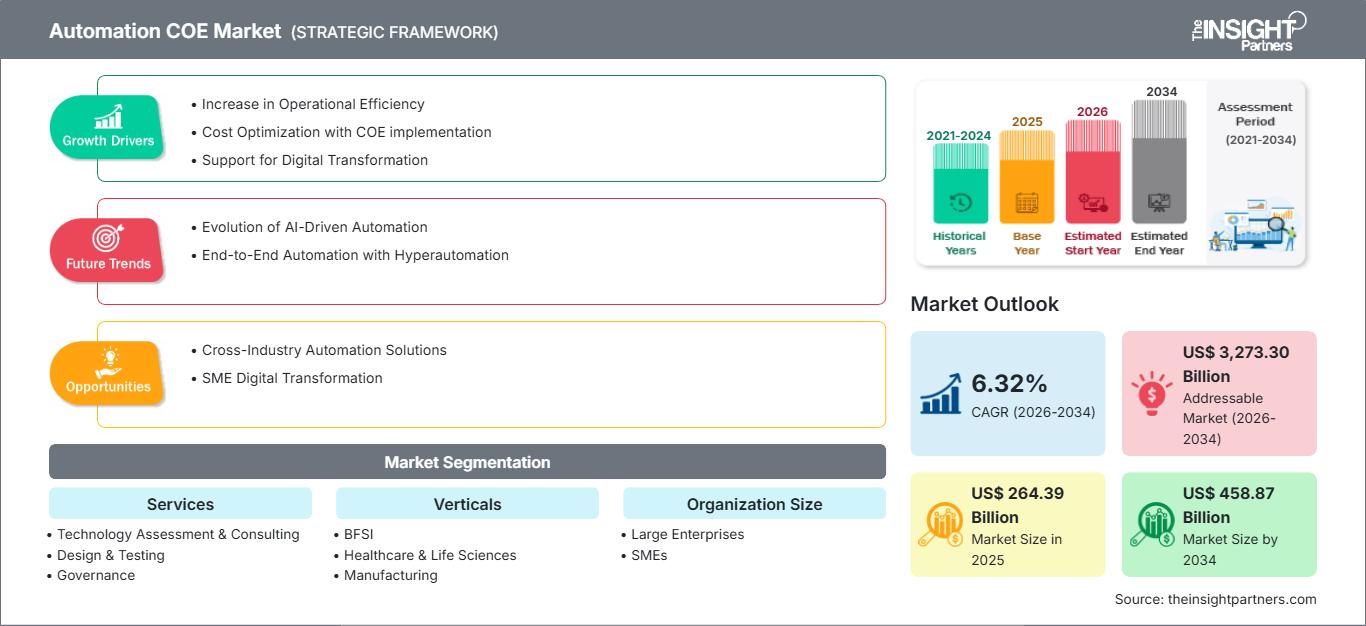
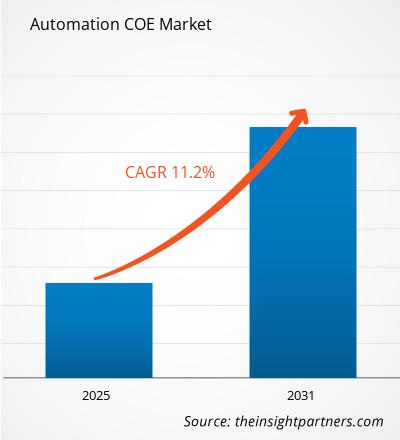
The automation CoE market was valued at US$ 264.39 Billion in 2025 and is projected to reach US$ 458.87 Billion by 2034, growing at a CAGR of 6.32% during 2026–2034. Enterprises are formalizing automation centers of excellence to govern robotics, workflow automation, industrial control, AI-enabled operations, and cross-functional transformation programs.
North America remains a major enterprise automation hub as manufacturers, utilities, healthcare networks, and financial institutions expand governance-led transformation. The automation CoE market size in the region is supported by mature consulting demand, industrial modernization, and strong adoption of digital operating models, with an estimated 34–37% share in 2025 and a CAGR of 5.8–6.5% during 2026–2034.
Automation COE Market Assessment and Insights
- North America holds 34–37% share in 2025 and grows at a CAGR between 5.8–6.5% during 2026–2034, supported by industrial automation governance, digital transformation budgets, and AI-enabled operating models.
- US accounts for 86–90% of North America in 2025 and grows at a CAGR between 5.7–6.4% during 2026–2034, led by large enterprises and advanced manufacturing.
- Europe holds 25–28% share in 2025 and grows at a CAGR between 5.4–6.1% during 2026–2034, with Germany, the UK, France, Italy, and Spain leading adoption.
- Asia Pacific accounts for 29–33% share in 2025 and grows at a CAGR between 6.8–7.6% during 2026–2034, led by China, Japan, India, South Korea, and Australia.
- Largest Segment: Implementation Support holds 31–35% market share in 2025 and grows at a CAGR between 6.0–6.7% during 2026–2034 as enterprises convert roadmaps into scaled programs.
- High Growth Segment: SMEs hold 24–28% share in 2025 and grow at a CAGR between 7.0–7.8% during 2026–2034 as packaged automation playbooks reduce entry barriers.
- Key companies analyzed in detail: FANUC Corporation, Emerson Electric Co., OMRON Corporation, Yaskawa Electric Corporation, Mitsubishi Electric Corporation, Yokogawa Electric Corporation, Kawasaki Heavy Industries, Ltd., ABB Ltd., Honeywell International Inc., and KUKA AG.
Source: The Insight Partners' analysis based on proprietary research, government publications, company annual reports, investor presentations, industry databases, and expert interviews.
Enterprise automation programs have moved from isolated robotics or workflow projects toward governed operating models that combine strategy, architecture, testing, deployment, and lifecycle control. The automation CoE market now reflects demand for structured decision rights, common technology standards, reusable process libraries, and performance measurement. Production dynamics are also changing as robotics vendors and industrial software providers embed simulation, AI support, and remote diagnostics into automation portfolios.
Demand in the future will depend on industrial resilience, labor challenges, cybersecurity demands, and the need to showcase the value of automation investments. New geographies will leverage CoE approaches for uniform factory upgrading, while developed regions will focus on governance, compliance, and scalability. Investment will go to companies offering services and automation solutions, which combine engineering skills with enterprise-wide discipline.
Automation COE Market Report Scope
| Report Attribute | Details |
|---|---|
| Market size in 2025 | US$ 264.39 Billion |
| Market Size by 2034 | US$ 458.87 Billion |
| Global CAGR (2026 - 2034) | 6.32% |
| Historical Data | 2021-2024 |
| Forecast period | 2026-2034 |
Automation COE Market Analysis
Growth in this market is due to the necessity of coordinating automation investments rather than permitting tool selection and project duplication within business units. COEs set the operating models, certify standards, evaluate benefits and assist in the conversion from pilots to deployment across various locations such as factories, branches, warehouses and shared services.
Market supply trends will be impacted by the combination of consulting, governance, design, testing and deployment support. There is a growing expectation for partners to have experience in robotics, control systems, process automation, data integration and change management. This leads to the requirement of multidisciplinary suppliers who can minimize delivery risk without limiting local flexibility.
Based on the market analysis, the industry automation frontrunners have positioned CoE support through hardware, software, and service ecosystems. FANUC Corporation, ABB Ltd., KUKA AG, Yaskawa Electric Corporation, Kawasaki Heavy Industries, Ltd., and OMRON Corporation bring in robotics expertise, whereas Emerson Electric Co., Honeywell International Inc., Yokogawa Electric Corporation, and Mitsubishi Electric Corporation provide relevance in process, control, and enterprise automation.
The investments are being made for design based on simulations, AI-driven programming, governance dashboards, and digital twin validation. Positioning requires aiding customers not only in purchasing but also managing the technologies. Vendors that integrate automation engineering, training, cybersecurity, and productivity outcomes will be able to secure advisory and implementation opportunities.
● REPORT CUSTOMIZATION
Tailor This Report To Align With Your Specific Business Requirements
This report can be customized to align precisely with your business objectives, scope, and target markets. Customization options include tailored segmentation, geography, competitive analysis, and strategic insights to support informed decision-making.
Customize This Report →WHAT YOU CAN ADJUST
- ● Segmentations
- ● Geography
- ● Competitive Analysis
- ● Language Preferences
Automation COE Market: Strategic Insights
Regional Insights
North America automation CoE market
North America holds 34–37% share in 2025 and grows at a CAGR between 5.8–6.5% during 2026–2034. Automation CoE market share in the region is supported by large manufacturing sites, advanced process industries, logistics networks, and enterprise digital programs that require governance over robotics, control systems, and workflow automation.
The U.S. leads regional value because enterprises have the budgets and operating complexity needed for formal CoE structures. Canada and Mexico add demand through automotive, food processing, energy, and cross-border manufacturing. Buyers prioritize safety, cybersecurity, productivity reporting, and standardized deployment methods across multi-site operations.
U.S. automation CoE Market
The U.S. accounts for 86–90% of North America in 2025 and grows at a CAGR between 5.7–6.4% during 2026–2034. Demand is strongest among large manufacturers, energy companies, healthcare systems, banks, retailers, and logistics operators that manage complex automation portfolios across many locations.
Company presence is deep, with Honeywell International Inc., Emerson Electric Co., FANUC Corporation, ABB Ltd., and KUKA AG supporting industrial automation, robotics, and digital operations. Application trends include smart factories, autonomous material handling, OT cybersecurity, predictive maintenance, and standardized project governance for enterprise productivity programs.
Europe automation CoE Market
Europe holds 25–28% share in 2025 and grows at a CAGR between 5.4–6.1% during 2026–2034. Germany is the leading country because automotive, machinery, chemicals, and industrial robotics users require structured automation governance. The UK supports service-led CoE adoption across BFSI, healthcare, retail, and public sector digital transformation.
France, Italy, and Spain add demand through manufacturing modernization, logistics optimization, and energy efficiency programs. European buyers emphasize worker safety, sustainability, data protection, and compliance documentation. ABB Ltd., KUKA AG, Siemens-linked ecosystems, OMRON Corporation, and Yokogawa Electric Corporation remain relevant across factory automation and process industries.
APAC automation CoE Market
APAC accounts for 29–33% share in 2025 and grows at a CAGR between 6.8–7.6% during 2026–2034. China leads on a regional scale through electronics, automotive, and industrial robotics deployment, while Japan contributes mature automation engineering and robotics suppliers.
India is expanding CoE adoption through IT services, manufacturing incentives, and enterprise shared services. South Korea supports semiconductor and electronics automation, while Australia adds mining, logistics, and infrastructure use cases. Regional growth is strengthened by labor productivity priorities and government-backed digital industry programs.
Middle East & Africa automation CoE Market
The Middle East & Africa region grows at a CAGR between 5.0–5.7% during 2026–2034, led by Saudi Arabia, the UAE, and South Africa. Energy, utilities, ports, and infrastructure operators are formalizing automation governance to improve reliability and project repeatability.
Saudi Arabia leads regional value through industrial diversification and smart infrastructure programs. The UAE supports logistics, aviation, and digital government automation, while South Africa adds mining and manufacturing modernization. The rest of MEA remains at an earlier stage but benefits from managed automation services.
Segmentation Analysis
Services
Services grow at a CAGR between 6.1–6.8% during 2026–2034. The market scope across services is shaped by the need to assess readiness, design operating models, test automation use cases, govern standards, and support implementation. Enterprises increasingly value integrated partners that can combine strategic advisory with field execution.
- Technology Assessment & Consulting helps enterprises identify automation readiness, prioritize use cases, evaluate platforms, and define business cases before committing capital to robotics, workflow, and industrial control initiatives.
- Design & Testing supports process mapping, simulation, proof-of-concept validation, control logic review, and user acceptance testing before automation programs are scaled across sites.
- Governance establishes standards, ownership, change control, security policies, performance tracking, and funding rules that prevent fragmented automation investments from weakening enterprise value.
- Implementation Support converts automation roadmaps into deployed solutions through configuration, integration, training, rollout management, troubleshooting, and post-launch optimization across business functions.
Verticals
Verticals grow at a CAGR between 6.2–6.9% during 2026–2034. Demand varies by operational intensity, compliance exposure, labor availability, and process repeatability. BFSI and IT services emphasize workflow automation, while manufacturing, logistics, healthcare, and retail use CoEs to align physical automation with data-driven operating models.
- BFSI uses automation CoEs to standardize compliance workflows, onboarding, claims, reporting, and fraud operations while maintaining auditability and strong control over regulated process changes.
- Healthcare & Life Sciences applies CoE structures to improve laboratory workflows, administrative processing, inventory accuracy, clinical documentation, and compliance-sensitive automation across distributed care environments.
- Manufacturing remains a major user of robotics, machine automation, quality inspection, maintenance, and production scheduling require consistent technical standards and plant-level change management.
- IT & ITES uses CoEs to scale service automation, ticket routing, software operations, infrastructure workflows, and AI-enabled support while maintaining centralized governance.
- Retail & Consumer Goods adopts CoE models for warehouse automation, pricing workflows, demand planning, returns processing, and store operations that require repeatable execution.
- Transportation & Logistics benefits from CoEs that coordinate routing, yard automation, warehouse robotics, asset tracking, and exception management across complex physical networks.
Organization Size
Organization Size grows at a CAGR between 6.3–7.0% during 2026–2034. Large enterprises dominate current spending because they manage complex portfolios, but SMEs are expanding faster as packaged consulting, cloud tools, and lower-code automation make structured governance more affordable.
- Large Enterprises use CoEs to govern global automation portfolios, align multiple business units, manage cybersecurity exposure, and ensure project benefits are visible to executive stakeholders.
- SMEs adopt lightweight CoE models to prioritize high-return use cases, access external expertise, reduce implementation mistakes, and compete with larger firms through targeted automation.
Opportunity Snapshot
Market Opportunity Snapshot
| Verticals | Revenue Contribution | Trend Tag | Adoption Stage |
| BFSI | High | Audit Automation | Mature |
| Healthcare & Life Sciences | Medium | Clinical Workflow | Scaling |
| Manufacturing | High | Smart Factory | Mature |
| IT & ITES | High | Service Bots | Mature |
| Retail & Consumer Goods | Medium | Warehouse Flow | Scaling |
| Transportation & Logistics | Medium | Fleet Workflow | Scaling |
Automation COE Market Growth Drivers and Impact Analysis
Need for Scalable Automation Governance
Automation projects typically start out with a pilot approach, but a lack of control will lead to duplication of efforts, inconsistent security measures, ambiguous ownership, and poor measurement of value generated. The CoE establishes an official governance structure, which includes standardization, approval processes, lifecycle management, and measurement. The impact on the market is substantial in that the buyer will be able to scale up automation throughout the enterprise without losing control.
Industrial Labor and Productivity Pressure
There are ongoing challenges of a shortage of workers, increasing wages, and the need for greater throughput by manufacturers, logistics companies, utilities, and health care firms. CoEs for automation focus on automating those tasks that have the least human involvement but increased consistency through robotics, automation of workflows, and AI-enabled systems. There is better spending discipline because CoEs make decisions about automation projects based on departmental comparisons and their measurable benefits.
Rising Complexity of AI and OT Integration
Automation solutions have begun to incorporate robotics, OT, enterprise solutions, analytics, cyber security, and AI models in their design. Such diversity increases the probability of integration issues, in case these solutions are implemented independently by the business units, IT, engineering, and cybersecurity teams. A CoE ensures the same architecture, testing approach, and escalation procedures for reducing the risk of deployments. The market implications include increased requirements for dedicated service partners with expertise in physical processes and digital governance.
Automation COE Market Future Trends
AI-Assisted CoE Decision Models
The automation CoE market trends will increasingly include AI tools that evaluate automation candidates, estimate benefits, recommend governance controls, and monitor project performance. These models will allow CoE leaders to measure the various initiatives based on their costs, complexities, risks, and productivity impacts. Since AI is being integrated into automation frameworks, the teams responsible for governance will also require validation of models, explanations of models, and control of biases in the models.
Digital Twin Validation Before Deployment
Future CoE implementations will make use of simulation and digital twin technology to validate workflows, robotic movement, safety boundaries, production bottlenecks, and energy usage prior to physical implementation. This minimizes risks during the commissioning process and helps in getting quicker approvals for complicated automation implementations. Validation through digital technologies will prove to be extremely beneficial in industries such as manufacturing, logistics, energy, and health care, in which the cost of downtime is high.
Automation COE Market Opportunities
Packaged CoE Models for Mid-Market Firms
The automation CoE market Forecasts indicate a strong opportunity in simplified CoE packages designed for SMEs and mid-market enterprises. These buyers need governance, business case templates, technology selection, and rollout support, but cannot fund large internal teams. Providers can offer subscription advisory, reusable playbooks, and remote implementation support. This creates recurring revenue while helping smaller organizations avoid common automation failures, such as poor process selection, weak ownership, and limited post-deployment measurement.
Vertical-Specific Governance Frameworks
Differentiation can be achieved through the design of CoE frameworks customized for BFSI, Healthcare, Manufacturing, Logistics, and Retail sectors. The risks, data, labor force considerations, and metrics differ across each industry. Customized frameworks lead to shortened sales cycles since potential buyers recognize templates, compliance rationale, and benchmarks that are relevant to them. This is a good opportunity for firms that possess both domain knowledge and automation engineering experience.
Frequently Asked Questions

- Comprehensive Market Sizing and Forecast Analysis
- Detailed Segmentation Analysis
- In-Depth Market Dynamics Assessment
- Regional and Country-Level Insights
- Competitive Landscape and Company Benchmarking
- Strategic Business Intelligence
Recent Reports
Testimonials

The Insight Partners provided valuable market intelligence that supported our global go-to-market strategy. Their team was professional, responsive, and attentive to our feedback, providing thoughtful analysis and helpful methodological clarifications throughout the project.
Junmo Kim Chief Financial Officer (CFO), Enertech Co., Ltd.
The Insight Partners' SCADA System Market report is comprehensive, with valuable insights on current trends and future forecasts. The team was highly professional, responsive, and supportive throughout. We are very satisfied and highly recommend their services.
RAN KEDEM Partner, Reali Technologies LTDs
I requested a report on a very specific software market and the team produced the report in a few days. The information was very relevant and well presented. I then requested some changes and additions to the report. The team was again very responsive and I got the final report in less than a week.
JEAN-HERVE JENN Chairman, Future Analytica
We worked with The Insight Partners for an important market study and forecast. They gave us clear insights into opportunities and risks, which helped shape our plans. Their research was easy to use and based on solid data. It helped us make smart, confident decisions. We highly recommend them.
PIYUSH NAGPAL Sr. Vice President, High Beam Global
The Insight Partners delivered insightful, well-structured market research with strong domain expertise. Their team was professional and responsive throughout. The user-friendly website made accessing industry reports seamless. We highly recommend them for reliable, high-quality research services
YUKIHIKO ADACHI CEO, Deep Blue, LLC.
This is the first time I have purchased a market report from The Insight Partners.While I was unsure at first, I visited their web site and felt more comfortable to take the risk and purchase a market report.I am completely satisfied with the quality of the report and customer service. I had several questions and comments with the initial report, but after a couple of dialogs over email with their analyst I believe I have a report that I can use as input to our strategic planning process.Thank you so much for taking the extra time and making this a positive experience.I will definitely recommend your service to others and you will be my first call when we need further market data.
JOHN SUZUKI President and Chief Executive Officer, Board Director, BK Technologies
I wish to appreciate your support and the professionalism you displayed in the course of attending to my request for information regarding to infectious disease IVD market in Nigeria. I appreciate your patience, your guidance, and the fact that you were willing to offer a discount, which eventually made it possible for us to close a deal. I look forward to engaging The Insight Partners in the future, all thanks to the impression you have created in me as a result of this first encounter.
DR CHIJIOKE ONYIA MANAGING DIRECTOR, PineCrest Healthcare Ltd.Reason to Buy
- Informed Decision-Making
- Understanding Market Dynamics
- Competitive Analysis
- Identifying Emerging Markets
- Customer Insights
- Market Forecasts
- Risk Mitigation
- Boosting Operational Efficiency
- Strategic Planning
- Investment Justification
- Tracking Industry Innovations
- Aligning with Regulatory Trends





 Get Free Sample for