
Automotive Digital Key Market Share, Growth & Forecast by 2034
Coverage: By Connectivity (Remote Cloud Key Access, Near Field Communication, Bluetooth, Wi-Fi); Device Type (Smartphone, Wearables); Application (Single Function, Multi-Function); Platform (IOS, Android) , and Geography (North America, Europe, Asia Pacific, and South and Central America)
- Status : Data Released
- Report Code : TIPRE00026047
- Category : Technology, Media and Telecommunications
- No. of Pages : 150
- Available Report Formats :


- Last update date : August 13, 2026


2025 Market Size
US$ 3.2 Bn
Base year value
2034 Forecast
US$ 19.69 Bn
Projected by 2034
CAGR 2026-2034
22.37 %
Growth rate
Addressable Market
US$ 90.20 Bn
(2026-2034)
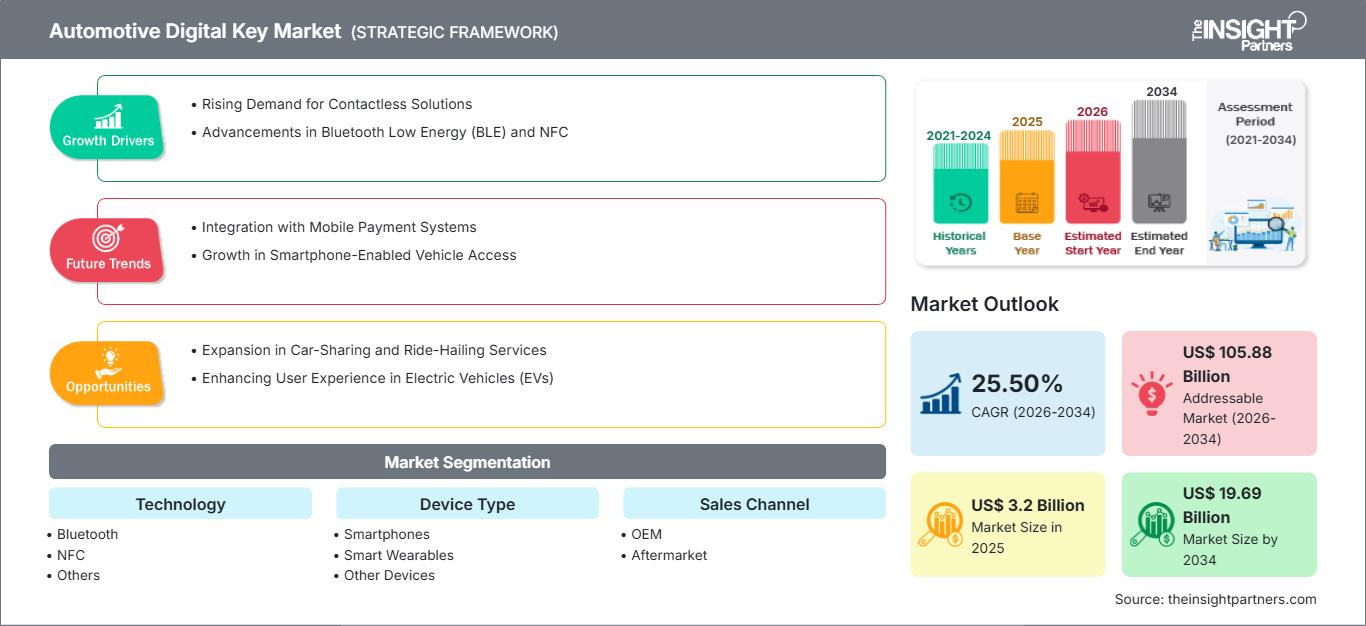
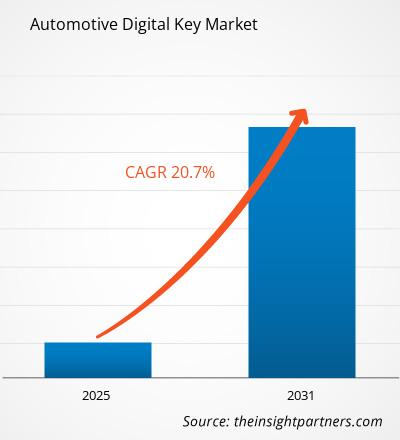
The Automotive Digital Key market was valued at US$ 3.2 billion in 2025 and is expected to reach US$ 19.69 billion by 2034; it is estimated to record a CAGR of 22.37% during 2026-2034.
Automotive Digital Key Market Assessment and Insights
- North America accounted for 32–35% Automotive Digital Key Market share in 2025 and is expected to grow at a CAGR of 24.5–26.5% between 2026–2034, led by connected SUV platforms, app-based ownership services, and digital access deployment across rental and corporate fleets.
- US represented 78–82% of North America in 2025 and is expected to grow at a CAGR of 24.8–26.8% between 2026–2034, supported by OEM telematics ecosystems.
- Europe held 26–29% share in 2025 and is projected to grow at a CAGR of 23.5–25.5% between 2026–2034, with Germany, the UK, France, Italy, and Spain leading deployments through premium vehicle programs and cybersecurity-focused standards adoption.
- Asia Pacific captured 34–38% share in 2025 and is forecast to grow at a CAGR of 26.5–28.5% between 2026–2034, driven by China, Japan, South Korea, India, and Australia as digital cockpit, EV, and smartphone ecosystems converge.
- Largest Segment: Smartphone represented an estimated 88–92% market share in 2025 and is expected to record a 24–26% CAGR during 2026–2034, reflecting existing consumer device ecosystems and wallet-based credential management.
- High Growth Segment: Wearables represented approximately 8–12% market share in 2025 and is modelled to expand at a 29–32% CAGR during 2026–2034, supported by smartwatch adoption and device-independent access convenience.
- Key companies analyzed in detail: BMW AG, Continental AG, Mercedes-Benz Group AG, Giesecke+Devrient GmbH, Huf Hülsbeck & Fürst GmbH & Co. KG, Robert Bosch GmbH, DENSO Corporation, Valeo SE, NXP Semiconductors N.V., STMicroelectronics N.V.
Source: The Insight Partners' analysis based on proprietary research, government publications, company annual reports, investor presentations, industry databases, and expert interviews.
Technology migration is changing the market’s trajectory from short-range convenience features to standards-compliant secure access systems. Early NFC implementations have been concerned with tap-to-unlock capabilities, whereas Bluetooth Low Energy has expanded remote keyless entry and key-sharing capabilities. Moving forward, the next step in the technology cycle involves the implementation of UWB for passive entry, accurate proximity detection, immunity to relay attacks, and connectivity with software-defined car platforms.
The ability to move forward will require OEMs to make the digital key feature standard beyond the higher-end models. Regulations pertaining to vehicle cybersecurity, growing EV fleets, and the necessity for fleet management operations to cut down on physical keys are driving adoption in new geographies. Suppliers with secure element, radio module, application framework, and certification capabilities can gain platform deals.
Automotive Digital Key Market Report Scope
| Report Attribute | Details |
|---|---|
| Market size in 2025 | US$ 3.2 Billion |
| Market Size by 2034 | US$ 19.69 Billion |
| Global CAGR (2026 - 2034) | 22.37% |
| Historical Data | 2021-2024 |
| Forecast period | 2026-2034 |
Automotive Digital Key Market Analysis
The expansion in automotive digital keys market is being fueled by the transition to connected cars, smartphone-based identity of customers, and application-based ownership experience. Vehicle access is being considered as one of the aspects of an extensive digital ecosystem, in which users can unlock, start, grant and revoke access via mobile credentials. The highest demand comes from the cases when car manufacturers offer their digital keys together with remote diagnostics, subscription-based services, electric vehicle charging processes, and cockpit personalizations.
According to the Automotive Digital Key Market report, the change in supply is being brought about by the fact that access solutions require integrated hardware, firmware, cloud services, and cybersecurity features. In order to deliver reliable operation, secure elements, NFC controllers, Bluetooth modules, ultra-wideband technology, and mobile wallet functionality have to function well on various phone and car models.
The automotive digital key market analysis reflects a competitive landscape with the participation of automakers, Tier 1s, semiconductor companies, and digital security companies. Early adopters of the technology are BMW AG and Mercedes-Benz Group AG, while Continental AG, Robert Bosch GmbH, DENSO Corporation, Valeo SE, Huf Hülsbeck & Fürst GmbH & Co. KG, NXP Semiconductors N.V., STMicroelectronics N.V., and Giesecke+Devrient GmbH provide modules, access systems, and secure credential services.
Increasing investment is focusing on certified, scalable, and cyber-secure architecture solutions. In 2025, the CCC broadened certification capabilities by including Bluetooth LE and UWB, thus building trust for the passive entry and start applications. This helps OEMs cut the costs of logistics associated with physical keys, enable fleet temporary access, and offer differentiated user experience without affecting the security of the authentication process.
● REPORT CUSTOMIZATION
Tailor This Report To Align With Your Specific Business Requirements
This report can be customized to align precisely with your business objectives, scope, and target markets. Customization options include tailored segmentation, geography, competitive analysis, and strategic insights to support informed decision-making.
Customize This Report →WHAT YOU CAN ADJUST
- ● Segmentations
- ● Geography
- ● Competitive Analysis
- ● Language Preferences
Automotive Digital Key Market: Strategic Insights
Regional Insights
North America automotive digital key market
In 2025, North America was estimated to lead the automotive digital key Market, accounting for 32-35% market share of automotive digital keys, with a projected CAGR growth of 24.5-26.5% up until 2034. The growth of this region can be attributed to advanced connected vehicle technology, high smartphone penetration rate, and OEM emphasis on secure access.
Other factors driving the growth include standards-based implementation and cybersecurity investments. Consumers are demanding the ability to access their vehicle via mobile wallets, remote applications, and individual driver profile. The automotive industry has been employing digital keys as a means of lowering key handling in dealerships, facilitating over-the-air activation services, and providing controlled access to family members and valet services.
U.S. automotive digital key Market
The USA contributed 78–82% to the North American automotive digital key Market in 2025 and is expected to witness a CAGR of 24.8–26.8% from 2026 to 2034. Adoption is seen in connected SUVs, high-end electric vehicles, and apps facilitating vehicle ownership where consumers utilize their phones to start the car, monitor its location, enable charging access, and schedule services.
Presence of companies helps in building the domestic ecosystem. Semiconductor providers, software vendors, cloud providers, and automotive companies are working together on interoperable access credentials. The role of fleets and rentals is key because digital keys will enable faster handover processes, better vehicle utilization, and issue of temporary permissions through central management.
Europe automotive digital key Market
Europe has a automotive digital key Market share ranging from 26% to 29% in 2025, and growth forecast is anticipated at a CAGR ranging from 23.5% to 25.5% for 2026 to 2034. Germany is leading the regional deployment owing to the extensive involvement of premium OEMs and Tier 1 suppliers in the connected vehicles access systems.
The UK and France are rapidly adopting through EV fleet, subscription ownership, and mobility platform. The Italy and Spain have been steadily increasing its adoption as connected vehicle penetration is increasing in mid-level segments. Consumer sensitivity to privacy, data security, and regulations for data privacy in Europe drive the demand for certified secure elements, encryption for credential sharing, and digital key specifications.
APAC automotive digital key Market
APAC accounted for 34–38% of the automotive digital key Market in 2025 and is forecast to grow at a CAGR of 26.5–28.5% through 2034. China is the leading country due to rapid EV adoption, digital cockpit integration, and smartphone-led vehicle ecosystems. Japan and South Korea contribute through advanced electronics supply chains and connected mobility platforms.
India and Australia are emerging as growth markets as premium passenger vehicles, shared mobility, and fleet digitization expand. The CCC reported a surge in 2025 certifications including automakers and module companies across Asia Pacific, reinforcing the region’s shift from proprietary digital access toward standardized secure vehicle connectivity.
Middle East & Africa automotive digital key Market
Middle East & Africa is expected to grow at a CAGR of 21.5–23.5% during 2026–2034, with the UAE and Saudi Arabia leading adoption. Premium vehicle ownership, smart city programs, connected infrastructure, and hospitality-focused mobility services support demand for secure, shareable, app-based vehicle access.
South Africa and the Rest of MEA are developing more gradually because vehicle connectivity penetration remains uneven. However, commercial fleets, dealership digitization, and high-end passenger vehicles create early demand pockets. Regional growth will depend on OEM availability, mobile network reliability, and consumer trust in data protection.
Segmentation Analysis
Connectivity
Connectivity within the Automotive Digital Key Market scope is modelled to grow at a 25–27% CAGR during 2026–2034 as manufacturers combine communication technologies to balance security, proximity accuracy, fallback access, and remote functionality. Multi-radio architectures are strategically important because no single protocol optimally addresses passive entry, tap authentication, long-distance commands, and secure credential exchanges.
- Remote Cloud Key Access: Supports credential provisioning, revocation, temporary authorization, and remote sharing, making cloud connectivity particularly valuable for rental operators, fleet managers, shared vehicles, and digitally managed ownership ecosystems.
- Near Field Communication: Provides deliberate short-range authentication and useful fallback functionality, enabling tap-to-unlock or start workflows while complementing longer-range technologies in security-focused multi-protocol access architectures.
- Bluetooth: Enables proximity detection and communication between smartphones and vehicles, supporting convenient access functions while serving as an important component of standardized digital key implementations and device discovery.
- Wi-Fi: Supports broader connected-vehicle communication and data exchange but has a more complementary access role, primarily strengthening connectivity environments in which vehicle applications and cloud-enabled functions operate.
Device Type
Device Type is modelled to expand at a 25–27% CAGR during 2026–2034. Smartphones dominate because consumers already carry compatible devices containing secure hardware, wireless connectivity, biometric authentication, and digital wallets. Wearables offer an emerging complementary interface, particularly where hands-free access and reduced dependence on carrying a smartphone improve convenience.
- Smartphone: Represents the principal digital-key interface because smartphones integrate secure credential storage, biometric verification, NFC and Bluetooth capabilities, application connectivity, and established operating-system frameworks for vehicle access and key sharing.
- Wearables: Smartwatches extend digital access to compact personal devices, providing convenient entry and authorization while creating additional ecosystem opportunities for automakers as compatible wearable hardware and wallet functionality expand.
Application
Application is modelled to grow at a 25–27% CAGR during 2026–2034, with market value increasingly migrating toward multi-function implementations. Automakers can use authenticated driver identity beyond unlocking, connecting credentials with engine authorization, personalization, access sharing, service permissions, and digitally managed vehicle experiences.
- Single Function: Primarily addresses defined access tasks such as unlocking or starting, offering a comparatively straightforward implementation pathway for vehicle platforms transitioning from conventional key systems toward mobile credentials.
- Multi-Function: Combines access with key sharing, driver identification, personalization, authorization, and connected services, creating greater strategic value as manufacturers develop integrated software-defined ownership and mobility experiences.
Platform
Platform is modelled to expand at a 25–27% CAGR during 2026–2034 as cross-platform interoperability becomes essential for mainstream adoption. Automakers must support diverse consumer device environments while maintaining consistent credential provisioning, sharing, security, and vehicle behavior across operating systems.
- IOS: Benefits from integrated wallet and wearable ecosystems, secure credential architecture, and adoption among premium vehicle customers, making platform compatibility strategically important for automakers targeting connected ownership experiences.
- Android: Offers broad global smartphone reach across multiple manufacturers, creating substantial scaling potential while requiring rigorous interoperability testing across device hardware, secure elements, operating-system versions, and regional implementations.
Opportunity Snapshot
| Application | Revenue Contribution | Trend Tag | Adoption Stage |
| Single Function | Medium | Tap Access | Mature |
| Multi-Function | High | Identity Integration | Scaling |
Automotive Digital Key Market Growth Drivers and Impact Analysis
Connected Vehicle Ownership Models Accelerate Digital Access
Ownership of connected vehicles is making digital keys operational infrastructure rather than an auxiliary device. The integration of remote start, charging, diagnosis, scheduling service and maintenance, payments, and sharing access in the OEM app interface is happening more and more. It becomes an obvious way to leverage digital credentials since consumers already interact with their vehicles via their smartphones. The benefits for car makers are no less tangible: Digital key technology allows for eliminating physical keys logistics, activating features remotely, and providing controlled access for family members, valets, services, rentals, and fleets.
Standards-Based Security Improves OEM Confidence
These two are key in adoption in that the credentials used have to be able to be used on multiple devices without being susceptible to relay attacks or duplication. CCC Digital Key has solutions which enable secure credential storage, verification, and transfer between different mobile and vehicle devices, whereas its expanded 2025 certification for Bluetooth LE and UWB enhances confidence in passive entry and start capability. This reduces the risks of implementation for all parties involved. This makes for easier platform adoption, especially where premium vehicles, shared mobility, and fleets need access management capabilities.
Fleet Digitization Creates Measurable Operational Value
The commercial fleets are an important driver for demand since manual handling of keys leads to downtime, risk of loss, and cumbersome administration. With the help of digital keys, operators have the option of issuing credentials according to drivers, vehicles, routes, time slots, or type of service. The access credentials can be remotely revoked, which minimizes misusage and ensures accountability. In addition, rental companies can reduce handover time, logistic fleets will increase the availability of their fleet, and corporate mobility programs will get better control of permissions.
Automotive Digital Key Market Future Trends
UWB-Led Passive Entry Becomes Mainstream
automotive digital key market trends point toward wider UWB adoption as automakers seek more precise proximity detection and stronger protection against relay attacks. UWB allows vehicles to assess device location more accurately than conventional radio approaches, enabling smoother passive entry and start experiences. As component costs decline and certification ecosystems mature, UWB will expand beyond luxury models into upper-mid-range passenger vehicles. Its role will also grow in in-cabin sensing, personalization, and secure handoff between vehicle, phone, and wearable ecosystems.
Digital Keys Become Part of Mobility Identity
Digital keys are expected to evolve into broader mobility identity tools. Instead of functioning only as a virtual replacement for a physical key, access credentials may connect to insurance, tolling, charging, parking, car sharing, and subscription services. This trend will require stronger consent management, credential portability, and privacy controls. OEMs that design digital keys as trusted identity layers can create recurring service revenue while improving customer experience across ownership, leasing, fleet use, and temporary vehicle access.
Automotive Digital Key Market Opportunities
OEM Platform Standardization for Mid-Range Vehicles
The strongest near-term opportunity lies in expanding digital keys from premium models to high-volume mid-range vehicles. OEMs can reduce cost by standardizing access hardware, secure elements, and software interfaces across vehicle platforms. This would allow digital keys to become a default connected feature rather than a luxury option. Suppliers that provide modular, certified, and scalable systems can win multi-model contracts. The automotive digital key market Forecasts remain favorable where platform reuse improves margins and accelerates regional rollout.
Fleet and Rental Access Automation
Fleet and rental operators offer a practical commercialization path because digital keys solve clear operational problems. Automated access can reduce counter queues, support remote pickup, improve vehicle turnover, and create detailed usage records. Corporate fleets can issue time-bound credentials to employees, contractors, or service technicians without distributing physical keys. This opportunity is especially attractive in airports, urban mobility hubs, logistics depots, and subscription-based vehicle programs where utilization rates and customer convenience directly affect profitability.
Frequently Asked Questions

- Comprehensive Market Sizing and Forecast Analysis
- Detailed Segmentation Analysis
- In-Depth Market Dynamics Assessment
- Regional and Country-Level Insights
- Competitive Landscape and Company Benchmarking
- Strategic Business Intelligence
Recent Reports
Testimonials

The Insight Partners' SCADA System Market report is comprehensive, with valuable insights on current trends and future forecasts. The team was highly professional, responsive, and supportive throughout. We are very satisfied and highly recommend their services.
RAN KEDEM Partner, Reali Technologies LTDs
I requested a report on a very specific software market and the team produced the report in a few days. The information was very relevant and well presented. I then requested some changes and additions to the report. The team was again very responsive and I got the final report in less than a week.
JEAN-HERVE JENN Chairman, Future Analytica
We worked with The Insight Partners for an important market study and forecast. They gave us clear insights into opportunities and risks, which helped shape our plans. Their research was easy to use and based on solid data. It helped us make smart, confident decisions. We highly recommend them.
PIYUSH NAGPAL Sr. Vice President, High Beam Global
The Insight Partners delivered insightful, well-structured market research with strong domain expertise. Their team was professional and responsive throughout. The user-friendly website made accessing industry reports seamless. We highly recommend them for reliable, high-quality research services
YUKIHIKO ADACHI CEO, Deep Blue, LLC.
This is the first time I have purchased a market report from The Insight Partners.While I was unsure at first, I visited their web site and felt more comfortable to take the risk and purchase a market report.I am completely satisfied with the quality of the report and customer service. I had several questions and comments with the initial report, but after a couple of dialogs over email with their analyst I believe I have a report that I can use as input to our strategic planning process.Thank you so much for taking the extra time and making this a positive experience.I will definitely recommend your service to others and you will be my first call when we need further market data.
JOHN SUZUKI President and Chief Executive Officer, Board Director, BK Technologies
I wish to appreciate your support and the professionalism you displayed in the course of attending to my request for information regarding to infectious disease IVD market in Nigeria. I appreciate your patience, your guidance, and the fact that you were willing to offer a discount, which eventually made it possible for us to close a deal. I look forward to engaging The Insight Partners in the future, all thanks to the impression you have created in me as a result of this first encounter.
DR CHIJIOKE ONYIA MANAGING DIRECTOR, PineCrest Healthcare Ltd.Reason to Buy
- Informed Decision-Making
- Understanding Market Dynamics
- Competitive Analysis
- Identifying Emerging Markets
- Customer Insights
- Market Forecasts
- Risk Mitigation
- Boosting Operational Efficiency
- Strategic Planning
- Investment Justification
- Tracking Industry Innovations
- Aligning with Regulatory Trends





 Get Free Sample for