
Automotive E-commerce Market Growth, Trends & Demand by 2034
Coverage: By Components (Informational and Multimedia, Engine, Tires and Wheels, Interior Accessories, Electrical Product); Vehicle (Passenger, Commercial); Consumer (B2B, B2C) , and Geography (North America, Europe, Asia Pacific, and South and Central America)
- Status : Data Released
- Report Code : TIPRE00021962
- Category : Automotive and Transportation
- No. of Pages : 150
- Available Report Formats :


- Last update date : August 12, 2026


2025 Market Size
US$ 122.05 Bn
Base year value
2034 Forecast
US$ 447.44 Bn
Projected by 2034
CAGR 2026-2034
15.53 %
Growth rate
Addressable Market
US$ 2,421.05 Bn
(2026-2034)
The automotive e-commerce market size stood at US$ 122.05 Billion in 2025 and is expected to reach US$ 447.44 Billion by 2034, growing at a CAGR of 15.53% during 2026–2034. This growth will be driven by online discovery of parts, marketplace-enabled retailing, digital fitment, mobile commerce, and increased adoption of e-commerce solutions by vehicle owners, repair shops, distribution centers, and specialty performance parts retailers.
North America continues to be a strategic regional focus for the automotive e-commerce market size owing to established retailing infrastructure, high levels of spending in the aftermarket, and online sourcing of tires, wheels, accessories, and spare parts. North America is projected to grow at a CAGR of 14.5% to 16.1% during 2026–2034.
Automotive E-commerce Market Assessment and Insights
- North America: Accounted for 31–34% share in 2025 and is expected to grow at a CAGR range of 14.5–16.1% between 2026–2034, supported by afterMarketplaces, warehouse networks, and online-first component discovery.
- US: Represented 82–86% of North America in 2025 and is expected to grow at a CAGR range of 14.7–16.3% between 2026–2034, led by digital auto parts retail and B2B workshop procurement.
- Europe: Held 23–26% share in 2025 and is projected to grow at a CAGR range of 13.8–15.4% between 2026–2034, with Germany, the UK, France, Italy, and Spain leading adoption.
- Asia Pacific: Captured 35–39% share in 2025 and is forecast to grow at a CAGR range of 16.2–18.0% between 2026–2034, led by China, Japan, South Korea, India, and Australia.
- Largest Segment: B2C held 57–61% market share in 2025 and is expected to grow at a CAGR range of 15.0–16.6% during 2026–2034 because vehicle owners increasingly compare, configure, and buy parts online.
- High Growth Segment: B2B held 39–43% market share in 2025 and is expected to grow at a CAGR range of 16.4–18.2% during 2026–2034 as workshops, fleets, and resellers digitize procurement.
- Key companies analyzed in detail: Awesome GTI Ltd., BB Wheels, Boogey Inc., Brock’s Performance, Cruisemaster Pty Ltd., Enjuku Racing Parts, LLC, International Motorsports Solutions LLC, JeepPeople.com, Metal Tech 4x4 LLC, RTW Wheels.
Source: The Insight Partners' analysis based on proprietary research, government publications, company annual reports, investor presentations, industry databases, and expert interviews.
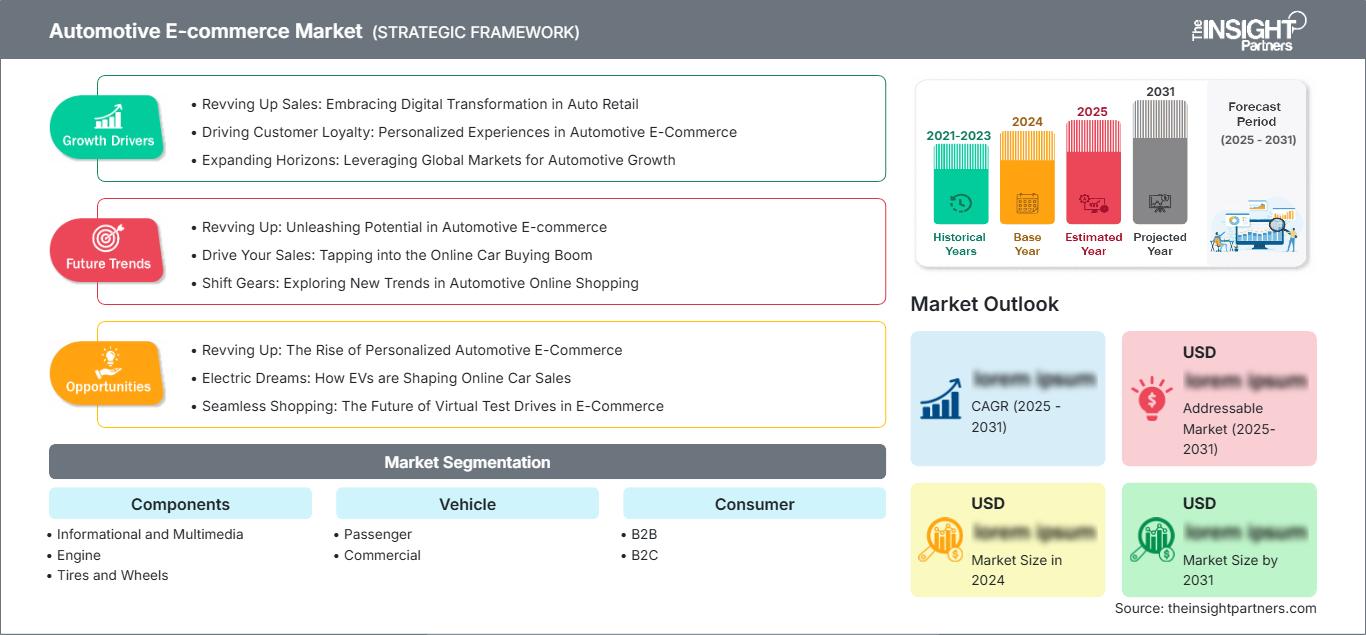
The industry will shift away from catalog-type websites and towards more advanced commerce ecosystems that will include fitment verification, real-time stock checking, installation guidance, marketplace ads, and faster delivery options. Specialty retailers will leverage content, community, and vehicle-based product breadth in order to beat out larger marketplaces. Production and logistics will be determined by SKU precision, reduced returns, cross-border shipping, and connections to suppliers, installers, and enthusiasts.
Demand from the future will be driven by connected vehicle data, AI-driven product recommendations, increased digital payment penetration, and the expansion of online to offline installation services. Geographies yet to be discovered will come into play thanks to the development of mobile commerce capabilities and improvements to the catalog systems of parts distributors. Investments will be made in warehouse automation, product information management, and fitment engines.
Automotive E-commerce Market Report Scope
| Report Attribute | Details |
|---|---|
| Market size in 2025 | US$ 122.05 Billion |
| Market Size by 2034 | US$ 447.44 Billion |
| Global CAGR (2026 - 2034) | 15.53% |
| Historical Data | 2021-2024 |
| Forecast period | 2026-2034 |
Automotive E-commerce Market Analysis
Growth in the automotive e-commerce marketplace occurs due to the consumer’s and workshop's migration from physical means to online means of research, comparison, and buying. Consumers expect the price transparency, extensive range of SKUs, feedbacks, delivery assurances, and fitment guarantees before the purchase. Online marketplace is particularly efficient for tires and wheels, interior products, electric components, and performance parts due to their large SKU numbers and specification filtering.
The supply conditions benefit the retailers who are able to correlate the product info with warehouse stock, car fitments, and deliveries. The analysis of the automotive e-commerce marketplace demonstrates that besides traffic, catalog quality, return policy, installation services, and fraud protection are the key factors nowadays. B2B portals gain increasing importance due to fast ordering, trade prices, and backorders monitoring requirements for workshops.
The competitive positioning is scattered between niche specialists and broad online retailers. The companies such as Awesome GTI Ltd and Enjuku Racing Parts LLC have a niche among enthusiasts for performance products; the others like BB Wheels, RTW Wheels, Metal Tech 4x4 LLC, and Brock’s Performance cater to wheel, off-road, and motorcycle performance products. Boogey Inc., International Motorsports Solutions LLC, JeepPeople.com, and Cruisemaster Pty Ltd. help broaden the scope into lighting, motorsports, Jeep parts, and towing products.
Investment trends indicate that the future lies with automated fitment technology, mobile sales channel, content-based conversions, and speedy delivery of products. According to industry associations, the trend has emerged that customers initiate their search through the Internet, while the marketplace inclusive automobile aftermarket e-commerce will experience greater growth rates than the non-marketplace segment.
● REPORT CUSTOMIZATION
Tailor This Report To Align With Your Specific Business Requirements
This report can be customized to align precisely with your business objectives, scope, and target markets. Customization options include tailored segmentation, geography, competitive analysis, and strategic insights to support informed decision-making.
Customize This Report →WHAT YOU CAN ADJUST
- ● Segmentations
- ● Geography
- ● Competitive Analysis
- ● Language Preferences
Automotive E-commerce Market: Strategic Insights
Regional Insights
North America automotive e-commerce market
North America accounted for 31–34% automotive e-commerce market share in 2025 and is expected to grow at a CAGR range of 14.5–16.1% through 2034. The region benefits from a large vehicle parc, high DIY activity, mature parcel logistics, and strong demand for tires, wheels, electrical products, and accessories.
Retailers are improving product pages with vehicle-year-make-model matching, live stock status, and installation content. Marketplace sales, direct web stores, and click-and-collect models coexist because consumers want both low prices and service confidence. Commercial repair buyers increasingly expect B2B portals with trade terms and fast fulfillment.
U.S. automotive e-commerce Market
The U.S. represented 82–86% of North America in 2025 and is projected to grow at a CAGR range of 14.7–16.3% during 2026–2034. Demand is supported by online-only retailers, marketplace sellers, specialty performance platforms, and large aftermarket distributors using omnichannel inventory.
Company presence is strongest across wheels, off-road, performance, lighting, and replacement categories. Application trends favor mobile checkout, customer reviews, compatibility filters, and same-day or two-day delivery promises. Workshops are also sourcing online to manage margins and compare distributor availability in real time.
Europe automotive e-commerce Market
Europe held 23–26% share in 2025 and is expected to grow at a CAGR range of 13.8–15.4% between 2026–2034. Germany leads through premium vehicle ownership, strong parts cataloging, and active online aftermarket channels. The UK has a mature enthusiast and repair market that supports performance, service, and accessory purchases.
France, Italy, and Spain are expanding as mobile commerce, parcel networks, and online price comparison improve. European buyers place high importance on homologation, warranty, returns, and delivery reliability. Cross-border selling remains attractive, but catalog localization and regulatory compliance are essential to reduce returns and customer disputes.
APAC automotive e-commerce Market
APAC accounted for 35–39% share in 2025 and is forecast to grow at a CAGR range of 16.2–18.0% through 2034. China leads because of large digital marketplaces, EV adoption, mobile payments, and dense logistics networks.
Japan and South Korea contribute advanced accessories and electronics demand, while India is scaling through smartphone-led retail and expanding vehicle ownership. Australia supports off-road, towing, and 4x4 e-commerce categories through retailers such as Cruisemaster Pty Ltd. and specialty importers.
Middle East & Africa automotive e-commerce Market
Middle East & Africa is expected to grow at a CAGR range of 12.2–14.0% during 2026–2034. Saudi Arabia and the UAE lead adoption through premium vehicles, performance upgrades, and growing online retail infrastructure.
South Africa and Rest of MEA remain earlier-stage but benefit from mobile commerce, used vehicle maintenance, and expanding parcel networks. Growth depends on payment trust, import duties, delivery reliability, and localized product data for harsh-climate replacement parts.
Segmentation Analysis
Components
Components is expected to grow at a CAGR range of 15.1–16.7% during 2026–2034. The automotive e-commerce market scope is broadening as buyers shift from simple accessories to higher-consideration components that require compatibility assurance, technical content, and dependable returns. Product data quality is becoming central to conversion.
- Informational and Multimedia products benefit from online comparison because buyers evaluate specifications, compatibility, installation effort, and user reviews before selecting audio, display, connectivity, and navigation-related products.
- Engine components require fitment precision, trusted brands, and technical documentation. Online sales expand where platforms reduce risk through vehicle matching, warranty clarity, and installation guidance.
- Tires and Wheels remain highly suitable for e-commerce because size filters, visual configurators, bundled fitment, and home or installer delivery simplify a complex purchase decision.
- Interior Accessories attract frequent B2C demand because consumers personalize comfort, storage, appearance, and protection features with relatively low installation complexity and wide online product availability.
- Electrical Product sales grow as lighting, sensors, batteries, chargers, and wiring accessories move online, although fitment accuracy and safety information remain critical for reducing returns.
Vehicle
Vehicle is expected to grow at a CAGR range of 15.0–16.6% during 2026–2034 as passenger vehicles drive scale and commercial vehicles increase digital procurement for uptime-sensitive replacement parts. Online catalog depth must serve both private customization and fleet maintenance needs.
- Passenger demand dominates due to high vehicle parc, personalization, maintenance cycles, DIY activity, and consumer willingness to compare prices and reviews before ordering parts.
- Commercial adoption is rising as fleets, workshops, and service operators use online channels to reduce procurement time, compare availability, and support predictable maintenance schedules.
Consumer
Consumer is expected to grow at a CAGR range of 15.4–17.2% during 2026–2034 as B2C remains the revenue base and B2B becomes more digitized. Retailers that support both buyer types can improve lifetime value and inventory turnover.
- B2B buyers prioritize trade pricing, fast reorder tools, invoice management, parts availability, and reduced downtime, making digital procurement increasingly important for workshops and fleets.
- B2C buyers prioritize reviews, price comparison, product imagery, compatibility filters, and delivery choice, especially for accessories, tires, wheels, lighting, and enthusiast upgrades.
Opportunity Snapshot
| Consumer | Revenue Contribution | Trend Tag | Adoption Stage |
| B2B | Medium | Trade Portals | Scaling |
| B2C | High | Mobile Buying | Mature |
Automotive E-commerce Market Growth Drivers and Impact Analysis
Digital Fitment Tools Reduce Purchase Risk
It is challenging to buy parts for vehicles on the Internet due to the fact that buyers have to make sure of the compatibility of the product with model year, trim, engine, wheel size, and fitment restrictions. Engine fitment, VIN matching, compatibility info, and guided search help decrease uncertainty and returns. The effect of that is enormous since confidence turns technical searching into purchasing. It becomes possible for clean catalogue retailers to offer more valuable components via the Internet and not only accessories.
Marketplace Scale Expands Product Discovery
Larger marketplaces have transformed the way consumers find aftermarket goods through the gathering of reviews, sellers, shipping methods, and comparison shopping all into one place. This provides traffic benefits for smaller niche brands but also greater competition when it comes to pricing and fulfillment capabilities. The net result is a two-channel approach, where the marketplace is used to gain reach while the website is employed for building brand loyalty. Automotive marketers must maintain consistent product information management within both channels.
Workshops Shift Procurement to Digital Portals
Repair professionals are now increasingly demanding online purchasing, as phone-based purchases are time-consuming and less transparent. Electronic B2B websites offer account pricing, real-time inventory levels, delivery windows, and purchasing histories, which allow workshops to optimize their bay usage. The effect will be more retention on the part of distributors who successfully marry catalog accuracy with quick delivery. With the increasing complexity of repair services, electronic catalogs that contain diagrams, installation instructions, and competing brands may become part of the day-to-day business process.
Automotive E-commerce Market Future Trends
AI Guided Parts Selection
The automotive e-commerce market trends point toward AI-guided product selection that interprets vehicle data, service symptoms, user intent, and purchase history. Instead of browsing large catalogs manually, buyers will receive filtered recommendations that balance compatibility, price, quality, delivery speed, and installation complexity. This can reduce returns and improve conversion in categories such as electrical products and engine components. The trend will require better structured data, stronger seller governance, and explainable recommendations that buyers can trust.
Online to Installer Fulfillment Models
Future platforms will increasingly combine online ordering with installer networks, allowing consumers to buy tires, wheels, electronics, or accessories and route delivery directly to a verified workshop. This model reduces friction for buyers who want online pricing but need professional installation. It also gives retailers a way to capture service-adjacent revenue without owning repair facilities. Success will depend on appointment integration, fitment accountability, returns handling, and clear responsibility when products or labor create customer issues.
Automotive E-commerce Market Opportunities
B2B Portal Expansion for Workshops
The strongest near-term opportunity is building trade-focused portals for repair shops, installers, fleet buyers, and specialty resellers. The automotive e-commerce market Forecasts remain favorable where suppliers provide account pricing, fast reorder tools, fitment verification, local inventory visibility, and delivery tracking. These functions reduce procurement friction and help workshops protect margins. Sellers that combine technical content with dependable fulfillment can become preferred digital suppliers, especially in fragmented aftermarket categories where service buyers need confidence more than broad browsing choice.
Specialty Category Direct Commerce
Specialty retailers can grow by owning high-intent niches such as wheels, off-road kits, performance parts, lighting, towing products, and enthusiast accessories. These categories benefit from expert content, build guides, fitment notes, and community validation that general marketplaces cannot always provide. The opportunity is to use direct commerce for higher margin, customer data, and repeat engagement while still using marketplaces selectively for acquisition. Strong post-purchase support can convert technical buyers into loyal communities.
Frequently Asked Questions

- Comprehensive Market Sizing and Forecast Analysis
- Detailed Segmentation Analysis
- In-Depth Market Dynamics Assessment
- Regional and Country-Level Insights
- Competitive Landscape and Company Benchmarking
- Strategic Business Intelligence
Recent Reports
Testimonials

The Insight Partners' SCADA System Market report is comprehensive, with valuable insights on current trends and future forecasts. The team was highly professional, responsive, and supportive throughout. We are very satisfied and highly recommend their services.
RAN KEDEM Partner, Reali Technologies LTDs
I requested a report on a very specific software market and the team produced the report in a few days. The information was very relevant and well presented. I then requested some changes and additions to the report. The team was again very responsive and I got the final report in less than a week.
JEAN-HERVE JENN Chairman, Future Analytica
We worked with The Insight Partners for an important market study and forecast. They gave us clear insights into opportunities and risks, which helped shape our plans. Their research was easy to use and based on solid data. It helped us make smart, confident decisions. We highly recommend them.
PIYUSH NAGPAL Sr. Vice President, High Beam Global
The Insight Partners delivered insightful, well-structured market research with strong domain expertise. Their team was professional and responsive throughout. The user-friendly website made accessing industry reports seamless. We highly recommend them for reliable, high-quality research services
YUKIHIKO ADACHI CEO, Deep Blue, LLC.
This is the first time I have purchased a market report from The Insight Partners.While I was unsure at first, I visited their web site and felt more comfortable to take the risk and purchase a market report.I am completely satisfied with the quality of the report and customer service. I had several questions and comments with the initial report, but after a couple of dialogs over email with their analyst I believe I have a report that I can use as input to our strategic planning process.Thank you so much for taking the extra time and making this a positive experience.I will definitely recommend your service to others and you will be my first call when we need further market data.
JOHN SUZUKI President and Chief Executive Officer, Board Director, BK Technologies
I wish to appreciate your support and the professionalism you displayed in the course of attending to my request for information regarding to infectious disease IVD market in Nigeria. I appreciate your patience, your guidance, and the fact that you were willing to offer a discount, which eventually made it possible for us to close a deal. I look forward to engaging The Insight Partners in the future, all thanks to the impression you have created in me as a result of this first encounter.
DR CHIJIOKE ONYIA MANAGING DIRECTOR, PineCrest Healthcare Ltd.Reason to Buy
- Informed Decision-Making
- Understanding Market Dynamics
- Competitive Analysis
- Identifying Emerging Markets
- Customer Insights
- Market Forecasts
- Risk Mitigation
- Boosting Operational Efficiency
- Strategic Planning
- Investment Justification
- Tracking Industry Innovations
- Aligning with Regulatory Trends





 Get Free Sample for