
Automotive E-Tailing Market Size, Trends & Growth by 2034
Coverage: By Vehicle Type (Passenger Vehicle, Commercial, Two-Wheeler); Vendor (OEM Vendor, Third-Party Vendor); Components (Infotainment, Interior Accessories, Engine Components, Tires, Electrical Products); Product Label (Branded, Counterfeit), and Geography (North America, Europe, Asia Pacific, and South and Central America)
- Status : Data Released
- Report Code : TIPRE00014072
- Category : Automotive and Transportation
- No. of Pages : 150
- Available Report Formats :


- Last update date : August 12, 2026


2025 Market Size
US$ 32.75 Bn
Base year value
2034 Forecast
US$ 64.35 Bn
Projected by 2034
CAGR 2026-2034
7.79 %
Growth rate
Addressable Market
US$ 436.98 Bn
(2026-2034)
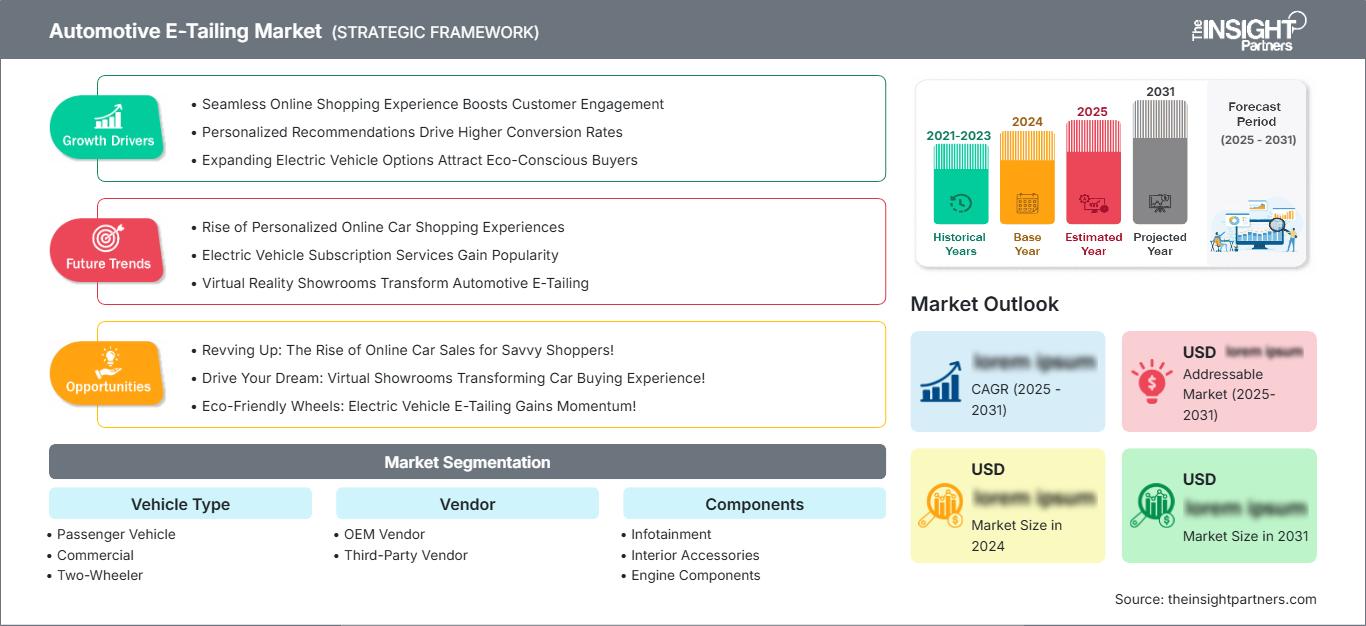
The automotive e-tailing market size in 2025 stood at US$ 32.75 Billion, and it will grow to US$ 64.35 Billion by 2034, exhibiting a CAGR of 7.79% during the 2026-2034 period. The growing trend among consumers of buying through online means, increasing sales of spare parts in the aftermarket using the online platform, and constant development in logistics infrastructure are driving the growth of the market worldwide.
Within North America, the automotive e-tailing market size continues to be driven by the already established e-commerce landscape, the widespread use of the Internet, and high consumer trust in the process of online buying of vehicle parts. Further, the growing use of omnichannel retailing tactics by automotive components manufacturers and distributors, combined with efficient last-mile delivery networks, will drive growth further. It is expected that a CAGR ranging between 6.8% and 7.4% will be achieved in the region.
Automotive E-Tailing Market Assessment and Insights
- North America: Accounted for 34–38% automotive e-tailing market share in 2025 and is expected to register a CAGR of 6.8–7.4% during 2026–2034. Strong aftermarket spending, established digital retail infrastructure, and increasing direct-to-consumer strategies continue to reinforce regional leadership.
- US: Represented 72–76% of North American revenue in 2025 and is anticipated to expand at a CAGR of 6.9–7.5% through 2034 owing to high online automotive parts penetration and expanding omnichannel retail networks.
- Europe: Held 26–30% market share in 2025 while growing at a CAGR of 6.6–7.2%. Germany, the UK, France, Italy, and Spain remain major contributors because of mature automotive aftermarket ecosystems and increasing digital retail adoption.
- Asia Pacific: Accounted for 27–31% share in 2025 and is projected to witness the fastest regional expansion with a CAGR of 8.8–9.5%. China, India, Japan, and South Korea continue to accelerate online automotive component purchases through expanding digital commerce ecosystems.
- Largest Segment: Passenger Vehicle accounted for 58–62% market share in 2025 and is expected to expand at a CAGR of 7.4–8.0% owing to higher vehicle ownership and increasing replacement component purchases through digital channels.
- High Growth Segment: Third-Party Vendor is projected to expand at a CAGR of 8.6–9.2% while accounting for 54–58% share in 2025, supported by wider product availability, competitive pricing, and expanding marketplace participation.
- Key companies analyzed in detail: Robert Bosch GmbH, Continental AG, AutoZone, Inc., Amazon.com, Inc., Alibaba Group Holding Limited, Walmart Inc., eBay Inc., Delticom AG, Advance Auto Parts, Inc., O'Reilly Automotive, Inc.
Source: The Insight Partners' analysis based on proprietary research, government publications, company annual reports, investor presentations, industry databases, and expert interviews.
Online commerce has revolutionized the way automotive aftermarkets make purchases in terms of visibility, pricing, and supplier availability. The ongoing investments in warehousing automation, forecast-based inventory management, artificial intelligence powered recommendation algorithms, and advanced logistics networks have improved the effectiveness of order fulfillment while allowing suppliers to retain customers in multiple markets geographically.
Further growth will likely be propelled by the increase in the vehicle parc, rise in electrification, online aftermarket involvement in developing countries, and favorable regulations in digital commerce. Investments in connected retail technologies, cloud-based inventory management, and localized distribution centers will help vendors to better cope with changing customer expectations regarding speed and transparency of the purchasing process.
Automotive E-Tailing Market Report Scope
| Report Attribute | Details |
|---|---|
| Market size in 2025 | US$ 32.75 Billion |
| Market Size by 2034 | US$ 64.35 Billion |
| Global CAGR (2026 - 2034) | 7.79% |
| Historical Data | 2021-2024 |
| Forecast period | 2026-2034 |
Automotive E-Tailing Market Analysis
However, the rate of growth in the automotive e-tailing market is increasing due to the increased purchase of automotive parts, accessories, and replacement items online. Increasing trust in online transactions, larger range of products, clear pricing information, and return policies are contributing to increased adoption among customers in both passenger and commercial vehicles. Increased use of electric vehicles has created diverse demand for replacement items that require the use of digital catalogues.
Manufacturers, distributors, logistics companies, digital marketplaces, and payment processing companies all create an integrated value chain to ensure quick shipment of the orders. Automation of warehouse management, predictive inventory management, and supply chain analysis are making deliveries faster and reducing stockouts in regional fulfillment centers.
Analysis of the automotive e-tailing market shows that the competitive intensity is likely to grow further due to ongoing development of digital competencies among existing players of the aftermarket along with growing competitiveness of global e-commerce firms in regard to automotive products. Robert Bosch GmbH, Continental AG, AutoZone, Inc., Advance Auto Parts, Inc., and O'Reilly Automotive, Inc. are likely to maintain focus on the development of integrated omnichannel ecosystems, whereas Amazon.com, Inc., Alibaba Group Holding Limited, Walmart Inc., eBay Inc., and Delticom AG will benefit from huge customer databases for developing the automotive components distribution channels.
Growing focus will be placed on such initiatives as AI-based product recommendations, intelligent inventory management systems, regional fulfillment centers, and customer loyalty programs. Expansion of the cooperation with OEMs, workshops, and logistics partners is expected.
● REPORT CUSTOMIZATION
Tailor This Report To Align With Your Specific Business Requirements
This report can be customized to align precisely with your business objectives, scope, and target markets. Customization options include tailored segmentation, geography, competitive analysis, and strategic insights to support informed decision-making.
Customize This Report →WHAT YOU CAN ADJUST
- ● Segmentations
- ● Geography
- ● Competitive Analysis
- ● Language Preferences
Automotive E-Tailing Market: Strategic Insights
Regional Insights
North America Automotive E-Tailing Market
North America is expected to hold 34–38% share of the worldwide automotive e-tailing market and grow at a CAGR of 6.8–7.4% until 2034. Large numbers of car owners, presence of an organized automotive aftermarket industry, high internet penetration, and well-established online payments systems will keep motivating people towards online purchase of replacement parts and accessories. E-commerce businesses are integrating online platforms with their physical distribution centers to provide same-day deliveries and better inventory management in metro cities.
US and Canada are making substantial investments in automation in warehouses, AI-based inventory planning, and omnichannel retailing to enhance consumer experiences. Increased consumption of parts and accessories for electric vehicles, predictive maintenance solutions, and connected cars will also aid in the growth of the regional market.
U.S. Automotive E-Tailing Market
North America's automotive e-tailing market share was dominated by the U.S., contributing 72–76%, and it is expected to record a CAGR of 6.9–7.5% through 2034. The well-developed network of aftermarket players in the U.S., high rate of Internet users, well-established logistics network, and high rate of digital payments are further expected to continue fueling the sales of automotive components through online platforms.
Leading companies such as AutoZone, Inc., Advance Auto Parts, Inc., O'Reilly Automotive, Inc., Amazon.com, Inc., and Walmart Inc. are continually upgrading their omnichannel distribution facilities and setting up more regional distribution centers. Connected vehicle technologies, electric vehicle service needs, and inventory optimization techniques are some of the factors supporting continuous market growth.
Europe Automotive E-Tailing Market
Europe has a market share of 26–30% of the worldwide revenues generated by this market and is expected to grow with a CAGR of 6.6–7.2% till 2034. Germany has the highest contribution in terms of region due to the strong manufacturing base for automobiles, well-established aftersales service, and presence of e-commerce. Regulations for ensuring proper vehicle maintenance, environmental sustainability, and consumer protection further fuel the online sales of parts and components.
The UK experiences steady growth of the online aftersales market due to the increasing demand for home delivery, lower prices online, and online retail platforms. The combination of increased cross-border trade in the e-commerce space, growth of independent workshops, and the use of digital payment methods makes France, Italy, and Spain to benefit from online tire, electronics, and interior accessories procurement.
APAC Automotive E-Tailing Market
Asia Pacific represented 27–31% of global revenue during 2025 and is projected to record the highest regional CAGR of 8.8–9.5% over the forecast period. China continues leading regional demand owing to its extensive e-commerce ecosystem, while India demonstrates accelerating aftermarket digitalization supported by rising vehicle ownership and smartphone adoption.
Japan, South Korea, and Australia continue expanding digital automotive retail through advanced logistics networks, high internet penetration, and increasing consumer preference for online aftermarket purchases. Government initiatives supporting digital commerce, coupled with expanding electric vehicle adoption, continue strengthening regional demand for online automotive products.
Middle East & Africa Automotive E-Tailing Market
The Middle East & Africa automotive e-tailing market continues expanding steadily and is anticipated to register a CAGR of 6.1–6.7% through 2034. Saudi Arabia remains the leading regional market due to increasing vehicle ownership, digital transformation initiatives, and expanding investments in logistics infrastructure. Growing smartphone penetration further supports online automotive component purchases.
The United Arab Emirates continues benefiting from advanced digital retail ecosystems and cross-border e-commerce activities, while South Africa maintains stable aftermarket demand supported by a large installed vehicle base. Expanding transportation infrastructure and improving digital payment adoption across the Rest of MEA are expected to strengthen long-term regional growth.
Segmentation Analysis
Vehicle Type
The Vehicle Type segment is projected to grow at a CAGR of 7.5–8.1% during 2026–2034. Rising global vehicle ownership, increasing average vehicle age, and growing preference for online procurement of replacement parts continue supporting segment expansion. The automotive e-tailing market scope continues broadening as digital platforms offer vehicle-specific product compatibility, transparent pricing, and faster delivery, encouraging consumers and fleet operators to purchase components through online channels.
- Passenger Vehicle – Passenger vehicles account for the largest demand due to their dominant global vehicle parc and frequent maintenance requirements. Consumers increasingly purchase filters, brakes, batteries, accessories, and lighting products through online platforms because of convenience and competitive pricing.
- Commercial – Commercial vehicle demand continues increasing as fleet operators adopt digital procurement systems for maintenance scheduling, inventory optimization, and cost-efficient sourcing of replacement components that minimize vehicle downtime and improve operational efficiency.
- Two-Wheeler – Growing motorcycle ownership across emerging economies supports online demand for tires, lubricants, electrical components, and riding accessories. Expanding digital marketplaces improve accessibility to branded products and enhance consumer purchasing confidence.
Vendor
The Vendor segment is anticipated to expand at a CAGR of 8.0–8.6% throughout the forecast period. Vendors continue strengthening digital storefronts, warehouse automation, and integrated logistics capabilities to improve customer experience. Expansion of marketplace ecosystems and direct online sales channels enables broader product availability while enhancing price transparency and inventory management efficiency.
- OEM Vendor – OEM vendors maintain strong customer confidence by supplying manufacturer-approved replacement components with assured compatibility, warranty coverage, and consistent quality, particularly for newer vehicles requiring certified maintenance products.
- Third-Party Vendor – Third-party vendors continue attracting consumers through extensive product portfolios, competitive pricing, rapid product availability, and partnerships with global logistics providers that improve fulfillment efficiency across domestic and international markets.
Components
The Components segment is expected to register a CAGR of 7.8–8.4% between 2026 and 2034. Continuous expansion of the automotive aftermarket, increasing customization trends, and higher replacement frequency for wear-and-tear products continue supporting digital sales. Improved search algorithms and vehicle compatibility databases further simplify online purchasing decisions.
- Infotainment – Connected infotainment systems, multimedia upgrades, navigation devices, and smart displays continue witnessing increasing online demand as vehicle owners seek enhanced digital driving experiences and seamless smartphone integration.
- Interior Accessories – Seat covers, floor mats, steering covers, organizers, and decorative accessories maintain consistent online demand because consumers frequently personalize vehicle interiors through convenient e-commerce purchasing channels.
- Engine Components – Engine filters, spark plugs, timing components, cooling products, and maintenance kits continue generating significant online sales owing to recurring servicing requirements across passenger and commercial vehicle categories.
- Tires – Online tire sales continue increasing through digital comparison tools, transparent pricing, home installation partnerships, and expanding availability of premium as well as economy product offerings across multiple vehicle categories.
- Electrical Products – Batteries, lighting systems, sensors, charging equipment, switches, and electronic modules continue benefiting from growing vehicle electrification and increasing replacement demand supported by digital product compatibility tools.
Product Label
The Product Label segment is forecast to grow at a CAGR of 7.2–7.8% through 2034. Consumer awareness regarding product quality, warranty coverage, and safety standards continues encouraging purchases of authenticated automotive products. Simultaneously, digital marketplaces increasingly implement seller verification and counterfeit detection mechanisms to improve marketplace integrity.
- Branded – Branded automotive products dominate online demand owing to stronger consumer trust, manufacturer warranties, verified quality standards, and compatibility assurance, making them the preferred choice for both individual consumers and professional repair workshops.
- Counterfeit – Counterfeit products remain present across some online marketplaces, creating challenges for platform operators and regulatory authorities. Increasing implementation of digital authentication technologies and stricter marketplace governance is gradually reducing their market presence.
Opportunity Snapshot
| Vehicle Type | Revenue Contribution | Trend Tag | Adoption Stage |
|---|---|---|---|
| Passenger Vehicle | High | DIY Repair | Mature |
| Commercial | Medium | Fleet Digital | Scaling |
| Two-Wheeler | Medium | Urban Mobility | Scaling |
Automotive E-Tailing Market Growth Drivers and Impact Analysis
Expansion of Global E-Commerce Infrastructure
The continuous expansion of digital commerce infrastructure has become one of the strongest catalysts supporting online automotive aftermarket sales. According to international e-commerce and logistics indicators, increasing internet penetration, secure digital payment adoption, and improvements in cross-border fulfillment capabilities continue expanding the addressable customer base for automotive products. Retailers are investing heavily in artificial intelligence-powered recommendation engines, automated fulfillment centers, and real-time inventory visibility to improve customer satisfaction while reducing delivery times. These investments are also enabling vendors to expand product assortments without proportional increases in physical retail space. As automotive ownership continues rising across developing economies, online platforms are becoming the preferred purchasing channel for replacement components, accessories, and maintenance products, creating long-term opportunities for manufacturers, distributors, and digital marketplace operators.
Growing Average Vehicle Age Increases Aftermarket Demand
An increasing average vehicle age across major automotive markets continues generating sustained demand for replacement parts and maintenance products. Older vehicles require more frequent servicing, including replacement of filters, brakes, batteries, tires, engine components, and electrical systems. Online automotive retailers benefit from this recurring purchasing behavior by providing wider product selection, competitive pricing, and convenient home delivery. Independent workshops and fleet operators are also adopting digital procurement platforms to streamline sourcing processes and reduce operational costs. Vehicle owners increasingly compare specifications, customer reviews, warranty information, and compatibility data before making purchasing decisions, encouraging higher conversion rates across digital channels. This structural trend continues supporting stable aftermarket demand despite fluctuations in new vehicle sales.
Advancements in Digital Supply Chain and Inventory Management
Digital transformation across automotive supply chains is improving inventory accuracy, fulfillment speed, and operational efficiency throughout the online aftermarket ecosystem. Cloud-based inventory platforms, predictive demand forecasting, warehouse automation, and real-time shipment tracking enable retailers to optimize stock availability while minimizing excess inventory. Artificial intelligence and machine learning applications further improve demand forecasting by analyzing purchasing behavior and seasonal replacement cycles. Enhanced supply chain visibility also enables manufacturers and distributors to respond more effectively to regional demand fluctuations and logistics disruptions. As fulfillment capabilities continue improving, customer confidence in online automotive purchases strengthens further, contributing to higher repeat purchase rates and expanding long-term revenue opportunities throughout the automotive aftermarket.
Automotive E-Tailing Market Future Trends
Artificial Intelligence Enhances Personalized Automotive Shopping
Artificial intelligence is expected to transform digital automotive retail through personalized product recommendations, predictive maintenance alerts, intelligent search functions, and automated customer support. The automotive e-tailing market trends increasingly reflect adoption of AI-powered recommendation engines capable of identifying compatible replacement parts based on vehicle identification numbers and maintenance history. Future developments are expected to integrate conversational commerce, augmented reality product visualization, and predictive inventory optimization, improving customer experience while reducing product returns. Vendors investing in intelligent digital commerce capabilities are expected to strengthen customer loyalty and improve operational efficiency over the coming decade.
Expansion of Omnichannel Retail Models
Automotive retailers are increasingly integrating physical stores, digital marketplaces, mobile applications, and service centers into unified omnichannel ecosystems. Customers are expected to benefit from flexible purchasing options including online ordering, store pickup, same-day delivery, and integrated installation services. Future investments will likely focus on connected inventory systems, unified customer relationship management platforms, and digital warranty management. These developments are anticipated to improve customer convenience while enabling retailers to maximize inventory utilization and strengthen competitive differentiation across both mature and emerging automotive markets.
Automotive E-Tailing Market Opportunities
Digital Expansion Across Emerging Automotive Markets
Rapid digitalization across emerging economies presents substantial long-term investment opportunities for online automotive retailers. The Automotive e-tailing market Forecasts indicate increasing internet penetration, expanding smartphone ownership, and improving logistics infrastructure across Asia Pacific, Latin America, and parts of the Middle East. Rising vehicle ownership combined with expanding digital payment ecosystems creates favorable conditions for marketplace expansion. Companies investing in localized digital platforms, multilingual customer support, regional warehouses, and strategic logistics partnerships are expected to capture significant future demand while strengthening competitive positioning in high-growth markets.
Growth Potential in Electric Vehicle Aftermarket Components
The accelerating global transition toward electric mobility creates new opportunities for digital automotive retailers supplying specialized replacement components and accessories. Growing demand for charging accessories, battery management products, thermal management systems, electronic sensors, and software-enabled maintenance solutions is expanding the online aftermarket ecosystem. Retailers capable of providing verified compatibility information, technical guidance, and rapid product availability will be well positioned to capitalize on increasing electric vehicle adoption. Strategic collaborations with OEMs, charging infrastructure providers, and specialized component manufacturers are expected to create additional revenue streams while supporting sustained long-term market expansion.
Frequently Asked Questions

- Comprehensive Market Sizing and Forecast Analysis
- Detailed Segmentation Analysis
- In-Depth Market Dynamics Assessment
- Regional and Country-Level Insights
- Competitive Landscape and Company Benchmarking
- Strategic Business Intelligence
Recent Reports
Testimonials

The Insight Partners' SCADA System Market report is comprehensive, with valuable insights on current trends and future forecasts. The team was highly professional, responsive, and supportive throughout. We are very satisfied and highly recommend their services.
RAN KEDEM Partner, Reali Technologies LTDs
I requested a report on a very specific software market and the team produced the report in a few days. The information was very relevant and well presented. I then requested some changes and additions to the report. The team was again very responsive and I got the final report in less than a week.
JEAN-HERVE JENN Chairman, Future Analytica
We worked with The Insight Partners for an important market study and forecast. They gave us clear insights into opportunities and risks, which helped shape our plans. Their research was easy to use and based on solid data. It helped us make smart, confident decisions. We highly recommend them.
PIYUSH NAGPAL Sr. Vice President, High Beam Global
The Insight Partners delivered insightful, well-structured market research with strong domain expertise. Their team was professional and responsive throughout. The user-friendly website made accessing industry reports seamless. We highly recommend them for reliable, high-quality research services
YUKIHIKO ADACHI CEO, Deep Blue, LLC.
This is the first time I have purchased a market report from The Insight Partners.While I was unsure at first, I visited their web site and felt more comfortable to take the risk and purchase a market report.I am completely satisfied with the quality of the report and customer service. I had several questions and comments with the initial report, but after a couple of dialogs over email with their analyst I believe I have a report that I can use as input to our strategic planning process.Thank you so much for taking the extra time and making this a positive experience.I will definitely recommend your service to others and you will be my first call when we need further market data.
JOHN SUZUKI President and Chief Executive Officer, Board Director, BK Technologies
I wish to appreciate your support and the professionalism you displayed in the course of attending to my request for information regarding to infectious disease IVD market in Nigeria. I appreciate your patience, your guidance, and the fact that you were willing to offer a discount, which eventually made it possible for us to close a deal. I look forward to engaging The Insight Partners in the future, all thanks to the impression you have created in me as a result of this first encounter.
DR CHIJIOKE ONYIA MANAGING DIRECTOR, PineCrest Healthcare Ltd.Reason to Buy
- Informed Decision-Making
- Understanding Market Dynamics
- Competitive Analysis
- Identifying Emerging Markets
- Customer Insights
- Market Forecasts
- Risk Mitigation
- Boosting Operational Efficiency
- Strategic Planning
- Investment Justification
- Tracking Industry Innovations
- Aligning with Regulatory Trends





 Get Free Sample for