
Automotive Electrical Connectors Market Trends and Analysis by 2034
Coverage: By Type (Cable Lugs, Battery Clamps, High Voltage Busbars, and Fuse Boxes), Vehicle Type (Passenger Cars, Light Commercial Vehicle (LCV), and Medium & Heavy Commercial Vehicle (M&HCV)); Powertrain Type (Internal Combustion Engine (ICE), Electric Vehicle (EV), Plug-In Hybrid Electric Vehicle (PHEV), Hybrid Electric Vehicle (HEV)), and Geography
- Status : Data Released
- Report Code : TIPRE00019916
- Category : Electronics and Semiconductor
- No. of Pages : 150
- Available Report Formats :


- Last update date : July 17, 2026


2025 Market Size
US$ 1.76 Bn
Base year value
2034 Forecast
US$ 3.77 Bn
Projected by 2034
CAGR 2026-2034
8.8 %
Growth rate
Addressable Market
US$ 24.73 Bn
(2026-2034)
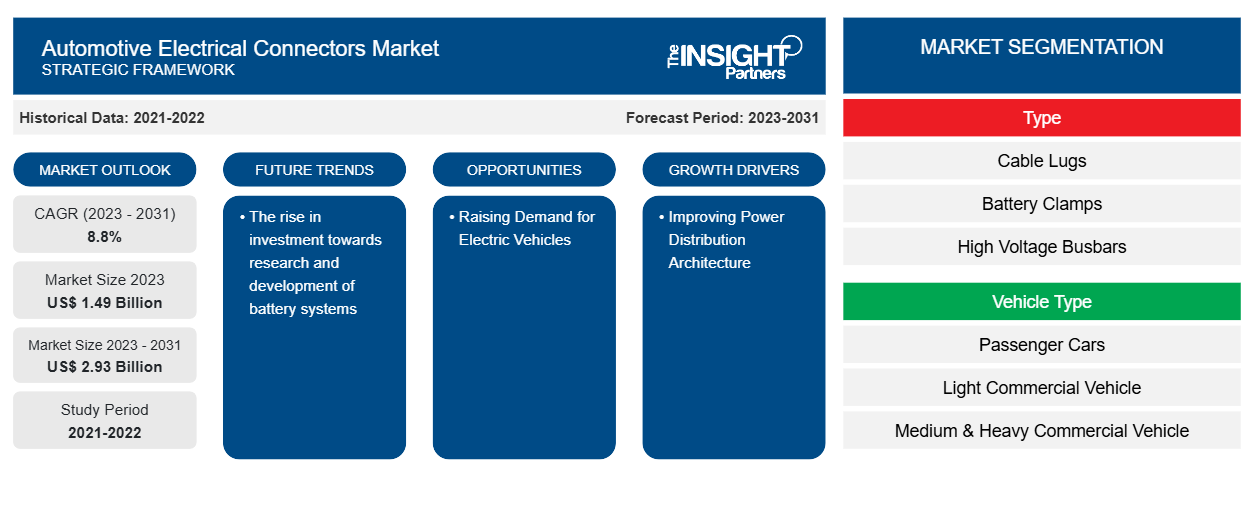
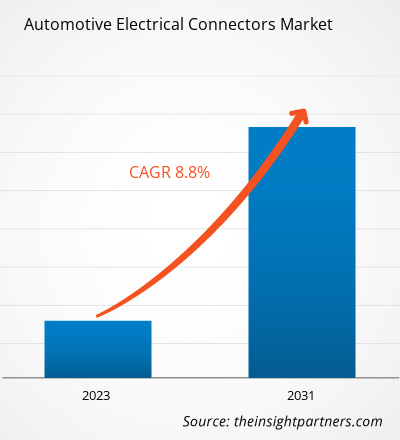
The Automotive Electrical Connectors Market size was valued at US$ 1.76 Billion in 2025 and is projected to reach US$ 3.77 Billion by 2034, registering a CAGR of 8.8% during 2026–2034. Demands have been influenced by more electronic content per unit, more extensive electrification schemes, and increasing demands for reliable power distribution in vehicles.
The Automotive Electrical Connectors Market size in North America is backed up by a projected compound annual growth rate of 7.8–8.5% through 2034, driven by battery pack solutions, 48V systems, and local manufacturing of electric vehicle components. Growth in investment from OEMs in high-voltage safety, sealed connectors, and charge ports is boosting demand among suppliers in the United States, Canada, and Mexico.
Automotive Electrical Connectors Market Assessment and Insights
- North America accounted for 28–32% of the Automotive Electrical Connectors Market share in 2025 and is expected to grow at a CAGR of 7.8–8.5% between 2026–2034, driven by EV assembly localization, fleet electrification, and high-voltage distribution upgrades.
- US represented 72–76% of North America in 2025 and is forecast to expand at 7.9–8.6% CAGR between 2026–2034, supported by domestic EV programs and connector-intensive platforms.
- Europe held 24–28% share in 2025 and is projected to grow at 7.4–8.1% CAGR between 2026–2034, with Germany, France, Italy, Spain, and the UK leading demand.
- Asia Pacific captured 34–38% share in 2025 and is expected to grow at 9.4–10.2% CAGR between 2026–2034, led by China, Japan, South Korea, India, and Australia.
- Largest Segment Passenger Cars held 58–62% market share in 2025 and is projected to grow at 8.1–8.7% CAGR between 2026–2034 as electronics density rises.
- High Growth Segment Electric Vehicle held 18–22% market share in 2025 and is projected to grow at 12.4–13.6% CAGR between 2026–2034 due to high-voltage systems.
- Key companies analyzed in detail: INTERCABLE S.r.l., Connor Manufacturing Services, Inc., Amphenol Corporation, Emerson Electric Co., Rogers Corporation, Molex LLC, TB&C Holding GmbH, Difvan, TE Connectivity Ltd., Flex-Cable Inc.
Source: The Insight Partners' analysis based on proprietary research, government publications, company annual reports, investor presentations, industry databases, and expert interviews.
Automotive electrical architecture is changing from being distributed through wiring to becoming compact and protected with modular connections. Automotive Electrical Connectors Market dynamics are being driven by OEM reductions in harness weights, increased voltage capacities, and standardized interfaces in battery packs, inverters, fuse boxes, and auxiliary systems. There are also shifts in production trends to allow for localization of stamping, molding, plating, and assembly processes to mitigate risks from lead times while preserving validation processes for thermal cycling, vibration, sealing, and electromagnetic compatibility.
The Automotive Electrical Connectors Market trends indicate that EV manufacturing operations set up in emerging regions of India, Mexico, Southeast Asia, and Eastern Europe will drive demand for automotive connectors in addition to existing automotive clusters. Regulatory changes driving the need for emissions, charging interoperability, and electrical safety requirements will continue to drive demand for high current and touch-safe connectors. Suppliers investing in engineering design expertise, materials development, automated testing, and localized production are poised to win.
Automotive Electrical Connectors Market Report Scope
| Report Attribute | Details |
|---|---|
| Market size in 2025 | US$ 1.76 Billion |
| Market Size by 2034 | US$ 3.77 Billion |
| Global CAGR (2026 - 2034) | 8.8% |
| Historical Data | 2021-2024 |
| Forecast period | 2026-2034 |
Automotive Electrical Connectors Market Analysis
The Automotive Electrical Connectors market forecast has been observed to have a very strong correlation with increased vehicle electrification, sensing density, and power management. Global Electric Vehicle sales have crossed 17 million units while total global automobile sales stood at 74.6 million units in 2024, indicating an increase in the addressable population for automotive electrical connectors that are high voltage, sealed, and resistant to vibrations.
Factors affecting supply include the availability of copper, aluminum, engineered plastics, metal plating, and the capability to crimp automatically. The supply chain comprises the suppliers of raw material, stamper of terminals, molding of connectors, assembly of harnesses, Tier 1 suppliers, and the OEM’s design engineers.
Automotive Electrical Connectors Market Report includes competitors are TE Connectivity Ltd., Amphenol Corporation, Molex LLC, Rogers Corporation, and INTERCABLE S.r.l., which compete through their range of products in high voltage applications. Specialty competitors are Connor Manufacturing Services, Inc., TB&C Holding GmbH, Difvan, and Flex-Cable Inc., specializing in custom-made terminals, bus bars, lugs, and cables.
Strategic areas of investment now center on intermateable connectors, automated testing, localized tooling, and compact designs for software-defined automobiles. The involvement of Emerson Electric Co. is valuable in terms of its capabilities in industrial automation and power management solutions, whereas connector providers are positioning themselves according to dual-sourcing and platform standardization, along with regional EV sourcing rules.
● REPORT CUSTOMIZATION
Tailor This Report To Align With Your Specific Business Requirements
This report can be customized to align precisely with your business objectives, scope, and target markets. Customization options include tailored segmentation, geography, competitive analysis, and strategic insights to support informed decision-making.
Customize This Report →WHAT YOU CAN ADJUST
- ● Segmentations
- ● Geography
- ● Competitive Analysis
- ● Language Preferences
Automotive Electrical Connectors Market: Strategic Insights
Regional Insights
North America Automotive Electrical Connectors Market
North America held 28–32% of the Automotive Electrical Connectors Market share in 2025 and is projected to grow at 7.8–8.5% CAGR during 2026–2034. The regional demand is driven by electric trucks, high voltage batteries routing, and local component sourcing. Mexico is expanding its assembly capabilities of harnesses and connectors, while Canada is contributing with investments to the batteries supply chain and commercial vehicles electrification initiatives.
Car manufacturers are reengineering their platforms in order to accommodate zonal control systems, increased data transfer rates, and ease of servicing. With local sourcing and higher safety validation driving the demand, preferred connector suppliers should be certified according to the USCAR, LV, and OEM standards. There is a particular demand for fuse boxes, battery clamps, busbars, and sealed lugs.
U.S. Automotive Electrical Connectors Market
The US accounted for 72–76% of North America in 2025 and is expected to expand at 7.9–8.6% CAGR during 2026–2034. The trend of increased connector intensity in EV and hybrid applications domestically is more pronounced near battery boxes, power electronics, DC-DC converters, and advanced driver assistance system technologies that require robust electrical and data connection systems.
Company presence is based on engineering, logistics, and manufacturing support services. TE Connectivity Ltd, Molex LLC, Amphenol Corporation, and Rogers Corporation take advantage of their OEM experience; specialty suppliers assist in short run customized design requirements. The applications environment involves 48V power electrical loads, power connectors, power distribution systems, and small terminals for zone electronics.
Europe Automotive Electrical Connectors Market
Europe held 24–28% share in 2025 and is forecast to grow at 7.4–8.1% CAGR during 2026–2034. Germany continues to be the leader due to its high-end vehicle portfolio, expertise in powertrain development, and platform investments in electric vehicles. The UK drives up demand by electrifying luxury cars as well as integrating the latest technology derived from motorsports into electric systems.
France, Italy, and Spain move volume via mass-market cars, vans, and local manufacture of parts. European companies emphasize traceability, recycling, and de-harnessing. Moreover, there is growing demand for bus bars, fuse boxes, and HV connectors due to the increase in 400V and 800V platforms.
APAC Automotive Electrical Connectors Market
APAC captured 34–38% share in 2025 and is projected to record 9.4–10.2% CAGR during 2026–2034. China is the dominant country, backed up by strong EV production capabilities, battery sourcing expertise, and rapid model turnover. Japan and South Korea provide fine-tuned electronics, hybrid technologies, and connector manufacturing with a focus on quality.
India and Australia may be smaller countries but are vital due to their capabilities to scale two-wheelers, passenger EVs, and localized components. Policies favoring local manufacturing, battery assembly, and charging infrastructure are driving the demand for cable lugs, battery clamps, fuse boxes, and high voltage busbars.
Middle East & Africa Automotive Electrical Connectors Market
Forecasted growth rate for Middle East & Africa is forecasted at 6.6%-7.4% CAGR from 2026 to 2034, with the leadership in demand belonging to Saudi Arabia thanks to its efforts in diversification of industries, fleet modernization, and trials of building charging infrastructure. The UAE focuses on luxury EVs and logistics electrification, while South Africa is the most advanced hub of vehicle manufacturing.
Several energy transition projects, mining equipment, ports construction, and transport network upgrade are some of the applications where heavy duty electrical connectors can be used. Demand in other MEA countries is also growing due to investments in infrastructure and importing of commercial vehicles.
Segmentation Analysis
Type
The Type segment is expected to grow at 8.2–8.9% CAGR during 2026–2034. The Automotive Electrical Connectors Market scope across type categories is expanding as vehicles require higher current capacity, better sealing, and compact packaging. Demand is strongest where components improve assembly efficiency, service safety, and power stability across battery, distribution, and protection systems.
- Cable Lugs remain essential for secure power transfer in battery, grounding, and high-current circuits, with demand tied to assembly reliability, corrosion resistance, and aftermarket service replacement.
- Battery Clamps support stable battery terminal connections across ICE, hybrid, and EV platforms, where vibration resistance, conductivity, and easy service access remain central procurement criteria.
- High Voltage Busbars are strategically important in EV battery packs and power electronics because they reduce wiring complexity, improve thermal behavior, and support compact high-current distribution.
- Fuse Boxes maintain a critical protection role as electronic loads increase, supporting circuit safety, modular integration, and simplified diagnostics across passenger and commercial vehicle architectures.
Vehicle Type
The Vehicle Type segment is projected to grow at 8.0–8.7% CAGR during 2026–2034. Passenger cars dominate connector consumption because of high production volume and rapid adoption of comfort, safety, and electrified systems. Commercial vehicles add higher durability requirements, especially where power distribution supports refrigeration, telematics, lifting systems, and electrified auxiliary loads.
- Passenger Cars lead demand through high unit volumes, rising infotainment content, advanced driver assistance, and expanding EV adoption that increases connector count per vehicle platform.
- Light Commercial Vehicle demand is linked to last-mile delivery electrification, fleet telematics, and auxiliary power needs, making sealed and serviceable connectors increasingly valuable.
- Medium & Heavy Commercial Vehicle applications require robust power connections for harsh duty cycles, higher vibration exposure, and growing adoption of electric buses, trucks, and specialty fleets.
Powertrain Type
The Powertrain Type segment is forecast to grow at 9.0–9.8% CAGR during 2026–2034. ICE vehicles continue to require stable low-voltage connectors, but electrified powertrains create the strongest content uplift. EVs, plug-in hybrids, and hybrids need high-voltage insulation, shielding, thermal stability, and compact routing for battery, charging, inverter, and auxiliary systems.
- Internal Combustion Engine platforms remain relevant through engine controls, lighting, infotainment, and safety electronics, although connector growth is more incremental than in electrified powertrains.
- Electric Vehicle applications require high-voltage busbars, shielded terminals, and protected power interfaces, making connector design central to safety, packaging, and charging performance.
- Plug-In Hybrid Electric Vehicle platforms combine ICE and EV electrical systems, creating complex connector requirements across charging, battery management, power conversion, and conventional vehicle electronics.
- Hybrid Electric Vehicle demand is supported by compact battery packs, regenerative braking systems, and power electronics that require durable connectors within limited packaging space.
Opportunity Snapshot
| Powertrain Type | Revenue Contribution | Trend Tag | Adoption Stage |
| Internal Combustion Engine | High | Stable Loads | Mature |
| Electric Vehicle | High | High Voltage | Scaling |
| Plug-In Hybrid Electric Vehicle | Medium | Dual Systems | Scaling |
| Hybrid Electric Vehicle | Medium | Compact Power | Mature |
Automotive Electrical Connectors Market Growth Drivers and Impact Analysis
Electrification Raises High-Voltage Connector Content
As compared to conventional cars, electric and hybrid cars need higher numbers of protected electrical interfaces since there are batteries, inverters, on-board charger, thermal systems, and auxiliary drives in electric and hybrid vehicles working at high voltages and currents. It shows up in a higher requirement for shielded connectors, bus bars, fuse boxes, and protected cable terminations. Those manufacturers who can prove their capabilities of touch safe products, good sealing, and electromagnetic compatibility find themselves in an advantageous position among OEMs. With the platform migration to 400V and 800V systems, connector design is not just procurement anymore; it is a safety and efficiency decision.
Software-Defined Vehicles Increase Electrical Architecture Complexity
The trend towards software-defined automobiles is creating a new demand on wiring harnesses by reducing the number of computing units while expanding the spread of sensors, actuators, displays, and safety mechanisms throughout the automobile. In such a situation, there is a requirement for small connectors that can provide reliable power and signaling within a highly condensed packaging environment. Zonal architecture helps in cutting down harness lengths, but it demands increased robustness in local connectors and module standardization. Today, original equipment manufacturers (OEMs) consider assembly efficiency, accessibility, and data integrity during connector evaluations.
Regional Supply Chain Localization Strengthens Procurement Stability
The automotive industry is getting its connectivity technologies closer through localization for risk management reasons, compliance with local content rules, and feedback in the engineering phase. Localization efforts have been made in North America, Europe, and India in the areas of stamping, molding, plating, and assembly to make OEMs more flexible using the dual-sourcing model. This driver opens up avenues for suppliers who have manufacturing facilities distributed across different locations and process control in place. Moreover, localization enables faster iterations of prototypes for electric vehicle platforms and commercial vehicles. Procurement shifts from cost to delivery and traceability.
Automotive Electrical Connectors Market Future Trends
Integrated Busbar and Connector Modules
One of the major Automotive Electrical Connectors Market trends includes the development of integrated modules consisting of busbars and connectors that will include functions of current distribution, mechanical integrity, and safety components. In future batteries and PDU systems, there will be a preference for assemblies that will reduce bends in cables, minimize the use of copper weight and facilitate automated assembly. It will bring together more collaboration from the suppliers of connectors, busbars, and battery packs. With increased globalization of EV platforms, modular interfaces will help reduce validation times and cater to regional versions.
Miniaturized High-Speed and Power Hybrid Interfaces
Future electronics in automobiles will need connectors to transport both power and data in increasingly smaller footprints without losing any data integrity or posing any risk to safety. Features like driver assistance systems, central computing units, battery diagnostics, and intelligent cabins will compel manufacturers towards a hybrid connector solution that will have shielding capability, high pin count, and temperature resistance. This development will be even more significant in the case of luxury passenger cars and commercial vehicles with telematics, route planning, and predictive maintenance capabilities. Differentiation will occur via low insertion force, secure terminal retention, electromagnetic properties, and tolerance in manufacture.
Automotive Electrical Connectors Market Opportunities
Localized EV Component Manufacturing Partnerships
Opportunities are plentiful for suppliers who engage in forming localized manufacturing partnerships around areas where EV production is concentrated. Investments can be made on equipment such as terminal stamping machines, crimping automation, bus bar formation machinery, and assembling of the connectors as per approved platforms. This strategy minimizes freight risk, allows for timely response to engineering modifications, and meets regional content needs. Suppliers could also engage in co-development of battery packs, onboard charging systems, and power distribution units. The best partnerships would be those with validated global designs and local manufacturing capabilities.
Aftermarket and Service Networks for Electrified Vehicles
Vehicle fleets with electrification have become a developing service opportunity for the supply of replacement lugs, clamps, fuse boxes, charging connectors, and assembly ready for diagnostics. Fleet managers require reliable supply of spare parts since the failure of an electrical component can impact delivery schedules, charging efficiency, and battery warranties. Service opportunities in this space could generate revenue through repair kits that have been certified, training of distributors, and traceable components that comply with OEM specifications. This opportunity is particularly promising in delivery vehicles, electric buses, carsharing, and high mileage passenger EVs.
Recent Developments
- June 2026: Einride completed its business combination with Legato Merger Corp. III, marking its transition to a publicly listed company on the Nasdaq. The Swedish autonomous and electric freight technology company began trading under the ticker symbols ENRD (ADSs) and ENRDW (warrants) on June 10, 2026. The transaction valued Einride at approximately US$1.35 billion and included US$113 million in oversubscribed PIPE financing to support the expansion of its AI-powered, autonomous, and electric freight solutions across global markets.
- June 2026: Nexans completed the acquisition of U.S.-based Republic Wire, strengthening its presence in the North American low-voltage cable market and advancing its electrification growth strategy. Republic Wire will become part of Nexans' PWR-Connect business, adding manufacturing capabilities, a nationwide distribution network, and strong customer relationships across the U.S. and Canada. Combined with Nexans' recent acquisition of Electro Cables in Canada, the deal creates an integrated North American platform to support growing demand from infrastructure, residential construction, and data center projects.
- June 2026: TE Connectivity signed an agreement to acquire INDECO, a leading provider of industrial connectivity solutions for harsh environments, to strengthen its Industrial Solutions portfolio. The acquisition expands TE's range of rugged connectors and connectivity products used in factory automation, energy, transportation, and industrial applications. By integrating INDECO's engineering expertise and product portfolio, TE aims to enhance its ability to deliver advanced connectivity solutions and accelerate growth in high-demand industrial markets.
Frequently Asked Questions

- Comprehensive Market Sizing and Forecast Analysis
- Detailed Segmentation Analysis
- In-Depth Market Dynamics Assessment
- Regional and Country-Level Insights
- Competitive Landscape and Company Benchmarking
- Strategic Business Intelligence
Recent Reports
Testimonials

The Insight Partners' SCADA System Market report is comprehensive, with valuable insights on current trends and future forecasts. The team was highly professional, responsive, and supportive throughout. We are very satisfied and highly recommend their services.
RAN KEDEM Partner, Reali Technologies LTDs
I requested a report on a very specific software market and the team produced the report in a few days. The information was very relevant and well presented. I then requested some changes and additions to the report. The team was again very responsive and I got the final report in less than a week.
JEAN-HERVE JENN Chairman, Future Analytica
We worked with The Insight Partners for an important market study and forecast. They gave us clear insights into opportunities and risks, which helped shape our plans. Their research was easy to use and based on solid data. It helped us make smart, confident decisions. We highly recommend them.
PIYUSH NAGPAL Sr. Vice President, High Beam Global
The Insight Partners delivered insightful, well-structured market research with strong domain expertise. Their team was professional and responsive throughout. The user-friendly website made accessing industry reports seamless. We highly recommend them for reliable, high-quality research services
YUKIHIKO ADACHI CEO, Deep Blue, LLC.
This is the first time I have purchased a market report from The Insight Partners.While I was unsure at first, I visited their web site and felt more comfortable to take the risk and purchase a market report.I am completely satisfied with the quality of the report and customer service. I had several questions and comments with the initial report, but after a couple of dialogs over email with their analyst I believe I have a report that I can use as input to our strategic planning process.Thank you so much for taking the extra time and making this a positive experience.I will definitely recommend your service to others and you will be my first call when we need further market data.
JOHN SUZUKI President and Chief Executive Officer, Board Director, BK Technologies
I wish to appreciate your support and the professionalism you displayed in the course of attending to my request for information regarding to infectious disease IVD market in Nigeria. I appreciate your patience, your guidance, and the fact that you were willing to offer a discount, which eventually made it possible for us to close a deal. I look forward to engaging The Insight Partners in the future, all thanks to the impression you have created in me as a result of this first encounter.
DR CHIJIOKE ONYIA MANAGING DIRECTOR, PineCrest Healthcare Ltd.Reason to Buy
- Informed Decision-Making
- Understanding Market Dynamics
- Competitive Analysis
- Identifying Emerging Markets
- Customer Insights
- Market Forecasts
- Risk Mitigation
- Boosting Operational Efficiency
- Strategic Planning
- Investment Justification
- Tracking Industry Innovations
- Aligning with Regulatory Trends





 Get Free Sample for