
Automotive Metal Stamping Market Size, Trends & Demand by 2034
Coverage: By Technology (Blanking, Embossing, Bending, Coining, Flanging, Others); Vehicle Type (Passenger Cars, Light Commercial Vehicles, Heavy Commercial Vehicles), and Geography (North America, Europe, Asia Pacific, and South and Central America)
- Status : Data Released
- Report Code : TIPRE00014495
- Category : Automotive and Transportation
- No. of Pages : 150
- Available Report Formats :


- Last update date : August 13, 2026


2025 Market Size
US$ 88.04 Bn
Base year value
2034 Forecast
US$ 116.34 Bn
Projected by 2034
CAGR 2026-2034
3.15 %
Growth rate
Addressable Market
US$ 928.24 Bn
(2026-2034)
The automotive metal stamping market is projected to grow from US$ 88.04 Billion in 2025 to US$ 116.34 Billion by 2034, registering a CAGR of 3.15 % during 2026–2034. Demand is supported by vehicle production recovery, lightweight body structures, EV battery enclosure requirements, and wider use of advanced forming processes across chassis, closures, structural reinforcements, and powertrain-related assemblies.
North America remains a significant contributor to the automotive metal stamping market size, with regional demand expected to grow at a CAGR of 2.8–3.2% during 2026–2034. Plant modernization, pickup and SUV production, EV platform investments, and supplier reshoring continue to support stamped component demand, especially for body-in-white structures, battery trays, frame components, and precision brackets.
Automotive Metal Stamping Market Assessment and Insights
- North America: Accounted for 27–29% share in 2025 and is projected to grow at a CAGR of 2.8–3.2% between 2026–2034, supported by automotive manufacturing scale and EV component investment.
- US: Represented 82–86% of North America in 2025 and is expected to grow at a CAGR of 2.7–3.1%, driven by stamping capacity tied to trucks, SUVs, and battery enclosures.
- Europe: Held 24–27% share in 2025 and is forecast to grow at a CAGR of 2.5–2.9%, with Germany, the UK, France, Italy, and Spain leading demand.
- Asia Pacific: Accounted for 38–42% share in 2025 and is projected to grow at a CAGR of 3.6–4.1%, supported by China, Japan, South Korea, India, and Southeast Asian production.
- Largest Segment: Blanking held 38–41% market share in 2025 and is projected to grow at a CAGR of 3.0–3.4% because it supports high-volume, low-waste component preparation.
- High Growth Segment: Light Commercial Vehicles held 19–23% market share in 2025 and is projected to grow at a CAGR of 3.8–4.3% as delivery and utility fleets expand.
- Key companies analyzed in detail: Clow Stamping Company, D&H Industries, Inc., Goshen Stamping Company, Keats Manufacturing Co., Kenmode, Inc., Magna International Inc., Manor Tool & Manufacturing Company, QMC-EMI, Tempco Manufacturing Company, Inc., Wisconsin Metal Parts, Inc.
Source: The Insight Partners' analysis based on proprietary research, government publications, company annual reports, investor presentations, industry databases, and expert interviews.
Metal stamping has advanced from repetitive sheet forming into a digitally controlled manufacturing discipline using simulation-led die design, servo presses, robotic transfer systems, and improved tool maintenance. The automotive metal stamping market benefits from consistent use in body panels, chassis parts, brackets, heat shields, and battery structures. Lightweighting is increasing demand for stamped aluminum and high-strength steel because automakers must balance crash performance, cost control, and manufacturability.
Future growth will depend on regional vehicle output, EV localization, and the ability of suppliers to manage material variation without increasing scrap. Emerging markets will add demand through compact vehicles and commercial mobility, while mature markets will emphasize automation and reshoring. Suppliers with deep toolmaking expertise, press capacity, welded assembly capability, and quality certifications will remain preferred partners for OEMs and Tier 1 manufacturers.
Automotive Metal Stamping Market Report Scope
| Report Attribute | Details |
|---|---|
| Market size in 2025 | US$ 88.04 Billion |
| Market Size by 2034 | US$ 116.34 Billion |
| Global CAGR (2026 - 2034) | 3.15% |
| Historical Data | 2021-2024 |
| Forecast period | 2026-2034 |
Automotive Metal Stamping Market Analysis
The automotive metal stamping market growth is driven by production scale, material efficiency, and the need for repeatable part quality across vehicle platforms. Stamping remains cost-effective for long production runs because dies can produce complex geometries with high consistency. Demand is also supported by EV battery enclosures, reinforced underbody parts, and lightweight closures requiring tighter forming precision.
Dynamics for supply will be affected by coil steel and aluminum availability, tooling times, press tonnages, and labor skills. The stamping companies are increasingly required by OEMs to provide value-added services such as design for manufacturing, welding, assembly, inspection and just-in-time deliveries. Value is thus shifting from part forming to program management and more engineering activities.
The competitive dynamics reveal a fragmented environment involving global players and specialized manufacturers targeting different volume levels. Magna International Inc. provides body and chassis programs in a global manner, whereas Clow Stamping Company, D&H Industries, Inc., Goshen Stamping Company, Keats Manufacturing Co., Kenmode, Inc., Manor Tool & Manufacturing Company, QMC-EMI, Tempco Manufacturing Company, Inc., and Wisconsin Metal Parts, Inc. are competing in terms of precise stamping, tooling capability and engineering for the customer.
Investment dynamics have been concentrated on servo presses, automated feeding, laser blanking, digital die simulation, and quality inspection systems. As highlighted in the Automotive Metal Stamping Market report, strategic positioning depends on the ability to reduce scrap, shorten tool tryout cycles, and process high-strength materials without defects. Suppliers that combine stamping, fabrication, welding, and assembly capabilities are better positioned to capture greater value from vehicle platform programs while improving manufacturing efficiency, quality, and supply chain integration.
● REPORT CUSTOMIZATION
Tailor This Report To Align With Your Specific Business Requirements
This report can be customized to align precisely with your business objectives, scope, and target markets. Customization options include tailored segmentation, geography, competitive analysis, and strategic insights to support informed decision-making.
Customize This Report →WHAT YOU CAN ADJUST
- ● Segmentations
- ● Geography
- ● Competitive Analysis
- ● Language Preferences
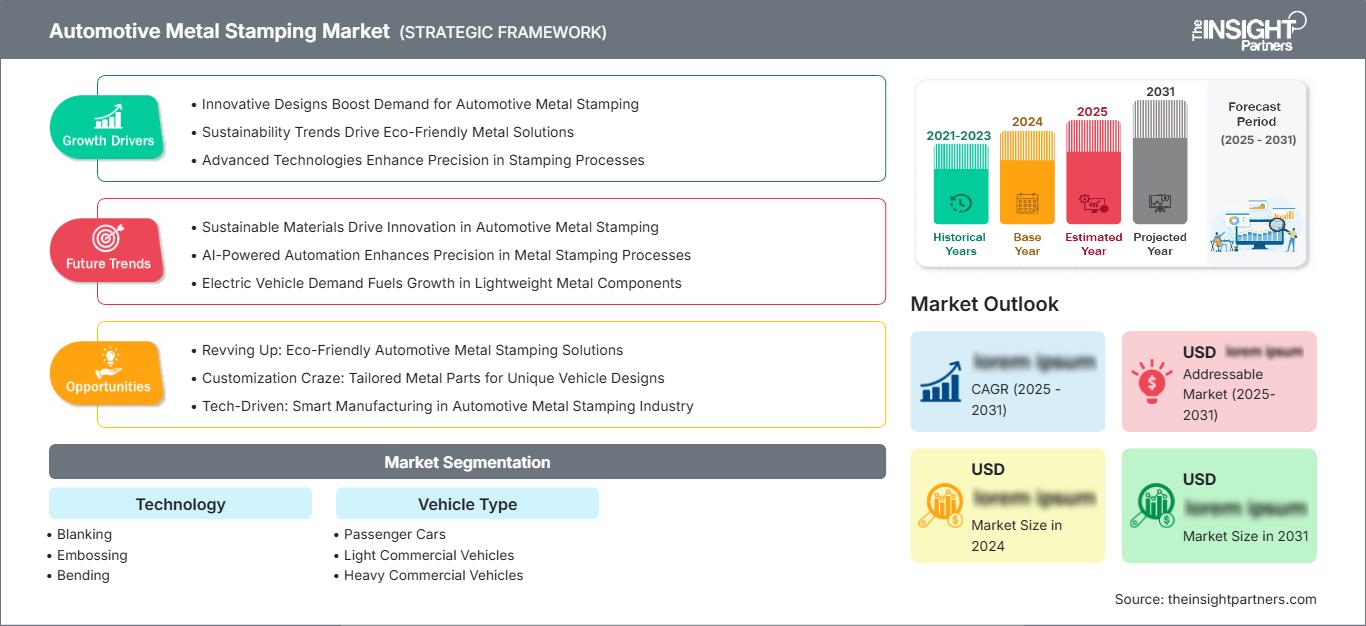
Automotive Metal Stamping Market: Strategic Insights
Regional Insights
North America automotive metal stamping market
North America held 27–29% share in 2025 and is projected to grow at a CAGR of 2.8–3.2% during 2026–2034. The automotive metal stamping market share is supported by a strong vehicle production base, pickup demand, and component localization. EV investments are expanding demand for battery enclosures, structural reinforcements, and frame components. The US dominates regional output, while Mexico supports cost-competitive stamping and assembly networks. Suppliers with large press capacity, welded assembly capability, and proximity to OEM plants are positioned to benefit from reshoring and platform renewal. Additionally, increasing investments in advanced manufacturing technologies, robotics, and material optimization are helping improve production efficiency, quality consistency, and supply chain resilience across the regional automotive sector.
U.S. automotive metal stamping Market
The US accounted for 82–86% of North America in 2025 and is projected to grow at a CAGR of 2.7–3.1%. Demand will be focused on trucks, SUVs, electric vehicle chassis, enclosures, battery protection devices, and underbody stampings. Corporate reach encompasses international suppliers as well as local precision stampers serving the OEMs, Tier 1 accounts, and aftermarket parts programs. Key trends involve the formation of high-strength steel materials, aluminum stampings, automated transfer presses, and weld assemblies, which contribute to increasing vehicle platform strength while maintaining low weight and cost. Increased domestic manufacturing investment, electric vehicle manufacturing plants, and lightweight vehicle design are driving new opportunities for metal stamping manufacturers.
Europe automotive metal stamping Market
Europe accounted for 24–27% share in 2025 and is expected to grow at a CAGR of 2.5–2.9%. Regional demands are led by Germany due to its use of OEM schemes, automation technology, and supplier expertise in body-in-white and structural components. On the other hand, the UK is driven by its involvement in the development of specialty vehicles and motorsport-related fabrication processes, whereas France, Italy, and Spain make their contribution through the production of small cars and commercial vehicles for exports. Emission standards and electric vehicle production increase the use of lightweight stamped components; however, the high cost of energy and lower volume of vehicle production are hindering growth compared to the Asia Pacific.
APAC automotive metal stamping Market
APAC held 38–42% share in 2025 and is forecast to grow at a CAGR of 3.6–4.1%. China leads due to its size with regard to electric and conventional vehicles, while Japan and South Korea offer contributions in terms of precision stamping and materials technology. India gains significance due to the production of passenger cars, the localization of suppliers, and the rise in light commercial vehicle demand. Australia offers specialized manufacturing and replacement parts. Regional development benefits from low-cost manufacturing, supply chain networks, and rising automation investments. Increasing manufacturing projects in EVs, rising exports, and utilization of lightweight vehicles are some of the other factors that will boost market opportunities in the region.
Middle East & Africa automotive metal stamping Market
The Middle East & Africa is projected to grow at a CAGR of 2.9–3.3% during 2026–2034. South Africa is the leading manufacturing hub, while Saudi Arabia and the UAE support demand through industrial diversification and vehicle assembly initiatives. Regional demand is strongest for replacement parts, commercial vehicles, and localized assembly support. Infrastructure projects and logistics expansion create moderate opportunities for stamped brackets, panels, and structural components. Limited press capacity and reliance on imports keep adoption below that of other regions. However, government-led industrial development programs, growing transportation investments, and efforts to expand local manufacturing capabilities are expected to gradually improve regional production capacity and supplier participation.
Segmentation Analysis
Technology
Technology is projected to grow at a CAGR of 3.2–3.7% during 2026–2034. The market scope across technologies is shaped by part complexity, material thickness, tooling cost, production volume, and finish requirements. Blanking dominates because it prepares high-volume parts efficiently, while bending and flanging gain importance in complex structural assemblies.
- Blanking remains the largest process because it delivers accurate flat profiles, supports long production runs, reduces material waste, and prepares parts for downstream bending, forming, welding, and assembly.
- Embossing adds stiffness, branding, grip texture, and functional surface features to panels and brackets, supporting applications where formed reinforcement or identification features are required.
- Bending is important for brackets, reinforcements, chassis parts, and frames, where controlled deformation helps achieve strength, fit, and packaging efficiency without adding material.
- Coining supports high-precision features, localized strengthening, and surface definition in small stamped parts where dimensional repeatability and controlled thickness are critical.
- Flanging enables edge formation, joining surfaces, sealing interfaces, and structural reinforcement, making it essential for closures, panels, battery trays, and welded assemblies.
Vehicle Type
Vehicle Type is expected to grow at a CAGR of 3.0–3.5% during 2026–2034. Passenger Cars lead demand because of high production volumes and broad use of stamped body panels, brackets, and reinforcements. Commercial vehicles create growth opportunities as logistics fleets require durable structural components.
- Passenger Cars dominate stamped component demand because doors, hoods, fenders, pillars, floors, brackets, and battery structures require repeatable forming across high-volume vehicle platforms.
- Light Commercial Vehicles are gaining share as e-commerce, delivery, and utility applications require stronger chassis parts, cargo-area reinforcements, battery enclosures, and cost-efficient body structures.
- Heavy Commercial Vehicles require robust stamped and fabricated components for cabins, frames, brackets, tanks, guards, and reinforcements where durability and serviceability outweigh lightweighting alone.
Opportunity Snapshot
| Vehicle Type | Revenue Contribution | Trend Tag | Adoption Stage |
| Passenger Cars | High | Body Panels | Mature |
| Light Commercial Vehicles | Medium | Fleet Frames | Scaling |
| Heavy Commercial Vehicles | Medium | Reinforced Parts | Mature |
Automotive Metal Stamping Market Growth Drivers and Impact Analysis
Lightweighting Requirements Across Vehicle Platforms
Vehicle weight reductions are being undertaken by automakers to increase fuel economy, boost electric vehicle ranges, and cut down emissions without compromising on safety. Aluminum stampings, high-strength steel, and tailor-welded blanks will make this possible since they allow for the creation of materials with increased strength-to-weight ratios. The effects are mostly felt in closures, reinforcements, battery packs, and underbody parts. The need to keep springback, cracking, and dimensional variations under control as more advanced materials are used will drive investments in simulation software, servo presses, coatings, and inspection technology.
EV Battery Structures and Underbody Protection
In EVs, there is a need for battery enclosures, crossmembers, shields, trays, and structural interface components that will not only safeguard the high-voltage systems but will also contribute to the crash performance. Stamping can be very useful for many such components since stamping allows for cost-effectiveness along with material flexibility. Such an influence also goes beyond the passenger vehicles to extend itself to electric vans and light trucks, where the batteries have higher volumes and hence need higher protection. Suppliers having forming, welding, sealing, and assembly capabilities can win more programs than just isolated stampings.
High-Volume Production Economics and Tooling Efficiency
The process of metal stamping is still appealing owing to its ability to yield lower cost per piece after validation of tooling, thus making it necessary for the manufacture of body and chassis parts in bulk. Blanking, bending, and flanging operations allow for a consistent output while minimizing waste, which allows OEMs to manage margins in the highly competitive segments of automobiles. It is a tangible advantage since the metal stampers have the ability to produce in more than one shift and also make localized parts around assembly plants.
Automotive Metal Stamping Market Future Trends
Servo Presses and Digital Die Simulation
One of the key automotive metal stamping market trends is wider adoption of servo presses and simulation-led die development. These tools allow suppliers to manage forming speed, pressure profiles, and material behavior more precisely, especially for high-strength steel and aluminum. Digital simulation reduces trial-and-error during tooling validation, shortening launch timelines and lowering scrap risk. As OEMs demand faster model refresh cycles, suppliers with strong virtual tryout capability will gain an advantage in complex body-in-white and EV component programs.
Localized Stamping Near EV Assembly Hubs
Stamping capabilities in the future will be driven by proximity to EV and battery assembly clusters, owing to the fact that battery casings and structural frames are big and sensitive and expensive to ship long distances. This development will benefit the suppliers who are able to integrate stamping, welding, painting and assembly closer to the OEM facilities. There is an added advantage for those who operate in North America, India, Southeast Asia and Europe, where localization of vehicle platforms is taking place.
Automotive Metal Stamping Market Opportunities
Integrated Stamping and Assembly Services
The automotive metal stamping market Forecasts point to a stronger opportunity for suppliers that move beyond single-process part production. OEMs increasingly prefer partners that can stamp, weld, assemble, inspect, and deliver subassemblies ready for line-side integration. This reduces supplier complexity and shortens production coordination. Stamping companies can capture higher margins by adding robotic welding, fastening, coatings, and dimensional inspection. The opportunity is especially relevant for battery trays, seat structures, brackets, closures, and underbody modules where tolerances and joining quality influence vehicle safety and manufacturing efficiency.
Aftermarket and Replacement Body Components
Vehicle parc growth and longer ownership cycles create opportunities for stamped replacement panels, brackets, guards, and repair components. Collision repair networks, commercial fleets, and independent workshops require reliable parts with consistent fit and finish. Suppliers can differentiate through fast tooling adaptation, regional distribution, and material compatibility with common vehicle platforms. This opportunity is attractive in emerging economies and high-mileage fleet markets where repair is often preferred over vehicle replacement. It also supports smaller precision stampers that cannot always compete for large OEM programs.
Frequently Asked Questions

- Comprehensive Market Sizing and Forecast Analysis
- Detailed Segmentation Analysis
- In-Depth Market Dynamics Assessment
- Regional and Country-Level Insights
- Competitive Landscape and Company Benchmarking
- Strategic Business Intelligence
Recent Reports
Testimonials

The Insight Partners provided valuable market intelligence that supported our global go-to-market strategy. Their team was professional, responsive, and attentive to our feedback, providing thoughtful analysis and helpful methodological clarifications throughout the project.
Junmo Kim Chief Financial Officer (CFO), Enertech Co., Ltd.
The Insight Partners' SCADA System Market report is comprehensive, with valuable insights on current trends and future forecasts. The team was highly professional, responsive, and supportive throughout. We are very satisfied and highly recommend their services.
RAN KEDEM Partner, Reali Technologies LTDs
I requested a report on a very specific software market and the team produced the report in a few days. The information was very relevant and well presented. I then requested some changes and additions to the report. The team was again very responsive and I got the final report in less than a week.
JEAN-HERVE JENN Chairman, Future Analytica
We worked with The Insight Partners for an important market study and forecast. They gave us clear insights into opportunities and risks, which helped shape our plans. Their research was easy to use and based on solid data. It helped us make smart, confident decisions. We highly recommend them.
PIYUSH NAGPAL Sr. Vice President, High Beam Global
The Insight Partners delivered insightful, well-structured market research with strong domain expertise. Their team was professional and responsive throughout. The user-friendly website made accessing industry reports seamless. We highly recommend them for reliable, high-quality research services
YUKIHIKO ADACHI CEO, Deep Blue, LLC.
This is the first time I have purchased a market report from The Insight Partners.While I was unsure at first, I visited their web site and felt more comfortable to take the risk and purchase a market report.I am completely satisfied with the quality of the report and customer service. I had several questions and comments with the initial report, but after a couple of dialogs over email with their analyst I believe I have a report that I can use as input to our strategic planning process.Thank you so much for taking the extra time and making this a positive experience.I will definitely recommend your service to others and you will be my first call when we need further market data.
JOHN SUZUKI President and Chief Executive Officer, Board Director, BK Technologies
I wish to appreciate your support and the professionalism you displayed in the course of attending to my request for information regarding to infectious disease IVD market in Nigeria. I appreciate your patience, your guidance, and the fact that you were willing to offer a discount, which eventually made it possible for us to close a deal. I look forward to engaging The Insight Partners in the future, all thanks to the impression you have created in me as a result of this first encounter.
DR CHIJIOKE ONYIA MANAGING DIRECTOR, PineCrest Healthcare Ltd.Reason to Buy
- Informed Decision-Making
- Understanding Market Dynamics
- Competitive Analysis
- Identifying Emerging Markets
- Customer Insights
- Market Forecasts
- Risk Mitigation
- Boosting Operational Efficiency
- Strategic Planning
- Investment Justification
- Tracking Industry Innovations
- Aligning with Regulatory Trends





 Get Free Sample for