
Automotive Packaging Market Size, Demand & Growth by 2034
Coverage: By Type (Expandable, Returnable); Component Type (Battery, Cooling Systems, Underbody components, Automotive filters, Engine components, Lighting components, Electric Components); Layer Type (Single Face, Single wall, Double wall, Triple Wall); Product Type (Boxes, Trays, Crates, Corrugated Partitions, Corrugated Pallets, Octabins, PoP Displays); End User (Sedan, SUV, Truck, Others) , and Geography (North America, Europe, Asia Pacific, and South and Central America)
- Status : Data Released
- Report Code : TIPRE00026590
- Category : Automotive and Transportation
- No. of Pages : 150
- Available Report Formats :


- Last update date : August 14, 2026


2025 Market Size
US$ 9.27 Bn
Base year value
2034 Forecast
US$ 13.18 Bn
Projected by 2034
CAGR 2026-2034
4.50 %
Growth rate
Addressable Market
US$ 104.64 Bn
(2026-2034)
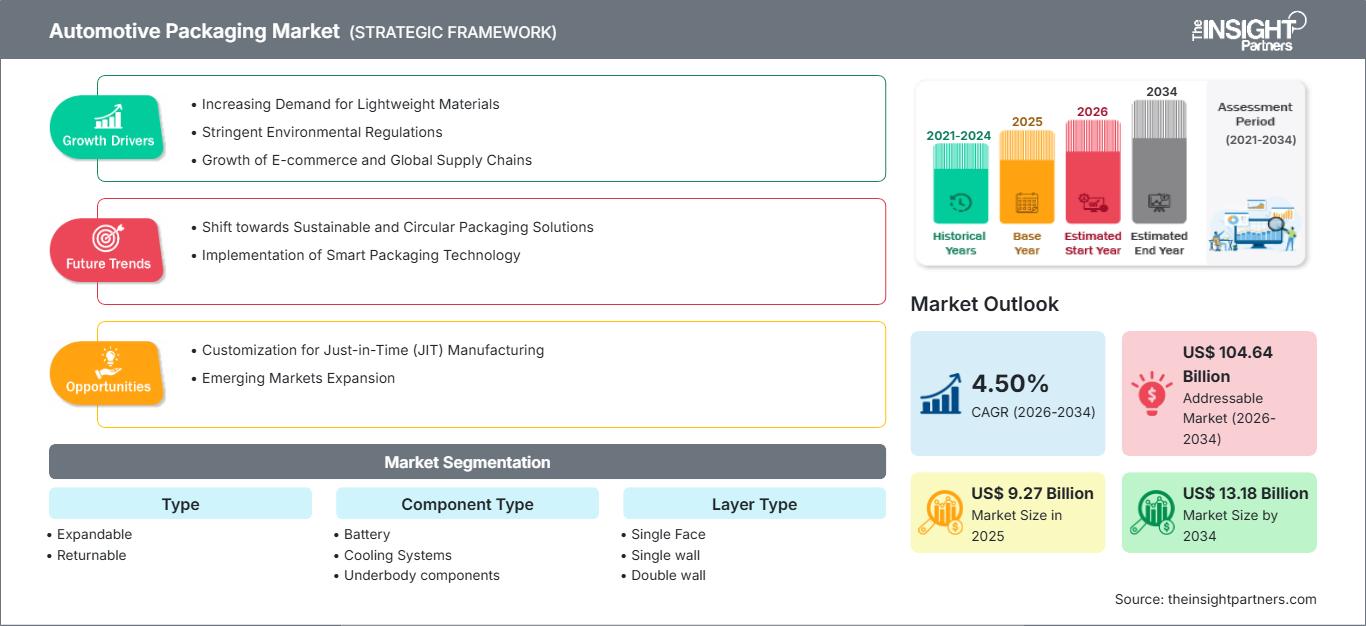
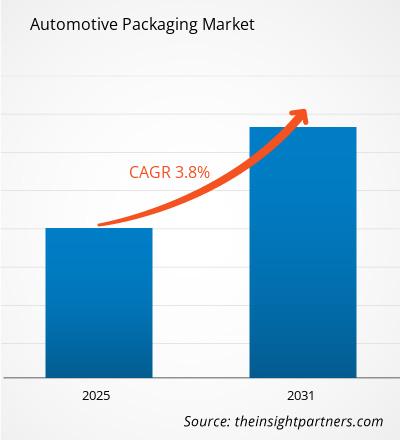
The automotive packaging market was valued at US$ 9.27 billion in 2025 and is projected to reach US$ 13.18 billion by 2034, registering a CAGR of 4.50% during 2026–2034. The market continues to expand as automotive manufacturers prioritize efficient, reusable, and sustainable packaging solutions for transporting components across increasingly complex global supply chains. Rising production of electric vehicles, growing cross-border component trade, and increasing emphasis on minimizing logistics damage are further strengthening market demand.
North America remains one of the most mature regional markets due to advanced automotive manufacturing infrastructure and widespread adoption of reusable logistics systems. The automotive packaging market size across the region is anticipated to expand at a CAGR of 4.2–4.8% through 2034, supported by increasing localization of component manufacturing, sustainability initiatives, and growing investments in returnable packaging systems designed to improve supply chain efficiency while reducing operational costs.
Automotive Packaging Market Assessment and Insights
- North America: Accounted for 29–32% share in 2025 and is projected to expand at a CAGR of 4.2–4.8% during 2026–2034. Strong automotive production, established logistics infrastructure, and high adoption of reusable packaging continue supporting regional growth.
- US: Represented approximately 76–80% of the North American market in 2025 and is expected to register a CAGR of 4.3–4.9%. Growing production of electric vehicles and increasing investments in automated warehousing continue driving packaging innovation.
- Europe: Held 27–30% share in 2025 while recording a CAGR of 4.0–4.6%. Germany, France, Italy, Spain, and the UK remain major automotive manufacturing hubs supporting demand for sustainable transport packaging.
- Asia Pacific: Accounted for 34–37% share in 2025 and is projected to register the highest CAGR of 5.0–5.6% during 2026–2034. China, Japan, India, and South Korea continue expanding automotive production and component exports.
- Largest Segment: Returnable packaging accounted for approximately 60–64% market share in 2025 and is expected to register a CAGR of 4.8–5.4% due to increasing sustainability initiatives and cost optimization.
- High Growth Segment: Battery packaging represented approximately 19–23% market share in 2025 and is projected to expand at a CAGR of 6.3–6.9%, supported by accelerating electric vehicle production.
- Key companies analyzed in detail: Nefab Group, New-Tech Packaging, Kronus, DS Smith Plc, Victory Packaging, Schoeller Allibert B.V., Orcon Industries Corporation, PRIMO, Robinson Industries, THIMM Group.
Source: The Insight Partners' analysis based on proprietary research, government publications, company annual reports, investor presentations, industry databases, and expert interviews.
Automotive manufacturers continue modernizing logistics operations by adopting lightweight, reusable, and recyclable packaging systems capable of protecting increasingly sophisticated vehicle components throughout domestic and international transportation. Growth in electric vehicle production has increased demand for customized packaging solutions capable of safely transporting batteries, electronic systems, and precision-engineered components while minimizing product damage and logistics costs.
Market growth in the future will be facilitated through automation in warehouses, digitized tracking systems, recyclable material use, and regionalization of automotive supply chain processes. Smart packing technologies, RFID-based containers, and circular economy approaches are likely to enhance packing efficiencies and assist companies in meeting environmental regulations as well as transport efficiencies.
Automotive Packaging Market Report Scope
| Report Attribute | Details |
|---|---|
| Market size in 2025 | US$ 9.27 Billion |
| Market Size by 2034 | US$ 13.18 Billion |
| Global CAGR (2026 - 2034) | 4.50% |
| Historical Data | 2021-2024 |
| Forecast period | 2026-2034 |
Automotive Packaging Market Analysis
The expansion of global automotive production continues to support automotive packaging market growth as manufacturers require reliable packaging solutions for transporting engines, batteries, lighting systems, filters, and precision electronic components. Increasing localization of production facilities and rising exports of automotive components are encouraging the adoption of reusable packaging formats that reduce logistics costs while improving operational efficiency and sustainability throughout the supply chain.
The packaging value chain includes raw material suppliers, corrugated packaging manufacturers, plastic container producers, automotive OEMs, component manufacturers, logistics companies, warehouse operators, and recycling providers. Increasing digitalization of warehouse management systems and automation within distribution centers continues strengthening demand for standardized packaging solutions capable of supporting high-volume manufacturing operations.
The competitive landscape within the automotive packaging market analysis is characterized by continuous product innovation, sustainability initiatives, and the expansion of reusable packaging portfolios. The Nefab Group, DS Smith Plc, Schoeller Allibert B.V., THIMM Group, Victory Packaging, and Orcon Industries Corporation continue to be dedicated to their investments in lightweight packaging products, custom-made protective packaging, and circular logistics to help build robust relationships with their customers in the automotive sector.
More and more investment strategies are being focused on using recycled materials, recyclable transport, digital tracking, and automation-friendly packaging. The packaging firms are setting up manufacturing units in regional areas in collaboration with the automotive OEMs to develop customized packaging that can be used for efficient transportation and less waste generation.
● REPORT CUSTOMIZATION
Tailor This Report To Align With Your Specific Business Requirements
This report can be customized to align precisely with your business objectives, scope, and target markets. Customization options include tailored segmentation, geography, competitive analysis, and strategic insights to support informed decision-making.
Customize This Report →WHAT YOU CAN ADJUST
- ● Segmentations
- ● Geography
- ● Competitive Analysis
- ● Language Preferences
Automotive Packaging Market: Strategic Insights
Regional Insights
North America Automotive Packaging Market
North America accounted for approximately 29–32% of the global automotive packaging market share in 2025 and is expected to register a CAGR of 4.2–4.8% during 2026–2034. The area has advantages such as an elaborate automobile manufacturing network, robust warehousing facilities, and reusable logistics systems. Automotive original equipment manufacturers (OEMs) and first-tier suppliers are continually substituting single-use packaging materials with returnable containers, corrugated packaging, and engineered plastic crates in order to increase efficiency while minimizing packaging waste and lowering transport costs in complex logistics chains.
North America, including the U.S., Canada, and Mexico, has well-integrated production networks of automobiles, which are in accordance with regional trade agreements and ensure continuous demand for packaging systems. Growing demand for electric vehicles, automation in distribution centers, and inventory control through digitization have increased demand for tailor-made packaging that will help protect valuable automobile parts.
U.S. Automotive Packaging Market
The US represented approximately 76–80% of the North American market in 2025 and is projected to expand at a CAGR of 4.3–4.9% during the forecast period. Massive automotive manufacturing operations, increasing electric vehicle production, and investment in automated warehouses keep driving packaging requirements. Automotive manufacturers are relying more on reusable plastic boxes, custom corrugated packaging, and engineered protection options to make transportation effective and prevent parts from being damaged during transport within the country and internationally.
Sustainable packaging solutions, RFID tracking, and returnable logistics systems keep receiving investments from manufacturers. Increased manufacturing of batteries, electronics, and lightweight components requires precisely engineered packaging able to protect sensitive products and facilitate lean manufacturing processes.
Europe Automotive Packaging Market
Europe accounted for approximately 27–30% of the global market in 2025 and is projected to grow at a CAGR of 4.0–4.6% during 2026–2034. Germany drives regional demand thanks to its vast capabilities of producing cars, developed supply chain, and sustainable manufacturing. There is ongoing development of packaging solutions for the automotive industry based on recyclable corrugated products and reusable transport packaging in accordance with growing ecological requirements and the ability to produce large volumes of cars.
The United Kingdom keeps advancing logistics in the automotive industry due to the digitalization of warehouses and the use of reusable packaging. France focuses on sustainable industrial manufacturing and light-weight packaging. Italy maintains its position as a manufacturer of premium car parts with special packaging needs, and Spain expands automotive exports because of infrastructure investments.
APAC Automotive Packaging Market
Asia Pacific accounted for approximately 34–37% of the global market in 2025 and is projected to register the highest CAGR of 5.0–5.6% during the forecast period. China dominates regional demand through its extensive automotive manufacturing industry, while Japan and South Korea continue investing in precision packaging for advanced automotive components.
India is experiencing rapid growth owing to expanding domestic vehicle production, increasing exports, and government initiatives supporting manufacturing. Australia contributes through specialized automotive component production and improved logistics infrastructure supporting regional supply chains.
Middle East & Africa Automotive Packaging Market
The Middle East & Africa market is expected to register a CAGR of 3.8–4.4% through 2034. Saudi Arabia and the UAE continue to invest in industrial diversification, logistics development, and automobile assembly processes, creating more demand for industrial packaging and logistics services.
South Africa remains the largest automotive manufacturing country in the region, creating consistent demand for corrugated packaging, reusable boxes, and export-oriented logistics services. The Rest of MEA's growth is driven by industrialization and automotive aftermarket developments.
Segmentation Analysis
Type
The Type segment is expected to register a CAGR of 4.6–5.2% during 2026–2034. Rising sustainability initiatives, increasing transportation efficiency requirements, and cost optimization continue driving the adoption of reusable industrial packaging solutions. The automotive packaging market scope continues expanding as manufacturers implement circular packaging systems capable of supporting multiple transportation cycles while minimizing waste generation.
- Expandable – Primarily used for one-way shipments requiring lightweight protective solutions. Expandable packaging offers flexibility, reduced storage requirements, and cost-effective protection for numerous automotive components.
- Returnable – Represents the dominant packaging type owing to repeated usage capability, lower lifecycle costs, improved sustainability performance, and increasing adoption across integrated automotive manufacturing supply chains.
Component Type
The Component Type segment is projected to expand at a CAGR of 5.1–5.7% during the forecast period. Increasing production of electric vehicles and advanced automotive electronics is generating higher demand for customized packaging solutions designed to protect complex components throughout transportation and storage.
- Battery – Requires specialized protective packaging capable of preventing vibration, moisture exposure, and impact damage during transportation while complying with safety regulations.
- Cooling Systems – Utilize customized packaging designed to protect delicate heat exchangers, pumps, and fluid management assemblies from mechanical damage.
- Underbody Components – Demand durable packaging solutions capable of safely transporting large structural automotive assemblies across manufacturing facilities.
- Automotive Filters – Require contamination-resistant packaging ensuring product cleanliness throughout storage and distribution.
- Engine Components – Utilize heavy-duty protective packaging that minimizes movement and prevents mechanical damage during transportation.
- Lighting Components – Require impact-resistant packaging capable of protecting precision optical assemblies and electronic lighting systems.
- Electric Components – Increasingly rely on anti-static, moisture-resistant, and customized protective packaging supporting sensitive electronic devices.
Layer Type
The Layer Type segment is anticipated to register a CAGR of 4.3–4.9% during 2026–2034. Growing transportation complexity and increasing shipment distances continue driving demand for stronger corrugated packaging configurations capable of protecting valuable automotive components.
- Single Face – Suitable for lightweight automotive parts requiring basic cushioning and flexible protective wrapping during handling.
- Single Wall – Widely utilized for medium-weight automotive components because it provides an effective balance between strength, weight, and cost efficiency.
- Double Wall – Preferred for heavier automotive assemblies requiring enhanced structural protection during long-distance transportation.
- Triple Wall – Utilized for large industrial automotive components requiring maximum compression strength and export-grade transportation protection.
Product Type
The Product Type segment reflects the broad range of packaging formats developed to accommodate different automotive components throughout manufacturing and supply chain operations. Growing automation in warehouses and increasing emphasis on reusable logistics systems are supporting innovation across packaging formats. This segment is expected to record a CAGR of 4.5–5.0% between 2026 and 2034 as OEMs prioritize operational efficiency and product protection.
- Boxes – The most commonly deployed packaging solution for transporting medium-sized automotive components owing to versatility, stackability, customization options, and compatibility with automated warehouse systems.
- Trays – Frequently adopted for organized handling of precision automotive parts, minimizing movement during transportation while improving inventory visibility and assembly-line efficiency.
- Crates – Designed for durable multi-use transportation of heavy automotive assemblies, offering superior structural support and lower lifecycle costs through repeated logistics operations.
- Corrugated Partitions – Used to separate delicate components within packaging systems, preventing contact damage while improving packaging density and reducing replacement costs.
- Corrugated Pallets – Lightweight alternatives to traditional wooden pallets that reduce shipping weight, simplify recycling, and support sustainability targets across automotive supply chains.
- Octabins – Suitable for bulk transportation of lightweight automotive materials and plastic components, enabling efficient storage, handling, and high-volume logistics operations.
- PoP Displays – Primarily utilized within aftermarket automotive retail channels to improve product presentation, merchandising efficiency, and promotional visibility while protecting packaged products during transportation.
Opportunity Snapshot
| Product Type | Revenue Contribution | Trend Tag | Adoption Stage |
|---|---|---|---|
| Boxes | High | Reusable Logistics | Mature |
| Trays | High | Precision Handling | Mature |
| Crates | High | Closed Loop | Scaling |
| Corrugated Partitions | Medium | Component Safety | Mature |
| Corrugated Pallets | Medium | Lightweight Shipping | Scaling |
| Octabins | Medium | Bulk Storage | Scaling |
| PoP Displays | Low | Aftermarket Retail | Emerging |
Automotive Packaging Market Growth Drivers and Impact Analysis
Growing Automotive Production and Global Component Trade
The manufacturing of vehicles is still on the increase in the Asian Pacific, Eastern European, and some countries in the Middle East regions. This has led to an increase in the movement of components through very complicated supply chain logistics networks internationally. These car manufacturers use packaging as one of the major elements of their processes in order to ensure that their products are protected against any form of damage, improve handling and reduce the cost of logistics through several means of transportation. The increased export of engines, batteries, lighting systems, and electronics has created a demand for returnable and corrugated packaging.
Rapid Expansion of Electric Vehicle Manufacturing
The manufacture of electric cars requires certain packaging requirements because lithium-ion batteries, electric motors, power electronics, and thermal management systems all require protection against vibration, moisture, static, and shock during transportation and storage. In addition, expensive products require packaging that is resistant to these elements. Suppliers of auto parts are adopting reusable packaging systems in order to achieve traceability of batteries and embrace the idea of circular logistics. The construction of battery megafactories in the North American, European, Chinese, Indian, and Southeast Asian regions is contributing to regional demand for automotive packaging systems.
Sustainability Regulations Accelerating Reusable Packaging Adoption
Sustainability initiatives, which help reduce the amount of waste generated by packaging, increase the reuse of materials, and reduce the release of greenhouse gases, are being embraced by various governments and automobile firms. More often than not, automakers have started using reusable packaging systems, returnable crates, recyclable corrugated papers, and other forms of returnable packaging in order to achieve their environmental goals and reduce future expenses. Circular economy policies in Europe, North America, and Asia have been encouraging better packaging lifecycle performance through sustainable design and recycling of materials to suppliers.
Automotive Packaging Market Future Trends
Smart Packaging Technologies Improving Supply Chain Visibility
Packaging manufacturers increasingly integrate RFID tags, QR codes, IoT sensors, and digital asset tracking technologies into reusable automotive containers. These innovations improve inventory visibility, shipment monitoring, predictive maintenance, and return logistics efficiency across global automotive supply chains. Digitalization enables manufacturers to reduce losses, optimize container utilization, and improve warehouse automation. These automotive packaging market trends are expected to strengthen operational efficiency while supporting data-driven logistics management and smarter inventory planning throughout the forecast period.
Lightweight Sustainable Materials Replacing Conventional Packaging
The invention of new materials is constantly impacting the logistics of automobiles because of the use of corrugated packaging, recyclable plastics, molded fiber and light composite materials. The providers are constantly working on minimizing the transportation weight, while at the same time maintaining sufficient packaging strength and performance. The manufacturers are increasingly interested in solutions that will help to decrease the carbon footprint while remaining committed to their sustainability goals.
Automotive Packaging Market Opportunities
Expansion of Circular Packaging Networks Across Emerging Manufacturing Hubs
Automotive manufacturers are expanding production facilities across India, Mexico, Vietnam, Indonesia, Thailand, and Eastern Europe to diversify global supply chains. These investments create opportunities for packaging providers offering reusable containers, return logistics systems, and digitally monitored packaging fleets. Growing localization of automotive manufacturing increases demand for region-specific packaging engineering, reverse logistics infrastructure, and customized transit solutions. Automotive packaging Market Forecasts indicate sustained investment in closed-loop packaging ecosystems as manufacturers pursue cost optimization and environmental compliance. Companies capable of delivering standardized reusable packaging integrated with digital tracking technologies are expected to strengthen long-term partnerships with OEMs and Tier-1 suppliers while improving operational efficiency across regional manufacturing networks.
Customized Packaging Solutions for Electric Vehicle Components
The production of electric vehicles remains a continuous source of packaging needs for batteries, electronic control units, lightweight structures, and thermal control systems. Packaging companies able to develop application-specific protective systems find themselves with considerable possibilities for growth in terms of customer expansion. Investment in production capacity for batteries means increasing needs for reusable battery shipping containers, anti-static packaging materials, moisture-proof materials, and modular packaging systems. There are also developments in automation-compatible packaging that make warehousing easier and safer for delicate parts through global distribution channels. Companies that incorporate sustainable packaging materials along with advanced engineering solutions can secure long-term contracts with growing automotive electrification around the world.
Frequently Asked Questions

- Comprehensive Market Sizing and Forecast Analysis
- Detailed Segmentation Analysis
- In-Depth Market Dynamics Assessment
- Regional and Country-Level Insights
- Competitive Landscape and Company Benchmarking
- Strategic Business Intelligence
Recent Reports
Testimonials

The Insight Partners' SCADA System Market report is comprehensive, with valuable insights on current trends and future forecasts. The team was highly professional, responsive, and supportive throughout. We are very satisfied and highly recommend their services.
RAN KEDEM Partner, Reali Technologies LTDs
I requested a report on a very specific software market and the team produced the report in a few days. The information was very relevant and well presented. I then requested some changes and additions to the report. The team was again very responsive and I got the final report in less than a week.
JEAN-HERVE JENN Chairman, Future Analytica
We worked with The Insight Partners for an important market study and forecast. They gave us clear insights into opportunities and risks, which helped shape our plans. Their research was easy to use and based on solid data. It helped us make smart, confident decisions. We highly recommend them.
PIYUSH NAGPAL Sr. Vice President, High Beam Global
The Insight Partners delivered insightful, well-structured market research with strong domain expertise. Their team was professional and responsive throughout. The user-friendly website made accessing industry reports seamless. We highly recommend them for reliable, high-quality research services
YUKIHIKO ADACHI CEO, Deep Blue, LLC.
This is the first time I have purchased a market report from The Insight Partners.While I was unsure at first, I visited their web site and felt more comfortable to take the risk and purchase a market report.I am completely satisfied with the quality of the report and customer service. I had several questions and comments with the initial report, but after a couple of dialogs over email with their analyst I believe I have a report that I can use as input to our strategic planning process.Thank you so much for taking the extra time and making this a positive experience.I will definitely recommend your service to others and you will be my first call when we need further market data.
JOHN SUZUKI President and Chief Executive Officer, Board Director, BK Technologies
I wish to appreciate your support and the professionalism you displayed in the course of attending to my request for information regarding to infectious disease IVD market in Nigeria. I appreciate your patience, your guidance, and the fact that you were willing to offer a discount, which eventually made it possible for us to close a deal. I look forward to engaging The Insight Partners in the future, all thanks to the impression you have created in me as a result of this first encounter.
DR CHIJIOKE ONYIA MANAGING DIRECTOR, PineCrest Healthcare Ltd.Reason to Buy
- Informed Decision-Making
- Understanding Market Dynamics
- Competitive Analysis
- Identifying Emerging Markets
- Customer Insights
- Market Forecasts
- Risk Mitigation
- Boosting Operational Efficiency
- Strategic Planning
- Investment Justification
- Tracking Industry Innovations
- Aligning with Regulatory Trends





 Get Free Sample for