
Awnings Market Share, Growth & Forecast by 2034
Coverage: By Type (Fixed, Retractable); Product (Patio, Window, Freestanding, Others); End User (Residential, Commercial) , and Geography (North America, Europe, Asia Pacific, and South and Central America)
- Status : Data Released
- Report Code : TIPRE00022024
- Category : Manufacturing and Construction
- No. of Pages : 150
- Available Report Formats :


- Last update date : November 03, 2026


2025 Market Size
US$ 3.76 Bn
Base year value
2034 Forecast
US$ 6.31 Bn
Projected by 2034
CAGR 2026-2034
5.92 %
Growth rate
Addressable Market
US$ 45.61 Bn
(2026-2034)
The Awnings Market was valued at US$ 3.76 Billion in 2025 and is expected to reach US$ 6.31 Billion by 2034, registering a CAGR of 5.92% during 2026–2034. The market covers exterior shading systems used to provide solar protection, weather protection, outdoor comfort, and architectural enhancement across residential and commercial settings. Its competitive structure includes fixed and retractable formats, with demand increasingly influenced by outdoor living, building comfort, energy efficiency, and integration with automated shading controls.
The Awnings Market size is supported by established residential replacement demand in North America and Europe, alongside expanding commercial applications and new construction activity in Asia Pacific. North America is estimated to expand at a ~4% CAGR through 2034, supported by home renovation, patio utilization, motorized retractable systems, and demand for exterior shading that can moderate solar heat gain. Product customization and dealer-led installation also support recurring replacement and upgrade activity.
Awnings Market Assessment and Insights
Regional Outlook
- North America: ~34% of the global market in 2025 | ~4% CAGR through 2034. Market position: North America remains the largest regional market, supported by mature residential adoption, remodeling expenditure, extensive patio and deck applications, and established specialist dealer networks. Motorized retractable products strengthen replacement and upgrade demand.
- US: ~82% of North American market revenue in 2025 | ~4% CAGR through 2034. Market position: The US is the leading country in North America, supported by large residential outdoor-living applications, renovation activity, and established manufacturers. Retractable patio and window systems have broad relevance across residential and selected commercial properties.
- Europe: ~27% of the global market in 2025 | ~5% CAGR through 2034. Market position: Europe is a mature shading market with strong demand for technically integrated products. Germany is the leading country in Europe, followed by established markets such as the UK, France, Italy, and Spain, where solar protection and outdoor comfort support adoption.
- Asia Pacific: ~24% of the global market in 2025 | ~7% CAGR through 2034. Market position: Asia Pacific is the fastest-growing region, supported by urban residential construction, rising disposable income, warmer climates, hospitality development, and increasing awareness of solar control. China is the leading country in Asia Pacific, with Japan, South Korea, India, and Australia providing additional demand centers.
Segment Outlook
- Retractable: ~58% Share in 2025 | ~6% CAGR through 2034. Market position: Retractable systems lead because they combine adjustable shade, outdoor-space flexibility, and weather-responsive operation. Motorization, remote control, compact cassette designs, and customization broaden their relevance across patios, windows, balconies, and commercial outdoor areas.
- Commercial: ~38% Share in 2025 | ~7% CAGR through 2034. Market position: Commercial applications represent the higher-growth main segment as restaurants, hospitality properties, retail locations, offices, schools, and public facilities increasingly use external shading to improve outdoor usability, thermal comfort, and weather protection.
Competitive Coverage
Accent Awning Company, Advanced Design Awnings & Signs, Awning Company of America, Carroll Architectural Shade, Eide Industries, Inc., KE USA Inc., Marygrove Awnings, NuImage Awnings / Futureguard, Sunesta, SunSetter Products
Methodology
The Insight Partners follows Data Collection & Secondary Research, Primary Research, Data Analysis, and Data Triangulation & Final Review to validate market estimates and insights.
Source: The Insight Partners' analysis based on proprietary research, government publications, company annual reports, investor presentations, industry databases, and expert interviews.
Awnings Market trends are moving away from traditional fabric covered systems towards more adaptable exterior shading solutions. Fixed products are still being used for windows, entranceways, storefronts, and situations where permanence is needed, but retractable systems are using more features such as motorization, cassettes, sensors, remote operation, and connectivity with smart home technology. The supply chain comprises fabric manufacturers, frame manufacturers, components suppliers, system integrators, installers, distributors, architects, and specialist retailers. In this way, manufacturers can compete through customized and well-integrated products rather than basic product specifications alone.
Future demand is also influenced by building performance concerns. Exterior shading can help reduce solar gain and enhance thermal comfort, but building performance discussions in Europe are increasingly focused on managing overheating and solar management. New markets in the Asia Pacific region are also emerging with the rise of urban residential buildings, hotels, and mixed-used developments. Investments are hence being made in motorized systems, weather resistant fabrics, architectural integration, and digital configurator solutions.
Awnings Market Report Scope
| Report Attribute | Details |
|---|---|
| Market size in 2025 | US$ 3.76 Billion |
| Market Size by 2034 | US$ 6.31 Billion |
| Global CAGR (2026 - 2034) | 5.92% |
| Historical Data | 2021-2024 |
| Forecast period | 2026-2034 |
Awnings Market Analysis
Awnings Market development is tightly connected to three demand segments: residential outdoor-living investments, commercial building improvement, and solar control at building level. Residential consumers treat their patios, balconies, decks and gardens as extensions of their living space, which leads to demand for shading flexibility. Commercial consumers employ awnings for dining outdoors, storefront protection, hospitality areas, and visitor comfort. Upstream activities include obtaining of the fabrics, aluminum and steel structures, motors, control systems, and other accessories, followed by fabrication and installation of awnings. The role of dealers persists because site measuring, structural assessment and installation affect product choice and lifecycle performance.
The dynamics of supply is characterized by fragmentation in the Awnings Market Report, where there is competition between well-established producers and regional fabricators as well as installers. SunSetter Products, Sunesta, Eide Industries, and Accent Awning Company concentrate on customization or retraction of the products, whereas KE USA Inc. and similar companies focus on architectural and commercial applications. The competitive advantages depend upon the motorized movement, fabric durability, casement protection, flexibility of design, installation ability and smart controls compatibility. Therefore, investments are now aimed at product engineering, dealers support, visualization and advanced manufacturing technology.
● REPORT CUSTOMIZATION
Tailor This Report To Align With Your Specific Business Requirements
This report can be customized to align precisely with your business objectives, scope, and target markets. Customization options include tailored segmentation, geography, competitive analysis, and strategic insights to support informed decision-making.
Customize This Report →WHAT YOU CAN ADJUST
- ● Segmentations
- ● Geography
- ● Competitive Analysis
- ● Language Preferences
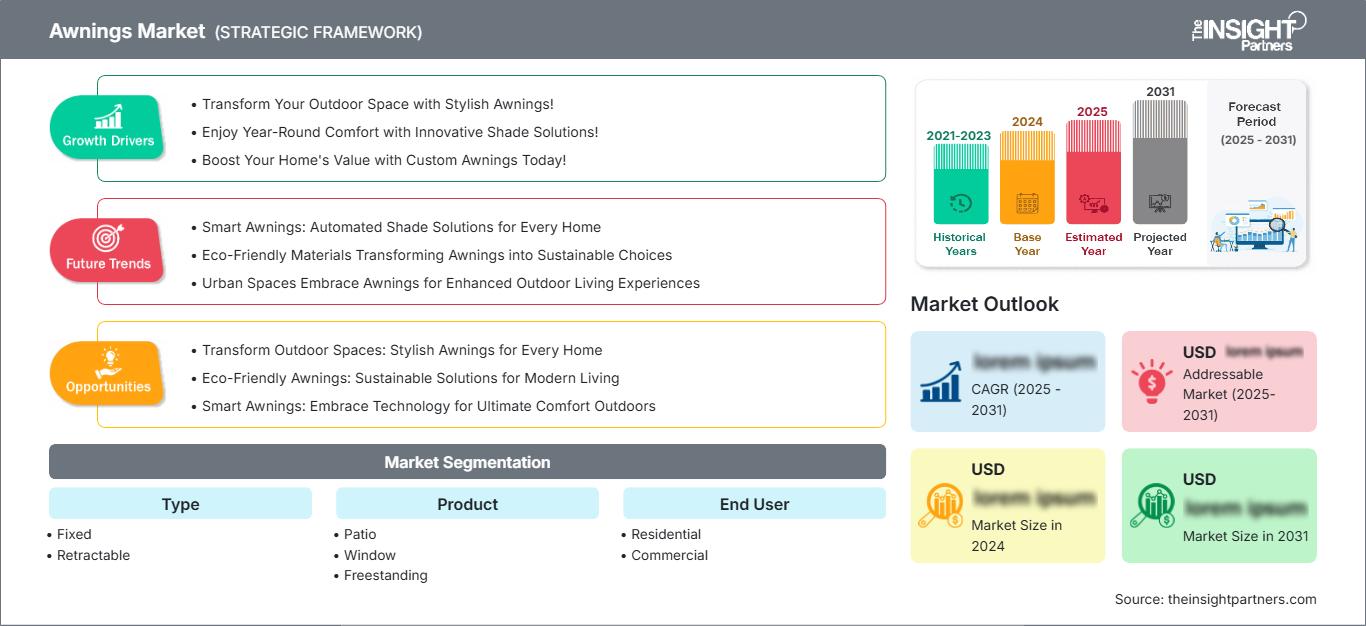
Awnings Market: Strategic Insights
Regional Insights
North America Awnings Market
The North American region represented ~34% of the worldwide Awnings Market share in 2025 and expected to register a ~4% CAGR over 2034. Favorable factors that include the presence of a mature installed base, robust home improvement activity, usage of patios and decks, and high consumer awareness levels with respect to exterior shading, drive the growth of the region. Residential segment continues to be the key end-use, and the commercial end-use includes the use of restaurants, hotels, retail buildings, and recreational sites.
The United States is responsible for ~82% of the North American market revenues, and also houses a significant number of manufacturers, installation service providers, distributors, and dealers of exterior awnings. Growing product demand in favor of motorized retractable types is driven by the ability of providing adjustable shading without permanently obscuring the view outdoors. Some of the established companies operating in the region include SunSetter Products, Sunesta, Accent Awning Company, Marygrove Awnings, and Eide Industries.
U.S. Awnings Market
The US held around ~82% of the revenue share in the North America market in 2025 and is projected to grow at a ~4% CAGR during the forecast period 2024-2034. The main driver of demand is the residential remodeling segment, which includes patios, decks, windows, balconies, and outdoor entertainment spaces.
The key competitive players include existing manufacturers and local installation service providers. SunSetter Products is one of the prominent companies operating in the retractable residential awnings segment, and Sunesta specializes in providing customized retractable patio and commercial products. Other service providers include Accent Awning Company among others, which serve residential and commercial needs. Commercial sector has demand driven from outdoor dining, hospitality, retail, and institutional sectors.
Europe Awnings Market
The Awnings Market share of Europe in 2025 was forecast to be ~27%, growing at a CAGR of ~5% till 2034. Germany will be the top country in Europe due to advanced manufacturing capabilities of external shades, architectural integration, and technical standards. The UK is demanding solar-shades for its residential additions, hospitality buildings, and commercial constructions, whereas France and Italy use their patio, terrace, and outdoor living spaces. There are excellent opportunities in Spain for the development of solar protection due to significant solar exposure and outdoor use.
European demand is driven by building comfort and heating mitigation needs. External shades are used in both newly-built houses and renovations since they can mitigate the impact of sunlight before it gets into the building. Hence, manufacturers are using weather sensors, motorization, lighting, and architectural cassettes in their products. Germany continues to be a hub for innovations and manufacturing of the product, whereas France, Italy, Spain, and the UK offer diverse end-user demand. Commercial uses include hospitality renovations and outdoor shaded space.
APAC Awnings Market
Asia Pacific accounted for approximately ~24% of the global market in 2025 and is expected to achieve a ~7% CAGR through 2034, making it the fastest-growing region. China is the leading country in Asia Pacific because of its large construction base, manufacturing ecosystem, urban population, and expanding residential and commercial development. Japan and South Korea offer demand for technically advanced shading, while India and Australia provide opportunities linked to residential construction, hospitality, and climatic exposure.
The region's growth is supported by urbanization, increasing interest in outdoor amenities, rising household purchasing power, and the need for solar protection. Australia has a mature market for outdoor shading, whereas China and India provide larger long-term volume opportunities. Japan and South Korea add demand for compact, durable, and increasingly automated systems. Suppliers with localized production and installation capabilities are positioned to address different climate, architectural, and price requirements across the region.
Middle East & Africa Awnings Market
Middle East & Africa is projected to grow at a ~6% CAGR through 2034. Saudi Arabia is the leading country in the Middle East & Africa based on construction activity, hospitality development, and investment in large-scale commercial and tourism projects. The UAE also provides substantial demand through hotels, restaurants, retail developments, villas, and mixed-use projects requiring outdoor shading and weather protection.
South Africa represents an established market within the region, supported by residential and commercial applications. Across the Gulf, high solar exposure and outdoor temperature conditions strengthen the functional value of awnings, while tourism and infrastructure projects create demand for large-format shading. In Africa, adoption remains more concentrated in urban and higher-income applications. Suppliers that can deliver durable fabrics, corrosion-resistant frames, wind protection, and installation services have greater relevance where climatic conditions place higher demands on exterior products.
Segmentation Analysis
Type
Type determines the operating mechanism and installation characteristics of the product. Retractable systems are estimated to represent the largest share and are projected to grow at a ~6% CAGR through 2034, supported by adjustable shade, motorization, and residential outdoor-living demand. Fixed systems remain important where permanent solar or weather protection is required, particularly for windows, entrances, storefronts, and selected commercial applications.
- Fixed: Fixed awnings provide permanent shading and weather protection with comparatively simple operating mechanisms. They remain relevant for windows, entrances, storefronts, and buildings where continuous coverage is preferred. Their structural simplicity supports use in cost-sensitive installations and applications requiring consistent architectural treatment.
- Retractable: Retractable awnings allow users to adjust coverage according to sunlight and weather conditions. Motorized versions increasingly integrate remote controls, sensors, and smart-home systems. Their flexibility supports patios, decks, balconies, windows, hospitality areas, and other spaces where users need variable outdoor coverage.
Product
Product includes patio, window, and freestanding formats and reflects the physical installation environment in the Awnings Market. Patio products are estimated to be the largest product category and are projected to grow at a ~6% CAGR through 2034 as outdoor living expands. Window products retain importance for solar control, while freestanding products are increasingly suited to gardens, hospitality spaces, events, and areas where wall mounting is impractical.
- Patio: Patio awnings address outdoor living spaces attached to or adjacent to residential and commercial buildings. Demand is linked to deck and terrace utilization, outdoor dining, entertainment, and weather protection. Motorization and integrated screens increase functional value in higher-specification installations.
- Window: Window awnings provide targeted solar protection and can support thermal comfort while reducing direct sunlight. They are used across residential and commercial buildings and can be particularly relevant where façade design, window orientation, or overheating considerations require external shading.
- Freestanding: Freestanding awnings provide shade without relying on a building façade for primary structural support. They are suitable for gardens, pools, terraces, restaurants, hospitality properties, and larger outdoor areas. Their modularity supports flexible layouts and increasingly sophisticated outdoor-space designs.
End User
End User separates residential and commercial demand in the Awnings Market. Residential applications remain the largest contributor, supported by renovation, outdoor living, and home-comfort requirements, with the segment expected to grow at a ~6% CAGR through 2034. Commercial applications are projected to record a ~7% CAGR as hospitality, retail, food service, education, and mixed-use developments increasingly monetize usable outdoor areas.
- Residential: Residential demand centers on patios, decks, balconies, windows, and gardens. Buyers increasingly consider motorized operation, fabric selection, weather resistance, and visual integration alongside basic shading. Replacement, remodeling, and outdoor-living upgrades provide recurring demand beyond new housing construction.
- Commercial: Commercial users deploy awnings at restaurants, hotels, retail stores, offices, schools, and recreational facilities. The products can improve outdoor usability, provide solar and weather protection, and support architectural identity. Larger installations also create opportunities for customized systems and professional project-based installation.
Opportunity Snapshot
| End User | Revenue Contribution | Trend Tag | Adoption Stage |
| Residential | High | Outdoor Living | Mature |
| Commercial | High | Hospitality Shading | Scaling |
Awnings Market Growth Drivers and Impact Analysis
Rising Demand for Outdoor Living and Usable Exterior Space
Residential and commercial properties are allocating greater attention to patios, terraces, balconies, gardens, and outdoor dining areas. Awnings provide a relatively flexible way to convert these areas into usable spaces while protecting occupants from direct sun and intermittent weather. In residential markets, remodeling projects can incorporate awnings without requiring major structural changes, making them relevant to incremental home improvement expenditure. Commercial operators can use shading to expand usable seating or customer areas. The impact is strongest for retractable and motorized systems because users can vary coverage according to weather and occupancy. This demand mechanism supports replacement activity as customers move from manual or basic products toward more convenient, durable, and integrated solutions.
Greater Focus on Solar Control and Building Thermal Comfort
External shading is gaining relevance as building owners seek passive approaches to managing solar heat and improving occupant comfort. Exterior awnings intercept solar radiation before it reaches glazing, reducing the amount of heat entering interior spaces. This mechanism is particularly important in warmer climates and during periods of elevated cooling demand. Building-performance initiatives in North America and Europe increasingly consider shading alongside glazing, ventilation, insulation, and mechanical cooling. The market impact is creating demand for products that can be positioned precisely, automated according to environmental conditions, and integrated with broader building-control systems. Manufacturers able to demonstrate reliable performance, durable fabrics, and compatibility with modern control systems can address both comfort-oriented residential demand and performance-oriented commercial projects.
Advancement of Motorized and Connected Shading Systems
Motorization is changing the value proposition of awnings by reducing the physical effort required to operate larger systems and enabling automated responses to environmental conditions. Remote controls, weather sensors, timers, smart-home platforms, and connected motors can coordinate shading with user preferences and building conditions. This technology is particularly relevant for larger patios, high-mounted awnings, commercial properties, and premium residential installations. The market impact extends beyond the motor itself because automation encourages upgrades to higher-value fabrics, cassette systems, sensors, and installation services. It also changes the competitive basis from simple fabrication toward system engineering and interoperability. As smart-home standards become more common, awning manufacturers can increasingly position connected control as part of the complete shading solution rather than as an optional accessory.
Awnings Market Future Trends
Integration of Large-Format and Architectural Shading
The Awnings Market trends are moving toward larger, more architecturally integrated shading systems that can cover expansive patios, glazed façades, conservatories, terraces, and outdoor hospitality areas. Modern buildings increasingly use larger glass surfaces, which can increase solar exposure and create demand for coordinated external shading. Manufacturers are responding with guided fabrics, cassette housings, structural frames, screens, and systems designed to blend with façades. Freestanding and over-glass configurations can address applications where conventional wall-mounted products are insufficient. Through 2034, the competitive opportunity is likely to shift toward systems that combine coverage, structural performance, aesthetics, and automation. This favors suppliers capable of working with architects, contractors, dealers, and building owners during specification and installation rather than operating only through standard retail channels.
Smart Controls and Climate-Responsive Exterior Shading
Smart control will increasingly connect awnings with sensors, home-automation platforms, weather stations, and broader building-management systems. The objective is to deploy shading according to sunlight, temperature, wind, rain, occupancy, and user preferences rather than relying entirely on manual operation. Such functionality can improve comfort while protecting fabrics and mechanical components during adverse weather. European shading manufacturers are already introducing products compatible with emerging smart-home connectivity standards, while North American suppliers are expanding motorized residential offerings. Over time, connected controls may become more important in premium residential and commercial projects, particularly where building owners seek measurable comfort and energy-management benefits. The trend also creates aftermarket opportunities through motor upgrades, sensors, controls, and replacement components.
Awnings Market Opportunities
Expansion of Commercial Outdoor-Space Solutions
Commercial property owners represent an attractive opportunity because a single project can require multiple awnings, integrated screens, lighting, controls, and installation services. Restaurants, hotels, resorts, retail outlets, schools, and mixed-use developments can use exterior shading to increase the functionality of terraces, entrances, courtyards, and dining areas. The commercial opportunity is also less dependent on individual household replacement cycles and can involve planned renovation or construction projects. Suppliers can strengthen their position by offering project engineering, standardized installation processes, fire and weather-performance options, custom branding, and coordinated accessories. The Awnings Market Forecasts therefore depend partly on the ability of manufacturers and dealers to move beyond individual-product sales and participate in larger architectural and commercial shading projects.
Localized Manufacturing and Integrated Dealer Networks
Localization offers an opportunity to reduce lead times, manage customization, and adapt products to regional climate and building requirements. Awnings frequently require site-specific dimensions, fabrics, mounting configurations, and installation methods, making local fabrication and dealer support commercially important. Manufacturers can improve competitiveness by combining centralized component sourcing with regional assembly, distribution, digital configuration, and trained installation networks. This approach is particularly relevant in Asia Pacific and emerging markets where product preferences and climate conditions vary considerably between countries. In mature markets, integrated dealer networks can support replacement, servicing, motor upgrades, fabric replacement, and accessory sales. The resulting model can create recurring revenue opportunities while improving delivery reliability and maintaining tighter control over installation quality.
Recent Developments
- May 2026: Warema Group announced an agreement to acquire Tarasola, a Polish manufacturer of premium pergolas and louvered roof systems. The transaction expands Warema's portfolio in outdoor sun and weather protection and strengthens its presence in Poland, Germany, and the UK. The announcement also highlights Tarasola's established project base and specialization in premium outdoor systems.
- March 2026: Warema Group introduced the Climara W25, a new generation of over-glass and conservatory awnings designed for large horizontal or inclined glass surfaces. The system uses NexDrive technology for fabric guidance and targets residential and commercial applications involving patio roofs, panoramic windows, and skylights. The launch reflects increasing emphasis on architectural integration and shading for larger glazed surfaces.
- January 2026: markilux introduced its FineLine fabric collection, comprising ten coordinated patterns across four colour families, with launch planned for February 2026. The development expands the company's awning fabric portfolio and reflects continued product differentiation through material selection, design integration, and customization. The company also announced expanded standard frame colours for rail-guided awnings during the same period.
Frequently Asked Questions

- Comprehensive Market Sizing and Forecast Analysis
- Detailed Segmentation Analysis
- In-Depth Market Dynamics Assessment
- Regional and Country-Level Insights
- Competitive Landscape and Company Benchmarking
- Strategic Business Intelligence
Recent Reports
Testimonials

The Insight Partners provided valuable market intelligence that supported our global go-to-market strategy. Their team was professional, responsive, and attentive to our feedback, providing thoughtful analysis and helpful methodological clarifications throughout the project.
Junmo Kim Chief Financial Officer (CFO), Enertech Co., Ltd.
The Insight Partners' SCADA System Market report is comprehensive, with valuable insights on current trends and future forecasts. The team was highly professional, responsive, and supportive throughout. We are very satisfied and highly recommend their services.
RAN KEDEM Partner, Reali Technologies LTDs
I requested a report on a very specific software market and the team produced the report in a few days. The information was very relevant and well presented. I then requested some changes and additions to the report. The team was again very responsive and I got the final report in less than a week.
JEAN-HERVE JENN Chairman, Future Analytica
We worked with The Insight Partners for an important market study and forecast. They gave us clear insights into opportunities and risks, which helped shape our plans. Their research was easy to use and based on solid data. It helped us make smart, confident decisions. We highly recommend them.
PIYUSH NAGPAL Sr. Vice President, High Beam Global
The Insight Partners delivered insightful, well-structured market research with strong domain expertise. Their team was professional and responsive throughout. The user-friendly website made accessing industry reports seamless. We highly recommend them for reliable, high-quality research services
YUKIHIKO ADACHI CEO, Deep Blue, LLC.
This is the first time I have purchased a market report from The Insight Partners.While I was unsure at first, I visited their web site and felt more comfortable to take the risk and purchase a market report.I am completely satisfied with the quality of the report and customer service. I had several questions and comments with the initial report, but after a couple of dialogs over email with their analyst I believe I have a report that I can use as input to our strategic planning process.Thank you so much for taking the extra time and making this a positive experience.I will definitely recommend your service to others and you will be my first call when we need further market data.
JOHN SUZUKI President and Chief Executive Officer, Board Director, BK Technologies
I wish to appreciate your support and the professionalism you displayed in the course of attending to my request for information regarding to infectious disease IVD market in Nigeria. I appreciate your patience, your guidance, and the fact that you were willing to offer a discount, which eventually made it possible for us to close a deal. I look forward to engaging The Insight Partners in the future, all thanks to the impression you have created in me as a result of this first encounter.
DR CHIJIOKE ONYIA MANAGING DIRECTOR, PineCrest Healthcare Ltd.Reason to Buy
- Informed Decision-Making
- Understanding Market Dynamics
- Competitive Analysis
- Identifying Emerging Markets
- Customer Insights
- Market Forecasts
- Risk Mitigation
- Boosting Operational Efficiency
- Strategic Planning
- Investment Justification
- Tracking Industry Innovations
- Aligning with Regulatory Trends





 Get Free Sample for