
Axial Flow Pump Market Size, Share & Forecast by 2034
Coverage: By Type (Miniwatt, High Power); Application (Domestic Water, Waste Water, Petroleum, Chemical, Food and Beverage) , and Geography (North America, Europe, Asia Pacific, and South and Central America)
- Status : Data Released
- Report Code : TIPRE00020885
- Category : Manufacturing and Construction
- No. of Pages : 150
- Available Report Formats :


- Last update date : August 26, 2026


2025 Market Size
US$ 4.77 Bn
Base year value
2034 Forecast
US$ 7.11 Bn
Projected by 2034
CAGR 2026-2034
4.54 %
Growth rate
Addressable Market
US$ 53.95 Bn
(2026-2034)
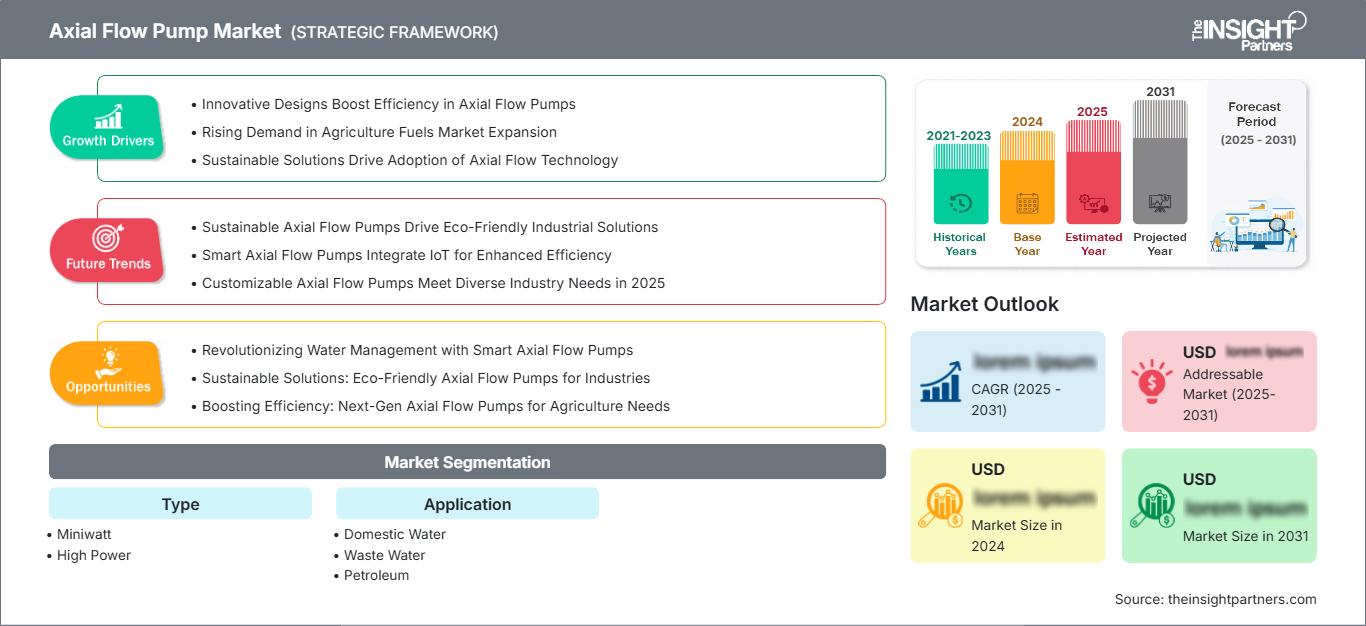
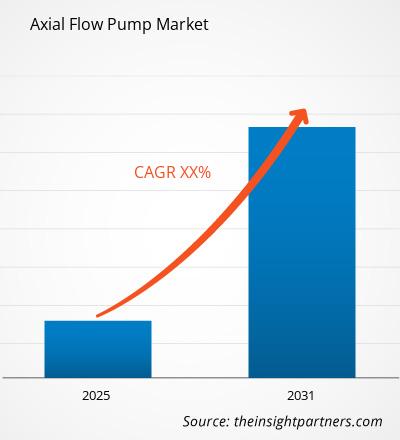
The axial flow pump market was valued at US$ 4.77 Billion in 2025 and is projected to reach US$ 7.11 Billion by 2034. The market is expected to register a CAGR of 4.54% during 2026–2034. Demand is anchored in high-volume, low-head fluid transfer across municipal water, wastewater, petroleum, chemical, and food and beverage operations, where hydraulic efficiency, reliability, and lifecycle cost increasingly govern equipment selection.
Within North America, axial flow pump market size expansion is modelled at a 4.0–4.5% CAGR through 2034. Replacement of ageing flood-control assets, tighter wastewater discharge requirements, and capital programs for resilient municipal drainage support procurement. Engineering demand also benefits from refurbishment of cooling-water circuits and chemical processing units, while variable-speed drives and condition monitoring increasingly influence tender specifications and total-cost evaluations.
Axial Flow Pump Market Assessment and Insights
- North America held 26–28% share in 2025 and is expected to grow at a 4.0–4.5% CAGR between 2026–2034, supported by municipal rehabilitation, stormwater resilience, and industrial replacement programs.
- US represented 78–82% of North American revenue in 2025 and is projected to expand at a 4.1–4.6% CAGR between 2026–2034.
- Europe accounted for 24–26% in 2025 and is forecast to grow at a 3.8–4.3% CAGR between 2026–2034, led by Germany, the UK, France, Italy, and Spain.
- Asia Pacific captured 34–37% in 2025 and should advance at a 5.0–5.6% CAGR between 2026–2034, with China, India, Japan, South Korea, and Australia generating demand.
- Largest Segment High Power held 66–70% market share in 2025 and is expected to register a 4.6–5.1% CAGR between 2026–2034.
- High Growth Segment Waste Water represented 22–26% market share in 2025 and is projected to record a 5.2–5.8% CAGR between 2026–2034.
- Key companies analyzed in detail: EBARA CORPORATION, Grundfos Holding A/S, KSB SE & Co. KGaA, LEO Group Co., Ltd., Pentair plc, Sulzer Ltd, The Weir Group PLC, WILO SE, Xylem Inc., and Flowserve Corporation.
Source: The Insight Partners' analysis based on proprietary research, government publications, company annual reports, investor presentations, industry databases, and expert interviews.
From traditional fixed speed axial flow machines that were controlled by mechanical controls to variable frequency drive, vibration sensors, temperature monitoring and maintenance through predictive measures has been a common practice in recent years. There has been the trend towards designing blades at particular angle, using materials that do not corrode, and designing modular discharge pipes in line with their duty point. Casting and motors are integral to production, thus making it vital to ensure quality metallurgy and accurate machining as well as having experienced servicing networks.
In the coming years, coastal towns, water reclamation companies, and industries in Asia, Middle East, and Africa will increase the potential market. Public spending in drainage, water reuse and intake systems for desalination plants will be accompanied by efficiency requirements and adaptation financing. Vendors that can assemble their products locally, assure material certification and respond to service needs will get preference especially in cases where utility companies move from buying the cheapest option to lifecycle performance.
Axial Flow Pump Market Report Scope
| Report Attribute | Details |
|---|---|
| Market size in 2025 | US$ 4.77 Billion |
| Market Size by 2034 | US$ 7.11 Billion |
| Global CAGR (2026 - 2034) | 4.54% |
| Historical Data | 2021-2024 |
| Forecast period | 2026-2034 |
Axial Flow Pump Market Analysis
The market growth of the axial flow pump can be seen as a result of the convergence of needs for flood control, irrigation modernization, process circulation, and municipal wastewater transport applications. Customers are interested in these pumps in cases when there is the need for high flow rate and low head because it is more efficient than the radial pumps in such circumstances. The industry consists of the relationship between the alloy suppliers, motor suppliers, hydraulic engineers, OEMs, engineering contractors, distributors, and field services.
The supply depends on large casting capacity, stainless steel parts, energy-efficient motors, and engineering capacity per project. The difference between the long cycle of approvals in municipalities and emergency requests in cases of flooding or mechanical failures of assets plays an important role in the market.
The axial flow pump market analysis shows a competitive landscape featuring diversified international manufacturers alongside specialists with industry knowledge for their particular applications. Competitors such as EBARA CORPORATION, Grundfos Holding A/S, KSB SE & Co. KGaA, Sulzer Ltd, Xylem Inc. and Flowserve Corporation rely on hydraulic engineering, maintenance, and digital control systems. Weir Group PLC specializes in challenging processes, while WILO SE, Pentair plc, and LEO Group Co., Ltd. increase accessibility via regional channels.
There is an investment trend in smart monitoring, high-efficiency motors, corrosion protection, and local testing. Thus, the competitive advantage comes not only from lower prices but from energy savings, fast installation and service coverage agreements that are backed up. Mergers and partnerships may help to add water treatment capabilities or aftermarket strength, but the successful portfolio maintains expertise in particular applications.
● REPORT CUSTOMIZATION
Tailor This Report To Align With Your Specific Business Requirements
This report can be customized to align precisely with your business objectives, scope, and target markets. Customization options include tailored segmentation, geography, competitive analysis, and strategic insights to support informed decision-making.
Customize This Report →WHAT YOU CAN ADJUST
- ● Segmentations
- ● Geography
- ● Competitive Analysis
- ● Language Preferences
Axial Flow Pump Market: Strategic Insights
Regional Insights
North America axial flow pump market
North America held 26–28% in 2025 and is expected to post a 4.0–4.5% CAGR during 2026–2034. Axial flow pump market share is driven by aging drainage facilities, hurricane or river flood exposure, agricultural water transport, as well as municipal facility rehabilitation. Variable speed requirements, remote monitoring systems, and high-efficiency motors are commonly specified to cut down electric bills and maintenance needs.
Canadian contribution comes from flood control, mining water, and municipal applications, while Mexican demand is driven by irrigation, food processing, and industrial wastewater handling. The procurement process is specification-driven with life cycle service capability, technical support within a country, and documentation being influential factors. Resilience programs from federal and state governments enhance visibility of the project. However, lengthy permitting process, civil works, and lengthy approval processes may cause delays in recognition of equipment revenue.
U.S. Axial Flow Pump Market
The U.S. represented 78–82% of North American revenue in 2025 and is projected to expand at a 4.1–4.6% CAGR through 2034. Municipal stormwater, coastal defense, agricultural transportation, and cooling water renovation generate recurring orders. Domestic engineering firms and distribution systems operated by Xylem Inc., Flowserve Corporation, Pentair plc, and other global manufacturers provide enhanced specification assistance and after-sales service.
The wastewater market segment is increasing its importance due to the need to cope with storm overflows and reuse capability extension among utility companies. Metallurgy, sealing capability, and proven track record in continuous operation are essential to petroleum and chemical industries, while hygienic processes and proper washdown capability are important for food and beverage producers. Municipal authorities prefer efficiency and ruggedness; however, disjointed municipal funding and lengthy civil construction delays restrict order scheduling. Retrofits are appealing because they offer increased hydraulic capability without reconstructing whole pump stations.
Europe Axial Flow Pump Market
Europe captured 24–26% in 2025 and is forecast to grow at a 3.8–4.3% CAGR through 2034, with Germany leading. The UK focuses on flood protection, drainage renewal, and wastewater management, which creates need for monitored and energy efficient pumping stations. Germany gains advantage due to the presence of chemicals industry, improvements in municipalities and engineering experience, facilitating both new production and refurbishment projects.
France invests in irrigation, coastal drainage, and water treatment, whereas Italy and Spain install drought management transfer system and agricultural modernization. European customers focus on Ecodesign-compatible motors, easy maintenance, noise reduction, and efficiency verification. KSB SE & Co. KGaA, Grundfos Holding A/S, WILO SE, Sulzer Ltd, and Xylem Inc. compete on the strength of service provision and technical support. Delays in licensing and cautious public spending restrain volume growth; however, the installation replacement is a predictable source of demand.
APAC Axial Flow Pump Market
APAC held 34–37% in 2025 and should record a 5.0–5.6% CAGR through 2034, with China leading. Urban drainage, irrigation, industrial wastewater, and coastal flood-control programs support high-power installations.
India offers the strongest project pipeline from water and agricultural infrastructure, while Japan and South Korea emphasize efficient replacement systems. Australia adds mining-water and irrigation demand. Local manufacturing improves price competitiveness, but international suppliers retain advantages in severe-duty metallurgy, controls, and lifecycle guarantees.
Middle East & Africa Axial Flow Pump Market
MEA is projected to grow at a 4.6–5.2% CAGR through 2034, led by Saudi Arabia. Desalination intake, irrigation, flood drainage, and industrial water systems create demand for corrosion-resistant high-capacity equipment.
The UAE prioritizes resilient urban drainage and water reuse, while South Africa supports municipal rehabilitation, mining-water, and power applications. Rest of MEA opportunities depend on development finance and contractor capacity. Harsh operating conditions elevate demand for robust materials, remote monitoring, and dependable regional spare-parts support.
Segmentation Analysis
Type
The Type segment is projected to expand at a 4.3–4.8% CAGR during 2026–2034. Within the axial flow pump market scope, selection depends on required discharge, duty cycle, installation footprint, and motor efficiency. High-power units dominate infrastructure and process circulation, whereas compact Miniwatt designs address localized transfer and lighter domestic duties. Modular hydraulics and variable-speed controls should improve application fit across both categories.
- Miniwatt serves compact domestic water transfer and localized circulation duties, where affordability, simple installation, and modest power requirements outweigh the need for heavy-duty continuous operation.
- High Power anchors municipal, industrial, and flood-control projects requiring uninterrupted high-volume transfer, engineered materials, precise duty-point selection, and comprehensive maintenance support.
Application
The Application segment is expected to register a 4.5–5.0% CAGR during 2026–2034. Municipal wastewater and domestic water projects provide repeatable infrastructure demand, while petroleum and chemical users require severe-duty circulation and corrosion resistance. Food and beverage facilities value cleanability and reliable process continuity. Across applications, energy consumption, material compatibility, solids handling, and service access determine specification and replacement timing.
- Domestic Water demand centers on raw-water intake, distribution support, irrigation, and drainage, with buyers prioritizing dependable operation, accessible maintenance, and efficient performance under variable seasonal flows.
- Waste Water is strategically important for stormwater, sewage transfer, and treatment-plant expansion, where high throughput, solids tolerance, remote monitoring, and rapid service response govern procurement.
- Petroleum applications require robust continuous circulation, controlled hydraulic performance, and materials suited to demanding fluids, making engineering documentation, reliability, and planned overhaul support essential purchasing criteria.
- Chemical users emphasize corrosion-resistant alloys, leak prevention, and stable low-head circulation in evaporators and reactors, favoring suppliers with application engineering and verified material traceability.
- Food and Beverage facilities deploy pumps for water handling and process circulation, where hygienic operating practices, straightforward cleaning, dependable uptime, and energy control support adoption.
Opportunity Snapshot
| Application | Revenue Contribution | Trend Tag | Adoption Stage |
| Domestic Water | Medium | Smart Intake | Mature |
| Waste Water | High | Storm Resilience | Scaling |
| Petroleum | Medium | Loop Reliability | Mature |
| Chemical | High | Corrosion Control | Scaling |
| Food and Beverage | Low | Clean Processing | Emerging |
Axial Flow Pump Market Growth Drivers and Impact Analysis
Expansion of Flood-Control and Stormwater Pumping Capacity
Heavy rains and urban growth lead to greater peak flows which gravity systems cannot always handle. Axial pumps offer high capacity and low head transfer suitable for use in drainage plants, levees, canals and coastal outlets. Financial investments influence the demand for such plants not only due to the pumps but because the entire system including drives, controls, trash racks, sensors and after-sales service is necessary. Redundancy and quick restarting ability are now becoming more common criteria for evaluating systems, making multi-pump plants preferable to single large installations. Vendors who can analyze transients, design propellers and work with civil constructors have a competitive edge in execution.
Modernization of Water and Wastewater Infrastructure
The need for increased throughput to cope with increasing population and aging infrastructure, as well as more stringent requirements on the efficiency of wastewater treatment, compels utilities to increase their intake, conveyance, aeration assistance, and discharge capability. The axial pump is an appropriate choice for situations involving high throughput where increased head is not required, and thus axial pumps are applicable to raw water lift, effluent conveyance, and wet weather bypassing applications. There is an incentive for replacement projects since improvements in hydraulic performance, premium motors, and speed control will decrease operational costs without requiring a new treatment facility. Bids are expected to include estimates of energy usage over realistic loads and a maintenance plan.
Industrial Preference for Efficient Continuous Circulation
Reactor units, evaporators, heat exchangers, and water handling processes in chemical, oil, power, and food processing plants need continuous flow. The use of high volume axial pumps can minimize hydraulic friction when the pumps are properly selected for the low head duties and will influence the cost of energy and operational time. Consequently, industrial users seek pumps that offer optimized duty point selection, materials compatibility, vibration management, and easy servicing in preference to standardized purchase price. Retrofitting of process intensification and debottlenecking also offers chances of introducing more flows in a restricted footprint. Pump suppliers capable of providing corrosion-resistant materials, casting certification, and condition monitoring have an edge. The driver becomes critical if downtime windows are minimal.
Axial Flow Pump Market Future Trends
Autonomous Hydraulic Optimization and Predictive Service
Axial flow pump market trends will be increasingly driven by sensor-packed offerings that incorporate vibrations, temperature, power, and flow readings together with adaptive control mechanisms. Future systems will not simply measure against predetermined threshold values, but will make a comparison of real-world performance against hydraulic models and detect fouling or wear, thus suggesting improvements before efficiency declines. Digital twins could assist utilities in simulating storm conditions and planning maintenance in advance of weather predictions. Analytics will be embedded within the service contract offerings of the manufacturers and will transform the equipment into performance relationships.
Application-Specific Materials and Modular Propeller Platforms
Future product development will pair standardized cores with configurable impellers, blade angles, coatings, seals, and motor options. This architecture can shorten lead times while preserving hydraulic fit for seawater, abrasive wastewater, corrosive process liquids, and hygienic water circuits. Additive manufacturing may support rapid prototypes and low-volume replacement components, although qualification will remain demanding for safety-critical duties. Permanent-magnet motors and refined computational fluid dynamics should lift part-load efficiency. Modular discharge-tube seating and accessible sensor packages will simplify removal and inspection. The commercial effect will be faster project execution, narrower inventory exposure, and more economical refurbishment of ageing stations.
Axial Flow Pump Market Opportunities
Performance-Based Retrofit Programs for Municipal Stations
The axial flow pump market forecasts support investment in retrofit packages that combine hydraulic reassessment, efficient motors, variable-speed drives, and condition monitoring. Many utilities cannot justify complete civil reconstruction, yet they can fund upgrades tied to measurable energy savings, capacity gains, or reduced emergency maintenance. Vendors should develop audit-to-commissioning offers with baseline testing, guaranteed performance bands, staged installation, and operator training. Financing partners can structure shared-savings or availability-based contracts for creditworthy utilities. Targeting stations with recurring wet-weather constraints creates a clear value proposition. A strong aftermarket footprint is essential because retrofit economics depend on accurate site data, compatible components, and rapid post-installation support.
Localized Assembly and Service Hubs in High-Growth Corridors
Suppliers can capture emerging demand by locating assembly, testing, and parts centers near irrigation, desalination, and urban water projects in India, Southeast Asia, the Gulf, and selected African markets. Localization reduces freight exposure, shortens lead times, and helps meet domestic-content requirements without transferring all high-value engineering. Investment should prioritize certified test capability, technician training, corrosion-resistant component inventories, and partnerships with experienced engineering contractors. Regional hubs also improve bid credibility because owners increasingly require guaranteed response times and lifecycle support. The opportunity favors modular product platforms that can be configured locally while retaining standardized quality controls, digital diagnostics, and global hydraulic design expertise.
Recent Developments
- July 2025: KSB SE & Co. KGaA – launched the AmaCan P generation of submersible motor pumps with axial propellers for municipal and industrial water, wastewater, stormwater, drainage, irrigation, flood control, and aquaculture duties. The design offers optional corrosion- and abrasion-resistant materials, selectable blade angles, IE3 or IE4 motor choices, intelligent vibration and leakage monitoring, and simplified self-centering installation.
- August 2025: RiverFlow, an industry leader in aquatic current generators for sports and entertainment applications in commercial and residential pools and lazy rivers, announced the release of its groundbreaking Non-Reversing Axial Flow Pump. This innovative solution represents a major advancement in pump safety and reliability.
Frequently Asked Questions

- Comprehensive Market Sizing and Forecast Analysis
- Detailed Segmentation Analysis
- In-Depth Market Dynamics Assessment
- Regional and Country-Level Insights
- Competitive Landscape and Company Benchmarking
- Strategic Business Intelligence
Recent Reports
Testimonials

The Insight Partners provided valuable market intelligence that supported our global go-to-market strategy. Their team was professional, responsive, and attentive to our feedback, providing thoughtful analysis and helpful methodological clarifications throughout the project.
Junmo Kim Chief Financial Officer (CFO), Enertech Co., Ltd.
The Insight Partners' SCADA System Market report is comprehensive, with valuable insights on current trends and future forecasts. The team was highly professional, responsive, and supportive throughout. We are very satisfied and highly recommend their services.
RAN KEDEM Partner, Reali Technologies LTDs
I requested a report on a very specific software market and the team produced the report in a few days. The information was very relevant and well presented. I then requested some changes and additions to the report. The team was again very responsive and I got the final report in less than a week.
JEAN-HERVE JENN Chairman, Future Analytica
We worked with The Insight Partners for an important market study and forecast. They gave us clear insights into opportunities and risks, which helped shape our plans. Their research was easy to use and based on solid data. It helped us make smart, confident decisions. We highly recommend them.
PIYUSH NAGPAL Sr. Vice President, High Beam Global
The Insight Partners delivered insightful, well-structured market research with strong domain expertise. Their team was professional and responsive throughout. The user-friendly website made accessing industry reports seamless. We highly recommend them for reliable, high-quality research services
YUKIHIKO ADACHI CEO, Deep Blue, LLC.
This is the first time I have purchased a market report from The Insight Partners.While I was unsure at first, I visited their web site and felt more comfortable to take the risk and purchase a market report.I am completely satisfied with the quality of the report and customer service. I had several questions and comments with the initial report, but after a couple of dialogs over email with their analyst I believe I have a report that I can use as input to our strategic planning process.Thank you so much for taking the extra time and making this a positive experience.I will definitely recommend your service to others and you will be my first call when we need further market data.
JOHN SUZUKI President and Chief Executive Officer, Board Director, BK Technologies
I wish to appreciate your support and the professionalism you displayed in the course of attending to my request for information regarding to infectious disease IVD market in Nigeria. I appreciate your patience, your guidance, and the fact that you were willing to offer a discount, which eventually made it possible for us to close a deal. I look forward to engaging The Insight Partners in the future, all thanks to the impression you have created in me as a result of this first encounter.
DR CHIJIOKE ONYIA MANAGING DIRECTOR, PineCrest Healthcare Ltd.Reason to Buy
- Informed Decision-Making
- Understanding Market Dynamics
- Competitive Analysis
- Identifying Emerging Markets
- Customer Insights
- Market Forecasts
- Risk Mitigation
- Boosting Operational Efficiency
- Strategic Planning
- Investment Justification
- Tracking Industry Innovations
- Aligning with Regulatory Trends





 Get Free Sample for