
Baby Care Packaging Market Share, Demand & Growth by 2034
Coverage: By Packaging (Pouches, Bottles, Tubes, Cans, Others); Material (Plastic [Polyethylene, Polypropylene, Polyethylene Terephthalate, Others], Paper and Paperboard, Glass, Metal); Application (Hair Care Products, Skin Care Products, Sanitation and Hygiene Products, Others), and Geography (North America, Europe, Asia Pacific, and South and Central America)
- Status : Data Released
- Report Code : TIPRE00013627
- Category : Chemicals and Materials
- No. of Pages : 150
- Available Report Formats :


- Last update date : August 17, 2026


2025 Market Size
US$ 3.33 Bn
Base year value
2034 Forecast
US$ 4.98 Bn
Projected by 2034
CAGR 2026-2034
4.58 %
Growth rate
Addressable Market
US$ 37.74 Bn
(2026-2034)
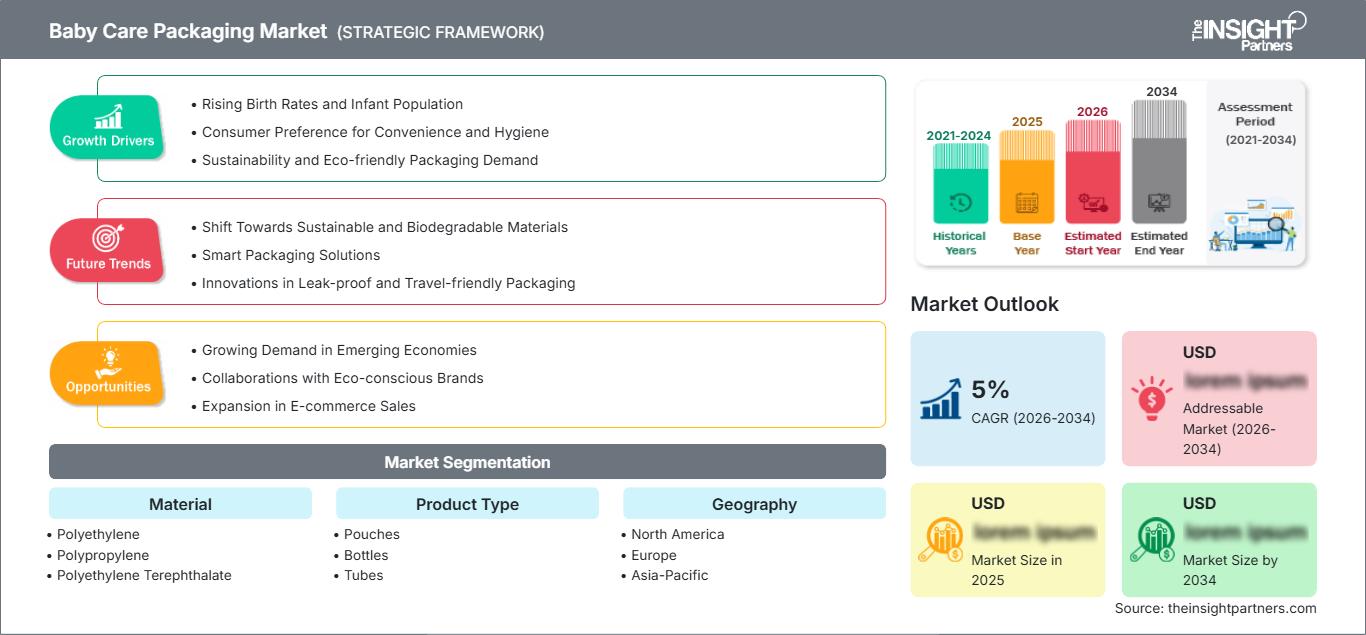
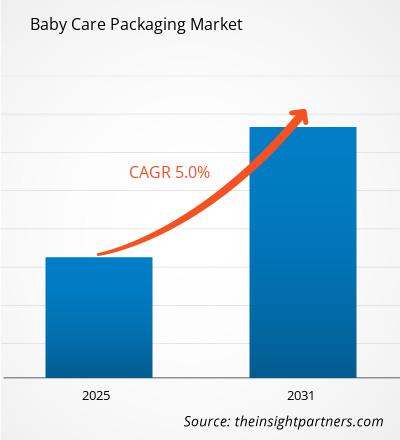
The Baby Care Packaging Market was valued at US$ 3.33 Billion in 2025 and is projected to reach US$ 4.98 Billion by 2034, expanding at a CAGR of 4.58% during 2026–2034. The market is supported by rising demand for safe, hygienic, and convenient packaging solutions for infant nutrition, baby toiletries, diapers, wipes, and healthcare products. Manufacturers are increasingly emphasizing lightweight materials, sustainable packaging formats, tamper-evident closures, and high-barrier packaging technologies to comply with evolving safety standards while improving product shelf life and consumer convenience.
Across North America, demand continues to benefit from premium baby care product consumption, stringent packaging regulations, and increasing adoption of recyclable and mono-material packaging formats. The Baby Care Packaging Market size in the region is supported by strong investments in advanced converting technologies, growing preference for flexible packaging, and expanding production capacities by leading packaging manufacturers. Continuous product innovation and increasing emphasis on circular economy initiatives are expected to support a steady CAGR in the range of 4.0%–4.5% throughout the forecast period.
Baby Care Packaging Market Assessment and Insights
- North America: Accounted for a 33–37% share in 2025 and is anticipated to expand at a CAGR of 4.0%–4.5% during 2026–2034, supported by premium infant care product demand, sustainable packaging adoption, and strong regulatory compliance across the U.S. and Canada.
- U.S.: Represented 79–83% of the North American market in 2025 and is projected to grow at a CAGR of 4.1%–4.6% through 2034, driven by innovation in recyclable plastic packaging, refill systems, and high consumer spending on baby wellness products.
- Europe: Held 26–30% share in 2025 and is expected to register a CAGR of 4.2%–4.7% during the forecast period. Germany, France, the UK, Italy, and Spain continue to lead regional demand owing to sustainability regulations and advanced packaging manufacturing capabilities.
- Asia Pacific: Accounted for a 28–32% share in 2025 and is projected to record the fastest regional CAGR of 5.2%–5.8%, supported by expanding middle-class populations, rising birth-related expenditures, and rapid growth of organized retail across China, India, Japan, and Southeast Asia.
- Largest Segment: Plastic is estimated to represent 68–73% market share in 2025 and register a 4.1–4.7% CAGR during 2026–2034, reflecting extensive use across bottles, tubes, closures, pouches, and wipes packaging.
- High Growth Segment: Pouches are assessed at 21–25% market share in 2025 and a 5.3–6.0% CAGR during 2026–2034, supported by refill systems, wipes applications, lower material intensity, portability, and flexible-packaging innovation.
- Key companies analyzed in detail: Amcor plc, Berry Global, Inc., DS Smith plc, International Paper Company, Mondi plc, ProAmpac Holdings Inc., Sealed Air Corporation, Silgan Holdings Inc., Smurfit Westrock plc, Sonoco Products Company, Winpak Ltd.
Source: The Insight Partners' analysis based on proprietary research, government publications, company annual reports, investor presentations, industry databases, and expert interviews.
Increasing consumer awareness regarding infant safety has accelerated innovation in materials, barrier technologies, and sustainable manufacturing across the value chain. Packaging manufacturers are investing in recyclable polymers, paper-based alternatives, digital printing, and lightweight designs while strengthening traceability and quality assurance. Growing demand for premium baby nutrition and personal care products has encouraged converters to introduce packaging solutions that combine functionality, product protection, and environmental performance. Consequently, the Baby Care Packaging Market growth trajectory remains supported by continuous improvements in production efficiency, supply chain integration, and packaging technology.
In terms of future outlook, investments are expected to be made in emerging countries where increased disposable incomes and the presence of organized retail have led to growing demands for packaged baby products. Initiatives taken for recycling packaging, extended producer responsibility, and reduction in virgin plastic consumption have made manufacturers redesign their portfolio of products. Capacity building activities in the Asia Pacific region and collaboration between packaging producers and consumer goods manufacturers are expected to drive innovations in the forecast period.
Baby Care Packaging Market Report Scope
| Report Attribute | Details |
|---|---|
| Market size in 2025 | US$ 3.33 Billion |
| Market Size by 2034 | US$ 4.98 Billion |
| Global CAGR (2026 - 2034) | 4.58% |
| Historical Data | 2021-2024 |
| Forecast period | 2026-2034 |
Baby Care Packaging Market Analysis
Demand for infant nutrition, baby skincare, diapers, wipes, and healthcare products continues to expand alongside increasing consumer preference for hygienic, tamper-evident, and sustainable packaging. The Baby Care Packaging Market analysis indicates that packaging suppliers are increasingly developing mono-material flexible structures, lightweight rigid containers, and recyclable solutions that satisfy both regulatory expectations and consumer sustainability preferences. Improvements in barrier properties, digital printing, and smart labeling technologies further strengthen product differentiation while supporting longer shelf life and enhanced supply chain visibility.
The market environment comprises resin manufacturers, paper producers, packaging converters, closure manufacturers, machine providers, brand owners, retailers, and recyclers. Value chain integration allows for efficient production along with a quick response to any regulatory changes and shifting customer needs. Continuous investment in automation and digital quality control, as well as molding solutions, contributes to increased manufacturing efficiency and decreased resource usage, which ensures further growth in the market.
Competition continues to be defined in terms of constant innovations, sustainable initiatives, mergers, and acquisitions. Global firms like Amcor plc, Berry Global, Inc., Mondi plc, ProAmpac Holdings Inc., Sonoco Products Company, Sealed Air Corporation, Silgan Holdings Inc., DS Smith plc, International Paper Company, Smurfit Westrock plc, and Winpak Ltd. continue to enhance their competitive positioning with recyclable packaging materials and innovative products for customers, along with light materials. Long-term supply contracts for multinational baby care brands are a further step in that direction.
Capital investments in the Baby Care Packaging Market are increasingly directed toward recyclable flexible packaging, fiber-based packaging technologies, advanced extrusion systems, and digital manufacturing capabilities. Companies are also expanding research into high-performance barrier materials that maintain product integrity while reducing environmental impact. Strategic collaborations between packaging manufacturers, raw material suppliers, and consumer goods companies are expected to accelerate the commercialization of next-generation packaging formats, supporting sustained demand across both developed and emerging economies over the forecast period.
● REPORT CUSTOMIZATION
Tailor This Report To Align With Your Specific Business Requirements
This report can be customized to align precisely with your business objectives, scope, and target markets. Customization options include tailored segmentation, geography, competitive analysis, and strategic insights to support informed decision-making.
Customize This Report →WHAT YOU CAN ADJUST
- ● Segmentations
- ● Geography
- ● Competitive Analysis
- ● Language Preferences
Baby Care Packaging Market: Strategic Insights
Regional Insights
North America Baby Care Packaging Market
North America accounted for 33–37% of the global Baby Care Packaging Market share in 2025 and is projected to register a CAGR of 4.0%–4.5% during 2026–2034. The region benefits from high consumer spending on infant nutrition, baby personal care products, and healthcare essentials, coupled with stringent packaging regulations enforced by agencies such as the U.S. Food and Drug Administration (FDA) and Health Canada. The demand for recyclable packaging, mono-material construction, and lighter packaging will drive investments in new packaging technologies and automation.
The presence of well-established packaging companies, well-established consumer goods companies, and robust retail networks makes the demand in this region even stronger. E-commerce sales of baby products have boosted the demand for durable and flexible packaging, leak-proof bottles, and tamper-proof closures. Sustainability initiatives by packaging suppliers and consumer goods companies are also boosting innovations in recycled plastics, paper packaging, and refillable packaging systems, making North America competitive on the global stage.
U.S. Baby Care Packaging Market
The U.S. represented 79–83% of the North American Baby Care Packaging Market in 2025 and is anticipated to expand at a CAGR of 4.1%–4.6% through 2034. Strong demand for premium infant formula, baby food, skincare, wipes, and diaper products continues to support packaging consumption. Manufacturers are increasingly introducing lightweight bottles, recyclable pouches, and high-barrier packaging formats that improve product protection while aligning with corporate sustainability objectives. Investments in digital printing and smart packaging technologies further enhance product traceability and consumer engagement.
Leading packaging companies maintain significant manufacturing and research facilities across the country, enabling the rapid commercialization of innovative materials and packaging formats. Expansion of omnichannel retailing has increased demand for durable shipping-ready packaging capable of protecting sensitive baby products during transportation. Rising adoption of post-consumer recycled content and circular packaging initiatives is expected to strengthen long-term industry competitiveness while supporting regulatory compliance and environmental objectives.
Europe Baby Care Packaging Market
Europe accounted for 26–30% of the global Baby Care Packaging Market in 2025 and is projected to record a CAGR of 4.2%–4.7% during 2026–2034. The region is characterized by stringent environmental legislation, widespread recycling infrastructure, and strong consumer preference for sustainable packaging materials. Germany remains the leading regional market due to its advanced packaging manufacturing ecosystem, high production capacity, and continuous investments in recyclable materials and automation technologies.
The United Kingdom continues to experience stable demand for premium baby care products through expanding online retail and increasing adoption of recyclable flexible packaging. Government initiatives supporting packaging waste reduction and extended producer responsibility are encouraging investments in fiber-based and mono-material packaging solutions.
Germany remains Europe's largest manufacturing hub for baby care packaging, supported by technologically advanced converting facilities, strong exports, and close collaboration between packaging suppliers and multinational consumer goods companies. Continuous investments in high-performance barrier materials and recycled-content packaging further enhance market competitiveness.
France, Italy, and Spain collectively contribute significant regional demand through expanding production of baby food, personal care products, and pharmaceutical packaging. Growing consumer awareness regarding environmentally responsible packaging, combined with increasing investments in paper-based solutions and circular economy initiatives, continues to strengthen long-term regional market development.
APAC Baby Care Packaging Market
Asia Pacific represented 28–32% of the global Baby Care Packaging Market in 2025 and is expected to achieve the highest regional CAGR of 5.2%–5.8% during 2026–2034. China leads regional production and consumption, while India records strong demand growth supported by rising birth-related expenditure, expanding organized retail, and increasing disposable incomes. The region also benefits from rapid urbanization, growing e-commerce penetration, and increasing demand for convenient, hygienic, and sustainable baby care products, further supporting packaging market expansion.
Japan and South Korea continue to emphasize premium-quality, lightweight, and high-barrier packaging for infant products, whereas Australia maintains steady demand through stringent food safety standards and sustainable packaging initiatives. Government support for manufacturing modernization and recycling infrastructure further strengthens regional investment opportunities and production capabilities.
Middle East & Africa Baby Care Packaging Market
The Middle East & Africa Baby Care Packaging Market is anticipated to expand at a CAGR of 4.3%–4.8% during 2026–2034. Saudi Arabia remains the largest regional market due to increasing investments in consumer goods manufacturing and packaging industries, while the UAE benefits from advanced logistics infrastructure and growing demand for premium imported baby care products. Rising urbanization, improving retail distribution networks, and increasing consumer awareness regarding product safety and hygiene are further supporting demand for high-quality baby care packaging solutions across the region.
South Africa continues to support regional packaging demand through its established consumer goods sector and expanding retail distribution networks. The Rest of the Middle East & Africa is witnessing the gradual adoption of recyclable packaging materials, supported by improving manufacturing capabilities, urbanization, and increasing awareness of sustainable packaging practices across infant care applications.
Segmentation Analysis
Packaging
Packaging in the Baby Care Packaging Market is projected to develop at a 4.4–5.0% CAGR during 2026–2034 as manufacturers balance portability, controlled dispensing, hygiene, resealability, and material efficiency. The Baby Care Packaging Market scope across packaging formats extends from rigid bottles and tubes for liquid formulations to flexible pouches for wipes and refill applications, making format selection closely dependent on formulation viscosity, barrier requirements, consumer usage, and filling-line compatibility.
- Pouches: Pouches are gaining strategic importance in wet wipes and refill applications because flexible structures reduce packaging weight, provide substantial printable surfaces, enable resealable features, and improve transportation efficiency relative to several conventional rigid alternatives.
- Bottles: Bottles maintain a strong position in shampoos, lotions, oils, washes, and liquid cleansers, where controlled dispensing, closure compatibility, leakage resistance, ergonomic handling, and compatibility with established filling equipment remain important procurement considerations.
- Tubes: Tubes are particularly relevant for creams, lotions, ointment-like products, and concentrated skin-care formulations because they support controlled application, product evacuation, portability, contamination management, and convenient single-handed consumer use.
- Cans: Cans serve selected powders, specialty formulations, and premium applications where structural protection, barrier performance, stacking characteristics, and extended product integrity can justify higher packaging weight compared with lightweight flexible formats.
Material
Material demand is projected to expand at a 4.3–4.9% CAGR during 2026–2034. Plastic remains central because PE, PP, and PET provide lightweight construction, moisture resistance, processability, and compatibility with numerous closures and converting technologies. Paper and paperboard are gaining attention where fibre substitution is technically feasible, while glass and metal retain selective positions where barrier performance, rigidity, premium presentation, or product compatibility justify additional weight.
- Plastic: Plastic dominates primary packaging applications because manufacturers can tailor stiffness, clarity, squeezability, moisture resistance, sealability, and dispensing performance while increasingly incorporating mono-material design principles and recycled content where regulatory and technical requirements permit.
- Polyethylene: PE is strategically important for flexible films, squeezable containers, and selected closures because its toughness, moisture resistance, sealing characteristics, and processing versatility support high-volume hygiene and personal-care packaging applications.
- Polypropylene: PP supports caps, closures, jars, dispensing components, and mono-material systems, combining chemical resistance with dimensional stability and molding performance that enables functional designs for creams, lotions, and other baby-care formulations.
- Polyethylene Terephthalate: PET is used where clarity, rigidity, dimensional stability, and visual product presentation are valued, particularly for transparent bottles and containers designed to differentiate liquid personal-care products on retail shelves.
- Paper and Paperboard: Fibre-based materials are increasingly evaluated for cartons, secondary packaging, and selected flexible applications as brands seek recyclable alternatives, though barrier requirements continue to determine suitability for moisture-sensitive and liquid-contact applications.
- Glass: Glass retains selective relevance for premium oils, creams, and specialty products, providing strong chemical compatibility and barrier performance, although weight, breakability, transportation cost, and handling requirements restrict broad mass-market adoption.
- Metal: Metal provides strong structural and barrier properties for selected formats, but material cost, weight, format limitations, and the prevalence of plastic alternatives constrain its role across mainstream baby personal-care packaging.
Application
Application is projected to register a 4.5–5.1% CAGR during 2026–2034, reflecting differentiated packaging requirements across hair, skin, sanitation, and hygiene products. Sanitation and hygiene applications create substantial demand for moisture-barrier flexible packaging, especially wipes, while skin care products require tubes, bottles, jars, and dispensing systems capable of protecting formulation integrity. Hair care supports established bottle and tube demand across shampoos, conditioners, and related formulations.
- Hair Care Products: Baby shampoos, conditioners, and scalp-care formulations sustain demand for lightweight bottles and tubes incorporating controlled-flow closures, ergonomic shapes, moisture resistance, brand differentiation, and secure sealing for household and travel usage.
- Skin Care Products: Lotions, creams, oils, gels, and protective skin formulations require packaging that supports accurate dispensing, formulation compatibility, contamination control, portability, and effective product evacuation across different viscosity profiles.
- Sanitation and Hygiene Products: Wet wipes and related hygiene products create substantial demand for flexible packs with moisture retention, barrier integrity, resealable closures, high-speed converting compatibility, portability, and reliable protection throughout repeated household use.
Opportunity Snapshot
| Application | Revenue Contribution | Trend Tag | Adoption Stage |
|---|---|---|---|
| Hair Care Products | Medium | Controlled Dispensing | Mature |
| Skin Care Products | High | Airless Systems | Scaling |
| Sanitation and Hygiene Products | High | Recyclable Wipes | Scaling |
| Others | Low | Format Diversification | Mature |
Baby Care Packaging Market Growth Drivers and Impact Analysis
Growing Demand for Premium Infant Nutrition and Personal Care Products
With the rising consumption of premium formula for infants, baby foods, skincare products, wipes, and health care supplies, the need for packaging materials remains consistently high throughout the world. Parents tend to emphasize safety, hygiene, convenience, and shelf life when choosing products, pushing manufacturers to introduce barrier films, tamper-proof seals, and childproof packages. Premiumization has also resulted in an increased requirement for attractive packages with quality print and dispensing mechanisms. Companies are working together with packaging manufacturers to produce packages that will be lightweight and strong, allowing for efficient transportation. These trends will help to justify the investment in packaging technology in the future.
Expansion of Sustainable Packaging Regulations and Circular Economy Initiatives
Governments and regulatory bodies around the world are working on tightening regulations regarding packaging waste management, requirements for recycled content and extended producer responsibility initiatives. Such regulations incentivize the manufacturers to redesign their packaging line-up by introducing more recyclable polymers, paper packaging and monomaterial flexible packaging formats. Investment in post-consumer recycled resins, fiber-based packaging, and lightweight packaging formats is also continuously increasing in order to meet the ambitious sustainability goals. Packaging providers are working in collaboration with recyclers and consumer products companies in order to increase the material recovery rate. With sustainability gaining importance in buying decisions, packaging options that are sustainable would prove beneficial to the companies in the future.
Rapid Growth of E-commerce and Omnichannel Retail Distribution
The growth in online retail has had a great impact on the packaging design needs for baby care products. They need to travel farther without losing their cleanliness, leak-proof nature, and strength. The need for this has prompted packaging firms to develop durable and flexible packages, corrugated boxes that are reinforced, and lightweight packages that have the capability of cutting down the cost of transportation without jeopardizing the safety of the contents. Through digital printing technology, customized branding is possible in order to increase traceability in online channels.
Baby Care Packaging Market Future Trends
Accelerating Adoption of Mono-material and Recyclable Packaging Solutions
Growing environmental commitments from consumer goods companies are accelerating the transition toward mono-material packaging structures that improve recyclability without compromising product protection. Packaging manufacturers are investing in advanced polyethylene and polypropylene technologies capable of replacing complex multilayer structures while maintaining barrier performance. The Baby Care Packaging Market trends indicate increasing commercialization of recyclable pouches, lightweight bottles, and paper-based secondary packaging supported by improved recycling infrastructure, regulatory incentives, and corporate sustainability commitments. Continued material innovation is expected to enhance circularity while reducing dependence on virgin plastics across global baby care packaging applications.
Integration of Smart Packaging and Digital Consumer Engagement
Sophisticated packaging techniques will be of growing importance to manufacturers trying to increase transparency, product authentication, and customer engagement. With the help of QR codes, NFC labeling, digital watermarks, and traceability systems, customers can check their product authentication and ingredient details as well as obtain directions through the use of mobile applications. Additionally, the incorporation of digital technology will help manufacturers improve supply chain visibility and inventory control, as well as comply with the changing regulations. Future investments will most likely be made in the integration of sustainable materials and intelligent packaging techniques for high-end baby care products.
Baby Care Packaging Market Opportunities
Expanding Manufacturing Investments Across Emerging Asian Economies
Rapid urbanization, rising disposable incomes, expanding middle-class populations, and increasing awareness of infant health are encouraging packaging manufacturers to expand production facilities throughout the Asia Pacific. Baby Care Packaging Market Forecasts indicate that investments in localized manufacturing, advanced converting technologies, and sustainable material production can significantly improve supply chain resilience while reducing transportation costs. Strategic partnerships with regional baby food and personal care manufacturers are expected to create long-term revenue opportunities. Companies establishing localized manufacturing capabilities will be better positioned to respond quickly to changing consumer preferences and evolving regulatory requirements across high-growth developing markets.
Development of High-Performance Fiber-based and Recycled Packaging Materials
The increasing need for sustainable packaging presents many business prospects for firms involved in the development of innovative fiber-based packaging and high-quality recycled packaging material. The innovations in barrier coatings, recyclable laminates, and food contact quality recycled polymers will ensure the increased use of such packaging and help achieve ever more sustainable goals. Working together, resin producers, paper makers, converters, and consumer goods firms can speed up the development of new kinds of packaging that are safe, durable, and recyclable. Companies with such innovative packaging technology will have an edge over their competitors during the forecast period.
Recent Developments
- April 2026: Procter & Gamble's Dreft introduced a comprehensive packaging redesign for its liquid detergent portfolio, simplifying product names to Dreft Baby, Dreft Toddler, and Dreft Family. The refreshed packaging features clearer stage-based labeling, improved shelf visibility, and upgraded graphics to help parents easily identify products for different child development stages. The redesign also included an enhanced Dreft Baby formula for improved stain removal while maintaining gentle care for sensitive skin.
- February 2026: Himalaya BabyCare unveiled refreshed eco-friendly packaging across its Gentle Baby Care Range as part of its sustainability roadmap. The redesigned packs are projected to eliminate 500 tonnes of plastic over the next five years (approximately 100 tonnes annually) while incorporating improved ergonomics, clearer labeling, enhanced grip, and better stability. The initiative reflects the company's commitment to reducing plastic waste while improving usability for parents.
Frequently Asked Questions

- Comprehensive Market Sizing and Forecast Analysis
- Detailed Segmentation Analysis
- In-Depth Market Dynamics Assessment
- Regional and Country-Level Insights
- Competitive Landscape and Company Benchmarking
- Strategic Business Intelligence
Recent Reports
Testimonials

The Insight Partners provided valuable market intelligence that supported our global go-to-market strategy. Their team was professional, responsive, and attentive to our feedback, providing thoughtful analysis and helpful methodological clarifications throughout the project.
Junmo Kim Chief Financial Officer (CFO), Enertech Co., Ltd.
The Insight Partners' SCADA System Market report is comprehensive, with valuable insights on current trends and future forecasts. The team was highly professional, responsive, and supportive throughout. We are very satisfied and highly recommend their services.
RAN KEDEM Partner, Reali Technologies LTDs
I requested a report on a very specific software market and the team produced the report in a few days. The information was very relevant and well presented. I then requested some changes and additions to the report. The team was again very responsive and I got the final report in less than a week.
JEAN-HERVE JENN Chairman, Future Analytica
We worked with The Insight Partners for an important market study and forecast. They gave us clear insights into opportunities and risks, which helped shape our plans. Their research was easy to use and based on solid data. It helped us make smart, confident decisions. We highly recommend them.
PIYUSH NAGPAL Sr. Vice President, High Beam Global
The Insight Partners delivered insightful, well-structured market research with strong domain expertise. Their team was professional and responsive throughout. The user-friendly website made accessing industry reports seamless. We highly recommend them for reliable, high-quality research services
YUKIHIKO ADACHI CEO, Deep Blue, LLC.
This is the first time I have purchased a market report from The Insight Partners.While I was unsure at first, I visited their web site and felt more comfortable to take the risk and purchase a market report.I am completely satisfied with the quality of the report and customer service. I had several questions and comments with the initial report, but after a couple of dialogs over email with their analyst I believe I have a report that I can use as input to our strategic planning process.Thank you so much for taking the extra time and making this a positive experience.I will definitely recommend your service to others and you will be my first call when we need further market data.
JOHN SUZUKI President and Chief Executive Officer, Board Director, BK Technologies
I wish to appreciate your support and the professionalism you displayed in the course of attending to my request for information regarding to infectious disease IVD market in Nigeria. I appreciate your patience, your guidance, and the fact that you were willing to offer a discount, which eventually made it possible for us to close a deal. I look forward to engaging The Insight Partners in the future, all thanks to the impression you have created in me as a result of this first encounter.
DR CHIJIOKE ONYIA MANAGING DIRECTOR, PineCrest Healthcare Ltd.Reason to Buy
- Informed Decision-Making
- Understanding Market Dynamics
- Competitive Analysis
- Identifying Emerging Markets
- Customer Insights
- Market Forecasts
- Risk Mitigation
- Boosting Operational Efficiency
- Strategic Planning
- Investment Justification
- Tracking Industry Innovations
- Aligning with Regulatory Trends





 Get Free Sample for