
Baby EEG Cap Market Size, Share & Forecast by 2034
Coverage: By Type (High - purity tin electrode, Ag/AgCl electrode); Application (Medical, Research) , and Geography (North America, Europe, Asia Pacific, and South and Central America)
- Status : Data Released
- Report Code : TIPRE00028544
- Category : Life Sciences
- No. of Pages : 150
- Available Report Formats :


- Last update date : November 06, 2026


2025 Market Size
US$ 12.98 Mn
Base year value
2034 Forecast
US$ 16.84 Mn
Projected by 2034
CAGR 2026-2034
2.93 %
Growth rate
Addressable Market
US$ 135.34 Mn
(2026-2034)
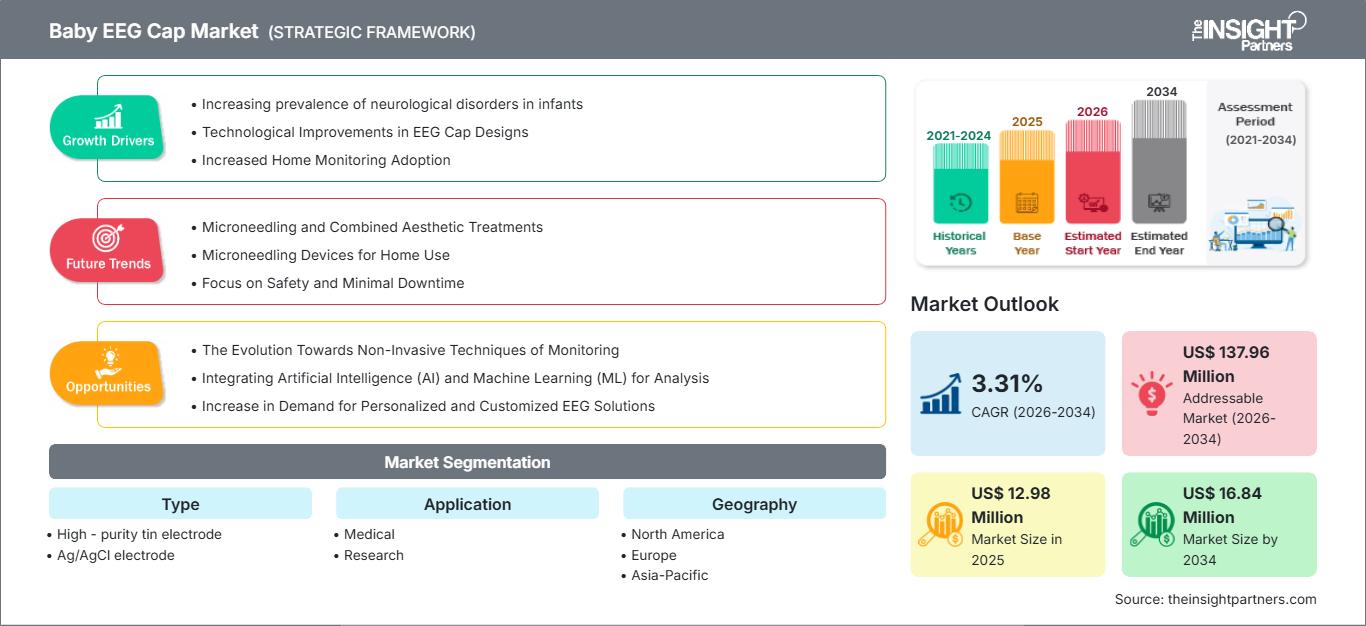
The baby EEG cap market was valued at US$ 12.98 Million in 2025 and is projected to reach US$ 16.84 Million by 2034, registering a CAGR of 2.93% during 2026–2034. These factors include improved monitoring of newborn neurological health, advancements in pediatric neuroscience research, increasing need for standardization of electrode placement, and increased availability of portable EEG systems. Development of new products focuses on fit of equipment to neonates, improved signal stability, compatibility with skin, electrode longevity, and decreased preparation times.
Within the region of North America, the baby EEG cap market size is anticipated to grow at a CAGR of ~3% up until 2034. The market drivers within the region include existing neonatal intensive care facilities, specialized pediatric neurology facilities, and high neuroscience research activity. There is an increasing need for caps which will be able to provide support for small-sized head, improved impedance management, and easy coupling to EEG amplifiers.
Baby EEG Cap Market Assessment and Insights
Regional Outlook
- North America: ~38% of the global market in 2025 | ~3% CAGR through 2034. Market position: North America leads through advanced neonatal care, developed pediatric neurology services, substantial neuroscience funding, and early adoption of high-density and portable EEG technologies.
- US: ~88% of North American market revenue in 2025 | ~3% CAGR through 2034. Market position: The US dominates North America through extensive neonatal intensive care capacity, pediatric epilepsy programs, university research laboratories, clinical trials, and demand for specialized brain-monitoring equipment.
- Europe: ~31% of the global market in 2025 | ~3% CAGR through 2034. Market position: Europe represents a mature market supported by established clinical neurophysiology, pediatric research, medical-device manufacturing, and demand across Germany, the UK, France, Italy, and Spain.
- Asia Pacific: ~23% of the global market in 2025 | ~5% CAGR through 2034. Market position: Asia Pacific is the fastest-growing region, supported by hospital modernization, neuroscience investment, local neurotechnology development, and expanding pediatric care across China, Japan, South Korea, India, and Australia.
Segment Outlook
- Application: ~100% Share in 2025 | ~3% CAGR through 2034. Market position: Application represents the complete demand structure, with medical use leading through neonatal seizure assessment, pediatric neurodiagnostics, sleep evaluation, and neurological monitoring in specialized care settings.
- Type: ~100% Share in 2025 | ~4% CAGR through 2034. Market position: Type has the stronger growth outlook as Ag/AgCl electrode caps gain adoption through stable electrochemical performance, low-noise recordings, reusable configurations, and compatibility with high-density research systems.
Competitive Coverage
Brain Products GmbH, ANT Neuro B.V., Compumedics Neuroscan, BIOPAC Systems, Inc., Mitsar Co., Ltd., g.tec medical engineering GmbH, Electrical Geodesics, Inc., BioSemi B.V., Mind Media B.V., Neuroelectrics Barcelona S.L.U., ADInstruments Pty Ltd., Nova Tech EEG, MAG & More GmbH, BrainMaster Technologies, Inc., EEG Info, TELEMEDX
Methodology
The Insight Partners follows Data Collection & Secondary Research, Primary Research, Data Analysis, and Data Triangulation & Final Review to validate market estimates and insights.
Source: The Insight Partners' analysis based on proprietary research, government publications, company annual reports, investor presentations, industry databases, and expert interviews.
In terms of the design of baby EEG caps, there has been a shift away from manually placed electrodes to caps that are fitted with standardized arrays of electrodes appropriate for the size of the newborn and infant head. Modern designs employ breathable material, insulated wires, color coding of the electrodes, replaceable parts, and connectors for amplifiers used for clinical and research purposes. The manufacture of caps entails a need to have stringent control over electrode shape, conductive materials used, shielding of the cables, elasticity of the cap, stitching, connectors, and cleanability.
From 2014 to 2034, investment is forecast to favor fast application caps, streamlined impedance testing, wireless amplifiers, automatic signal quality assistance, and artificial intelligence-assisted EEG data analysis. Growing needs will be driven by neonatal units acquiring neurological monitors and laboratories performing developmental neuroscience experiments. With regard to regulatory requirements relating to electrical safety, biocompatibility, cleanability, software interface, and clinical effectiveness, quality systems will be an important consideration among suppliers. Collaboration between cap makers, amplifier manufacturers, neonatal experts, and analytical software companies will be useful.
Baby EEG Cap Market Report Scope
| Report Attribute | Details |
|---|---|
| Market size in 2025 | US$ 12.98 Million |
| Market Size by 2034 | US$ 16.84 Million |
| Global CAGR (2026 - 2034) | 2.93% |
| Historical Data | 2021-2024 |
| Forecast period | 2026-2034 |
Baby EEG Cap Market Analysis
The growth of the baby eeg cap market is driven by neonatal seizures monitoring, brain injury assessment, pediatric sleep studies, developmental neuroscience, and need for standardizing signal acquisition. The value chain encompasses electrode material vendors, textile manufacturers, connector manufacturers, EEG amplifier firms, software developers, research laboratories, hospitals, NICUs, pediatric neurologists, neurophysiology technologists, distributors, and maintenance service providers.
The ability to supply depends on electrode uniformity, flexibility of the fabric, strength of the wire, connector adaptability, cleanability and availability of various cap sizes. Manufacturers should cater for any slight variation in head circumference without affecting electrodes and contact point. Technical support is critical since the efficiency of the cap is dependent on preparation, conductive paste, impedance, amplifier settings and training.
Competitors identified in the Baby EEG Cap Market report include specialist EEG cap manufacturers, neuroscience research instrument providers, clinical neurodiagnostics firms, and hardware-software integration providers. Cap or electrode-system technologies are offered by manufacturers including Brain Products GmbH, ANT Neuro B.V., Compumedics Neuroscan, Electrical Geodesics, Inc., and BioSemi B.V.. Other companies in the market include BIOPAC Systems, Inc., Mitsar Co., Ltd., g.tec medical engineering GmbH, Mind Media B.V., Neuroelectrics Barcelona S.L.U., and ADInstruments Pty Ltd..
Capital expenditure is centered around baby sizing, dense configurations, re-usable caps, wireless recording, fast placement, and automatic quality evaluation. Market position is based on amplifier compatibility, channel number and flexibility, data quality, technical support, cleaning advice, part replacement, and the ability to support medical and research protocols.
● REPORT CUSTOMIZATION
Tailor This Report To Align With Your Specific Business Requirements
This report can be customized to align precisely with your business objectives, scope, and target markets. Customization options include tailored segmentation, geography, competitive analysis, and strategic insights to support informed decision-making.
Customize This Report →WHAT YOU CAN ADJUST
- ● Segmentations
- ● Geography
- ● Competitive Analysis
- ● Language Preferences
Baby EEG Cap Market: Strategic Insights
Regional Insights
North America Baby EEG Cap Market
The North American region accounted for ~38% of the global revenue in 2025 and is expected to grow at ~3% until 2034. This baby EEG cap market share is influenced by existing neonatal ICUs, pediatric epileptic programs, academic medical centers, and research money invested in brain development in infants. There are various applications, such as routine EEGs, continuous EEG monitoring, developmental EEG research, sleep EEG analysis, and multimodal recordings of EEG with imaging or physiological data.
There are contributions from Canada through university hospitals, neonatal research networks, and pediatric neuroscience programs. Regional growth will be steady, as baby EEG caps fall into a niche category of reusables, which have relatively long replacement periods. Growth of the baby EEG caps market will require installation of new monitoring equipment, increased number of channels, cap usage, expansion of protocols, and replacing of existing incompatible equipment.
U.S. Baby EEG Cap Market
The United States constitutes approximately ~88% Baby EEG Cap Market share in North American revenues during 2025 and is anticipated to demonstrate CAGR of ~3% up to 2034. The dominance of US in the North America region is attributed to strong neonatal intensive care units, pediatric hospitals, epilepsy centers, university neurosciences laboratories, and infant neurological development research. Medical applications include seizure detection and neurological evaluation and research projects include cognition, sensory perception, language, sleep and development studies.
Brain Products GmbH, ANT Neuro B.V., Compumedics Neuroscan, BIOPAC Systems, Inc., Electrical Geodesics, Inc., BioSemi B.V., and ADInstruments Pty Ltd. have sales, integration or research market presence. Channel numbers, electrode types, sizing in infants, amplifier compatibility, time taken for preparation, technical support and reusability are factors that affect purchases.
Europe Baby EEG Cap Market
Europe constituted ~31% of the global revenue in 2025 and is expected to grow at ~3% through 2034. Some of the factors driving the regional demand include advanced clinical neurophysiology, pediatric hospitals, developmental neuroscience laboratories, and medical device standards. Germany is the key market within Europe because of its research facilities, medical devices manufacturing, university hospitals, and neurotechnology companies.
It is advantageous for the UK to have neonatal research networks, pediatric neurology centers, and universities conducting research on cognitive development. France has a combination of public hospitals and neuroscience institutes. Italy has clinical neurophysiology and developmental research, while Spain has pediatric hospitals, university laboratories, and neurotechnology collaboration.
Procurement considerations in Europe increase due to the need for documentation of conformity, cleanability of reusable products, data interoperability, durable electrodes, and compatibility with available amplifiers. The neurotechnology companies in the region include Brain Products GmbH, ANT Neuro B.V., g.tec medical engineering GmbH, BioSemi B.V., Mind Media B.V., Neuroelectrics Barcelona S.L.U., and MAG & More GmbH. The demand for the systems is moving towards those that are less variable in fitting and easy to set up without compromising on the signal quality.
APAC Baby EEG Cap Market
The Asia Pacific region generated around ~23% of global revenue in 2025, and is projected to achieve a ~5% CAGR from 2026 to 2034 to become the highest growing region. Japan is the dominant country in the Asia Pacific region because of its high level of development in pediatric care and neuroscience studies, as well as the stringent standards for equipment quality.
China makes contributions with hospital spending and academic research. South Korea is able to combine a highly developed healthcare system and neurotechnology industry. India holds the potential with developing pediatric hospitals and neuroscience laboratories. Australia holds an already existing network of neonatal and university research facilities.
Middle East & Africa Baby EEG Cap Market
The Middle East & Africa market is projected to expand at a CAGR of ~3% through 2034. The UAE is positioned as the leading country in the Middle East & Africa, supported by tertiary pediatric hospitals, imported neurodiagnostic equipment, private healthcare investment, and specialized medical services. Saudi Arabia contributes through hospital expansion and academic medical infrastructure.
South Africa presents itself as an important sub-Saharan market owing to the presence of university hospitals with specialized neurological services. In Rest of MEA, adoption takes place in large referral hospitals and research centers. Success will depend on availability of pediatric neurology capability, EEG technicians, maintenance, consumables, research collaborations, and procurement funding.
Segmentation Analysis
Type
Type is central to the baby eeg cap market scope because electrode material influences signal stability, polarization behavior, maintenance, durability, cleaning procedures, and compatibility with conductive media. Procurement decisions reflect recording duration, channel count, amplifier configuration, reusable life, and required signal quality. Ag/AgCl electrode caps are projected to register a CAGR of ~4% during 2026–2034 as clinical and research users prioritize stable low-noise acquisition. Buyers also evaluate electrode replacement, corrosion resistance, cap comfort, and technical servicing.
- High - purity tin electrode: High-purity tin electrodes provide a cost-conscious option for routine clinical EEG and compatible monitoring systems. Their relevance depends on dependable contact, established preparation procedures, connector compatibility, maintenance requirements, and institutional familiarity.
- Ag/AgCl electrode: Ag/AgCl electrodes support stable electrochemical behavior and high-quality electrophysiological recordings. They are widely relevant to research-grade and sensitive clinical applications requiring low-noise signals, reusable construction, and consistent performance across repeated sessions.
Application
Application segment in the Baby EEG Cap Market determines cap configuration, recording duration, staffing, signal-quality expectations, and data-processing requirements. Medical use prioritizes rapid preparation, reliable electrode positioning, clinical compatibility, and safe cleaning, whereas research protocols may require higher density and customizable layouts. Research is projected to register a CAGR of ~4% during 2026–2034 as developmental neuroscience, language studies, sleep research, multimodal imaging, and infant cognition programs expand. Users increasingly require flexible cap sizes, synchronized data acquisition, and reproducible electrode placement.
- Medical: Medical applications include neonatal seizure monitoring, pediatric neurological assessment, sleep evaluation, and investigation of suspected brain dysfunction. Demand centers on dependable setup, clinical amplifier compatibility, skin access, infection-control procedures, and technician efficiency.
- Research: Research applications examine infant cognition, sensory development, language acquisition, sleep, social interaction, and neurodevelopmental trajectories. High-density configurations, customizable layouts, multimodal compatibility, and precise repeat-session placement are strategically important.
Opportunity Snapshot
| Application | Revenue Contribution | Trend Tag | Adoption Stage |
| Medical | High | Neonatal Monitoring | Mature |
| Research | Medium | Developmental Neuroscience | Scaling |
Baby EEG Cap Market Growth Drivers and Impact Analysis
Increasing Need for Neonatal Neurological Monitoring
Newborns receiving intensive care may require neurological assessment when clinicians suspect seizures, encephalopathy, infection, metabolic disturbance, or other conditions affecting brain function. EEG provides direct information on cerebral electrical activity, but conventional setup can require specialist availability and substantial preparation. Infant-sized caps can standardize electrode positioning and reduce variation between recordings when used by trained personnel. The commercial impact extends across caps, amplifiers, conductive media, software, technical support, and replacement accessories. Demand remains concentrated in specialist centers because interpretation and clinical response require trained teams. Manufacturers that simplify fitting while preserving access for clinical examination and imaging can improve workflow suitability.
Expansion of Developmental Neuroscience Research
Universities and research hospitals use infant EEG to examine language development, attention, memory, sensory processing, sleep, social cognition, and the effects of early-life conditions. These studies require caps that fit different head circumferences while maintaining repeatable electrode locations across participants and sessions. Higher channel counts and multimodal synchronization increase equipment value but also add preparation, artifact-management, and data-processing complexity. Market impact includes demand for customizable caps, research amplifiers, event-marking systems, analysis software, and methodological training. Suppliers that support protocol design and provide compatible sizes can develop durable institutional relationships despite the relatively small number of specialized laboratories.
Demand for Standardized and Faster EEG Setup
Individually positioning multiple electrodes can be time-consuming, particularly when recording from infants who move, sleep unpredictably, or tolerate handling poorly. Preconfigured caps place electrodes according to established layouts and can reduce setup variability when appropriately fitted. Faster preparation may enable laboratories and clinical teams to complete more recordings and reduce failed sessions caused by poor tolerance. Commercial demand favors breathable fabrics, protected wiring, clear sizing, accessible electrode openings, and straightforward impedance checks. Setup efficiency must not compromise contact quality or skin observation. Training, conductive-media selection, cleaning, and regular inspection remain essential for dependable performance.
Baby EEG Cap Market Future Trends
Rapid-Application and Reduced-Gel Electrode Systems
Baby eeg cap market trends are moving toward electrode systems that reduce preparation time, conductive-gel requirements, and post-recording cleanup. Saline-based, semi-dry, and improved dry-electrode approaches could make infant EEG more practical in time-sensitive and research settings. Through 2034, adoption will depend on whether these technologies maintain reliable contact across hair conditions, head shapes, movement, and extended recording periods. Manufacturers must balance speed with comfort, signal fidelity, electrode pressure, and skin safety. Hybrid systems combining rapid setup with optional gel enhancement may gain relevance where fully dry performance remains inconsistent. Standardized comparison with conventional Ag/AgCl recordings will influence clinical acceptance.
Artificial Intelligence-Supported Neonatal EEG Workflows
Artificial intelligence is expected to support signal-quality checks, artifact recognition, event prioritization, and seizure-screening workflows. Integrated systems could alert staff to detached electrodes or deteriorating contact and help specialists prioritize recordings requiring urgent review. These tools are unlikely to replace expert interpretation, particularly in complex neonatal cases, but they may improve access where pediatric neurophysiology expertise is limited. Commercial development will increasingly connect fitted headcaps, portable amplifiers, cloud-enabled review, and validated analytical software. Adoption will depend on clinical evidence, algorithm transparency, cybersecurity, workflow compatibility, and clear accountability for treatment decisions.
Baby EEG Cap Market Opportunities
Integrated Cap, Amplifier, and Analytics Platforms
Manufacturers can create value by offering coordinated systems that combine infant-sized caps, portable amplifiers, impedance guidance, acquisition software, secure remote review, and automated signal-quality support. Baby eeg cap market Forecasts indicate that integrated platforms could reduce interoperability problems and simplify procurement for hospitals establishing neonatal monitoring services. Investment should prioritize modular configurations that allow facilities to select channel count, cap size, and analytics according to clinical need. Closed systems may limit adoption if they prevent compatibility with existing equipment, so open data formats and adaptable connectors will remain important. Training and implementation support can further differentiate platform providers.
Pediatric Neurotechnology Expansion in Emerging Markets
Hospital investment across Asia Pacific and the Middle East creates opportunities for affordable infant EEG caps bundled with training, maintenance, and distributor support. Suppliers can develop regional cap inventories, replacement programs, and multilingual setup materials to reduce delays associated with imported equipment. Partnerships with university hospitals and pediatric research networks can support validation, professional education, and local reference sites. Commercial success requires more than low pricing because inconsistent fitting or unavailable technical service can reduce utilization. Programs integrating equipment with technician training and remote specialist support offer a stronger foundation for sustained adoption.
Recent Developments
- June 2026: NeuroBell raised US$ 5.5 million to support the launch of LUNA, a portable neonatal EEG platform with automated seizure-detection capability. The financing supports planned US market entry and wider hospital adoption, illustrating investment in simplified bedside EEG acquisition and analytics for neonatal intensive care.
- November 2025: Ceribell, Inc. expanded its point-of-care EEG technology into neonatal use following regulatory clearances covering infant-specific headcaps and seizure-detection software. Its neonatal headcap accommodates newborn and preterm head circumferences while supporting skin checks and access to the fontanelle, demonstrating increasing specialization of pediatric EEG hardware.
- January 2025: CergenX Limited - The US Food and Drug Administration granted Breakthrough Device Designation to Wave, an artificial intelligence-supported neonatal EEG assessment platform, and accepted it into the Total Product Lifecycle Advisory Program. The development supports closer regulatory engagement for technology intended to make newborn brain assessment more accessible to non-specialist clinical teams.
Frequently Asked Questions

- Comprehensive Market Sizing and Forecast Analysis
- Detailed Segmentation Analysis
- In-Depth Market Dynamics Assessment
- Regional and Country-Level Insights
- Competitive Landscape and Company Benchmarking
- Strategic Business Intelligence
Recent Reports
Testimonials

The Insight Partners provided valuable market intelligence that supported our global go-to-market strategy. Their team was professional, responsive, and attentive to our feedback, providing thoughtful analysis and helpful methodological clarifications throughout the project.
Junmo Kim Chief Financial Officer (CFO), Enertech Co., Ltd.
The Insight Partners' SCADA System Market report is comprehensive, with valuable insights on current trends and future forecasts. The team was highly professional, responsive, and supportive throughout. We are very satisfied and highly recommend their services.
RAN KEDEM Partner, Reali Technologies LTDs
I requested a report on a very specific software market and the team produced the report in a few days. The information was very relevant and well presented. I then requested some changes and additions to the report. The team was again very responsive and I got the final report in less than a week.
JEAN-HERVE JENN Chairman, Future Analytica
We worked with The Insight Partners for an important market study and forecast. They gave us clear insights into opportunities and risks, which helped shape our plans. Their research was easy to use and based on solid data. It helped us make smart, confident decisions. We highly recommend them.
PIYUSH NAGPAL Sr. Vice President, High Beam Global
The Insight Partners delivered insightful, well-structured market research with strong domain expertise. Their team was professional and responsive throughout. The user-friendly website made accessing industry reports seamless. We highly recommend them for reliable, high-quality research services
YUKIHIKO ADACHI CEO, Deep Blue, LLC.
This is the first time I have purchased a market report from The Insight Partners.While I was unsure at first, I visited their web site and felt more comfortable to take the risk and purchase a market report.I am completely satisfied with the quality of the report and customer service. I had several questions and comments with the initial report, but after a couple of dialogs over email with their analyst I believe I have a report that I can use as input to our strategic planning process.Thank you so much for taking the extra time and making this a positive experience.I will definitely recommend your service to others and you will be my first call when we need further market data.
JOHN SUZUKI President and Chief Executive Officer, Board Director, BK Technologies
I wish to appreciate your support and the professionalism you displayed in the course of attending to my request for information regarding to infectious disease IVD market in Nigeria. I appreciate your patience, your guidance, and the fact that you were willing to offer a discount, which eventually made it possible for us to close a deal. I look forward to engaging The Insight Partners in the future, all thanks to the impression you have created in me as a result of this first encounter.
DR CHIJIOKE ONYIA MANAGING DIRECTOR, PineCrest Healthcare Ltd.Reason to Buy
- Informed Decision-Making
- Understanding Market Dynamics
- Competitive Analysis
- Identifying Emerging Markets
- Customer Insights
- Market Forecasts
- Risk Mitigation
- Boosting Operational Efficiency
- Strategic Planning
- Investment Justification
- Tracking Industry Innovations
- Aligning with Regulatory Trends





 Get Free Sample for