
Beta Carotene Market Size, Trends & Demand by 2034
Coverage: By Form (Beadlet, Powder); Source (Natural and Synthetic); Application (Food and Beverages, Pharmaceuticals and Nutraceuticals, Animal Nutrition, Personal Care);, and Geography
- Status : Data Released
- Report Code : TIPRE00010415
- Category : Chemicals and Materials
- No. of Pages : 150
- Available Report Formats :


- Last update date : August 27, 2026


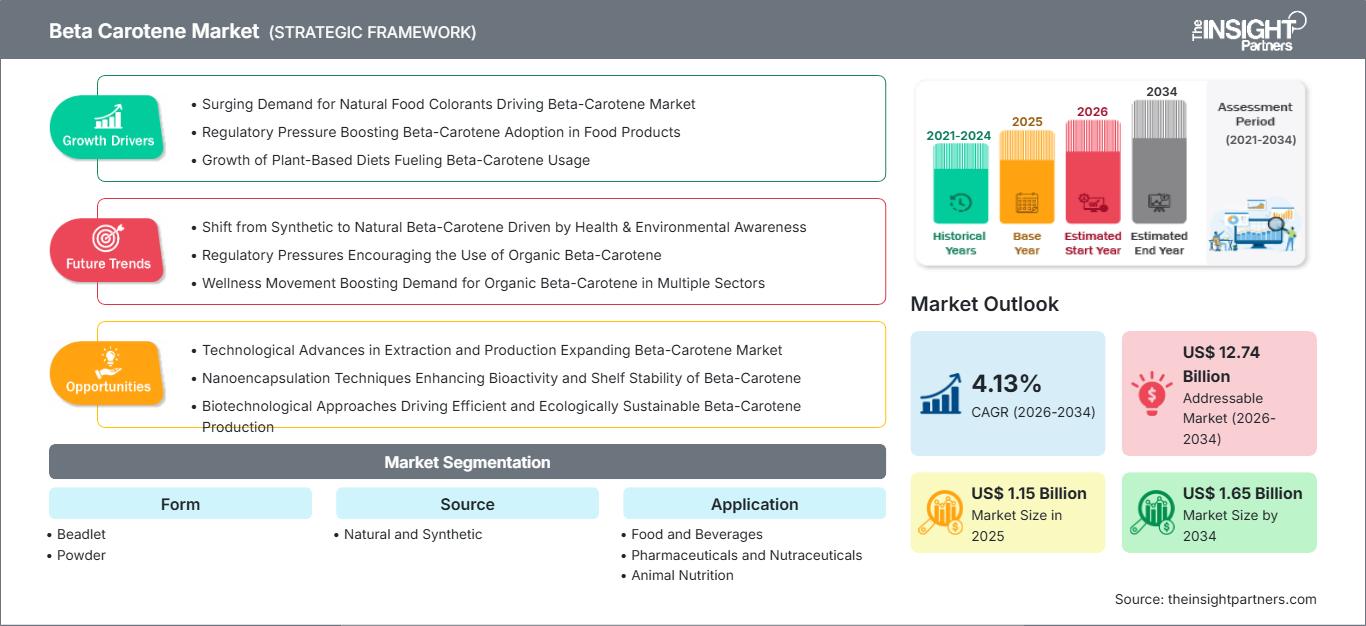
2025 Market Size
US$ 1.15 Bn
Base year value
2034 Forecast
US$ 1.65 Bn
Projected by 2034
CAGR 2026-2034
4.13 %
Growth rate
Addressable Market
US$ 12.74 Bn
(2026-2034)
The Beta Carotene Market was valued at US$ 1.15 Billion in 2025 and is projected to reach US$ 1.65 Billion by 2034, registering a CAGR of 4.13% during 2026–2034. Demand is supported by its dual role as a provitamin A ingredient and colorant across food, beverages, supplements, pharmaceuticals, animal nutrition, and personal care formulations. Product development increasingly focuses on stability, dispersibility, natural sourcing, and formulation compatibility.
North America remains an important consumption center, supported by demand for clean-label food colors, dietary supplements, functional beverages, and fortified products. The Beta Carotene Market size outlook is shaped by reformulation activity, expanding nutraceutical consumption, and increased use of natural color systems, supporting a regional CAGR of 4.4%–5.2% during 2026–2034.
Beta Carotene Market Assessment and Insights
- North America: Accounted for 24%–28% Beta Carotene Market in 2025 and is projected to expand at a CAGR of 4.4%–5.2% during 2026–2034. Demand is supported by natural-color reformulation, supplements, functional beverages, and pharmaceutical nutrition products.
- U.S.: Represented 72%–76% of the North American market in 2025 and is anticipated to register a CAGR of 4.6%–5.4% during 2026–2034, supported by dietary supplements and food-color replacement.
- Europe: Held 25%–29% share in 2025 and is expected to grow at a CAGR of 3.8%–4.6% during 2026–2034. Germany, France, the UK, Italy, and Spain remain significant markets because of established nutrition, food processing, and pharmaceutical industries.
- Asia Pacific: Accounted for 35%–39% share in 2025 and is forecast to register a CAGR of 4.7%–5.5% during 2026–2034. China, Japan, India, South Korea, and Australia support regional demand through food processing, supplements, animal nutrition, and personal care.
- Largest Segment: Food and Beverages represented 38%–42% market share in 2025 and is expected to grow at a CAGR of 3.9%–4.5% during 2026–2034, supported by color replacement and fortification.
- High Growth Segment: Personal Care represented 12%–16% market share in 2025 and is projected to register a CAGR of 4.7%–5.4% during 2026–2034, supported by natural formulation trends.
- Key companies analyzed in detail: BASF SE, Avanschem, DSM-Firmenich, Divi's Nutraceuticals, Foodchem International Corporation, Lycored Ltd., Nutralliance, Otsuka Pharmaceutical Co., Ltd., Allied Biotech Corporation, Sensient Technologies Corporation.
Source: The Insight Partners' analysis based on proprietary research, government publications, company annual reports, investor presentations, industry databases, and expert interviews.
The Beta Carotene Market has transitioned from traditional synthetic colorant use to differentiated carotenoids with uses in nutritional, coloration, and formulation purposes. The advent of microencapsulation, beadlets, cold-water dispersing, oil dispersion, and oxidative stability has extended the applicability of the market. The presence of natural beta carotene sourced from algae and fermentation further enables manufacturers with other sources of supply when looking at labeling and ingredient sourcing.
Growth in the Beta Carotene Market will be shaped by regional reformulation practices, supplement intake, and developments in specialty nutrition. Asia Pacific will continue to hold its place as the leading regional market, while North America gains from natural coloring alternatives and functional nutrition. Europe holds significance due to established regulation policies, food quality needs, and sourceable ingredients. Sourceable ingredients and formulation assistance will be key buying criteria.
Beta Carotene Market Report Scope
| Report Attribute | Details |
|---|---|
| Market size in 2025 | US$ 1.15 Billion |
| Market Size by 2034 | US$ 1.65 Billion |
| Global CAGR (2026 - 2034) | 4.13% |
| Historical Data | 2021-2024 |
| Forecast period | 2026-2034 |
Beta Carotene Market Analysis
Beta Carotene Market potential is directly related to its capacity to integrate visual functionality with nutritional attributes. It can be used by food processors in beverages, dairy, bakery, confectionery, and ready meals, as well as by supplement producers in tablets, capsules, gummies, and liquids. Value chain includes carotenoid suppliers, algae and fermentation suppliers, formulators, distributors, food processors, supplements producers, and pharma players.
Cost economics differ depending on the source and manufacturing method. Synthesis-based manufacturing gives the reliability and scalability benefits, whereas natural sources enable differentiation for manufacturers who want to utilize naturally-derived ingredients. Formulation technologies affect stability since carotenoids are sensitive to oxygen, light, and heat. Therefore, beadlets, dispersible powders, emulsion-based formulations, and protected oil dispersions are more often determining suitability for particular applications.
Beta Carotene Market analysis reveals that the current level of competition relies on source flexibility, formulation capability, regulatory documentation, applications support, and supply chain reliability. BASF SE and DSM-Firmenich possess wide-ranging carotenoid portfolios, while Divi’s Nutraceuticals and Lycored Ltd. have a presence in specialized nutrition applications. Sensient Technologies Corporation increases its competitive position by virtue of natural color formulation capabilities, while Foodchem International Corporation and Allied Biotech Corporation compete via ingredient supply and applications support.
Other factors contributing to the level of competitive positioning are vertical integration and geographic reach of companies. Otsuka Pharmaceutical Co., Ltd. offers capabilities in both nutritional and pharmaceutical applications, while Avanschem and Nutralliance offer specialized ingredient applications. Suppliers are focusing on quality systems, customization of concentration, stability enhancement, and customized delivery systems. Companies offering capabilities in both natural and synthetic products can better adapt to regional regulatory requirements, formulation cost considerations, and customer needs.
● REPORT CUSTOMIZATION
Tailor This Report To Align With Your Specific Business Requirements
This report can be customized to align precisely with your business objectives, scope, and target markets. Customization options include tailored segmentation, geography, competitive analysis, and strategic insights to support informed decision-making.
Customize This Report →WHAT YOU CAN ADJUST
- ● Segmentations
- ● Geography
- ● Competitive Analysis
- ● Language Preferences
Beta Carotene Market: Strategic Insights
Regional Insights
North America Beta Carotene Market
North America accounted for 24%–28% of the global Beta Carotene market share in 2025 and is projected to expand at a CAGR of 4.4%–5.2% during 2026–2034. Demand is supported by dietary supplements, fortified foods, functional beverages, and reformulation toward naturally positioned colorants. The U.S. represents the dominant market because of its extensive food processing and nutraceutical manufacturing base.
Natural color replacement is generating extra formulation interest as food companies look at options to synthetic colors. Canada adds value with its functional foods, nutritional supplements, and processed drinks. Suppliers are focusing more on dispersibility, stability, clean-label positioning, and technical information. The local ecosystem also enjoys the advantage of having already developed distribution channels for ingredients and product development capabilities.
U.S. Beta Carotene Market
The U.S. represented 72%–76% of North America's market in 2025 and is expected to register a CAGR of 4.6%–5.4% during 2026–2034. The demand includes dietary supplements, fortified food products, beverages, and natural coloring formulations. Leading players in the supply chain such as BASF SE, Sensient Technologies Corporation, and DSM-Firmenich are providing raw materials or formulation expertise for various uses.
The food manufacturers are reconsidering artificial color systems, thus providing avenues for use of beta carotene as yellow, orange, and red-orange coloring systems. The ingredient is also used in nutraceuticals as a source of provitamin A. With the presence of regulations and consumer concerns regarding ingredients, along with already existing supplement usage, there is potential for market growth.
Europe Beta Carotene Market
Europe represented 25%–29% of global market share in 2025 and is projected to expand at a CAGR of 3.8%–4.6% during 2026–2034. Germany continues to be the most prominent market, thanks to the food processing industry, nutritional ingredients, pharmaceuticals, and formulation expertise. Ingredient regulations play a significant role in the purchasing decisions in the region.
The UK sustains demand via functional foods, supplements, beverages, and personal care applications. Germany has the advantages of nutritional and ingredient manufacturing capability. France, Italy, and Spain are contributing through food processing, nutraceuticals, cosmetics, and pharmaceutical formulations. The regional manufacturers are becoming increasingly conscious of natural sourcing, traceability, stability, and application claim in choosing carotenoid ingredients.
APAC Beta Carotene Market
Asia Pacific accounted for 35%–39% share in 2025 and is forecast to grow at a CAGR of 4.7%–5.5% during 2026–2034. China is still leading in terms of market, owing to food processing, nutritional supplements, and ingredient processing. On the other hand, Japan and South Korea focus on providing quality nutrition with functional formulation, whereas India is gaining an advantage due to increased production of nutraceuticals and pharmaceutical products.
Australia is contributing by means of dietary supplements and food usage. Manufacturers in the region now give emphasis to stable powders, beadlets, and natural source ingredients.
Middle East & Africa Beta Carotene Market
The Middle East & Africa are expected to register a CAGR of 3.9%–4.7% during 2026–2034. Saudi Arabia represents a leading regional market because of food manufacturing, pharmaceutical development, and nutritional product demand. The UAE supports consumption through food processing, distribution, and personal care, while South Africa contributes through supplements, beverages, and processed foods.
The rest of the MEA demand remains linked to food fortification, dietary supplementation, and expanding consumer access to packaged nutrition products. Regional investment in food processing and healthcare infrastructure can improve distribution coverage and formulation capabilities. Suppliers with stable logistics and regulatory documentation are better positioned to serve fragmented markets.
Segmentation Analysis
Form
The Form segment is projected to expand at a CAGR of 3.9%–4.6% during 2026–2034. Form selection depends on application requirements, processing conditions, solubility, stability, and dosage format. Beadlets provide controlled handling and protection, while powders support dry blending and beverage applications. The Beta Carotene Market scope continues broadening as formulators demand application-specific delivery systems.
- Beadlet – Favored in dietary supplements, fortified foods, and functional formulations because encapsulation improves handling, dispersion, and protection against environmental degradation during processing and storage.
- Powder – Used extensively in dry mixes, beverages, tablets, and premixes where convenient dosing, blending characteristics, and formulation flexibility are important procurement considerations.
Source
The Source segment is anticipated to register a CAGR of 4.1%–4.8% during 2026–2034. Source selection increasingly reflects label positioning, production economics, regulatory acceptance, consistency, and customer requirements. Synthetic material remains important for dependable supply, while natural sources benefit from clean-label preferences and demand for naturally derived ingredients.
- Natural – Derived from sources including algae and fermentation, natural beta carotene supports formulations seeking naturally derived positioning and is increasingly considered for food, beverage, supplement, and personal care products.
- Synthetic – Provides consistent composition, scalable production, and predictable color performance, making it important for standardized applications where cost, supply reliability, and reproducibility influence purchasing decisions.
Application
The Application segment is forecast to grow at a CAGR of 3.9%–4.5% during 2026–2034. Food and beverage remains the largest demand center, while pharmaceuticals, nutraceuticals, animal nutrition, and personal care diversify consumption. Application growth depends on regulatory permissions, formulation compatibility, nutritional positioning, and stability requirements across finished products.
- Food and Beverages – Represents the leading application through use in beverages, dairy, bakery, confectionery, sauces, and fortified foods requiring stable yellow-to-orange coloration and nutritional functionality.
- Pharmaceuticals and Nutraceuticals – Demand is supported by use in supplements and nutritional formulations where beta carotene functions as a provitamin A ingredient and contributes antioxidant properties.
- Animal Nutrition – Adoption reflects supplementation requirements in livestock and other animal feeds, particularly where carotenoid availability from preserved forage or formulated feed is insufficient.
- Personal Care – Utilization is associated with cosmetic formulations seeking carotenoid coloration and functional ingredient positioning, particularly in products emphasizing naturally derived formulation components.
Opportunity Snapshot
| Application | Revenue Contribution | Trend Tag | Adoption Stage |
|---|---|---|---|
| Food and Beverages | High | Natural Colors | Mature |
| Pharmaceuticals and Nutraceuticals | High | Nutrient Fortification | Mature |
| Animal Nutrition | Medium | Feed Supplementation | Scaling |
| Personal Care | Medium | Natural Formulas | Scaling |
Beta Carotene Market Growth Drivers and Impact Analysis
Increasing reformulation toward naturally positioned food colors
The food industry is revisiting its approach to colors because there is more emphasis on the components used in foods. Beta carotene can be used in foods to give yellow to orange coloration, while also having the functionality to give provitamin A properties. As such, it has dual benefits which make it more useful in beverages, dairy, confections, bakery and nutrition. Reformulations can increase the need for beta carotene whether in nature or nature-identical forms based on economics of formulation and labeling objectives. This implies that suppliers need more color stability, dispersion and application support. In addition, this trend will drive efforts towards protecting color functionality during processing through encapsulation and other delivery technologies. Eventually, reformulation effort will increase the customer base from nutritional manufacturers to food and beverage companies.
Expansion of dietary supplements and functional nutrition products
Growing consumption of vitamins, minerals, fortified beverages, gummies, capsules, and wellness products is strengthening demand for carotenoid ingredients with established nutritional functionality. β-carotene acts as a provitamin A and can be used in various dosage forms such as powders, beadlets, oils, and dispersible formulations. Supplement makers distinguish their products based on the source, strength, stability, and ease of formulation. The result is that the suppliers have to come up with formulations that fit the needs of new dosage forms as opposed to using commodity ingredients alone. The market is driven by the innovations in the sports nutrition, healthy aging, immunity support and general wellness supplements.
Broader use of carotenoids in animal nutrition formulations
Animal nutrition provides a distinct demand channel because beta carotene contributes provitamin A functionality and can support nutritional supplementation when feed sources contain inadequate carotenoid levels. Processes involved in feed processing, preservation, and storage may lead to a reduction in natural beta carotene content, thus emphasizing the need for supplementation in specific livestock farming systems. This is being met through stable powder formulations that have the ability to mix uniformly in feeds. Thus, there can be diversification of the product in areas other than human nutrition because of increased interest in areas such as animal productivity, reproduction performance, feed conversion efficiency, and nutritional consistency. Further research into the feed additives will affect product formulation specifications.
Beta Carotene Market Future Trends
Greater integration of microencapsulation and advanced delivery systems
The Beta Carotene Market trends outlook increasingly centers on delivery technologies that improve stability, dispersibility, and application performance. Microencapsulation can shield carotenoids from oxygen, light, humidity, and processing stresses, as well as enhancing their compatibility with beverages, dry blends, tablets, and other end-products. Manufacturers will likely develop beadlet architecture, carriers, and controlled release strategies that suit particular formulation scenarios. Focusing more on particle engineering will also decrease processing losses and ensure dosage uniformity. With consumers demanding less in terms of formulation tradeoffs, formulators will have to compete with one another through delivery efficiency, rather than merely relying on active compound concentration. This trend is expected to foster greater cooperation between the makers of ingredients and formulators downstream in the value chain.
Increasing differentiation between natural and synthetic sourcing models
Future purchasing decisions are likely to distinguish more clearly between natural-source and synthetic beta carotene based on labeling, cost, availability, regulatory treatment, and application performance. Natural raw materials may capitalize on consumer demand for clear natural products, while artificial manufacturing will still be crucial in case of necessity for a consistent composition and availability. Production via fermentation may additionally widen the selection of raw material sources, decreasing reliance on specific agricultural or algal sources. Manufacturers will offer more information on the origin of the material and will supply lifecycle data for formulation purposes. It may lead to development of a dual value chain that will not be a one-size-fits-all market. Purchasing departments will have to evaluate source economics along with color performance characteristics.
Beta Carotene Market Opportunities
Expansion of natural-color replacement programs in mainstream foods
Beta Carotene Market Forecasts indicate an opportunity to expand beyond specialist nutrition applications as food companies reformulate products using naturally positioned color systems. Suppliers can target beverages, dairy products, bakery items, confectionery, sauces, and prepared foods where yellow-to-orange shades are technically achievable. Commercial success will depend on matching the color intensity, stability, processing tolerance, and cost requirements of existing formulations. Application laboratories can help customers shorten reformulation cycles by testing dosage, carrier systems, and processing conditions before commercial production. Producers that combine natural sourcing with reliable supply and technical documentation can address larger food manufacturers requiring standardized performance across multiple production facilities. The opportunity is particularly relevant where consumers expect familiar visual characteristics while manufacturers seek alternatives to synthetic color systems.
Development of specialized ingredients for personalized nutrition and supplements
The expansion of personalized nutrition, targeted supplementation, and condition-specific wellness products creates opportunities for higher-value carotenoid formulations. Suppliers can develop concentrated beadlets, dispersible powders, combination products, and dosage-specific systems for gummies, capsules, beverages, and functional foods. Partnerships with supplement manufacturers can support application testing and improve integration into new product formats. Differentiation can also come from source transparency, stability data, compatibility with other micronutrients, and standardized active content. As consumers increasingly evaluate supplement ingredients according to provenance and functionality, suppliers can move toward application-specific products rather than broad commodity offerings. Such positioning can support stronger customer relationships and reduce dependence on undifferentiated bulk ingredient sales.
Recent Developments
- June 2026: GRA Nutra Corp. launched AuraBC, a natural, clean-label beta-carotene food color produced through non-GMO fermentation technology. The ingredient is designed for food and beverage applications, including beverages and gummies, and is offered in formats such as spray-dried powders, beadlets, granulations, oil suspensions, and emulsions. GRA Nutra plans to bring its first commercial production plant online in early 2027.
- June 2025: DSM-Firmenich expanded its distribution partnership with Brenntag Specialties Pharma to Poland and the Czech Republic. Under the arrangement, Brenntag distributes DSM-Firmenich's portfolio of more than 40 vitamins and carotenoids for pharmaceutical applications, including beta-carotene. The expanded agreement covers distribution across seven European markets and strengthens pharmaceutical ingredient supply-chain access in Central and Eastern Europe.
- August 2025: Tudana launched strawberry juice with pulp and strawberry jam in Turkmenistan. The company's strawberry jam contains beta-carotene alongside pectin, vitamins, and minerals, demonstrating the incorporation of naturally occurring beta-carotene into processed fruit products. Tudana operates a greenhouse complex in Ahal province and distributes its products through more than 300 retail outlets in Turkmenistan, with exports to Kazakhstan and Uzbekistan.
Frequently Asked Questions

- Comprehensive Market Sizing and Forecast Analysis
- Detailed Segmentation Analysis
- In-Depth Market Dynamics Assessment
- Regional and Country-Level Insights
- Competitive Landscape and Company Benchmarking
- Strategic Business Intelligence
Recent Reports
Testimonials

The Insight Partners provided valuable market intelligence that supported our global go-to-market strategy. Their team was professional, responsive, and attentive to our feedback, providing thoughtful analysis and helpful methodological clarifications throughout the project.
Junmo Kim Chief Financial Officer (CFO), Enertech Co., Ltd.
The Insight Partners' SCADA System Market report is comprehensive, with valuable insights on current trends and future forecasts. The team was highly professional, responsive, and supportive throughout. We are very satisfied and highly recommend their services.
RAN KEDEM Partner, Reali Technologies LTDs
I requested a report on a very specific software market and the team produced the report in a few days. The information was very relevant and well presented. I then requested some changes and additions to the report. The team was again very responsive and I got the final report in less than a week.
JEAN-HERVE JENN Chairman, Future Analytica
We worked with The Insight Partners for an important market study and forecast. They gave us clear insights into opportunities and risks, which helped shape our plans. Their research was easy to use and based on solid data. It helped us make smart, confident decisions. We highly recommend them.
PIYUSH NAGPAL Sr. Vice President, High Beam Global
The Insight Partners delivered insightful, well-structured market research with strong domain expertise. Their team was professional and responsive throughout. The user-friendly website made accessing industry reports seamless. We highly recommend them for reliable, high-quality research services
YUKIHIKO ADACHI CEO, Deep Blue, LLC.
This is the first time I have purchased a market report from The Insight Partners.While I was unsure at first, I visited their web site and felt more comfortable to take the risk and purchase a market report.I am completely satisfied with the quality of the report and customer service. I had several questions and comments with the initial report, but after a couple of dialogs over email with their analyst I believe I have a report that I can use as input to our strategic planning process.Thank you so much for taking the extra time and making this a positive experience.I will definitely recommend your service to others and you will be my first call when we need further market data.
JOHN SUZUKI President and Chief Executive Officer, Board Director, BK Technologies
I wish to appreciate your support and the professionalism you displayed in the course of attending to my request for information regarding to infectious disease IVD market in Nigeria. I appreciate your patience, your guidance, and the fact that you were willing to offer a discount, which eventually made it possible for us to close a deal. I look forward to engaging The Insight Partners in the future, all thanks to the impression you have created in me as a result of this first encounter.
DR CHIJIOKE ONYIA MANAGING DIRECTOR, PineCrest Healthcare Ltd.Reason to Buy
- Informed Decision-Making
- Understanding Market Dynamics
- Competitive Analysis
- Identifying Emerging Markets
- Customer Insights
- Market Forecasts
- Risk Mitigation
- Boosting Operational Efficiency
- Strategic Planning
- Investment Justification
- Tracking Industry Innovations
- Aligning with Regulatory Trends





 Get Free Sample for