
Beverage Cartoners Market Trends, Size & Growth by 2034
Coverage: By Type (Refrigerated Carton, Shelf-Stable Carton), By End- Use (Soft Drinks, Dairy Products, RTD Tea and Coffee, Carbonated Soda, Water, Alcoholic Beverages, Others), and Geography
- Status : Data Released
- Report Code : TIPRE00025659
- Category : Chemicals and Materials
- No. of Pages : 150
- Available Report Formats :


- Last update date : August 27, 2026


2025 Market Size
US$ 857.64 Bn
Base year value
2034 Forecast
US$ 1,275.66 Bn
Projected by 2034
CAGR 2026-2034
4.51 %
Growth rate
Addressable Market
US$ 9,686.12 Bn
(2026-2034)
The Beverage Cartoners market is valued at US$ 857.64 Billion in 2025 and is projected to reach US$ 1,275.66 Billion by 2034, registering a CAGR of 4.51% from 2026 to 2034. Demand is shaped by beverage diversification, automation, shelf-life requirements, and investment in efficient packaging lines. Beverage Cartoners represents a packaging equipment market serving producers that require automated carton forming, filling-line integration, closing, and secondary packing capabilities.
North America remains an important market because beverage producers are increasing automation to manage labor constraints, frequent product changeovers, and shorter production runs. The Beverage Cartoners Market size outlook is supported by continued demand for dairy, ready-to-drink beverages, and shelf-stable products, while packaging machinery upgrades increasingly emphasize flexible handling, faster changeovers, and digital production monitoring.
Beverage Cartoners Market Assessment and Insights
- North America: North America is estimated to account for a 24–28% share in 2025 and is expected to expand at a 3.8–4.4% CAGR between 2026 and 2034, supported by automated packaging investment, mature beverage manufacturing, and replacement of aging equipment.
- U.S.: The U.S. represents approximately 76–80% of North America's 2025 market and is projected to grow at a 3.9–4.5% CAGR between 2026–2034, led by dairy, RTD beverages, and automated multipack operations.
- Europe: Europe holds an estimated 27–31% share in 2025 and is projected to register a 4.0–4.6% CAGR between 2026 and 2034, with Germany, France, Italy, the UK, and Spain supported by mature dairy and beverage packaging ecosystems.
- Asia Pacific: Asia Pacific is estimated at a 31–35% share in 2025 and is expected to grow at a 5.2–5.9% CAGR between 2026 and 2034, led by China, Japan, India, South Korea, and Australia through beverage diversification and manufacturing expansion.
- Largest Segment: Shelf-Stable Carton is estimated to hold a 55–60% market share in 2025, expanding at a 4.7–5.2% CAGR from 2026–2034 because of ambient distribution and extended shelf-life requirements.
- High Growth Segment: RTD Tea and Coffee is estimated to represent a 12–16% share in 2025, with a 5.5–6.2% CAGR from 2026–2034, supported by convenient single-serve consumption.
- Key companies analyzed in detail: Tetra Pak International S.A., Econocorp Inc., SIG Combibloc GmbH, R.A. Jones & Co., Gerhard Schubert GmbH, Elopak ASA, Krones AG, China Joylong Group Co., Ltd., Jacob White Packaging Ltd., Syntegon Technology GmbH
Source: The Insight Partners' analysis based on proprietary research, government publications, company annual reports, investor presentations, industry databases, and expert interviews.
Beverage packaging equipment has transitioned from stand-alone mechanical cartoners to servo-based machinery that can coordinate carton erection, product filling, sealing, inspection, and line control. Machine versatility has become important in the context of beverage producers managing an increasing number of SKUs and packing formats. Digital diagnostics, predictive maintenance, robotic integration, and quick format changeovers have become important considerations affecting equipment design and capital spending decisions by large and medium-sized beverage plants.
During the forecast period, capital expenditure is likely to gravitate towards developing beverage manufacturing hubs, especially in Asia and certain Middle Eastern countries. Legislative concerns about material efficiency and recyclability will affect carton design and machinery design. At the same time, beverage manufacturers will be inclined to invest in machinery that will accommodate several formats of cartons without extensive mechanical alterations.
Beverage Cartoners Market Report Scope
| Report Attribute | Details |
|---|---|
| Market size in 2025 | US$ 857.64 Billion |
| Market Size by 2034 | US$ 1,275.66 Billion |
| Global CAGR (2026 - 2034) | 4.51% |
| Historical Data | 2021-2024 |
| Forecast period | 2026-2034 |
Beverage Cartoners Market Analysis
Beverage Cartoners market is driven by the rise in consumption of packaged dairy products, shelf stable beverages, RTD beverages, and portion controlled formats. In the supply chain for the product, one can find cartonboard producers, converters and printers, filler equipment makers, beverage cartoner makers, systems integrators, beverage makers and maintenance service providers. This implies that the demand for such machinery is influenced not only by consumption of beverages but also the modernization cycles of the manufacturing plants and line integration needs.
There are more supply conditions that increasingly favor makers of machinery that possess capabilities in mechanical engineering, automation software, robotics and after sales services. In beverage makers' evaluation process, there are issues of throughput, footprint, changeover time, handling capacity, hygiene standards and line integration. There is increased demand for flexible equipment among beverage makers that have several formats and need flexible packaging machinery.
Positioning in the Beverage Cartoners Market is based upon technological range, installed base, engineering capacity, and geographical service coverage. Tetra Pak International S.A. has a good positioning in processing and carton packaging ecosystem, SIG Combibloc GmbH and Elopak ASA focus on carton beverage systems, Krones AG is involved in beverage line solutions, and Gerhard Schubert GmbH, R.A. Jones & Co., and Econocorp Inc. have specialized cartoning solutions.
Moreover, the Beverage Cartoners Market report reveals increased importance of modularity of automation and efficiency of investments. Specialized equipment suppliers include Syntegon Technology GmbH, Jacob White Packaging Ltd., and China Joylong Group Co., Ltd. The market competition becomes more and more favorable to the suppliers of the solutions which are capable of combining cartoning equipment with robotics for loading, checking, serialization, and manufacturing control. Thus, capital investments are more and more based upon life cycle productivity of a machine and not its cost only.
● REPORT CUSTOMIZATION
Tailor This Report To Align With Your Specific Business Requirements
This report can be customized to align precisely with your business objectives, scope, and target markets. Customization options include tailored segmentation, geography, competitive analysis, and strategic insights to support informed decision-making.
Customize This Report →WHAT YOU CAN ADJUST
- ● Segmentations
- ● Geography
- ● Competitive Analysis
- ● Language Preferences
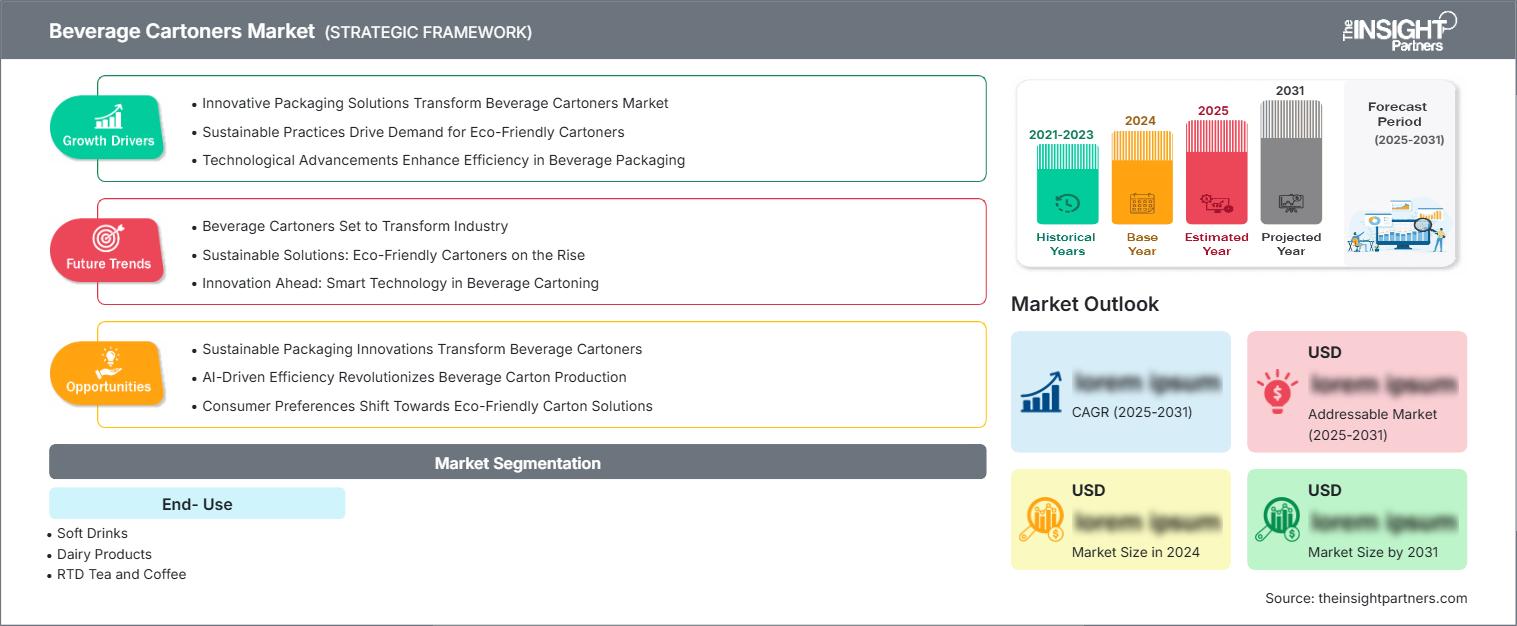
Beverage Cartoners Market: Strategic Insights
Regional Insights
North America Beverage Cartoners Market
North America is estimated to hold a 24–28% of the beverage cartoners market share in 2025 and is expected to expand at a 3.8–4.4% CAGR through 2034. The region benefits from sophisticated food and beverage manufacturing, established automation infrastructure, and recurring investment in packaging-line modernization. The U.S. represents the principal demand center, supported by large dairy, soft-drink, juice, and RTD beverage producers. Canada contributes through dairy and shelf-stable beverage production.
The availability of labor, machine reliability, and production flexibility continue to be primary factors for purchasing decisions. The demand for servo-controlled machines, automatic changeovers, automated inspections, and automated material handling is rising among beverages producers. The need for sustainable solutions drives the adoption of machinery that can work with light weight packaging and changing paperboard structures. Systems able to produce many SKUs with low downtime are becoming preferred by regional producers.
U.S. Beverage Cartoners Market
The U.S. accounts for approximately 76–80% of North America's 2025 market and is projected to grow at a 3.9–4.5% CAGR through 2034. Demand comes from dairy, shelf-stable milk, juice, RTD coffee, tea, sports beverages, and packaged water. Major packaging-equipment suppliers maintain strong customer and service networks across the country.
Automated cartoning is becoming more and more common among beverage processing companies in order to tackle manpower challenges and increase uniformity in productivity. Quick-changeover cartoners are especially useful when producers have a wide variety of pack sizes and seasonal products. Companies like Econocorp Inc. and R.A. Jones & Co. can offer cartoning services, while more comprehensive companies like Tetra Pak International S.A. have cartoning machines for processing and packaging needs.
Europe Beverage Cartoners Market
Europe represents an estimated 27–31% Beverage Cartoners Market in 2025 and is projected to expand at a 4.0–4.6% CAGR through 2034. Germany continues to be one of the top nations due to its machinery manufacturing capabilities and advanced beverages industry. The UK, France, Italy, and Spain make important contributions to the market in terms of dairy, juice, coffee, and other beverage applications.
In the case of the UK, producers with experience in manufacturing beverages and dairy items are on the lookout for solutions that will help them package their products efficiently and automate their operations. The growing need for sustainability also plays an important role in choosing appropriate machinery solutions.
Germany boasts a robust machinery industry alongside a significant beverage processing industry. High levels of automation along with strict engineering standards make cartoning equipment demand attractive. Today manufacturers focus more on servo control, robotics integration, quality control, and machine data communication. International and local machinery suppliers compete using custom engineering, support, and integration into packaging lines.
France, Italy, and Spain feature diverse beverage industries including dairy products, juices, coffee, water, and alcoholic beverages. Increasingly, the focus of equipment demand is on effective shelf stable packaging and multipacking automation. It is especially true for Italy regarding machinery engineering. Meanwhile, France and Spain represent significant demand for beverages processing. Europe should be regarded as a technologically developed region with steady equipment replacement needs.
APAC Beverage Cartoners Market
APAC is estimated to command 31–35% of the 2025 market and is projected to register a 5.2–5.9% CAGR through 2034. China leads regional demand, followed by Japan, India, South Korea, and Australia. Expanding packaged beverage consumption and the modernization of food-processing facilities support machinery investment.
Industrial automation, urbanization, cold chain development, and increased RTD consumption are driving demand. India and China offer significant opportunities for expansion, while Japan and South Korea focus on precision industrial automation. There are regional policies that encourage manufacturers to increase their packaging lines and enhance production efficiencies through modernization.
Middle East & Africa Beverage Cartoners Market
The Middle East & Africa Beverage Cartoners Market is expected to expand at a 4.2–5.0% CAGR through 2034. Saudi Arabia leads regional demand, followed by the UAE and South Africa. Beverage production investments, food-security initiatives, urban population growth, and infrastructure development support demand for automated packaging machinery.
Saudi Arabia and the UAE are expanding modern food-processing capacity, while South Africa has an established beverage manufacturing base. The rest of the MEA markets are gradually adopting automated packaging systems as domestic production increases. Shelf-stable cartons are particularly relevant where distribution distances and temperature conditions make extended product stability commercially valuable.
Segmentation Analysis
Type
The Beverage Cartoners Market scope covers refrigerated and shelf-stable cartoning systems used across major beverage applications, with analysis focused on equipment configurations, end-use requirements, production flexibility, automation, and changing packaging formats. Type remains a fundamental purchasing criterion because carton characteristics determine filling-line configuration, sealing requirements, storage conditions, and distribution economics. The segment is expected to expand at a 4.3–4.8% CAGR from 2026 to 2034. Shelf-stable formats remain strategically important, while refrigerated formats benefit from fresh beverage diversification.
- Refrigerated Carton: Refrigerated cartons serve fresh dairy and selected beverage applications requiring cold-chain distribution. Demand remains concentrated in developed markets where chilled logistics and frequent retail replenishment support established consumption patterns.
- Shelf-Stable Carton: Shelf-stable cartons occupy the dominant position because aseptic and ambient formats enable longer distribution windows. Their strategic importance increases in emerging markets where cold-chain infrastructure remains uneven.
End- Use
End-use segmentation in the Beverage Cartoners Market captures differences in filling speed, carton geometry, hygiene requirements, and production scheduling. The segment is expected to grow at a 4.5–5.0% CAGR from 2026 to 2034. Beverage diversification is encouraging manufacturers to purchase flexible equipment that accommodates changing product characteristics.
- Soft Drinks: Soft drinks create steady demand for automated secondary packaging because producers operate high-volume lines and multiple carton configurations. Efficient loading and changeover capabilities remain important for seasonal and promotional SKUs.
- Dairy Products: Dairy products require hygienic handling and dependable carton sealing. Growth in shelf-stable milk, flavored milk, and plant-based alternatives is broadening equipment requirements across ambient and refrigerated production environments.
- RTD Tea and Coffee: RTD tea and coffee are increasingly packaged in convenient formats supporting on-the-go consumption. Manufacturers value compact cartoners, flexible feeding systems, and quick format changes for varied serving sizes.
- Carbonated Soda: Carbonated soda remains a high-volume application where packaging machinery must maintain consistent throughput and reliable carton handling. Established production lines support recurring replacement and modernization demand.
- Water: Packaged water applications increasingly require efficient secondary packaging and lightweight material handling. Cartoners support grouped retail formats and distribution efficiency, particularly where producers are expanding multipack offerings.
- Alcoholic Beverages: Alcoholic beverage producers use cartoning systems for selected premium, multipack, and ready-to-drink products. Flexible machinery is valuable because packaging formats and promotional configurations can vary substantially.
Opportunity Snapshot
| End- Use | Revenue Contribution | Trend Tag | Adoption Stage |
|---|---|---|---|
| Soft Drinks | High | High Throughput | Mature |
| Dairy Products | High | Aseptic Lines | Mature |
| RTD Tea and Coffee | Medium | On-the-Go | Scaling |
| Carbonated Soda | High | Multi-SKU | Mature |
| Water | Medium | Multipack Lines | Scaling |
| Alcoholic Beverages | Medium | Premium Packs | Scaling |
Beverage Cartoners Market Growth Drivers and Impact Analysis
Expansion of Shelf-Stable and Aseptic Beverage Production
The increasing adoption of shelf-stable beverages is strengthening demand for packaging systems that integrate reliably with high-speed filling and carton-handling operations. The benefits of aseptic processing enable manufacturers to offer beverages without the need for constant refrigeration. It makes it easier for manufacturers to invest in equipment that enables them to maintain high production rates even with changing carton sizes. This type of equipment is particularly applicable when producing dairy, juices, plant-based beverages, and ready-to-drink beverages. It is not only the new plants that benefit from this trend but also those that were already in operation since there would be the need to upgrade controls, feeders, sealing machines, and robotics.
Rising Beverage SKU Complexity and Production Flexibility Requirements
The beverage manufacturers in the Beverage Cartoners Market have started to work on many flavors, package configurations, seasonals, and consumer-specific products. Such a complex situation enhances the importance of those cartoners that can quickly change their configurations and automate recipes. The traditional machinery that is made for a limited production configuration may result in more downtime and poor asset efficiency when there is fragmentation of product portfolio. The flexible cartoning machine takes care of the issue by the means of servomotors, programmability, tool-less changeover, and modular feeders. Such productivity gains may be a driving factor even in the case when there is a higher cost of new equipment. Manufacturers often link their packaging machines with manufacturing execution systems to keep a track of downtime, productivity, and quality. Thus, there is a trend of increasing demand of such equipment from beverage manufacturers.
Automation Investment to Offset Labor and Productivity Constraints
Labor availability is influencing packaging-line investment across mature and emerging beverage manufacturing markets. Cartoning processes require coordinated product feeding, carton erection, loading, closing, and quality inspection, making them suitable for automation and robotics. Manufacturers increasingly use automated systems to improve repeatability, reduce manual handling, and maintain output during labor shortages. The impact is especially significant for plants operating continuously or handling high-volume beverage products. Modern equipment can also incorporate machine vision, automated fault detection, remote monitoring, and predictive maintenance, reducing unplanned downtime. Suppliers with automation and systems-integration capabilities, therefore, gain an advantage in complex projects. Over time, automation can also alter procurement criteria by shifting evaluation from equipment speed alone toward total operating efficiency, maintenance requirements, workforce productivity, and integration with existing plant-control infrastructure.
Beverage Cartoners Market Future Trends
Digital and AI-Ready Packaging Line Management
The Beverage Cartoners Market trends outlook increasingly includes connected equipment, factory-wide data integration, and AI-ready production environments. Packaging machinery is moving beyond isolated programmable logic controllers toward systems capable of collecting and contextualizing operational information across multiple production stages. Future installations are likely to emphasize predictive maintenance, anomaly detection, automated performance benchmarking, and recipe optimization. These capabilities can help beverage producers identify recurring stoppages, reduce changeover losses, and improve equipment utilization. Tetra Pak's Factory OS development in 2026 illustrates this direction by connecting automation, data, and analytics across food and beverage manufacturing environments. As connectivity becomes more standardized, machine suppliers will increasingly compete on software architecture, cybersecurity, interoperability, and the ability to convert equipment data into actionable production insights.
Higher Renewable Content and Simplified Carton Structures
Carton packaging is moving toward structures that increase paper content and reduce dependence on conventional barrier materials. This trend will affect machinery because new carton constructions may require adjustments to forming, sealing, handling, and quality-control processes. Tetra Pak introduced a 1-liter aseptic carton with a paper-based barrier in April 2026, increasing renewable content to 90% when combined with plant-based polymers and reporting up to a 50% lower carbon footprint under its specified comparison. Similar developments can encourage equipment suppliers to design systems capable of handling evolving carton stiffness, material composition, and sealing characteristics. Regulatory pressure, customer sustainability targets, and recycling infrastructure development will reinforce investment in compatible machinery.
Beverage Cartoners Market Opportunities
Automation Platforms for Emerging Beverage Manufacturing Hubs
Beverage Cartoners Market Forecasts indicate continued investment in flexible and automated equipment as beverage manufacturers expand RTD, dairy, shelf-stable, and other packaged beverage portfolios. The strongest investment opportunities are emerging where beverage consumption is increasing while packaging infrastructure is being modernized. India, China, Southeast Asia, the Middle East, and selected African markets are expanding domestic food and beverage processing, creating demand for efficient packaging lines. Suppliers can address this opportunity through modular cartoning platforms that combine scalable throughput with flexible format handling. Local service capability will remain important because beverage manufacturers typically require installation, commissioning, operator training, spare parts, and technical support throughout the equipment lifecycle. Systems designed for phased capacity expansion can also reduce capital barriers for mid-sized processors. The opportunity is particularly relevant to shelf-stable dairy, juice, tea, coffee, and functional beverage producers seeking longer distribution reach without investing immediately in highly complex multi-line installations.
Cartoning Systems Compatible with Next-Generation Sustainable Packaging
The development of paper-based barriers, higher renewable content, and simplified carton structures creates opportunities for machinery suppliers that can adapt equipment to changing packaging specifications. Producers require forming and sealing systems that maintain package integrity while accommodating differences in material stiffness, coating behavior, and sealing characteristics. Tetra Pak's 2026 paper-based barrier development demonstrates how packaging-material innovation is moving toward commercial high-volume applications rather than remaining limited to pilot projects. Equipment suppliers can therefore differentiate through configurable forming modules, digital setup controls, automated inspection, and validation tools. This opportunity extends to retrofits because beverage manufacturers may prefer upgrading installed machinery rather than replacing complete production lines when new carton materials become commercially viable.
Recent Developments
- February 2025: SIG established an aseptic carton packaging facility in India to strengthen its local manufacturing capabilities and support growing demand for aseptic beverage packaging. The investment reflects the increasing localization of carton production and the expansion of aseptic packaging infrastructure in India, particularly for dairy, juice, and other shelf-stable beverage applications.
- In February 2025, The Shop Beer Co. reported that its new canning line had replaced an undersized previous system following production growth. The line includes a 12-head rotary filler operating at about 100 cans/minute, while an intermittent-motion cartoner from Smurfit Westrock handles 4-count and 12-count configurations. The cartoner's changeover takes about 40 minutes, supporting greater production flexibility.
Frequently Asked Questions

- Comprehensive Market Sizing and Forecast Analysis
- Detailed Segmentation Analysis
- In-Depth Market Dynamics Assessment
- Regional and Country-Level Insights
- Competitive Landscape and Company Benchmarking
- Strategic Business Intelligence
Recent Reports
Testimonials

The Insight Partners' SCADA System Market report is comprehensive, with valuable insights on current trends and future forecasts. The team was highly professional, responsive, and supportive throughout. We are very satisfied and highly recommend their services.
RAN KEDEM Partner, Reali Technologies LTDs
I requested a report on a very specific software market and the team produced the report in a few days. The information was very relevant and well presented. I then requested some changes and additions to the report. The team was again very responsive and I got the final report in less than a week.
JEAN-HERVE JENN Chairman, Future Analytica
We worked with The Insight Partners for an important market study and forecast. They gave us clear insights into opportunities and risks, which helped shape our plans. Their research was easy to use and based on solid data. It helped us make smart, confident decisions. We highly recommend them.
PIYUSH NAGPAL Sr. Vice President, High Beam Global
The Insight Partners delivered insightful, well-structured market research with strong domain expertise. Their team was professional and responsive throughout. The user-friendly website made accessing industry reports seamless. We highly recommend them for reliable, high-quality research services
YUKIHIKO ADACHI CEO, Deep Blue, LLC.
This is the first time I have purchased a market report from The Insight Partners.While I was unsure at first, I visited their web site and felt more comfortable to take the risk and purchase a market report.I am completely satisfied with the quality of the report and customer service. I had several questions and comments with the initial report, but after a couple of dialogs over email with their analyst I believe I have a report that I can use as input to our strategic planning process.Thank you so much for taking the extra time and making this a positive experience.I will definitely recommend your service to others and you will be my first call when we need further market data.
JOHN SUZUKI President and Chief Executive Officer, Board Director, BK Technologies
I wish to appreciate your support and the professionalism you displayed in the course of attending to my request for information regarding to infectious disease IVD market in Nigeria. I appreciate your patience, your guidance, and the fact that you were willing to offer a discount, which eventually made it possible for us to close a deal. I look forward to engaging The Insight Partners in the future, all thanks to the impression you have created in me as a result of this first encounter.
DR CHIJIOKE ONYIA MANAGING DIRECTOR, PineCrest Healthcare Ltd.Reason to Buy
- Informed Decision-Making
- Understanding Market Dynamics
- Competitive Analysis
- Identifying Emerging Markets
- Customer Insights
- Market Forecasts
- Risk Mitigation
- Boosting Operational Efficiency
- Strategic Planning
- Investment Justification
- Tracking Industry Innovations
- Aligning with Regulatory Trends





 Get Free Sample for