
Compostable Foodservice Packaging Market Demand, Share & Growth by 2034
Coverage: By Product Type (Trays, Cups and Plates, Cutlery, Clamshell, Bowls, Pouches and Sachets, and Others) and Material [Paper and Paperboard, Compostable Plastic (Bio-Plastic), and Others]
- Status : Data Released
- Report Code : TIPRE00029846
- Category : Chemicals and Materials
- No. of Pages : 150
- Available Report Formats :


- Last update date : August 21, 2026


2025 Market Size
US$ 20.24 Bn
Base year value
2034 Forecast
US$ 32.50 Bn
Projected by 2034
CAGR 2026-2034
5.4 %
Growth rate
Addressable Market
US$ 239.14 Bn
(2026-2034)
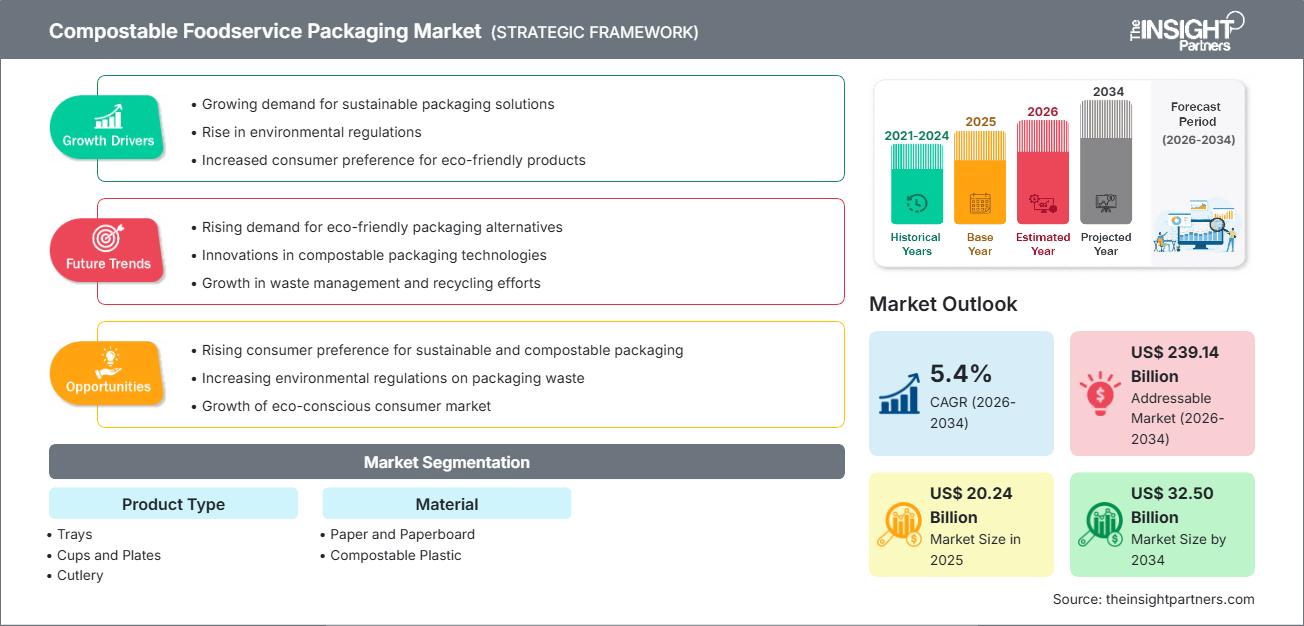
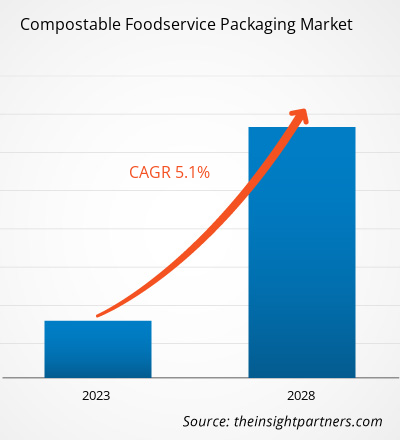
The Compostable Foodservice Packaging market size was valued at US$ 20.24 billion in 2025 and forecast to reach US$ 32.50 billion by 2034, registering a CAGR of 5.4% in the period of 2026–2034. The market includes trays, cups, plates, cutlery, clamshells, bowls, pouches, and sachets made from paper, paperboard, and compostable plastic material suitable for foodservice applications involving single-use packaging.
In North America, the region will continue to be one of the largest markets for compostable foodservice packaging driven by food delivery services, institutional foodservice, stadiums, universities, and municipal waste diversion programs. This region is expected to grow at a CAGR of 5.1–5.7% up to 2034 due to the regulation of certain conventional plastics and increasing use of compostable materials.
Compostable Foodservice Packaging Market Assessment and Insights
- North America: North America is estimated to hold a 30–34% Compostable Foodservice Packaging market share in 2025, growing at a 5.1–5.7% CAGR between 2026–2034, supported by foodservice regulation, institutional procurement, delivery packaging, and established compostable-product certification infrastructure.
- US: The US is estimated to represent 78–82% of North America in 2025, expanding at a 5.0–5.5% CAGR between 2026–2034, supported by restaurant, institutional, stadium, and catering applications.
- Europe: Europe is estimated at 27–31% share in 2025, advancing at a 5.0–5.6% CAGR between 2026–2034, with Germany, France, the UK, Italy, and Spain supporting demand through packaging regulation and foodservice sustainability programs.
- Asia Pacific: Asia Pacific is estimated at 25–29% share in 2025, registering a 6.0–6.7% CAGR between 2026–2034, led by China, Japan, South Korea, India, and Australia as organized foodservice expands.
- Largest Segment: Cups and Plates are estimated to hold a 24–28% market share in 2025, expanding at a 5.5–6.0% CAGR between 2026–2034, supported by beverages and ready-to-eat meals.
- High Growth Segment: Compostable Plastic is estimated to hold a 28–32% market share in 2025, growing at a 6.2–6.8% CAGR between 2026–2034, driven by PLA-based products and flexible packaging applications.
- Key companies analyzed in detail: Genpak LLC, Good Start Packaging, Dart Container Corporation, Graphic Packaging International LLC, WestRock Company, Be Green Packaging, Pactiv LLC, Anchor Packaging, BioBag Americas Inc., and ECO-PRODUCTS, INC.
Source: The Insight Partners' analysis based on proprietary research, government publications, company annual reports, investor presentations, industry databases, and expert interviews.
Compostable foodservice packaging market report indicates that dynamics have moved from plain fiber-based options to engineered packaging featuring attributes such as moisture resistance, heat resistance, rigidity, stack ability, printability, and certification for compostability. The focus for new product development includes molded fiber, bagasse, paperboard, PLA coatings, compostable polymers, and more. Companies are additionally focusing on PFAS reduction, food contact requirements, barriers, and compatibility with commercial composting. Such developments are enabling compostable packaging to move beyond simple plates and containers into high-performance packaging like clamshells, cups, coated food containers, and sachets.
According to the Compostable Foodservice Packaging Market forecast, the focus of investments would be on fiber forming machinery, barrier coatings, compostable polymer compounding, lightweighting, and certification. Emerging markets in Asia would offer volume potential due to growth in organized foodservice and delivery channels, while Europe and North America will focus on compliance and end-of-life issues. Waste infrastructure will continue to be important commercially due to the value of compostability claims only being maximized where collection and processing systems can accept certified packaging along with food waste.
Compostable Foodservice Packaging Market Report Scope
| Report Attribute | Details |
|---|---|
| Market size in 2025 | US$ 20.24 Billion |
| Market Size by 2034 | US$ 32.50 Billion |
| Global CAGR (2026 - 2034) | 5.4% |
| Historical Data | 2021-2024 |
| Forecast period | 2026-2034 |
Compostable Foodservice Packaging Market Analysis
Value chain demand includes restaurants, caterers, institutional kitchens, quick service operations, food delivery services, stadiums, universities, hospitals, and corporate catering departments. Material suppliers offer paperboard, agricultural fibers, PLA, coatings, adhesives, and additives, whereas converters convert these materials into various application formats. Thus, the Compostable Foodservice Packaging Market relies on coordinated material performance, converting efficiencies, certifications, food contact approvals, distribution, and waste management acceptance.
Compostable Foodservice Packaging Market trends indicate that changing supply conditions tend to create advantage for those manufacturers who can find a way to harmonize sustainability considerations with practical needs. Foodservice operations need packaging which will protect against greasiness, moisture, high temperature, compaction, and leakage but which will not cause confusion regarding its disposal. Certified products may be granted more weight in procurement processes if sustainability criteria are included in agreements. On the other hand, increased material and converting costs, lack of convenient ways to compost, and variable local acceptance levels can impede widespread use of such packaging.
Competitive positioning depends on the scale of manufacturing, material knowledge, product range, geographic footprint, certification ability, and customization. Genpak LLC provides an extensive portfolio of compostable foodservice products, while Graphic Packaging International LLC offers paper-based and PLA-coated products. Pactiv LLC works with foodservice customers via a large variety of packaging abilities, and Dart Container Corporation has both foodservice scale and sustainable molded-fiber production. ECO-PRODUCTS, INC. focuses on compostable foodservice products and overall waste diversion system.
WestRock Company, Anchor Packaging, Be Green Packaging, Good Start Packaging, BioBag Americas Inc. and other companies focus on particular product types, fiber materials, distribution footprint, and material expertise. Investment is increasingly allocated to PFAS-free molded fiber, compostable coating, certification, lightweighting, and manufacturing automation. Competitiveness is becoming dependent on supplier’s ability to prove performance and end-of-life compatibility rather than renewable material claim alone.
● REPORT CUSTOMIZATION
Tailor This Report To Align With Your Specific Business Requirements
This report can be customized to align precisely with your business objectives, scope, and target markets. Customization options include tailored segmentation, geography, competitive analysis, and strategic insights to support informed decision-making.
Customize This Report →WHAT YOU CAN ADJUST
- ● Segmentations
- ● Geography
- ● Competitive Analysis
- ● Language Preferences
Compostable Foodservice Packaging Market: Strategic Insights
Regional Insights
North America Compostable Foodservice Packaging Market
North America is estimated to account for 30–34% share in 2025 and is projected to grow at a 5.1–5.7% CAGR through 2034. The US represents the dominant market because restaurants, institutional foodservice operators, stadiums, universities, and catering businesses increasingly incorporate compostable formats into procurement strategies. Product demand is particularly strong for cups, plates, bowls, trays, and hinged containers used for prepared meals and beverages.
Demand is also driven by sustainability efforts in the foodservice sector and purchases made by institutions. The regional suppliers have the advantage of having well-defined certification processes and an eco-system for composters, haulers, distributors, and food service providers that is relatively well-developed. This is especially true of California because its framework for foodservice packaging looks at the compostability of packaging according to specific standards.
U.S. Compostable Foodservice Packaging Market
US is estimated to account for 78-82% of North American demand in 2025 and will see growth at a CAGR of 5.0-5.5% till 2034. Demand is dominated by quick-service restaurants, institutional eating establishments, food delivery services, stadium food and beverage, colleges/universities, catering services, and corporate cafeteria. Cups, plates, clamshells, and bowls continue to be significant as they directly substitute existing single-use formats.
Relevant product offerings/ capabilities can be seen from Genpak LLC, Dart Container Corporation, Pactiv LLC, Graphic Packaging International LLC, and ECO-PRODUCTS, INC. Application trend includes use of formats which are PFAS free, certified compostable, water-resistant, stackable, and microwaveable. Operators are also checking whether the chosen formats are accepted by local composting facility before procuring them.
Europe Compostable Foodservice Packaging Market
Europe is estimated to hold 27–31% share in 2025 and is projected to grow at a 5.0–5.6% CAGR. Germany is a leading country, supported by large foodservice, packaging, retail, and industrial ecosystems. The UK, France, Italy, and Spain also contribute significantly through restaurant chains, takeaway consumption, tourism, institutional catering, and packaging sustainability policies.
There is already a developed foodservice packaging environment in the UK with robust sustainability standards for retail and restaurants chains. The German approach centers around the efficiency of packaging, recycling and waste reduction, thus requiring material and destination statements from companies. In France, there have been more stringent rules regarding particular single-use packaging formats and an increased focus on reusable and alternative solutions. Italy and Spain offer opportunities through tourism, hospitality, catering as well as certification of compostable materials.
APAC Compostable Foodservice Packaging Market
APAC is estimated to represent 25–29% share in 2025 and is expected to register a 6.0–6.7% CAGR. China leads regional demand, followed by Japan, South Korea, India, and Australia. Expanding organized foodservice, delivery platforms, urban consumption, and institutional catering are increasing demand for practical alternatives to conventional disposables.
In terms of volume, China offers the biggest advantage, whereas Japan and South Korea focus on product quality and performance. The Indian market is very promising in terms of food delivery, quick service restaurants, and regulations concerning certain disposable plastic products. The Australian market enjoys sustainable procurement of foodservice items and composting. Investment in molded fiber, PLA, coated paper, and agricultural waste should be made in these markets.
Middle East & Africa Compostable Foodservice Packaging Market
Middle East and Africa is expected to expand at a 4.4–5.1% CAGR through 2034, with the UAE and Saudi Arabia representing leading demand centers. Hospitality, tourism, aviation catering, organized foodservice, and major events create recurring requirements for disposable food packaging, particularly cups, trays, bowls, and clamshells.
South Africa provides an important African market through organized retail and foodservice. Saudi Arabia and the UAE are supported by infrastructure investment, hospitality development, tourism, and sustainability initiatives. The wider region remains more fragmented because composting infrastructure is uneven. Suppliers with durable products, strong distribution, clear certification, and practical waste-management guidance are better positioned to expand adoption beyond major metropolitan markets.
Segmentation Analysis
Product Type
Product Type is divided into Trays, Cups and Plates, Cutlery, Clamshell, Bowls, and Pouches and Sachets. The segment is projected to grow at a 5.2–5.9% CAGR between 2026–2034, with demand reflecting food format, serving temperature, leakage risk, portability, and operator handling requirements. Cups and Plates retain a broad installed base, while clamshells and bowls benefit from delivery and takeaway meals.
- Trays: Trays serve prepared meals, catering, bakery, and institutional applications where rigidity and compartmentalization are important. Fiber and paperboard formats provide lightweight structures while supporting portion control and transport stability.
- Cups and Plates: Cups and plates represent high-volume foodservice formats spanning beverages, desserts, snacks, and meals. Their strategic importance reflects frequent single-use consumption and straightforward substitution opportunities.
- Cutlery: Compostable cutlery addresses foodservice operations requiring convenient utensils for takeaway, catering, and institutional meals. Fiber, wood-based, and compostable polymer formats compete according to strength, heat tolerance, and handling.
- Clamshell: Clamshells are important for takeaway and delivery because hinged designs combine containment, visibility, stacking, and portability. Compostable fiber versions increasingly target meals requiring grease and moisture resistance.
- Bowls: Bowls support soups, salads, noodles, grain meals, desserts, and prepared foods. Adoption depends on rigidity, leak resistance, temperature tolerance, and compatibility with lids for delivery.
- Pouches and Sachets: Pouches and sachets address condiments, sauces, dressings, and portion-controlled ingredients. Compostable flexible structures offer opportunities where reduced material use and convenient dispensing are priorities.
Material
Material includes Paper and Paperboard and Compostable Plastic. The segment is expected to grow at a 5.1–5.8% CAGR between 2026–2034. Material selection depends on required barrier properties, forming technology, food-contact compliance, cost, compostability certification, printability, and available waste-management infrastructure. Paper-based solutions remain highly relevant, while compostable plastics support applications requiring transparency, flexibility, or specialized barrier performance.
- Paper and Paperboard: Paper and paperboard provide a broad substrate base for cups, plates, trays, cartons, and containers. Their renewable-fiber positioning and established converting infrastructure support continued foodservice adoption.
- Compostable Plastic: Compostable plastic supports applications requiring flexibility, transparency, sealing, or complex geometry. PLA and other certified compostable polymers are particularly relevant to cups, lids, flexible packaging, and selected food containers.
Opportunity Snapshot
| Product Type | Revenue Contribution (High/Medium/Low) | Trend Tag | Adoption Stage |
| Trays | High | Meal Portability | Scaling |
| Cups and Plates | High | Beverage Service | Mature |
| Cutlery | Medium | Utensil Substitution | Scaling |
| Clamshell | High | Delivery Meals | Scaling |
| Bowls | Medium | Ready Meals | Scaling |
| Pouches and Sachets | Low | Portion Packaging | Emerging |
Compostable Foodservice Packaging Market Growth Drivers and Impact Analysis
Expansion of takeaway and delivery foodservice
The ongoing trend towards takeaway, delivery, grab-and-go and prepared food means higher usage of single-use foodservice containers. These distribution methods require packaging to be designed in such a way that it would protect food items during transportation while keeping certain temperature, strength and appearance. Compostable materials become very important when it comes to packaging that should fit food waste collection or sustainable purchasing policies. The effect will be most prominent on clamshells, bowls, cups, trays, and plates since these product categories make direct contact with the food and are hard to substitute with reusable containers. Foodservice packaging providers work on improving fiber structures, moisture barriers, venting systems and closures. When foodservice operators standardize packaging for all their locations and menu items, successful formats get very high recurring purchase volume.
Restrictions on selected conventional single-use packaging
Regulatory action affecting selected single-use packaging encourages foodservice operators to reassess material choices. Requirements can vary by jurisdiction, product format, coating, and disposal pathway, making compliance an important procurement consideration. Compostable products can benefit where certified alternatives are recognized within local waste-management systems. However, regulations also increase the need for accurate product claims because packaging described as compostable may require specific certification or acceptance conditions. Suppliers therefore face greater pressure to document materials, testing, food-contact suitability, and end-of-life performance. The commercial impact extends to product redesign, certification investment, and portfolio rationalization. Companies with established compliance teams and broad material capabilities can respond faster to regulatory changes, while smaller suppliers may face higher relative costs when adapting products to different regional requirements.
Greater emphasis on PFAS-free foodservice packaging
The movement toward PFAS-free food-contact packaging is influencing the formulation and design of grease-resistant foodservice products. Historically, performance requirements for oily or wet foods encouraged barrier treatments that could complicate sustainability objectives. New product development increasingly seeks fiber-based structures and alternative coatings that provide sufficient grease and moisture resistance without relying on intentionally added PFAS. This driver affects trays, plates, bowls, clamshells, and paper-based food containers particularly strongly. Manufacturers must balance barrier performance with compostability, machinability, cost, and food-contact requirements. The resulting innovation is encouraging molded-fiber formulations, alternative coatings, improved forming processes, and thinner structures. Over time, PFAS-free requirements can strengthen demand for suppliers with formulation expertise and testing capabilities capable of demonstrating both functional performance and compliant material composition.
Compostable Foodservice Packaging Market Future Trends
Higher-performance fiber structures
Future product development is likely to prioritize fiber structures capable of replacing a wider range of conventional plastic formats. Molded-fiber technology is expected to advance through improved forming precision, thinner walls, better surface finish, stronger moisture resistance, and enhanced dimensional stability. These improvements can expand fiber packaging into foods with heavier sauces, higher temperatures, and longer transport times. Manufacturers may also combine different fiber sources or engineered coatings to achieve application-specific performance without significantly increasing package weight. Automated forming and quality-control technologies should improve production consistency as volumes increase. The result will be a broader range of compostable trays, bowls, clamshells, and plates capable of meeting operational requirements previously associated with plastic. Product differentiation will increasingly depend on measured performance rather than material claims alone.
Systems-based composting compatibility
The market is expected to move toward systems-based approaches in which packaging selection is linked directly with collection, hauling, and composting operations. Foodservice operators increasingly need assurance that packaging accepted at the point of use can move through the intended waste pathway without creating contamination. Suppliers may therefore provide clearer disposal instructions, collection guidance, certification information, and operator training alongside packaging products. Venue-specific programs at stadiums, campuses, hospitals, and corporate facilities can accelerate this model because procurement and waste management are often centrally coordinated. The approach may also encourage standardized packaging portfolios within individual foodservice systems. Over time, product acceptance could depend as much on local infrastructure and contamination performance as on laboratory compostability certification, creating opportunities for suppliers able to support the complete packaging-to-composting pathway.
Compostable Foodservice Packaging Market Opportunities
Regional production of agricultural-fiber packaging
Investment opportunities exist in regions where agricultural residues can provide locally available feedstock for molded-fiber packaging. Bagasse, bamboo, wheat straw, and other plant residues can support packaging production while reducing dependence on imported polymer inputs. Local sourcing can also shorten supply chains and support packaging manufacturing close to large foodservice markets. Investors should prioritize regions with reliable agricultural output, suitable pulping or fiber-processing infrastructure, water-management capabilities, and access to certified composting systems. Product strategies can initially target trays, plates, bowls, and clamshells because these formats can accommodate molded-fiber structures. Successful facilities will require consistent feedstock quality and process controls to maintain dimensional stability and food-contact performance. Regional manufacturing can therefore create cost and logistics advantages while supporting differentiated sustainability positioning.
Integrated packaging and waste-management solutions
A further opportunity is to combine packaging supply with waste-management support for large foodservice customers. Stadiums, universities, hospitals, airports, hotels, and corporate campuses can benefit from coordinated packaging procurement, employee training, bin design, signage, collection, and composting partnerships. Suppliers can create recurring service relationships by helping customers measure contamination, improve sorting, and select formats accepted by local processors. This model changes the commercial proposition from selling individual packaging units to managing packaging performance across the operating environment. It also creates opportunities for digital tools that track product specifications, certification, collection volumes, and waste outcomes. Providers with packaging expertise can partner with haulers and composters rather than building every capability internally. Such partnerships can improve adoption where infrastructure, rather than product availability, is the principal market constraint.
Recent Developments
- June 2026: Hotpack partnered with Malaysia’s HZ Corporation to expand global reach of sustainable foodservice packaging. The joint venture (JV) targets high-growth markets across the Middle East, Southeast Asia, Australia, New Zealand, and North America with paper-based alternatives to single-use plastics.
- June 2026: OISHI Holding Company Limited (OISHI) joined forces with SCG Chemicals (SCGC) to co-develop and elevate eco-friendly food packaging innovation. The collaboration introduces SCGC’s “EcoRevo” biodegradable technology into the production of plastic packaging for the food business, creating new alternatives that meet consumer needs while supporting long-term environmental stewardship and advancing the circular economy in a tangible way.
Frequently Asked Questions

- Comprehensive Market Sizing and Forecast Analysis
- Detailed Segmentation Analysis
- In-Depth Market Dynamics Assessment
- Regional and Country-Level Insights
- Competitive Landscape and Company Benchmarking
- Strategic Business Intelligence
Recent Reports
Testimonials

The Insight Partners' SCADA System Market report is comprehensive, with valuable insights on current trends and future forecasts. The team was highly professional, responsive, and supportive throughout. We are very satisfied and highly recommend their services.
RAN KEDEM Partner, Reali Technologies LTDs
I requested a report on a very specific software market and the team produced the report in a few days. The information was very relevant and well presented. I then requested some changes and additions to the report. The team was again very responsive and I got the final report in less than a week.
JEAN-HERVE JENN Chairman, Future Analytica
We worked with The Insight Partners for an important market study and forecast. They gave us clear insights into opportunities and risks, which helped shape our plans. Their research was easy to use and based on solid data. It helped us make smart, confident decisions. We highly recommend them.
PIYUSH NAGPAL Sr. Vice President, High Beam Global
The Insight Partners delivered insightful, well-structured market research with strong domain expertise. Their team was professional and responsive throughout. The user-friendly website made accessing industry reports seamless. We highly recommend them for reliable, high-quality research services
YUKIHIKO ADACHI CEO, Deep Blue, LLC.
This is the first time I have purchased a market report from The Insight Partners.While I was unsure at first, I visited their web site and felt more comfortable to take the risk and purchase a market report.I am completely satisfied with the quality of the report and customer service. I had several questions and comments with the initial report, but after a couple of dialogs over email with their analyst I believe I have a report that I can use as input to our strategic planning process.Thank you so much for taking the extra time and making this a positive experience.I will definitely recommend your service to others and you will be my first call when we need further market data.
JOHN SUZUKI President and Chief Executive Officer, Board Director, BK Technologies
I wish to appreciate your support and the professionalism you displayed in the course of attending to my request for information regarding to infectious disease IVD market in Nigeria. I appreciate your patience, your guidance, and the fact that you were willing to offer a discount, which eventually made it possible for us to close a deal. I look forward to engaging The Insight Partners in the future, all thanks to the impression you have created in me as a result of this first encounter.
DR CHIJIOKE ONYIA MANAGING DIRECTOR, PineCrest Healthcare Ltd.Reason to Buy
- Informed Decision-Making
- Understanding Market Dynamics
- Competitive Analysis
- Identifying Emerging Markets
- Customer Insights
- Market Forecasts
- Risk Mitigation
- Boosting Operational Efficiency
- Strategic Planning
- Investment Justification
- Tracking Industry Innovations
- Aligning with Regulatory Trends





 Get Free Sample for