
Bio-solvents Market Share, Demand & Growth by 2034
Coverage: by Product (Lactate Ester, Soy Methyl Ester Alcohol, Glycols, Others); Application (Paints and Coatings, Adhesives and Sealants, Printing Inks, Others) , and Geography (North America, Europe, Asia Pacific, and South and Central America)
- Status : Data Released
- Report Code : TIPRE00012661
- Category : Chemicals and Materials
- No. of Pages : 150
- Available Report Formats :


- Last update date : August 27, 2026


2025 Market Size
US$ 5.73 Bn
Base year value
2034 Forecast
US$ 7.49 Bn
Projected by 2034
CAGR 2026-2034
3.41 %
Growth rate
Addressable Market
US$ 61.21 Bn
(2026-2034)
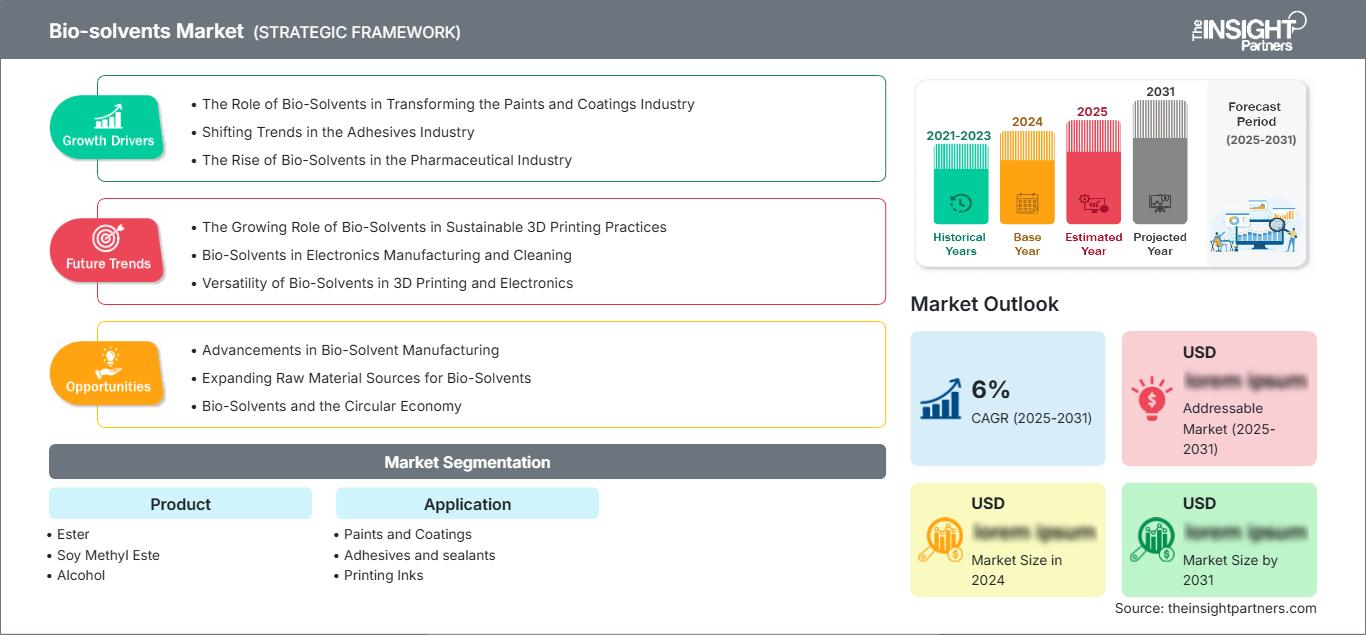
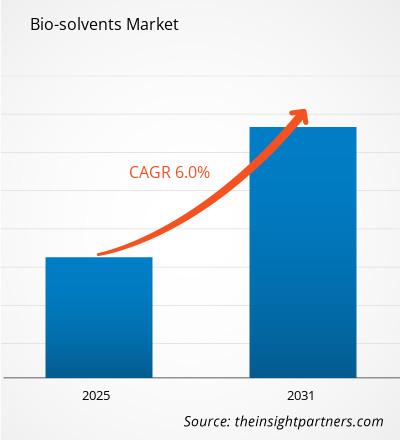
The Bio-Solvents market was valued at US$ 5.73 Billion in 2025 and is projected to reach US$ 7.49 Billion by 2034, registering a CAGR of 3.41% during 2026–2034. The growth in the market is due to the increased use of bio-based solvents as an alternative to petroleum-based solvents in products such as coatings, adhesives, printing inks, cleaners, agricultural products, and industrial chemicals. The factors that drive the market include VOC regulations, availability of renewable feedstocks, formulation needs, and concern about carbon content.
North America continues to be a structurally strong region for the market due to the presence of specialized chemical manufacture, availability of agricultural feedstock, and need for low-VOC products. The Bio-Solvents Market Report is bolstered by the increased use of the product in the segments of paints & coatings, adhesives & sealants, printing inks, industrial cleaners, and agricultural formulations.
Bio-solvents Market Assessment and Insights
- North America: North America is estimated to hold a 28–32% share in 2025 and expand at a 4.0–4.8% CAGR between 2026 and 2034, supported by renewable feedstock availability, coatings demand, VOC reduction initiatives, and established specialty chemical manufacturing.
- U.S.: The U.S. is estimated to represent 63–67% of North American demand in 2025 and grow at a 4.1–4.9% CAGR between 2026–2034, supported by coatings, inks, cleaners, agriculture, and specialty chemical applications.
- Europe: Europe is estimated to account for a 33–36% share in 2025 and register a 3.6–4.4% CAGR between 2026 and 2034, with Germany, France, Italy, the UK, and Spain supported by sustainability policies and chemical-management requirements.
- Asia Pacific: Asia Pacific is estimated at a 22–25% share in 2025 and is projected to grow at a 4.8–5.7% CAGR between 2026 and 2034, led by China, Japan, South Korea, and India.
- Largest Segment: Alcohol is estimated to hold a 35–39% market share in 2025 and grow at a 3.8–4.5% CAGR between 2026–2034, reflecting broad formulation compatibility and established production infrastructure.
- High Growth Segment: Adhesives and sealants are estimated to account for a 20–24% market share in 2025 and expand at a 5.0–5.8% CAGR between 2026–2034, supported by lower-VOC formulation development.
- Key companies analyzed in detail: Archer-Daniels-Midland Company, BASF SE, BioAmber Inc., Cargill, Incorporated, Corbion N.V., Dow Inc., Florida Chemical Company, Huntsman International LLC, Shenzhen Esuns Industrial Co., Ltd., Stepan Company.
Source: The Insight Partners' analysis based on proprietary research, government publications, company annual reports, investor presentations, industry databases, and expert interviews.
Bio-Solvents are moving away from being renewable substitutes to being well-established formulation ingredients where solvency, renewable content, VOCs performance, biodegradability, and employee safety affect purchase decisions. Development of technology involves bio-alcohols, methyl esters, lactate esters, bio-based glycols, and specialty renewable intermediates. The producers are merging renewable raw materials with existing chemical infrastructure to make them scalable and consistent at the same time.
These trends will continue owing to growing usage in developing countries such as those of the Asia Pacific region. Investment flows towards fermentation-derived intermediates, renewable agricultural feedstocks, mass-balance process, and specific solvent systems are increasing. Growing attention to VOCs emissions, chemical safety, and carbon intensity of chemical products creates additional barriers for qualification of new products. These trends will motivate suppliers to disclose renewable content, life cycle assessments, and performance parameters next to usual product data.
Bio-solvents Market Report Scope
| Report Attribute | Details |
|---|---|
| Market size in 2025 | US$ 5.73 Billion |
| Market Size by 2034 | US$ 7.49 Billion |
| Global CAGR (2026 - 2034) | 3.41% |
| Historical Data | 2021-2024 |
| Forecast period | 2026-2034 |
Bio-solvents Market Analysis
Bio-Solvents Market growth is becoming more related to formulations industries seeking alternative options for low VOCs, renewable solvents, and safety without affecting their technical attributes. The supply chain includes renewable feedstocks such as vegetable oils, sugars, starches, biomass and others; fermentation, esterification, alcohols production, purification, blending, and transportation. The producers then sell the solvents to coating, adhesive, ink, agricultural, cleaning, and industrial chemicals producers.
Supply economics include feedstock cost, conversion efficiency, regional supply, purification, logistics, and certifications. Soy methyl esters and bio-alcohols have access to existing renewable feedstock chains whereas fermentation solvents offer an extra diversification option. Integrated feedstock and production facilities may help secure supply and mitigate the volatility of raw material markets. Compatibility with formulations is very important since the customers prefer renewable solvents that can be integrated into existing production without major changes.
From the Bio-Solvents Market Report, it can be inferred that there is a competitive market that is based on portfolio scope, feedstock, formulation skills, applications, and sustainability certification. BASF SE leverages its expertise in specialty chemicals together with its feedstock based in renewables, whereas Dow Inc. plays a role in the market for bio-circular and bio-based chemicals solutions. Archer-Daniels-Midland Company and Cargill, Incorporated leverage their agricultural feedstock skills, and Corbion N.V. leverages its fermentation-based lactate chemistry.
There is also a trend for differentiation among competitors through specialization in application-based grades and low carbon footprint production process. The Step Company is a key player that delivers bio-based esters and formulations, whereas Florida Chemical Company is a leader in delivering citrus based specialty chemicals. Huntsman International LLC operates in the specialty formulations space, whereas Shenzhen Esuns Industrial Co., Ltd. delivers renewable solvents. BioAmber Inc. is an old competitor in the bio-based chemicals market which does not operate anymore.
● REPORT CUSTOMIZATION
Tailor This Report To Align With Your Specific Business Requirements
This report can be customized to align precisely with your business objectives, scope, and target markets. Customization options include tailored segmentation, geography, competitive analysis, and strategic insights to support informed decision-making.
Customize This Report →WHAT YOU CAN ADJUST
- ● Segmentations
- ● Geography
- ● Competitive Analysis
- ● Language Preferences
Bio-solvents Market: Strategic Insights
Regional Insights
North America Bio-Solvents Market
The North American Bio-Solvents Market Share is expected to be 28–32% in 2025 and is expected to experience growth at 4.0–4.8% CAGR through 2034. The region has an already established coatings, adhesives, printing, cleaning, and industrial chemicals industry, which can accommodate renewable solvents without much investment in new equipment. The U.S. is the major demand source due to its specialty chemical production and agriculture base.
The country of Canada participates in developing and producing bio-based chemicals, whereas the U.S. holds the most significant number of formulation facilities and centers. Bio-alcohols, methyl esters, glycols, and specialty esters have become increasingly important for areas where there is a need for VOCs reduction and safe handling. The regional demand continues to depend on coatings reformulations, industrial cleaning, printing, and agricultural applications.
U.S. Bio-Solvents Market
The US is expected to contribute 63-67% of North America demand by 2025 and to experience a growth of 4.1-4.9% CAGR until 2034. It is a large market with high presence of coatings, construction, printing, agriculture, consumer products, and chemical industries, with high availability of agricultural feedstock. Environmental regulation on VOCs and chemicals safety drives the gradual formulation replacement.
The capabilities in the renewable solvents chemistry and in the formulation systems are represented by: Cargill, Incorporated, Archer-Daniels-Midland Company, BASF SE, Dow Inc. and Stepan Company. The applications range from paints, industrial cleaners, printing inks, agriculture formulations, to adhesives. The most promising sectors are those in which it is possible to add renewable content with VOC, safety, biodegradability, or carbon footprint benefits without compromising the technical performance.
Europe Bio-Solvents Market
Europe’s market share is expected to be between 33% and 36% in 2025 and forecasted growth will be between 3.6% and 4.4% CAGR up to 2034. The top markets are Germany, the UK, France, Italy, and Spain. Solvent choice will continue to be affected by chemical management regulations, circular economy, use of renewable feedstocks, and sustainability-based purchasing policies.
The UK will benefit from coatings, printing, and specialty chemical applications. Germany, being rich in chemical production, will have an opportunity to benefit from its formulation industry. France will gain from bio-based chemicals and agriculture-related formulations. Italy and Spain will contribute through coatings, adhesives, printing, packaging, and industrial manufacturing. European buyers tend to favor renewable content, lifecycle data, and reduced carbon footprint in the supplier selection process.
APAC Bio-Solvents Market
APAC is expected to hold 22%-25% market share in 2025 and will have a 4.8%-5.7% CAGR during 2025-2034 driven by demand in China. Applications include coatings, printing, agriculture, electronics, and industrial cleaning in China, Japan, South Korea, India, and Australia.
Adoption is linked to industrial development and emission reduction. Indian development involves agricultural feedstock and industrial production, while Japan and South Korea emphasize high-performance and sustainable materials. China uses extensive chemical manufacturing along with regulations.
Middle East & Africa Bio-Solvents Market
The Middle East & Africa segment is projected to witness a CAGR of 3.7–4.5% over the forecast period of 2034. The industrial base in Saudi Arabia and the UAE is well-established, whereas South Africa emerges as an important market in Africa. Application areas in construction, coatings, maintenance, agriculture, and specialty chemicals dominate.
There are emerging opportunities in Saudi Arabia and the UAE to diversify the chemical industry, which is currently based only on hydrocarbons. The applications in South Africa include agriculture, coatings, cleaning, and formulation of chemicals.
Segmentation Analysis
Product
The Bio-Solvents Market scope by product covers Ester, Soy Methyl Ester, Alcohol, Glycols, and Others. Product selection determines solvency, evaporation behavior, compatibility, safety characteristics, and renewable-content potential. Alcohols provide broad application versatility, while esters and soy methyl esters support industrial and formulation uses. Glycols serve coatings, inks, and chemical-processing applications. The product segment is projected to expand at a 3.2–4.1% CAGR during 2026–2034.
- Esters: Esters provide strong solvency and formulation flexibility across coatings, inks, cleaners, and industrial applications. Compatibility with established formulations supports substitution where lower environmental impact and renewable feedstock content are required.
- Soy Methyl Este: Soy methyl ester-based solvents provide renewable alternatives to petroleum-derived fluids. Demand is supported by industrial cleaning, coatings, agricultural formulations, and applications requiring high flash points and favorable handling characteristics.
- Alcohol: Alcohol represents the largest product category because ethanol and related bio-alcohols offer broad compatibility, established production infrastructure, and application familiarity across cleaning, coatings, personal care, and chemical-processing formulations.
- Glycols: Bio-based glycols provide controlled solvency, water miscibility, and low volatility. Their role is expanding in coatings, inks, resins, and industrial formulations where manufacturers seek renewable or bio-circular feedstock alternatives.
- Others: Other products include specialty renewable solvent chemistries such as terpenes and emerging bio-derived intermediates. Adoption remains application-specific but creates opportunities for customized formulations requiring differentiated solvency or environmental profiles.
Application
Application demand is shaped by the ability of renewable solvents to satisfy performance, regulatory, safety, and formulation requirements simultaneously. Paints and coatings represent a major established outlet, while adhesives and sealants provide faster substitution potential. Printing inks remain important for packaging and industrial printing. The application segment is projected to grow at a 3.5–4.4% CAGR during 2026–2034.
- Paints and Coatings: Paints and coatings remain a major application because solvent selection directly influences VOC emissions, drying, film formation, viscosity, and worker exposure. Bio-based options support reformulation while retaining established coating technologies.
- Adhesives and sealants: Adhesive and sealant manufacturers increasingly evaluate renewable solvents to reduce VOC intensity while maintaining resin compatibility, application consistency, open time, and curing performance across construction and industrial products.
- Printing Inks: Printing ink formulators use bio-solvents where solvency, drying behavior, color development, and substrate compatibility must be maintained. Packaging applications create additional interest in lower-VOC and renewable solvent systems.
- Others: Other applications cover cleaning, agriculture, pharmaceuticals, personal care, and specialty industrial formulations. Adoption depends strongly on regulatory requirements, solvent safety profiles, formulation compatibility, and renewable feedstock economics.
Opportunity Snapshot
| Application | Revenue Contribution | Trend Tag | Adoption Stage |
|---|---|---|---|
| Paints and Coatings | High | VOC Reduction | Scaling |
| Adhesives and sealants | Medium | Low-VOC Formulas | Scaling |
| Printing Inks | Medium | Renewable Inks | Scaling |
| Others | Medium | Specialty Solvents | Emerging |
Bio-solvents Market Growth Drivers and Impact Analysis
Increasing substitution of petroleum-derived solvents
Increasing attention to VOC emissions, worker exposure, biodegradability, and carbon intensity is encouraging the substitution of conventional petroleum-derived solvents. Renewable alternatives can provide bio-based carbon content while maintaining required solvency and formulation performance. This driver is particularly relevant in coatings, inks, cleaning products, agriculture, and specialty chemical applications where solvent composition directly affects environmental and safety profiles. Commercial availability from established producers reduces the technical barrier to substitution. As formulators increasingly evaluate lifecycle impacts alongside performance, renewable solvents gain relevance in supplier qualification and product development. Demand is consequently shifting toward products that combine renewable feedstocks with predictable technical properties, consistent purity, regulatory compliance, and supply reliability.
Expansion of low-VOC coatings and formulation technologies
Expansion of low-VOC coatings is creating demand for solvent systems capable of meeting performance requirements under increasingly stringent emissions expectations. Bio-based solvents can contribute through lower VOC characteristics, higher flash points, biodegradability, or renewable carbon content, depending on chemistry. Paint and coating manufacturers increasingly evaluate solvent packages as part of broader reformulation strategies rather than treating them as isolated ingredients. This encourages suppliers to develop blends and application-specific grades that maintain drying, flow, leveling, and resin compatibility. The commercial impact extends into industrial, automotive, wood, and protective coatings. As sustainability specifications increasingly become procurement requirements, suppliers with documented environmental attributes and consistent technical data gain greater opportunities for qualification.
Growing availability of renewable feedstocks and bio-based intermediates
Greater availability of vegetable oils, sugars, starch-derived intermediates, fermentation products, and other renewable feedstocks is strengthening the supply foundation for bio-solvent production. Feedstock diversification reduces dependence on individual agricultural sources and allows producers to develop regionally optimized manufacturing pathways. Companies with integrated agricultural or biochemical capabilities can capture value across multiple stages, from feedstock sourcing to solvent conversion and formulation support. Increased availability also supports specialty solvent development, including lactate esters, methyl esters, and renewable glycols. Improved process efficiency and production scale can progressively narrow cost differences against conventional alternatives. Producers with strong feedstock relationships and conversion technologies therefore have opportunities to improve both supply resilience and product differentiation.
Bio-solvents Market Future Trends
Bio-Solvents trends toward certified renewable and mass-balance feedstocks
Bio-Solvents Market trends are increasingly shifting toward verified renewable-content claims rather than broad sustainability positioning. Buyers are expected to request certifications, chain-of-custody documentation, carbon-footprint calculations, and traceable feedstock information during supplier qualification. Mass-balance approaches can gain importance because they enable existing chemical infrastructure to incorporate renewable or circular feedstocks without requiring entirely new production plants. Dow Inc. already uses mass-balance systems for bio-circular and bio-based glycol products, illustrating how established production assets can support lower-carbon materials. Future procurement decisions will increasingly consider technical performance together with feedstock provenance, certification credibility, and lifecycle impact. Suppliers capable of quantifying renewable content and environmental benefits should gain advantages where sustainability data becomes part of purchasing specifications.
Expansion of application-specific solvent blends
Future product development is expected to move from individual bio-based solvents toward application-specific blends designed around precise formulation requirements. Coatings, inks, adhesives, agriculture, and cleaning products often require multiple properties simultaneously, including solvency, evaporation control, flash point, viscosity, substrate compatibility, and drying behavior. Blended systems can provide performance closer to conventional solvent packages while increasing renewable content. This approach can lower switching barriers because formulators can optimize existing production processes rather than redesign entire formulations. Specialty suppliers are likely to strengthen technical service and co-development capabilities alongside product portfolios. The trend creates opportunities for differentiated grades tailored to specific resins, pigments, active ingredients, and manufacturing conditions, increasing the strategic value of application expertise.
Bio-solvents Market Opportunities
Development of high-renewable-content solvent systems for coatings
Coatings manufacturers represent an attractive investment area because solvent selection influences VOC performance, application behavior, drying, and environmental positioning. Suppliers can develop high-renewable-content solvent packages combining alcohols, esters, glycols, and specialty bio-based intermediates to meet specific resin requirements. The strongest opportunity lies in products that deliver measurable renewable content without requiring equipment changes or sacrificing coating quality. Technical collaboration with resin producers and formulators can accelerate qualification and create proprietary formulation advantages. Regional production near agricultural feedstock sources may improve economics and supply security. Companies that combine formulation testing with verified carbon data can strengthen customer adoption. These opportunities are particularly relevant for industrial, wood, protective, and decorative coatings seeking progressive reductions in fossil-derived raw materials.
Expansion of bio-solvent platforms for agricultural formulations
Bio-Solvents Market Forecasts indicate increasing potential for agricultural formulations, including crop-protection products, adjuvants, oil dispersions, and emulsifiable concentrates. Solvent systems must dissolve active ingredients efficiently while supporting storage stability, field performance, worker safety, and regulatory acceptance. Suppliers can develop biodegradable carriers, lower-VOC systems, organic-compatible formulations, and solvent packages optimized for biological crop-protection products. Regional development is particularly relevant in the Asia Pacific and Latin America, where agricultural production is expanding, and formulation requirements are becoming more sophisticated. Application-specific platforms can create differentiated value beyond commodity substitution. Producers that combine solvent chemistry with emulsification, dispersion, and formulation expertise can build stronger positions with agrochemical manufacturers seeking renewable alternatives.
Recent Developments
- April 2026: Merck KGaA launched its first bio-based solvent portfolio specifically for high-performance liquid chromatography (HPLC). The portfolio uses renewable feedstocks and includes drop-in replacements for acetonitrile, methanol, and ethanol. Merck reported an average 25.9% reduction in CO₂ equivalents compared with conventional fossil-fuel-based HPLC solvents while maintaining established chromatography performance and compatibility with existing HPLC and LC-MS methods.
- May 2026: Celtic Renewables Ltd. joined a consortium that secured £7 million to develop pharmaceutical-grade bio-based solvents. The 36-month program, supported through Innovate UK and the Department of Health and Social Care, focuses on membrane purification technologies to industrialize production while meeting pharmaceutical purity requirements. The consortium includes AstraZeneca, GSK, Croda, Cytiva, CPI, and Queen Mary University of London.
Frequently Asked Questions

- Comprehensive Market Sizing and Forecast Analysis
- Detailed Segmentation Analysis
- In-Depth Market Dynamics Assessment
- Regional and Country-Level Insights
- Competitive Landscape and Company Benchmarking
- Strategic Business Intelligence
Recent Reports
Testimonials

The Insight Partners' SCADA System Market report is comprehensive, with valuable insights on current trends and future forecasts. The team was highly professional, responsive, and supportive throughout. We are very satisfied and highly recommend their services.
RAN KEDEM Partner, Reali Technologies LTDs
I requested a report on a very specific software market and the team produced the report in a few days. The information was very relevant and well presented. I then requested some changes and additions to the report. The team was again very responsive and I got the final report in less than a week.
JEAN-HERVE JENN Chairman, Future Analytica
We worked with The Insight Partners for an important market study and forecast. They gave us clear insights into opportunities and risks, which helped shape our plans. Their research was easy to use and based on solid data. It helped us make smart, confident decisions. We highly recommend them.
PIYUSH NAGPAL Sr. Vice President, High Beam Global
The Insight Partners delivered insightful, well-structured market research with strong domain expertise. Their team was professional and responsive throughout. The user-friendly website made accessing industry reports seamless. We highly recommend them for reliable, high-quality research services
YUKIHIKO ADACHI CEO, Deep Blue, LLC.
This is the first time I have purchased a market report from The Insight Partners.While I was unsure at first, I visited their web site and felt more comfortable to take the risk and purchase a market report.I am completely satisfied with the quality of the report and customer service. I had several questions and comments with the initial report, but after a couple of dialogs over email with their analyst I believe I have a report that I can use as input to our strategic planning process.Thank you so much for taking the extra time and making this a positive experience.I will definitely recommend your service to others and you will be my first call when we need further market data.
JOHN SUZUKI President and Chief Executive Officer, Board Director, BK Technologies
I wish to appreciate your support and the professionalism you displayed in the course of attending to my request for information regarding to infectious disease IVD market in Nigeria. I appreciate your patience, your guidance, and the fact that you were willing to offer a discount, which eventually made it possible for us to close a deal. I look forward to engaging The Insight Partners in the future, all thanks to the impression you have created in me as a result of this first encounter.
DR CHIJIOKE ONYIA MANAGING DIRECTOR, PineCrest Healthcare Ltd.Reason to Buy
- Informed Decision-Making
- Understanding Market Dynamics
- Competitive Analysis
- Identifying Emerging Markets
- Customer Insights
- Market Forecasts
- Risk Mitigation
- Boosting Operational Efficiency
- Strategic Planning
- Investment Justification
- Tracking Industry Innovations
- Aligning with Regulatory Trends





 Get Free Sample for