
Biosensor for COVID19 Market Share, Size & Demand by 2034
Coverage: By Product Type (Wearable Biosensors, Biosensor Detection, Others); Treatment(Hospital, Clinic, Other), and Geography (North America, Europe, Asia Pacific, and South and Central America)
- Status : Data Released
- Report Code : TIPRE00015210
- Category : Life Sciences
- No. of Pages : 150
- Available Report Formats :


- Last update date : November 05, 2026


2025 Market Size
US$ 1.38 Bn
Base year value
2034 Forecast
US$ 3.98 Bn
Projected by 2034
CAGR 2026-2034
12.47 %
Growth rate
Addressable Market
US$ 23.39 Bn
(2026-2034)
The biosensor for covid19 market was valued at US$ 1.38 Billion in 2025 and is projected to reach US$ 3.98 Billion by 2034, expanding at a CAGR of 12.47% during 2026–2034. Growth is supported by decentralized infectious-disease testing, demand for rapid results, advances in electrochemical and optical sensing, and greater integration of biosensors with connected health platforms. Continued coronavirus surveillance also sustains investment beyond emergency-response procurement.
Within North America, the biosensor for covid19 market size is expected to increase at approximately ~12% CAGR through 2034. Regional growth reflects established point-of-care infrastructure, broad access to respiratory testing, and continuing investment in outbreak preparedness. Demand is evolving from pandemic-scale procurement toward sustainable applications involving multiplex respiratory detection, decentralized clinical testing, remote symptom monitoring, and digital reporting across hospitals, clinics, pharmacies, and community settings.
Biosensor for COVID19 Market Assessment and Insights
Regional Outlook
- North America: ~38% of the global biosensor for covid19 market share in 2025 | ~12% CAGR through 2034. Market position: North America leads through established diagnostic infrastructure, extensive point-of-care deployment, connected healthcare capabilities, product-development activity, and sustained public-health interest in respiratory surveillance.
- US: ~88% of North American market revenue in 2025 | ~12% CAGR through 2034. Market position: The US anchors regional demand through hospital testing networks, decentralized diagnostics, regulatory activity, consumer self-testing familiarity, and investment in wearable and digitally connected sensing platforms.
- Europe: ~29% of the global market in 2025 | ~11% CAGR through 2034. Market position: Europe maintains a mature position through coordinated disease surveillance, established laboratory systems, and diagnostic manufacturing capabilities led by Germany, the UK, France, Italy, and Spain.
- Asia Pacific: ~25% of the global market in 2025 | ~15% CAGR through 2034. Market position: Asia Pacific is the fastest-growing region, supported by large patient populations, domestic manufacturing, point-of-care expansion, and biosensor research across China, Japan, South Korea, India, and Australia.
Segment Outlook
- Biosensor Detection: ~59% Share in 2025 | ~12% CAGR through 2034. Market position: The segment leads because direct viral, antigen, antibody, and biomarker detection remains central to diagnosis, screening, clinical decision-making, and infectious-disease surveillance across decentralized settings.
- Wearable Biosensors: ~28% Share in 2025 | ~16% CAGR through 2034. Market position: Wearable systems record stronger growth as continuous monitoring, remote observation, and algorithm-assisted interpretation expand beyond infection detection toward respiratory deterioration and recovery management.
Competitive Coverage
Abbott Laboratories, Siemens Healthineers AG, Medtronic plc, F. Hoffmann-La Roche Ltd, ACON Laboratories, Inc., Universal Biosensors, Inc., LifeScan IP Holdings, LLC, LifeSensors, Inc., Nova Biomedical Corporation, Pharmaco-Kinesis Corporation
Methodology
The Insight Partners follows Data Collection & Secondary Research, Primary Research, Data Analysis, and Data Triangulation & Final Review to validate market estimates and insights.
Source: The Insight Partners' analysis based on proprietary research, government publications, company annual reports, investor presentations, industry databases, and expert interviews.
COVID-19 biosensing technologies have evolved from the use of emergency lateral flow and laboratory-enabled tests to miniaturized and connected biosensors which can potentially be multiplexed. Research and development efforts have increasingly focused on the integration of electrochemical, optical, field-effect transistors, microfluidic and nanomaterials for biosensing with portable electronics. Production considerations have therefore moved from maximized emergency production to analytical reproducibility, mutational stability, shelf-life, ease-of-use, and integration into respiratory disease workflows.
In terms of future investment, flexible biosensors that can be used for the detection of SARS-CoV-2, influenza, respiratory syncytial viruses, and any other future respiratory viruses will gain momentum. The importance of the Asia Pacific will rise due to manufacturing capacity and biosensor research in the region, while emerging markets present a chance for low-cost biosensing systems requiring minimum lab equipment.
Biosensor for COVID19 Market Report Scope
| Report Attribute | Details |
|---|---|
| Market size in 2025 | US$ 1.38 Billion |
| Market Size by 2034 | US$ 3.98 Billion |
| Global CAGR (2026 - 2034) | 12.47% |
| Historical Data | 2021-2024 |
| Forecast period | 2026-2034 |
Biosensor for COVID19 Market Analysis
Biosensor for COVID-19 market growth is enabled by the need for timely and convenient information that enables patient triage, infection control, and disease surveillance. Laboratory tests are still critical, although centralization could be a limiting factor in busy times. Biosensors reduce the time taken and enable convenient testing, so long as they are of sufficient sensitivity and specificity and the samples are handled correctly.
The biosensor for COVID-19 ecosystem consists of the following players: bioreceptors developers, nanomaterials suppliers, microfluidic experts, semiconductors manufacturers, assay developers, wearable device companies, diagnostics makers, software firms, health facilities, and distributors. The supply needs depend on the particular technology and include the following: stable biological agents, consistent sensor surfaces, well-manufactured cartridges, quality electronics, and reliable quality control processes.
According to the biosensor for covid19 market analysis, competition comprises traditional diagnostic vendors and general biosensor producers. Amongst these are Abbott Laboratories, Siemens Healthineers AG, and F. Hoffmann-La Roche Ltd which supply respiratory tests and point of care solutions. Medtronic plc brings about connected monitoring competencies while Universal Biosensors, Inc., LifeSensors, Inc., Nova Biomedical Corporation, ACON Laboratories, Inc., LifeScan IP Holdings, LLC, and Pharmaco-Kinesis Corporation bring sensing, diagnostic, or platform development competencies.
Investment is being directed towards multiplex detection, inexpensive manufacturing, smartphone connectivity, wearable monitoring, and sensing architectures that are flexible. For companies that shift their coronavirus products to respiratory and infectious disease platforms, they are less reliant on the sales driven by the outbreak of the disease. The strategic value will increasingly be determined by the platform flexibility, validation of data, and the interoperability of the information.
● REPORT CUSTOMIZATION
Tailor This Report To Align With Your Specific Business Requirements
This report can be customized to align precisely with your business objectives, scope, and target markets. Customization options include tailored segmentation, geography, competitive analysis, and strategic insights to support informed decision-making.
Customize This Report →WHAT YOU CAN ADJUST
- ● Segmentations
- ● Geography
- ● Competitive Analysis
- ● Language Preferences
Biosensor for COVID19 Market: Strategic Insights
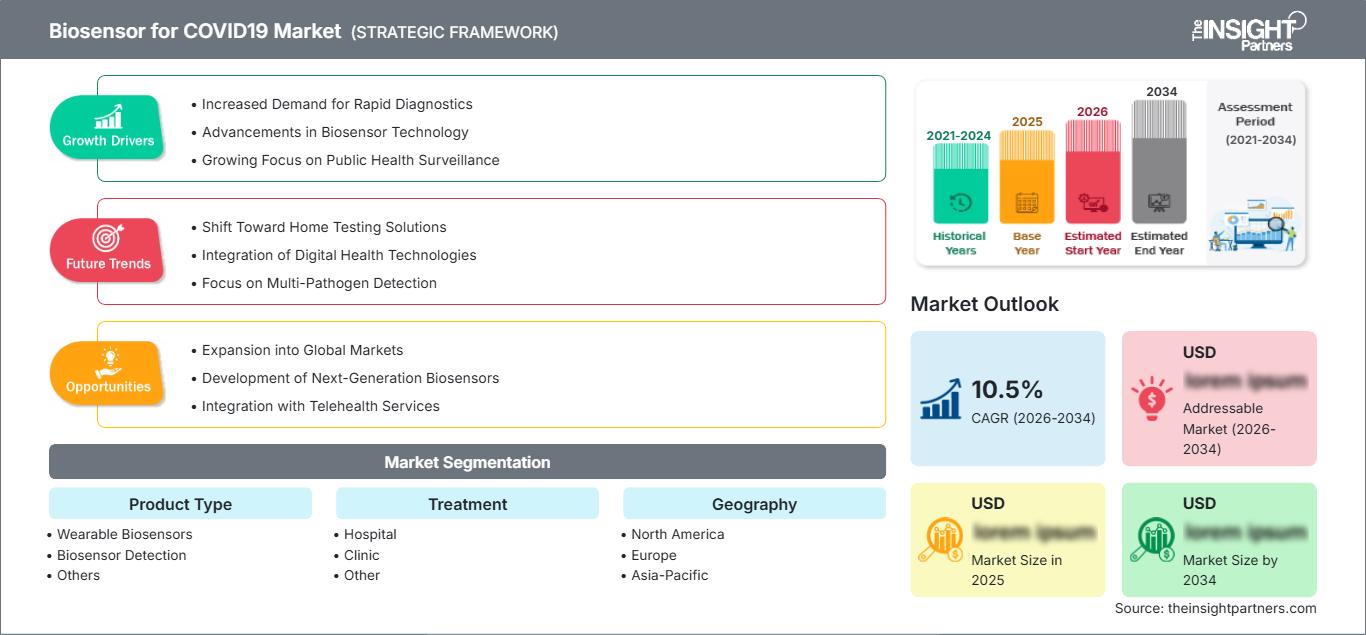
Regional Insights
North America biosensor for covid19 market
North America accounted for an estimated ~38% of global revenue in 2025 and is projected to expand at approximately ~12% CAGR through 2034. The region has an integrated system of point-of-care test infrastructure, diagnostic capability, digital health systems, and significant resources for public health surveillance. Clinicians in hospitals and outpatient facilities are increasingly assessing the utility of respiratory tests in non-emergency pandemic situations.
The market share for the biosensor for covid19 is influenced by early adoption, consumer use of self-tests, and presence of major companies for diagnostics and biomedical technology. The future demand is likely to be driven by multiplex tests, digital reporting, and biosensors that can be used for respiratory diagnostics. Canada makes its contribution to this market with its lab networks and biomedical research, whereas the United States is the hub for commercialization and other activities.
U.S. biosensor for covid19 market
The US represented approximately ~88% of North American revenue in 2025 and is forecast to grow at ~12% CAGR through 2034. Diversified market players include hospitals, clinics, pharmacies, government agencies for public health, and consumers. Market development trends have shifted from the use of large amounts of emergency stock to the use of testing, testing for combinations of respiratory viruses, outbreak preparedness and high risk population monitoring.
The companies having some exposure to the diagnostics market or to health care in general are Abbott Laboratories, Siemens Healthineers AG, F. Hoffmann-La Roche Ltd, Medtronic plc, ACON Laboratories, Inc., LifeScan IP Holdings, LLC and Nova Biomedical Corporation. Analysis of test performance, specimen collection, speed of test results, data reporting, need for storage and cost become more relevant when purchasing tests.
Europe biosensor for covid19 market
Europe held an estimated ~29% of global revenue in 2025 and is expected to register approximately ~11% CAGR through 2034. The region combines pharmaceutical and diagnostic manufacturing, developed laboratory networks, public healthcare systems, and coordinated infectious-disease surveillance. Germany is the leading country in Europe, supported by its diagnostic industry, research infrastructure, hospital capacity, and medical-device engineering base.
The UK has capabilities in biosensors, public health, and decentralized diagnostics. France is contributing to demand via hospital laboratories, biotech innovations, and structured procurement of healthcare services. Italy and Spain have experience in large-scale testing for respiratory pathogens and now are working on integration of COVID-19 testing within the seasonal approach.
European demand is anticipated to prefer assays with capabilities of differentiating several respiratory pathogens and solutions that have already fulfilled performance requirements and standards. Procurement is not going to depend on the volume of emergencies and would be more related to clinical pathways, monitoring of vulnerable populations, and seasonal surveillance. Environmental issues regarding single-use cartridges and electronic elements can influence platform and waste management procurement.
APAC biosensor for covid19 market
Asia Pacific accounted for approximately ~25% of global revenue in 2025 and is projected to record the fastest CAGR of ~15% through 2034. China is the leading country in Asia Pacific, supported by diagnostic manufacturing scale, biosensor research, healthcare digitization, and a substantial addressable population.
Japan contributes precision sensing and medical-device development, while South Korea combines electronics expertise with diagnostic manufacturing. India offers expanding point-of-care demand and cost-efficient production potential. Australia supports clinical research and public-health surveillance. Regional growth will be influenced by localized manufacturing, government preparedness programs, smartphone connectivity, and demand for affordable tests suitable for decentralized healthcare settings.
Middle East & Africa biosensor for covid19 market
The Middle East & Africa market is forecast to grow at approximately ~13% CAGR through 2034 from a smaller commercial base. Saudi Arabia is positioned as the leading country in the Middle East & Africa due to healthcare investment, laboratory modernization, and digital-health development. The UAE supports adoption through advanced hospitals, travel-related screening capabilities, and connected care infrastructure.
South Africa maintains important diagnostic, research, and public-health capabilities. Across the rest of the region, adoption depends on affordability, stable distribution, product shelf life, trained personnel, and compatibility with limited laboratory resources. Investment in electricity, telecommunications, healthcare facilities, and cold-chain infrastructure can improve access, although simple room-temperature platforms may offer the greatest decentralized value.
Segmentation Analysis
Product Type
The biosensor for covid19 market scope includes wearable monitoring products, dedicated detection platforms, and supporting biosensor configurations differentiated by measurement principle, specimen type, portability, and data connectivity. Purchasing depends on intended use, analytical performance, time to result, workflow requirements, and total operating cost. Wearable Biosensors are projected to expand at approximately ~16% CAGR during 2026–2034 as remote monitoring and continuous physiological assessment become more integrated into infectious-disease management.
- Wearable Biosensors: Wearable devices monitor physiological indicators such as temperature, oxygen saturation, respiratory patterns, heart rate, and activity. Their value lies in identifying deterioration or recovery patterns rather than independently confirming infection.
- Biosensor Detection: Detection platforms identify viral components, antibodies, or associated biomarkers using biological recognition elements linked to measurable signals. They support rapid testing, clinical screening, surveillance, and research across centralized and decentralized environments.
- Others: Other products include experimental breath sensors, environmental sensing platforms, biosensor components, and specialized research devices. Commercial relevance depends on validation, sample-handling simplicity, manufacturing economics, and differentiation from established diagnostic methods.
Treatment
Treatment segmentation reflects the setting in which biosensor outputs support testing, monitoring, triage, or patient-management decisions. Requirements vary considerably by infrastructure, user expertise, throughput, and clinical risk. Hospitals prioritize integrated and validated systems, while decentralized settings favor simpler products with limited equipment needs. Clinic applications are expected to register approximately ~14% CAGR through 2034 as respiratory testing becomes embedded within routine outpatient assessment.
- Hospital: Hospitals use biosensors for admission screening, infection control, patient triage, laboratory support, and monitoring of respiratory deterioration. Procurement emphasizes clinical validation, connectivity, throughput, quality controls, and integration with electronic health records.
- Clinic: Clinics require rapid systems that support diagnosis and patient-management decisions during a single visit. Compact instruments, simple cartridges, moderate throughput, and results that can be interpreted without specialized laboratory infrastructure are strategically important.
- Other: Other settings include pharmacies, community testing sites, workplaces, homes, research laboratories, and public-health programs. Demand favors affordability, ease of use, portable operation, clear result interpretation, and secure digital reporting where available.
Opportunity Snapshot
| Treatment | Revenue Contribution | Trend Tag | Adoption Stage |
| Hospital | High | Integrated Triage | Mature |
| Clinic | High | Respiratory Panels | Scaling |
| Other | Medium | Community Testing | Scaling |
Biosensor for COVID19 Market Growth Drivers and Impact Analysis
Integration of COVID-19 into routine respiratory testing
SARS-CoV-2 testing is shifting from isolated emergency programs toward routine respiratory-disease management. Patients presenting with similar symptoms may require differentiation among COVID-19, influenza, respiratory syncytial virus, and other infections. Biosensor platforms that detect multiple targets from one specimen can improve clinical utility and support more efficient treatment decisions. This transition creates demand for adaptable cartridges, multiplex receptor arrays, and instrumentation that remains useful outside major COVID-19 waves. The commercial impact is a more stable procurement model in which platform value is based on year-round respiratory testing rather than dependence on unpredictable pandemic volumes.
Demand for decentralized and rapid clinical decisions
Hospitals and clinics require timely information to determine isolation, additional testing, monitoring, or escalation of care. Biosensors can support this requirement by converting biological recognition into an electrical, optical, or visual signal near the patient. Rapid turnaround can reduce dependence on specimen transport and centralized laboratory schedules. However, clinical value depends on matching performance to the intended setting and disease stage. Market impact favors compact systems with automated controls, limited preparation steps, and clear connectivity. Products that combine speed with dependable quality assurance are better positioned than devices optimized solely for low manufacturing cost.
Expansion of connected monitoring and digital surveillance
COVID-19 accelerated acceptance of remote monitoring, self-testing, telehealth, and digital symptom reporting. Wearable biosensors and connected diagnostic platforms can help clinicians monitor temperature, oxygen saturation, respiration, activity, and other indicators among patients recovering outside hospitals. At a population level, aggregated and appropriately governed data may support outbreak awareness. Commercial opportunities therefore extend beyond the sensor to software, analytics, cloud integration, and clinical dashboards. Vendors must address privacy, cybersecurity, algorithm validation, and interoperability because disconnected data can increase workload without improving decisions. Successful platforms will link measurements with actionable thresholds and defined care pathways.
Biosensor for COVID19 Market Future Trends
Multiplex and variant-resilient detection platforms
Biosensor for covid19 market trends increasingly favor systems capable of detecting several respiratory targets while maintaining performance as circulating variants change. Developers are expected to combine conserved viral targets, interchangeable bioreceptors, microfluidic sample preparation, and sensor arrays within common platforms. Such architectures can reduce dependence on a single pathogen and improve commercial utilization between infection waves. Future competition will focus on analytical sensitivity, cross-reactivity control, time to result, manufacturing reproducibility, and the speed at which assays can be updated. Regulatory strategies that support controlled platform modifications could become commercially important, especially when new respiratory threats require rapid assay adaptation.
Wearables moving from monitoring to predictive support
Wearable devices are expected to progress from passive measurement toward algorithm-assisted identification of changes that may indicate infection or deterioration. Continuous data can establish personal baselines and detect deviations in temperature, respiratory rate, oxygen saturation, sleep, or activity before an individual seeks care. These systems will not necessarily replace confirmatory diagnostics, but they may help prioritize testing and clinical review. Adoption will depend on reducing false alerts, validating algorithms across diverse populations, and integrating outputs into manageable care workflows. Partnerships among sensor companies, healthcare providers, and digital-health platforms will be important to establishing clinically meaningful use cases.
Biosensor for COVID19 Market Opportunities
Adaptable platforms for broader outbreak preparedness
The biosensor for covid19 market Forecasts support investment in platforms that can be reconfigured for emerging respiratory pathogens rather than remaining tied to one virus. Manufacturers can develop common readers, modular receptor chemistries, interchangeable cartridges, and standardized data interfaces. This approach creates value for governments, hospitals, airports, laboratories, and employers seeking preparedness without maintaining extensive single-purpose inventories. Commercial models could combine baseline surveillance capacity with rapid manufacturing expansion during outbreaks. Success requires validated switching procedures, reliable supply chains, and clear regulatory pathways for modified assays.
Affordable biosensors for decentralized healthcare
Emerging markets create opportunities for low-cost biosensors that operate without complex laboratory infrastructure or continuous cold-chain support. Investment should focus on room-temperature stability, simple specimen handling, battery-powered readers, visual or smartphone-assisted interpretation, and locally manufacturable consumables. Distribution partnerships with pharmacies, clinics, and public-health programs can improve access beyond urban hospitals. Suppliers should also develop training and quality-control systems because product availability alone does not ensure dependable results. Platforms that later accommodate influenza, dengue, or other locally relevant infections may achieve stronger utilization and better procurement economics.
Recent Developments
- September 2025: Research teams developing graphene-silver biosensors, a peer-reviewed study introduced a hybrid metasurface biosensor concept intended to improve rapid and precise COVID-19 detection. The work used graphene and silver structures to enhance electromagnetic sensitivity, illustrating continuing investment in label-free sensing architectures that could support future portable detection systems after experimental and clinical validation.
- February 2025: Abbott Diagnostics Scarborough, Inc., the US FDA issued a substantially equivalent decision for the BinaxNOW COVID-19 Antigen Self-Test through the traditional 510(k) pathway. The decision indicates the transition of established COVID-19 self-testing products from emergency-focused authorization toward conventional medical-device regulation and longer-term respiratory diagnostic use.
- January 2025: Abbott Laboratories continued operating its Pandemic Defense Coalition, a network connecting scientific and public-health organizations to identify, track, analyze, and test emerging viral threats. The initiative supports infectious-disease surveillance and illustrates how diagnostic companies are extending COVID-era infrastructure toward broader outbreak preparedness and variant monitoring.
Frequently Asked Questions

- Comprehensive Market Sizing and Forecast Analysis
- Detailed Segmentation Analysis
- In-Depth Market Dynamics Assessment
- Regional and Country-Level Insights
- Competitive Landscape and Company Benchmarking
- Strategic Business Intelligence
Recent Reports
Testimonials

The Insight Partners provided valuable market intelligence that supported our global go-to-market strategy. Their team was professional, responsive, and attentive to our feedback, providing thoughtful analysis and helpful methodological clarifications throughout the project.
Junmo Kim Chief Financial Officer (CFO), Enertech Co., Ltd.
The Insight Partners' SCADA System Market report is comprehensive, with valuable insights on current trends and future forecasts. The team was highly professional, responsive, and supportive throughout. We are very satisfied and highly recommend their services.
RAN KEDEM Partner, Reali Technologies LTDs
I requested a report on a very specific software market and the team produced the report in a few days. The information was very relevant and well presented. I then requested some changes and additions to the report. The team was again very responsive and I got the final report in less than a week.
JEAN-HERVE JENN Chairman, Future Analytica
We worked with The Insight Partners for an important market study and forecast. They gave us clear insights into opportunities and risks, which helped shape our plans. Their research was easy to use and based on solid data. It helped us make smart, confident decisions. We highly recommend them.
PIYUSH NAGPAL Sr. Vice President, High Beam Global
The Insight Partners delivered insightful, well-structured market research with strong domain expertise. Their team was professional and responsive throughout. The user-friendly website made accessing industry reports seamless. We highly recommend them for reliable, high-quality research services
YUKIHIKO ADACHI CEO, Deep Blue, LLC.
This is the first time I have purchased a market report from The Insight Partners.While I was unsure at first, I visited their web site and felt more comfortable to take the risk and purchase a market report.I am completely satisfied with the quality of the report and customer service. I had several questions and comments with the initial report, but after a couple of dialogs over email with their analyst I believe I have a report that I can use as input to our strategic planning process.Thank you so much for taking the extra time and making this a positive experience.I will definitely recommend your service to others and you will be my first call when we need further market data.
JOHN SUZUKI President and Chief Executive Officer, Board Director, BK Technologies
I wish to appreciate your support and the professionalism you displayed in the course of attending to my request for information regarding to infectious disease IVD market in Nigeria. I appreciate your patience, your guidance, and the fact that you were willing to offer a discount, which eventually made it possible for us to close a deal. I look forward to engaging The Insight Partners in the future, all thanks to the impression you have created in me as a result of this first encounter.
DR CHIJIOKE ONYIA MANAGING DIRECTOR, PineCrest Healthcare Ltd.Reason to Buy
- Informed Decision-Making
- Understanding Market Dynamics
- Competitive Analysis
- Identifying Emerging Markets
- Customer Insights
- Market Forecasts
- Risk Mitigation
- Boosting Operational Efficiency
- Strategic Planning
- Investment Justification
- Tracking Industry Innovations
- Aligning with Regulatory Trends





 Get Free Sample for