
Blood Circulation Machine Market Share, Size & Demand by 2034
Coverage: By Technology (Acupressure Therapy, Vibration Therapy, Mental Therapy, Others); Application (Arthritis, Varicose veins, Nerve atrophy, Others), and Geography (North America, Europe, Asia Pacific, and South and Central America)
- Status : Data Released
- Report Code : TIPRE00017778
- Category : Life Sciences
- No. of Pages : 150
- Available Report Formats :


- Last update date : August 17, 2026


2025 Market Size
US$ 1.34 Bn
Base year value
2034 Forecast
US$ 2.15 Bn
Projected by 2034
CAGR 2026-2034
5.38 %
Growth rate
Addressable Market
US$ 15.82 Bn
(2026-2034)
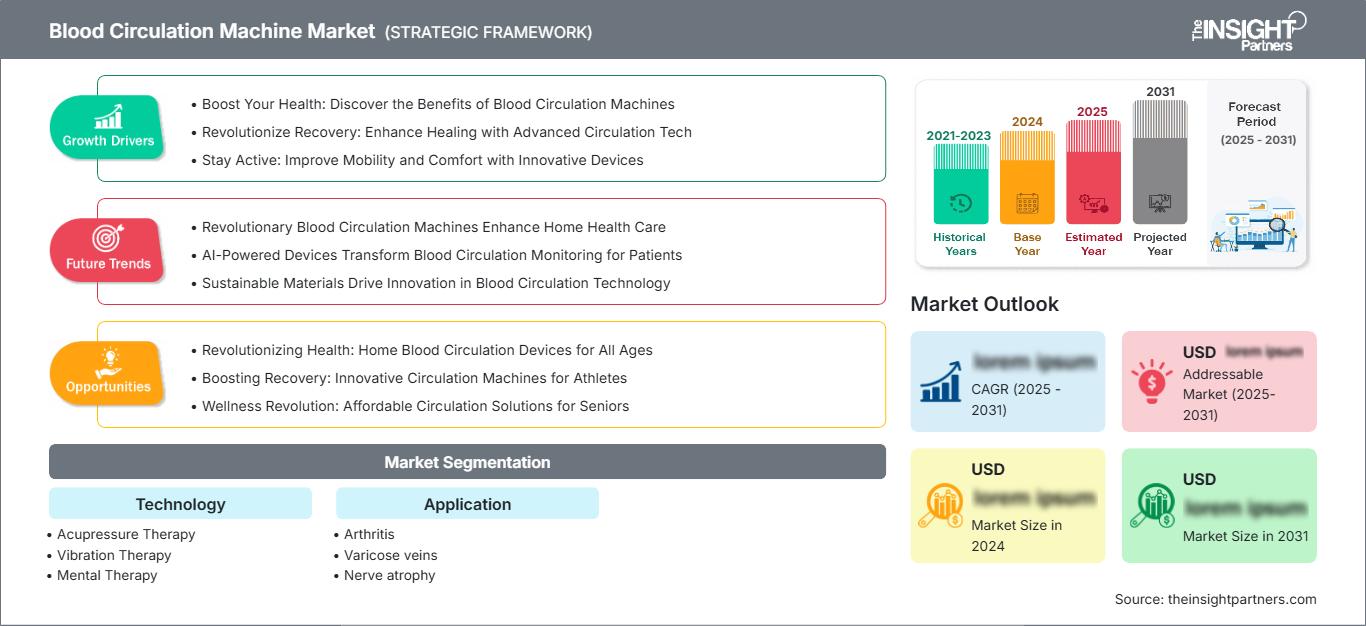
The Blood Circulation Machine Market was valued at US$ 1.34 Billion in 2025 and is projected to reach US$ 2.15 Billion by 2034, registering a CAGR of 5.38% during 2026–2034. Expansion is supported by rising interest in non-invasive wellness technologies, home-based physical recovery, and circulation-focused devices. Product development increasingly combines mechanical stimulation, targeted pressure, vibration, and user-oriented controls to address mobility, discomfort, and recovery requirements across consumer and therapeutic settings.
North America is positioned for steady expansion, with an estimated CAGR of 4.7–5.1% between 2026 and 2034. The Blood Circulation Machine Market size is supported by an aging population, increasing adoption of home-based wellness equipment, and continued interest in non-pharmacological approaches for managing musculoskeletal discomfort and mobility-related concerns.
Blood Circulation Machine Market Assessment and Insights
- North America: The region is estimated to account for a 32–36% share in 2025 and is projected to grow at a CAGR of 4.7–5.1% between 2026–2034, supported by aging demographics and established home healthcare distribution.
- US: The US represents an estimated 70–74% share of North America in 2025 and is expected to expand at a CAGR of 4.6–5.0% during 2026–2034, led by home wellness adoption.
- Europe: Europe is estimated to hold a 24–28% share in 2025 and register a CAGR of 4.5–4.9% through 2034, with Germany, the UK, France, Italy, and Spain supporting demand through aging populations and rehabilitation awareness.
- Asia Pacific: Asia Pacific is estimated at a 25–29% share in 2025 and is projected to grow at a CAGR of 6.1–6.5%, led by China, Japan, South Korea, India, and Australia through expanding consumer wellness ecosystems.
- Largest Segment: Technology accounts for an estimated 44–48% share in 2025, with a CAGR of 5.1–5.5% during 2026–2034 as vibration-oriented systems gain wider consumer acceptance.
- High Growth Segment: Application is estimated at a 38–42% share in 2025, with a CAGR of 5.8–6.2% during 2026–2034 as mobility-focused use expands.
- Key companies analyzed in detail: Ultra Health Port, Taicn, Huangwei, LUYAO, Mimir, Shanghai Rongtai Health Technology Corporation Limited, JSB Health & Fitness Pvt Ltd, GHK H48, Nureca Limited, and TENS.
Source: The Insight Partners' analysis based on proprietary research, government publications, company annual reports, investor presentations, industry databases, and expert interviews.
Product evolution is moving from basic mechanical stimulation toward multifunctional equipment combining vibration, pressure points, infrared support, adjustable intensity, and compact form factors. Manufacturing remains fragmented, with suppliers differentiating through motor durability, ergonomic design, operating modes, portability, and price positioning. The Blood Circulation Machine Market is therefore developing across both dedicated circulation products and broader wellness platforms.
Future growth will be focused on home-based fitness solutions based on digital technology, light equipment, and recovery solutions. There are many chances for distribution within emerging markets since more people have access to healthcare and self-manage issues related to movement and pain from their homes. There are also encouraging signs with regard to safety guidelines for electrical and at-home equipment.
Blood Circulation Machine Market Report Scope
| Report Attribute | Details |
|---|---|
| Market size in 2025 | US$ 1.34 Billion |
| Market Size by 2034 | US$ 2.15 Billion |
| Global CAGR (2026 - 2034) | 5.38% |
| Historical Data | 2021-2024 |
| Forecast period | 2026-2034 |
Blood Circulation Machine Market Analysis
Demand is influenced by demographic aging, sedentary lifestyles, rehabilitation requirements, and consumer interest in non-invasive wellness routines. The Blood Circulation Machine Market growth ecosystem includes component suppliers, motor and electronics manufacturers, therapy-equipment assemblers, distributors, online retailers, physiotherapy providers, and direct-to-consumer channels. Demand is particularly relevant where users seek repeatable home sessions without frequent clinical appointments.
Supply still features fairly easy access to manufacturing technologies, making it possible for many regional companies to compete on price and functionality. Parts like motors, controllers, pressure sensors, vibration generators, enclosures, and power supplies may be obtained via existing electronics and consumer devices distribution channels. Distinguishing characteristics now include not only reliability and after-sales service, but also safety documentation, ergonomics, and multiple stimulation types in one device.
The competitive landscape comprises specialist wellness-equipment providers as well as wider home health care portfolios. Ultra Health Port specializes in physiotherapy and circulation machines, whereas JSB Health & Fitness Pvt Ltd is a blend of wellness equipment with an existing logistics and service infrastructure. Nureca Limited has Dr. Trust as its main brand, with products available both for the connected home health care and wellness sectors, whereas Shanghai Rongtai Health Technology Corporation Limited focuses on high-end massage and intelligent therapy technology.
Investment focus is turning to the diversification of the product offering, improved digital interface, and better consumer distribution rather than increasing production capacity. Brands that are active within this crowded competitive landscape include Taicn, Huangwei, LUYAO, Mimir, GHK H48, and TENS. The key to strategic positioning increasingly lies in offering products that are affordable, functional, serviceable, and have a unique value proposition.
● REPORT CUSTOMIZATION
Tailor This Report To Align With Your Specific Business Requirements
This report can be customized to align precisely with your business objectives, scope, and target markets. Customization options include tailored segmentation, geography, competitive analysis, and strategic insights to support informed decision-making.
Customize This Report →WHAT YOU CAN ADJUST
- ● Segmentations
- ● Geography
- ● Competitive Analysis
- ● Language Preferences
Blood Circulation Machine Market: Strategic Insights
Regional Insights
North America Blood Circulation Machine Market
North America is estimated to hold a 32–36% of the Blood Circulation Machine Market share in 2025 and is projected to expand at a CAGR of 4.7–5.1% through 2034. The local opportunity is characterized by the presence of well-developed healthcare systems, consumers' knowledge about rehabilitation products, and a rising tendency to stay healthy at home. The USA represents the key market, but there are other opportunities offered by Canada and Mexico owing to the development of retail and healthcare channels.
Furthermore, there are growing trends towards an aging population and interest in maintaining mobility without resorting to complicated medical procedures. A combination of vibration, pressure treatment, heat and compact controls can satisfy a variety of consumer needs. When entering the North American market, manufacturers need to pay attention to safety labeling, electrical requirements, user instructions, warranty service, and clinically correct product claims since the purchase decision is based on reliability and appropriateness.
U.S. Blood Circulation Machine Market
The US accounts for approximately 70–74% of North America's 2025 market and is forecast to grow at a CAGR of 4.6–5.0% during 2026–2034. The scope is a function of advanced e-commerce distribution, home healthcare usage, and availability of physiotherapy and wellness devices. The target group includes the elderly, the physically active, and those in need of comfort at home.
The applications have become more focused on legs, feet, mobility, therapy, and relaxation. The availability of international and Indian wellness brands in the USA helps ensure product availability through online stores and specialty retailers. Regulatory issues play a key role due to the safety and usability concerns for electric devices used at home.
Europe Blood Circulation Machine Market
Europe is estimated to represent a 24–28% share in 2025 and is expected to grow at a CAGR of 4.5–4.9% through 2034. Germany is the leading country, followed by the UK, France, Italy, and Spain, with demand shaped by demographic aging, rehabilitation awareness, and established consumer healthcare channels.
The UK and Germany provide relatively mature environments for home wellness and rehabilitation products, supported by strong healthcare infrastructure and consumer familiarity with therapeutic equipment. France, Italy, and Spain contribute through aging populations, expanding wellness consumption, and greater interest in non-invasive mobility support. Across Europe, manufacturers face a more demanding regulatory environment, making documentation, electrical safety, product traceability, and responsible therapeutic positioning important commercial considerations.
APAC Blood Circulation Machine Market
APAC is estimated to command a 25–29% share in 2025 and is projected to record a CAGR of 6.1–6.5%. China is the leading country, supported by manufacturing capacity and domestic wellness demand, while Japan and South Korea benefit from advanced consumer health technologies.
India and Australia add regional breadth through expanding home healthcare and wellness channels. Demographic aging is particularly significant across Asia Pacific, increasing interest in mobility and active aging solutions. Industrial capabilities, digital commerce, and public emphasis on preventive health support market development, while local manufacturers can compete through cost-effective designs and compact equipment suited to residential use.
Middle East & Africa Blood Circulation Machine Market
The Middle East and Africa are expected to develop from a smaller base, with Saudi Arabia leading the regional opportunity. Saudi Arabia and the UAE benefit from healthcare modernization and infrastructure investment, while South Africa provides a relatively established healthcare and consumer market environment.
The rest of MEA remains more fragmented because purchasing power, distribution networks, and clinical equipment availability vary significantly between countries. The regional outlook is supported by investment in healthcare infrastructure, wellness facilities, and preventive services. Energy availability and urban infrastructure support powered equipment adoption in major population centers, although import logistics and service coverage remain important constraints for suppliers.
Segmentation Analysis
Technology
Technology represents the principal product classification, with a CAGR of 5.1–5.5% during 2026–2034. Product selection depends on the intended stimulation mechanism, ease of operation, intensity control, and perceived comfort. Vibration-oriented systems benefit from broad consumer familiarity, while acupressure-based equipment appeals to users seeking pressure-point stimulation. Mental therapy remains a smaller, specialized approach within the portfolio.
- Acupressure Therapy: Acupressure-based products appeal to consumers seeking pressure-point stimulation and traditional wellness concepts. Their strategic importance lies in combining familiar therapeutic principles with powered equipment suitable for repeat home use.
- Vibration Therapy: Vibration therapy has broad positioning across relaxation, mobility, and recovery applications. Manufacturers emphasize adjustable intensity, portable construction, and multifunctional operation to reach consumers seeking convenient daily routines.
- Mental Therapy: Mental therapy equipment occupies a specialized position, emphasizing relaxation and perceived stress reduction. Its relevance is strongest where circulation-oriented wellness products are positioned as broader physical and mental recovery solutions.
Application
Application is projected to expand at a CAGR of 5.8–6.2% during 2026–2034. Demand is linked to the specific mobility or discomfort concern addressed by the equipment. Arthritis and varicose veins provide broad use cases, while nerve atrophy represents a more specialized application requiring careful positioning around therapeutic expectations and appropriate professional guidance.
- Arthritis: Arthritis-related use represents an important demand pool because consumers frequently seek convenient methods for managing stiffness, discomfort, and mobility limitations alongside established clinical care.
- Varicose veins: Varicose vein applications create demand for lower-limb-focused equipment and products designed around relaxation and circulation support, particularly among consumers seeking home-based comfort measures.
- Nerve atrophy: Nerve atrophy applications are more specialized and require careful product positioning. Equipment serving this need can support targeted wellness routines where users value controlled stimulation and straightforward operation.
Opportunity Snapshot
| Segment Name | Revenue Contribution | Trend Tag | Adoption Stage |
|---|---|---|---|
| Leukemia | High | Precision Therapy | Mature |
| Lymphoma | High | Antibody Therapy | Mature |
| Myeloma | High | Combination Regimens | Mature |
| Chemotherapeutic | High | Cytotoxic Backbone | Mature |
| MAbs/Targeted Therapies | High | Targeted Biology | Scaling |
| Immunotherapeutic | Medium | Immune Engagers | Scaling |
Blood Circulation Machine Market Growth Drivers and Impact Analysis
Population Aging Expands Mobility-Focused Wellness Demand
Population aging results in an increase in the target customer group for the development of the equipment, facilitating mobility and well-being. WHO statistics state that the world population aged over 60 years will reach 1.4 billion in 2030, against 1 billion in 2020. Such trends become more relevant with regard to convenient and easily operable home equipment aimed at promoting the wellness and health of older people. Commercial potential is especially high when it comes to the ease of use, portability, and convenience for repeated workouts. This means that suppliers can increase market penetration through the design of user-friendly controls, simple installation, and instructions. Retailers can take advantage of placing the product near the equipment of mobility aids and physical therapy tools.
Expansion of Home-Based Care Supports Repeat Device Use
The trend of health care at home and wellness gives rise to continuous opportunities for equipment that is easy to use without much installation. FDA recommendations on home-use equipment put emphasis on the issues of safety and effectiveness of such equipment and on how it will work in an environment where it will be used by its owner, stressing the necessity of user-friendly controls and safety in design. From the commercial point of view, it provides opportunities for equipment that does not require much installation in order to be bought not only from specialized clinical channels but also from any other channel of distribution.
Broader Interest in Non-Invasive Wellness Encourages Product Diversification
The growing popularity of non-invasive solutions for relaxation, movement, and recovery has broadened the use case potential for circulation-based products. According to the WHO, the use of traditional, complementary, and integrative medicine is recorded in 170 countries, highlighting how widely consumers are acquainted with non-pharmacological treatments. It creates an opportunity for solutions that integrate mechanical stimulation with the concept of pressure points or vibration. Commercial success will most likely lie in multi-purpose platforms instead of limited-use equipment. Manufacturers may diversify their product range through adjustable settings, interchangeable parts, and integration of vibration and pressure stimulation. But still, the right positioning is important since wellness effects must not substitute for diagnostics or treatment.
Blood Circulation Machine Market Future Trends
AI-Assisted Personalization Will Reshape Device Interfaces
The Blood Circulation Machine Market trends are likely to move toward personalized operating programs that adjust intensity, duration, and stimulation patterns according to user preferences. The devices may track the usage history of the session and make suggestions through some easy algorithmic models regarding routines. There could be a mobile interface for helping users track the consistency of their usage. The next stage of development will probably focus more on personalized usage than on clinical analysis. There might be sensors that could detect touch, motion, or pressure to increase the comfort and consistency of usage. This would also be helpful for designing premium products with personalized features.
Compact Multifunctional Systems Will Gain Residential Relevance
The future developments of products would be expected to revolve around systems that would be designed to accommodate several body areas through a single device instead of multiple devices for different parts of the body. People who have smaller houses may desire devices that would integrate the functionalities of vibration, acupressure, heating and programmability into one. This approach will be able to decrease the space needed for storage and increase the value attached to the products. The manufacturers might even go for a modular approach when designing the products to enable easy maintenance and replacement of components. Portability will become more significant in developing countries because of the desire for cost and flexibility.
Blood Circulation Machine Market Opportunities
Develop Affordable Regional Product Platforms
Emerging economies offer opportunities for manufacturers that can adapt product specifications to local purchasing power and infrastructure conditions. India, Southeast Asia, Latin America, and selected Middle Eastern markets provide attractive channels because home wellness awareness is expanding while specialist clinical equipment remains unevenly distributed. The Blood Circulation Machine Market Forecasts can benefit from localized models featuring essential functions, low maintenance requirements, and region-specific electrical configurations. Investors should prioritize partnerships with established distributors, physiotherapy networks, pharmacies, and e-commerce platforms rather than relying exclusively on premium retail. Local assembly or regional sourcing could further improve cost competitiveness. A tiered portfolio spanning entry-level, mid-range, and multifunctional products would allow suppliers to capture varied consumer budgets.
Build Service-Led Distribution and After-Sales Networks
After-sales support represents a strategic opportunity because powered wellness equipment requires user confidence in durability, maintenance, and warranty handling. Suppliers can differentiate through spare-parts availability, instructional content, installation assistance, and responsive service channels. The Blood Circulation Machine Market Report can therefore support commercial decisions by assessing not only product demand but also channel readiness and service economics. Companies entering new markets should map warranty costs, repair logistics, distributor capabilities, and return rates before scaling inventory. Partnerships with physiotherapy centers and wellness retailers can provide demonstration opportunities while creating feedback loops for product refinement. A service-led approach may improve retention and strengthen brand credibility where competing devices have similar basic specifications.
Recent Developments
- June 2026: Nureca Limited, the company behind Dr Trust, announced that Dr Trust 360 had surpassed 2.4 million registered users and launched Dr Trust Intelligence, an AI-powered analytics suite providing body-composition interpretation, trend detection, and guided recommendations. The initiative demonstrates continued movement toward connected home healthcare platforms and personalized wellness management.
- May 2026: Shanghai Rongtai Health Technology Corporation Limited showcased its RT9000 series and an AI therapy robot at the 139th Canton Fair. The company highlighted intelligent massage technologies, full-body stretching functions, and advanced mechanical control, reinforcing its strategic shift toward technology-led smart health solutions and broader international exposure for its wellness equipment portfolio.
- March 2026: JSB Health & Fitness Pvt Ltd expanded its home-wellness content and product positioning around at-home pain management, circulation, and recovery. Its March 2026 publications addressed home wellness adoption and non-medicated pain-management equipment, reflecting the company's focus on consumer education, digital distribution, and broader integration of wellness devices into household routines.
Frequently Asked Questions

- Comprehensive Market Sizing and Forecast Analysis
- Detailed Segmentation Analysis
- In-Depth Market Dynamics Assessment
- Regional and Country-Level Insights
- Competitive Landscape and Company Benchmarking
- Strategic Business Intelligence
Recent Reports
Testimonials

The Insight Partners provided valuable market intelligence that supported our global go-to-market strategy. Their team was professional, responsive, and attentive to our feedback, providing thoughtful analysis and helpful methodological clarifications throughout the project.
Junmo Kim Chief Financial Officer (CFO), Enertech Co., Ltd.
The Insight Partners' SCADA System Market report is comprehensive, with valuable insights on current trends and future forecasts. The team was highly professional, responsive, and supportive throughout. We are very satisfied and highly recommend their services.
RAN KEDEM Partner, Reali Technologies LTDs
I requested a report on a very specific software market and the team produced the report in a few days. The information was very relevant and well presented. I then requested some changes and additions to the report. The team was again very responsive and I got the final report in less than a week.
JEAN-HERVE JENN Chairman, Future Analytica
We worked with The Insight Partners for an important market study and forecast. They gave us clear insights into opportunities and risks, which helped shape our plans. Their research was easy to use and based on solid data. It helped us make smart, confident decisions. We highly recommend them.
PIYUSH NAGPAL Sr. Vice President, High Beam Global
The Insight Partners delivered insightful, well-structured market research with strong domain expertise. Their team was professional and responsive throughout. The user-friendly website made accessing industry reports seamless. We highly recommend them for reliable, high-quality research services
YUKIHIKO ADACHI CEO, Deep Blue, LLC.
This is the first time I have purchased a market report from The Insight Partners.While I was unsure at first, I visited their web site and felt more comfortable to take the risk and purchase a market report.I am completely satisfied with the quality of the report and customer service. I had several questions and comments with the initial report, but after a couple of dialogs over email with their analyst I believe I have a report that I can use as input to our strategic planning process.Thank you so much for taking the extra time and making this a positive experience.I will definitely recommend your service to others and you will be my first call when we need further market data.
JOHN SUZUKI President and Chief Executive Officer, Board Director, BK Technologies
I wish to appreciate your support and the professionalism you displayed in the course of attending to my request for information regarding to infectious disease IVD market in Nigeria. I appreciate your patience, your guidance, and the fact that you were willing to offer a discount, which eventually made it possible for us to close a deal. I look forward to engaging The Insight Partners in the future, all thanks to the impression you have created in me as a result of this first encounter.
DR CHIJIOKE ONYIA MANAGING DIRECTOR, PineCrest Healthcare Ltd.Reason to Buy
- Informed Decision-Making
- Understanding Market Dynamics
- Competitive Analysis
- Identifying Emerging Markets
- Customer Insights
- Market Forecasts
- Risk Mitigation
- Boosting Operational Efficiency
- Strategic Planning
- Investment Justification
- Tracking Industry Innovations
- Aligning with Regulatory Trends





 Get Free Sample for