
Blood Culture Tests Market Growth, Demand & Size by 2034
Coverage: By Product (Instruments, Consumables, Reagents and Kits, Software and Services); Method (Conventional Blood Culture, Automated Blood Culture); Technology (Proteomic Technology, Culture-based Technology, Molecular Technology); End User (Hospitals and Clinics, Diagnostic and Research Laboratories, Others), and Geography (North America, Europe, Asia Pacific, and South and Central America)
- Status : Data Released
- Report Code : TIPRE00019260
- Category : Life Sciences
- No. of Pages : 150
- Available Report Formats :


- Last update date : August 17, 2026


2025 Market Size
US$ 6.72 Bn
Base year value
2034 Forecast
US$ 11.44 Bn
Projected by 2034
CAGR 2026-2034
6.09 %
Growth rate
Addressable Market
US$ 82.23 Bn
(2026-2034)
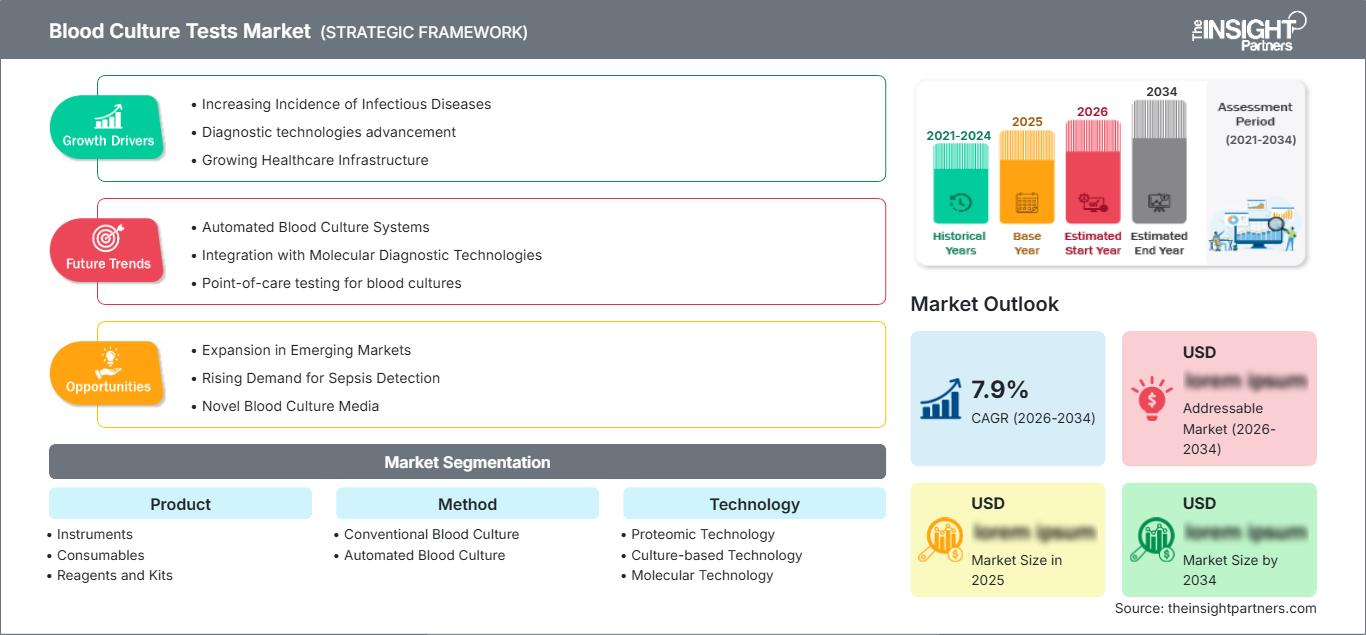
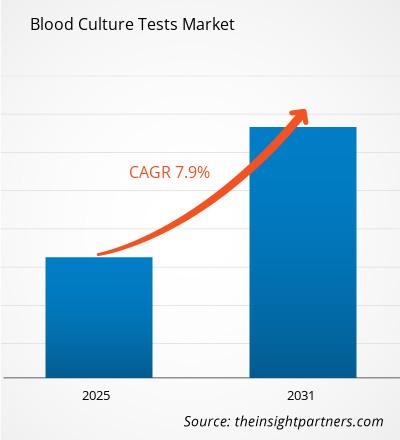
The global Blood Culture Tests market was valued at US$ 6.72 billion in 2025 and is expected to reach US$ 11.44 billion by 2034; it is estimated to record a CAGR of 6.09% during 2026-2034.
Blood Culture Tests Market Assessment and Insights
- North America: North America represented an estimated 38–42% Blood Culture Tests Market share in 2025 and is projected to grow at a CAGR of 6.2–6.7% between 2026–2034, supported by mature laboratory infrastructure, sepsis programs, and automation adoption.
- US: The US accounted for an estimated 82–86% of North American revenue in 2025, with a projected CAGR of 6.1–6.6% through 2034, led by hospital microbiology demand.
- Europe: Europe held an estimated 25–29% share in 2025 and is expected to register a 6.0–6.5% CAGR through 2034. Germany, the UK, France, Italy, and Spain remain important demand centers.
- Asia Pacific: Asia Pacific captured an estimated 20–24% share in 2025 and is forecast to grow at 7.1–7.7%, led by China, Japan, India, and South Korea as laboratory modernization accelerates.
- Largest Segment: Consumables represented an estimated 55–60% market share in 2025, with a 6.5–7.0% CAGR between 2026–2034, reflecting recurring bottle and reagent requirements.
- High Growth Segment: Molecular Technology held an estimated 12–16% market share in 2025 and is projected to grow at 8.5–9.2%, benefiting from rapid identification workflows.
- Key companies analyzed in detail: Becton, Dickinson and Company, Thermo Fisher Scientific Inc., bioMérieux SA, Danaher Corporation, F. Hoffmann-La Roche Ltd, Bruker Corporation, Abbott Laboratories, Luminex Corporation, Autobio Diagnostics Co., Ltd., Abtek Biologicals Ltd.
Source: The Insight Partners' analysis based on proprietary research, government publications, company annual reports, investor presentations, industry databases, and expert interviews.
The Blood Culture Tests Market has developed from manual procedures in microbiology laboratories to automated incubation, continuous monitoring, automatic identification, and connected laboratory operations. Automation minimizes the need for repeated handling, as well as enables standardized detection methods. Manufacturing trends now center around bottle homogeneity, media formulation, compatibility with machines, and resilience of supplies. The FDA's 2024 notification regarding disruptions to BD BACTEC blood culture media bottles showed how supply chain concerns could impact diagnostics.
Future developments will see adoption increase in new health care systems, where microbiology laboratories are increasingly investing in automation and surveillance of antimicrobial resistance. Regulatory focus on diagnostics quality and traceability will encourage connected workflows and validated supplies. WHO's antimicrobial resistance diagnostics program particularly encourages bacteriology capabilities, standardized lab systems, and innovations that enable precise, quick, and usable diagnostics.
Blood Culture Tests Market Report Scope
| Report Attribute | Details |
|---|---|
| Market size in 2025 | US$ 6.72 Billion |
| Market Size by 2034 | US$ 11.44 Billion |
| Global CAGR (2026 - 2034) | 6.09% |
| Historical Data | 2021-2024 |
| Forecast period | 2026-2034 |
Blood Culture Tests Market Analysis
Demand is influenced by sepsis diagnostics, antimicrobial stewardship, hospital acquired infections monitoring, and differentiation between true bloodstream infections and contaminants. The market for Blood Culture Tests is thus driven by an interconnected ecosystem that includes specimen collection, media, automation equipment, identification technology, laboratory management system, and clinical interpretation. The supply of blood culture tests depends on the capacity for sterile production, media, plastics, glass, sensors, and specific instrumentation supplies.
Hospitals usually focus on the accuracy of time-to-detection, constant supply of bottles, and compatibility of the solution with their existing laboratory environment. Diagnostic laboratories prefer higher throughput and quality control, while research laboratories require special media and more flexibility in workflow. The value chain is becoming more and more focused on the suppliers who can integrate instruments and consumables with informatics.
Platform capability rather than instrument capability alone seems to be the key to competitive positioning. Becton, Dickinson and Company is strong in automated culture through the BACTEC brand, while bioMérieux SA has the edge with integrated microbiology and rapid molecular platforms. Thermo Fisher Scientific Inc. has traditionally covered culture media, susceptibility testing, and microbiology platforms, whereas Danaher Corporation can leverage a larger diagnostic portfolio.
F. Hoffmann-La Roche Ltd, Abbott Laboratories, Bruker Corporation, Luminex Corporation, Autobio Diagnostics Co., Ltd., and Abtek Biologicals Ltd. operate in complementary niches of diagnostics or microbiology segments. Investment is increasingly made in automation, connectivity, faster organism detection, and integration into workflows. An example of portfolio rebalancing by Thermo Fisher through its agreement to sell its microbiology business to Astorg in 2026 for about US$1.075 billion demonstrates that point well.
● REPORT CUSTOMIZATION
Tailor This Report To Align With Your Specific Business Requirements
This report can be customized to align precisely with your business objectives, scope, and target markets. Customization options include tailored segmentation, geography, competitive analysis, and strategic insights to support informed decision-making.
Customize This Report →WHAT YOU CAN ADJUST
- ● Segmentations
- ● Geography
- ● Competitive Analysis
- ● Language Preferences
Blood Culture Tests Market: Strategic Insights
Regional Insights
North America Blood Culture Tests Market
North America contributes to 38-42% of 2025 revenue with CAGR at 6.2-6.7% until 2034. This market region enjoys a robust network of hospitals laboratories, a higher presence of automated platforms, an effective antimicrobial stewardship program and a high need for a reproducible microbiology workflow. The USA is still the major market, whereas Canada meets the regional market demand through centralized laboratory services and tertiary care facilities.
Purchases are made taking into account workflow efficiency and not just the price of the instrument. The hospitals require continuous monitoring, supply of consumables, connectivity to the laboratory information system and compatibility with antimicrobial susceptibility workflows. In 2024, there was a shortage of blood culture bottles in the USA.
U.S. Blood Culture Tests Market Market
The US accounted for an estimated 82–86% of North American sales in 2025 and is expected to register a CAGR of 6.1–6.6%. Major hospitals, reference labs, academic institutions, and IDN organizations ensure high utilization of instruments and continual need for consumables. Key vendors have already established their commercial and service presence in the country.
Trends in applications are increasingly focused on sepsis workflows, antibiotic stewardship, bloodstream infections monitoring, and diagnostic stewardship. Machine learning studies, which included over 135,000 blood culture orders from the ED, highlight increasing attention to using clinical information for better testing and minimizing its inappropriate ordering.
Europe Blood Culture Tests Market
Europe had a market share of 25-29% in 2025 and is anticipated to grow at a CAGR of 6.0-6.5%, with Germany being the major market in terms of countries. The growth will be fueled by well-developed hospital laboratories, antimicrobial resistance (AMR) programs, and European regulation of diagnostic products and quality systems.
In the UK, there is sustained demand due to centralized laboratory systems and AMR programs. Germany has huge hospital infrastructure along with microbiology testing capabilities. France, Italy, and Spain will drive the market via their healthcare systems and tertiary care laboratories. In all these markets, the laboratories are moving towards automation, traceability, and integration while replacing existing platforms. According to WHO, AMR causes an estimated 133,000 deaths per year in the European Region.
APAC Blood Culture Tests Market
In 2025, APAC is expected to hold 20-24% share and grow at a CAGR of 7.1-7.7%, thus being the fastest growing market among all. China is leading regional demand, followed by Japan, South Korea, India, and Australia. Lab modernization and increase in hospital facilities widen adoption of automated testing.
Expansion of industries includes policies related to surveillance of infectious diseases and antimicrobial resistance. China and Japan can be considered as matured laboratories while India is a huge market for automation within growing diagnostics industry. Australia and South Korea facilitate adoption with high level of hospital infrastructure and laboratory systems.
Middle East & Africa Blood Culture Tests Market
MEA region is expected to register growth at a CAGR of 5.4%-6.0%, with Saudi Arabia being the key player among all other countries in terms of demand, followed by UAE and South Africa. Hospital infrastructure development, development of tertiary care facilities, and upgrading laboratories increase the need for standardized blood stream infection tests.
Saudi Arabia and UAE have good healthcare infrastructure development plans whereas South Africa continues to be the main country for laboratories for testing of infections. Demand in rest of MEA is relatively inconsistent owing to inconsistent budgetary plans, personnel availability and maintenance capacity.
Segmentation Analysis
Product
Product remains central to laboratory purchasing because each workflow depends on compatible hardware, recurring consumables, reagents, software, and technical support. The segment is estimated to expand at a CAGR of 6.4–6.9% during 2026–2034. Recurring consumables and reagents support revenue continuity, while connected software increasingly influences instrument replacement decisions.
- Instruments: Automated analyzers remain strategically important for laboratories seeking continuous incubation, standardized detection, higher throughput, and reduced manual observation requirements.
- Consumables: Culture bottles and related consumables form the recurring foundation of testing workflows, making availability, compatibility, contamination control, and supply reliability critical procurement considerations.
- Reagents and Kits: Reagents and kits support organism identification and downstream interpretation, with demand linked closely to laboratory throughput and the expansion of integrated microbiology workflows.
- Software and Services: Connectivity, instrument monitoring, maintenance, validation, and laboratory support services increasingly differentiate platforms as laboratories pursue standardized digital operations.
Method
Method is expected to register a CAGR of 6.3–6.8% during 2026–2034. Conventional culture remains indispensable because it enables organism recovery and downstream susceptibility testing, whereas automated culture increasingly dominates operational workflows by improving monitoring consistency and reducing manual intervention.
- Conventional Blood Culture: Conventional workflows remain important where laboratories require established culture procedures, flexible downstream testing, or cost-conscious approaches to microbiological investigation.
- Automated Blood Culture: Automated systems gain preference in higher-volume facilities because continuous monitoring, standardized incubation, and workflow integration can improve laboratory productivity and result management.
Technology
Technology is projected to grow at 7.0–7.6% during 2026–2034 as laboratories combine established culture methods with faster analytical technologies. The Blood Culture Tests Market scope increasingly encompasses hybrid workflows in which culture provides recoverable organisms while molecular or proteomic tools accelerate identification.
- Proteomic Technology: Proteomic approaches support rapid organism characterization after positive cultures and can shorten identification workflows without requiring complete replacement of established culture infrastructure.
- Culture-based Technology: Culture-based technology remains foundational because it provides viable isolates for identification, susceptibility testing, epidemiological investigation, and antimicrobial stewardship.
- Molecular Technology: Molecular methods attract investment where rapid identification is strategically important, particularly for high-risk bloodstream infections requiring accelerated clinical intervention.
End User
End User is expected to grow at a CAGR of 6.1–6.7% during 2026–2034. Hospitals and clinics remain the principal demand center, while diagnostic and research laboratories support centralized testing, reference services, surveillance, and specialized microbiology applications.
- Hospitals and Clinics: These facilities generate substantial testing demand because suspected sepsis, intensive-care cases, immunocompromised patients, and healthcare-associated infections require timely microbiological investigation.
- Diagnostic and Research Laboratories: Centralized laboratories value high throughput, standardized workflows, instrument utilization, and connectivity across multiple specimen sources and healthcare facilities.
- Others: Other users include specialized institutions and settings requiring targeted microbiology capabilities, particularly where surveillance, research, or specialized infectious disease testing is performed.
Opportunity Snapshot
| Segment Name | Revenue Contribution | Trend Tag | Adoption Stage |
|---|---|---|---|
| Hospitals and Clinics | High | Sepsis Testing | Mature |
| Diagnostic and Research Laboratories | Medium | Centralized Testing | Scaling |
| Others | Low | Specialty Testing | Emerging |
Blood Culture Tests Market Growth Drivers and Impact Analysis
Rising Antimicrobial Resistance and Sepsis Burden
The increasing incidence of antimicrobial resistance is driving up the need for microbiological verification before any escalation or de-escalation of antibiotics. According to the WHO, in 2023, about one out of six lab-confirmed cases of bacterial infections were resistant to antibiotics, with bloodstream infections with resistant Gram-negative bacteria being especially critical. This creates an environment in which hospital labs need to enhance their culture capabilities, improve the quality of samples, and link the findings from the microbiology laboratory to antimicrobial stewardship programs. On a commercial level, the effects do not stop at the acquisition of equipment because increased testing leads to increased need for bottles, media, reagents, services, and software.
Expansion of Automated Microbiology Workflows
The economic implications of automation for the laboratory industry include converting repetitive tasks such as incubation, detection, monitoring, and documentation into standardized activities through instrumental controls. Automation has the capacity to run constantly, can accommodate greater sample volumes, and has better monitoring capabilities than the intermittency characteristic of manual monitoring. Such capabilities are particularly significant for hospitals that experience intensive care loads, as well as for laboratories operating in a centralized fashion in order to serve several institutions. The business aspects of automation include not only the placement of the instrument but also the ongoing requirement of related supplies and maintenance. Automation is becoming more and more a part of workflow analysis as opposed to a mere acquisition.
Strengthening Laboratory Quality and Diagnostic Stewardship
The laboratory quality programs are putting more focus on the collection of the specimens, contamination issues, blood volume, traceability, and appropriate testing. All these aspects have a direct impact on platform economics since poor collecting of specimens may result in decreased diagnostic significance and increased frequency of repeats and additional antibiotic exposure. The FDA reaction to the blood culture media shortage in 2024 is another example of the disruptions that might affect the patient's diagnosis and subsequent follow-up and antimicrobial stewardship. As a result, procurement teams are paying more attention to the supply chain resilience, quality control, integration, and vendor cooperation. Suppliers may be benefited from the products addressing the workflow risks that can be measured, namely contamination, insufficient blood volume, late detection, and poor documentation.
Blood Culture Tests Market Future Trends
AI-Assisted Diagnostic Stewardship
Blood Culture Tests market trends will evolve towards artificial intelligence technology capable of determining clinical context both before and after ordering cultures. In the future, such algorithms may take into account patient history within electronic health records, laboratory history, vital signs, exposure to medications, and past microbiological data to order cultures only in cases where there is a high probability that tests can be helpful. Algorithms of this sort could help with diagnostic stewardship since they would not require conducting unnecessary tests and, at the same time, maintain the sensitivity for those patients who are at risk. It is expected that this process of integration will first occur through laboratory information systems and clinical decision-support systems rather than through replacement of current analyzers.
Integrated Culture-to-Identification Workflows
Future platforms are likely to connect positive culture detection more closely with rapid identification and downstream susceptibility workflows. Instead of treating incubation, organism identification, and antimicrobial testing as separate laboratory stages, manufacturers can create coordinated workflows that transfer results and sample information automatically. This architecture may reduce manual transcription and accelerate clinical communication after a positive result. Proteomic and molecular technologies will increasingly complement culture rather than replace it, particularly where viable isolates remain necessary for susceptibility testing and epidemiological work. Hospitals may consequently favor systems offering modular upgrades instead of complete platform replacement. The resulting competitive environment will place greater emphasis on interoperability, standardized data exchange, software updates, and validated performance across different laboratory volumes and specimen profiles.
Blood Culture Tests Market Opportunities
Regional Laboratory Modernization Programs
The Blood Culture Tests Market Forecasts indicate meaningful investment opportunities in healthcare systems upgrading microbiology capacity across Asia Pacific, the Middle East, and selected Latin American markets. Investors and suppliers can target facilities moving from manual or semi-automated workflows toward continuous monitoring systems. Commercial strategies should emphasize scalable configurations, local technical support, training, and predictable consumable supply rather than relying solely on premium instrumentation. Partnerships with regional distributors, hospital groups, and laboratory networks can shorten implementation cycles and create multi-site opportunities. Vendors should also adapt service contracts to local maintenance capabilities and procurement structures. Such strategies can improve utilization after installation and reduce the risk that capital equipment remains underused because of inadequate staffing, servicing, reagent availability, or workflow integration.
Connected Microbiology Infrastructure
A second opportunity lies in building connected microbiology infrastructure that links instruments, laboratory information systems, quality dashboards, antimicrobial stewardship teams, and clinical users. Suppliers can create differentiated offerings around data visibility, remote monitoring, predictive maintenance, automated quality checks, and standardized reporting. Hospitals increasingly need actionable laboratory information rather than isolated instrument outputs, particularly when multiple facilities operate under one health system. Investment should therefore prioritize open connectivity, cybersecurity, validated software, and implementation support. The strongest commercial models may combine hardware placement with recurring software and service contracts, creating revenue streams beyond initial equipment sales. As laboratories consolidate testing, connected platforms can also facilitate standardized operating procedures and comparative performance monitoring across sites.
Recent Developments
- April 2026: Thermo Fisher Scientific Inc. announced a definitive agreement to sell its microbiology business to Astorg for approximately US$1.075 billion, including cash and a US$50 million seller note. The microbiology business generated US$645 million in 2025 revenue and includes antimicrobial susceptibility testing and culture media solutions for clinical and other applications.
- February 2026: bioMérieux SA reported 2025 sales of €4.07 billion and highlighted 4% organic growth in microbiology. Its broader diagnostics portfolio also recorded continued expansion, including a larger installed base for BIOFIRE systems, reinforcing its strategy around integrated infectious disease diagnostics and microbiology workflows.
- November 2025: Becton, Dickinson and Company reported fiscal 2025 results and noted that Diagnostic Solutions returned to positive growth, with BD BACTEC utilization continuing to recover and exceeding 85% of historical levels in the US. The company also highlighted ongoing investment and portfolio development across its diagnostic businesses.
Frequently Asked Questions

- Comprehensive Market Sizing and Forecast Analysis
- Detailed Segmentation Analysis
- In-Depth Market Dynamics Assessment
- Regional and Country-Level Insights
- Competitive Landscape and Company Benchmarking
- Strategic Business Intelligence
Recent Reports
Testimonials

The Insight Partners provided valuable market intelligence that supported our global go-to-market strategy. Their team was professional, responsive, and attentive to our feedback, providing thoughtful analysis and helpful methodological clarifications throughout the project.
Junmo Kim Chief Financial Officer (CFO), Enertech Co., Ltd.
The Insight Partners' SCADA System Market report is comprehensive, with valuable insights on current trends and future forecasts. The team was highly professional, responsive, and supportive throughout. We are very satisfied and highly recommend their services.
RAN KEDEM Partner, Reali Technologies LTDs
I requested a report on a very specific software market and the team produced the report in a few days. The information was very relevant and well presented. I then requested some changes and additions to the report. The team was again very responsive and I got the final report in less than a week.
JEAN-HERVE JENN Chairman, Future Analytica
We worked with The Insight Partners for an important market study and forecast. They gave us clear insights into opportunities and risks, which helped shape our plans. Their research was easy to use and based on solid data. It helped us make smart, confident decisions. We highly recommend them.
PIYUSH NAGPAL Sr. Vice President, High Beam Global
The Insight Partners delivered insightful, well-structured market research with strong domain expertise. Their team was professional and responsive throughout. The user-friendly website made accessing industry reports seamless. We highly recommend them for reliable, high-quality research services
YUKIHIKO ADACHI CEO, Deep Blue, LLC.
This is the first time I have purchased a market report from The Insight Partners.While I was unsure at first, I visited their web site and felt more comfortable to take the risk and purchase a market report.I am completely satisfied with the quality of the report and customer service. I had several questions and comments with the initial report, but after a couple of dialogs over email with their analyst I believe I have a report that I can use as input to our strategic planning process.Thank you so much for taking the extra time and making this a positive experience.I will definitely recommend your service to others and you will be my first call when we need further market data.
JOHN SUZUKI President and Chief Executive Officer, Board Director, BK Technologies
I wish to appreciate your support and the professionalism you displayed in the course of attending to my request for information regarding to infectious disease IVD market in Nigeria. I appreciate your patience, your guidance, and the fact that you were willing to offer a discount, which eventually made it possible for us to close a deal. I look forward to engaging The Insight Partners in the future, all thanks to the impression you have created in me as a result of this first encounter.
DR CHIJIOKE ONYIA MANAGING DIRECTOR, PineCrest Healthcare Ltd.Reason to Buy
- Informed Decision-Making
- Understanding Market Dynamics
- Competitive Analysis
- Identifying Emerging Markets
- Customer Insights
- Market Forecasts
- Risk Mitigation
- Boosting Operational Efficiency
- Strategic Planning
- Investment Justification
- Tracking Industry Innovations
- Aligning with Regulatory Trends





 Get Free Sample for