
Blood Glucose Device Market Size, Share & Growth by 2034
Coverage: By Type ( Self-Monitoring Blood Glucose Devices, Continuous Blood Glucose Monitoring Devices ); Technique ( Invasive, Non-Invasive ); Distribution Channel ( Hospital Pharmacy, Retail Pharmacy, Online Sales ), and Geography (North America, Europe, Asia Pacific, and South and Central America)
- Status : Data Released
- Report Code : TIPRE00019608
- Category : Life Sciences
- No. of Pages : 150
- Available Report Formats :


- Last update date : July 22, 2026


2025 Market Size
US$ 27.97 Bn
Base year value
2034 Forecast
US$ 51.46 Bn
Projected by 2034
CAGR 2026-2034
7.92 %
Growth rate
Addressable Market
US$ 375.68 Bn
(2026-2034)
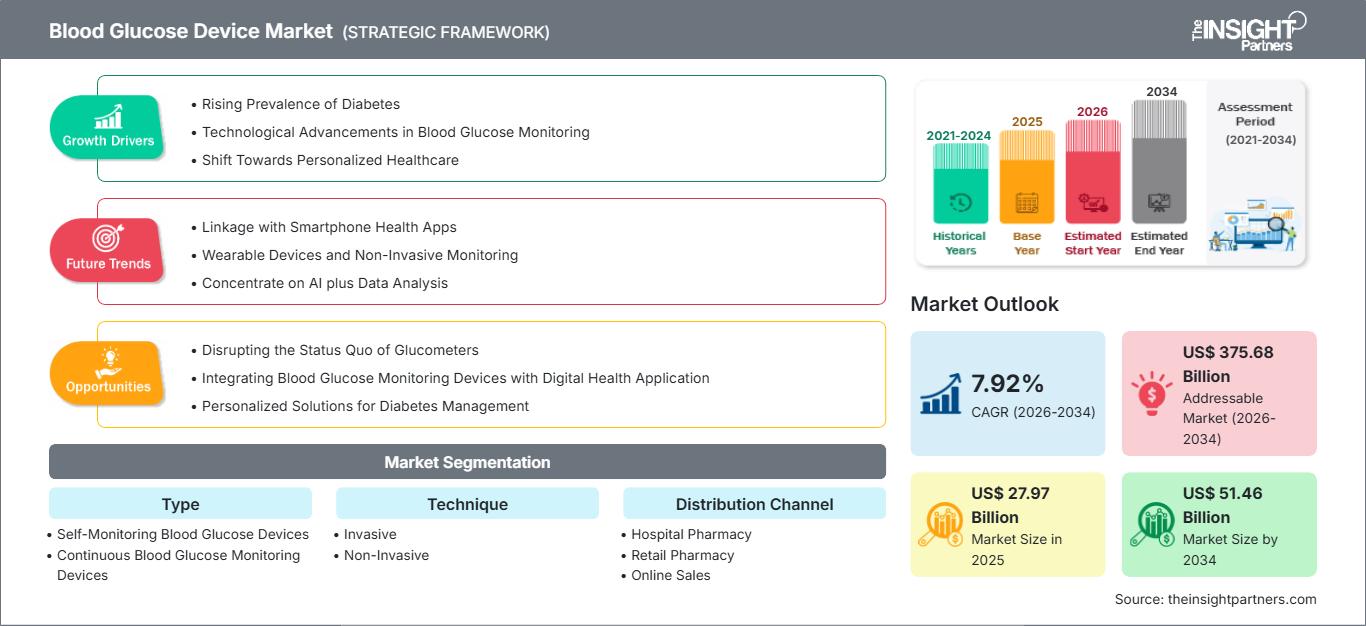
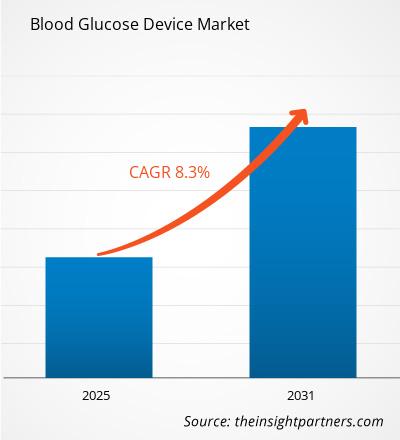
The Blood Glucose Device Market was valued at US$ 27.97 Billion in 2025 and is projected to reach US$ 51.46 Billion by 2034, expanding at a CAGR of 7.92% during 2026–2034. Market expansion is supported by the growing prevalence of diabetes, rising adoption of digital disease management tools, and continuous innovation in glucose sensing technologies. Increasing integration of monitoring devices with mobile applications and connected healthcare ecosystems continues to strengthen long-term demand across developed and emerging healthcare markets.
Across North America, favorable reimbursement frameworks, high diabetes awareness, and strong adoption of continuous monitoring solutions sustain market momentum. The Blood Glucose Device Market size in the region benefits from expanding use of wearable health technologies and growing clinical emphasis on preventive glucose management. Regional growth is expected to remain in the range of 8.0%–9.0% CAGR through 2034, supported by product innovation, increasing diabetic populations, and broader healthcare digitization initiatives.
Blood Glucose Device Market Assessment and Insights
- North America accounted for 38–42% share in 2025 and is anticipated to grow at a CAGR of 8.0%–9.0% during 2026–2034, supported by high adoption of CGM technologies, reimbursement support, and the strong presence of leading manufacturers.
- US represented 74–78% of North American demand in 2025 and is projected to expand at a CAGR of 8.1%–9.1% during 2026–2034, driven by diabetes management innovation and connected healthcare adoption.
- Europe held 24–28% share in 2025 and is expected to register a CAGR of 7.8%–8.8% during 2026–2034, with Germany, the UK, and France remaining primary revenue contributors.
- Asia Pacific captured 22–26% share in 2025 and is forecast to grow at a CAGR of 10.0%–11.0% during 2026–2034, led by China, Japan, India, and South Korea amid rising diabetes prevalence.
- Largest Segment: Continuous Blood Glucose Monitoring Devices held a market share of 56–60% in 2025 and is projected to advance at a CAGR of 9.5%–10.5% during 2026–2034 due to increasing clinical preference for real-time glucose monitoring.
- High Growth Segment: Non-Invasive techniques accounted for 18–22% share in 2025 and are expected to expand at a CAGR of 11.5%–12.5% during 2026–2034, supported by ongoing sensor innovation and patient convenience advantages.
- Key companies analyzed in detail: B. Braun Melsungen AG, Medtronic plc, DiaMonTech GmbH, Terumo Corporation, LifeScan, Inc., F. Hoffmann-La Roche Ltd., Sanofi, Abbott Laboratories, Ascensia Diabetes Care Holdings AG, DexCom, Inc.
Source: The Insight Partners' analysis based on proprietary research, government publications, company annual reports, investor presentations, industry databases, and expert interviews.
The evolution of biosensors, microelectronics, and wireless technology has had a significant impact on the performance of devices used in the healthcare industry. Continuous monitoring has become the order of the day in place of the previous episodic method of monitoring patients. The production of medical devices is concentrating more on making smaller sensors that last longer, have increased precision, and integrate with smartphones.
Future expectations include positive impacts on the sector resulting from investments into non-invasive monitoring devices, intelligent data analysis, and remote patient management systems. The regulatory authorities keep promoting innovation, which improves patients' results and makes the sector more accessible. The developing countries in the Asia Pacific, Latin America, and the Middle East are receiving strategic investments owing to growth in healthcare spending, increasing number of diabetes patients, and better knowledge of disease management.
Blood Glucose Device Market Report Scope
| Report Attribute | Details |
|---|---|
| Market size in 2025 | US$ 27.97 Billion |
| Market Size by 2034 | US$ 51.46 Billion |
| Global CAGR (2026 - 2034) | 7.92% |
| Historical Data | 2021-2024 |
| Forecast period | 2026-2034 |
Blood Glucose Device Market Analysis
The Blood Glucose Device Market growth trajectory remains strongly linked to the expanding global diabetes burden and increasing emphasis on personalized healthcare management. As per international health organizations, the incidence of diabetes has been on the increase in both developed and developing economies, thus ensuring consistent demand for reliable monitoring technology. Increased knowledge about diabetes management, its complications, and monitoring techniques also contributes to the rising demand. The supply side has been getting increasingly advanced through the incorporation of advanced biosensors, semiconductor technologies, connectivity technologies, and healthcare cloud solutions.
Manufacturers have continued forging relationships with healthcare organizations, pharmacies, insurance companies, and digital health portals to enhance the availability of their products. Such changes make it possible for patients to measure glucose levels more reliably and communicate information to health professionals. Interoperability between glucose monitors and applications is being improved to foster user adoption and engagement among type 1 and type 2 diabetics.
The Blood Glucose Device Market analysis indicates that competition is intensifying as established manufacturers and technology-focused specialists invest in next-generation sensing platforms. Abbott Laboratories and DexCom, Inc. hold significant market shares in continuous monitoring; Medtronic plc has an advantage in the field of comprehensive diabetes management. F. Hoffmann-La Roche Ltd. and Ascensia Diabetes Care Holdings AG have continued enhancing their monitoring product lines, whereas DiaMonTech GmbH concentrates on developing non-invasive systems.
Investments have started to shift toward data analytics, artificial intelligence, remote monitoring platforms, and microsensors. Collaboration is still a crucial element for companies as they strive for rapid product commercialization and integration into the healthcare systems. B. Braun Melsungen AG, Sanofi, Terumo Corporation, and LifeScan, Inc., among other companies, continue to focus on optimizing their portfolio and expanding their presence in the market.
● REPORT CUSTOMIZATION
Tailor This Report To Align With Your Specific Business Requirements
This report can be customized to align precisely with your business objectives, scope, and target markets. Customization options include tailored segmentation, geography, competitive analysis, and strategic insights to support informed decision-making.
Customize This Report →WHAT YOU CAN ADJUST
- ● Segmentations
- ● Geography
- ● Competitive Analysis
- ● Language Preferences
Blood Glucose Device Market: Strategic Insights
Regional Insights
North America Blood Glucose Device Market
North America represented 38–42% Blood Glucose Device Market share in 2025 and remains the largest regional contributor. High diabetes prevalence, favorable reimbursement systems, and rapid adoption of wearable healthcare technologies support regional demand. Hospitals, specialty clinics, and outpatient care providers increasingly integrate continuous monitoring systems into standard diabetes management programs. The region is projected to register a CAGR of 8.0%–9.0% through 2034.
Strong innovation ecosystems continue supporting the commercialization of advanced monitoring platforms. Regulatory support for connected medical devices, expanding telehealth utilization, and growing acceptance of preventive healthcare models further strengthen growth prospects. Industry participants benefit from established distribution networks, sophisticated healthcare infrastructure, and ongoing investments in digital health technologies.
U.S. Blood Glucose Device Market
The United States accounted for 74–78% of North American demand in 2025 and is forecast to grow at a CAGR of 8.1%–9.1% through 2034. High adoption of continuous glucose monitoring devices among both insulin-dependent and non-insulin-dependent patients remains a major market driver. Broad commercial availability, favorable reimbursement policies, and extensive healthcare coverage contribute to sustained technology uptake across hospitals, clinics, and home-care settings. Major participants, including Abbott Laboratories, DexCom, Inc., Medtronic plc, and F. Hoffmann-La Roche Ltd. maintain substantial commercial operations throughout the country and continue investing in product innovation and user experience improvements. Growing use of remote monitoring applications, integrated digital health platforms, smartphone connectivity, and AI-assisted diabetes management solutions continues to support demand. Increasing consumer preference for user-friendly wearable devices, real-time glucose insights, and personalized disease management tools further strengthens adoption rates. Rising diabetes prevalence and greater awareness of preventive healthcare are also expected to support long-term market expansion.
Europe Blood Glucose Device Market
Europe held 24–28% share in 2025 and is expected to record a CAGR of 7.8%–8.8% during the forecast period. Germany remains the leading national market due to strong healthcare spending, advanced diabetes management programs, and broad availability of innovative monitoring technologies. The nation also sees substantial manufacturing and distribution operations that contribute to growth in the region. The United Kingdom shows a good uptake of CGM technologies via public healthcare programs, expanded reimbursement scope, and preventive diabetes care emphasis. In France, Italy, and Spain, there is an observed growth in the demand owing to rising numbers of diabetic patients, improved patient access to cutting-edge monitoring devices, and enhanced use of digital health solutions. All these nations together are able to gain the advantage of a favorable regulatory landscape, growing patient awareness, continuous technological developments, and growing implementation of connected glucose monitoring solutions.
APAC Blood Glucose Device Market
Asia Pacific accounted for 22–26% share in 2025 and is anticipated to grow at a CAGR of 10.0%–11.0%, making it the fastest expanding regional market. China remains the leading contributor due to its large diabetic population and increasing healthcare modernization efforts.
Japan, South Korea, India, and Australia are also witnessing the accelerating adoption of monitoring technologies. Government health initiatives, growing healthcare expenditure, and increasing awareness of chronic disease management continue to encourage demand across urban and semi-urban populations.
Middle East & Africa Blood Glucose Device Market
The Middle East & Africa market is projected to expand at a CAGR of 7.0%–8.0% through 2034. Saudi Arabia and the UAE are leading contributors owing to rising diabetes incidence, substantial healthcare infrastructure investments, and increasing adoption of digital healthcare solutions. Government initiatives aimed at improving chronic disease management and expanding access to advanced medical technologies are further supporting market growth across the region. South Africa and the rest of the region continue benefiting from healthcare modernization programs, growing chronic disease management initiatives, and increased awareness of diabetes monitoring technologies. Expanding diagnostic capabilities, improving reimbursement environments, stronger healthcare access, and greater integration of connected healthcare platforms are expected to support long-term market development across major economies. Rising demand for effective glucose management solutions and the gradual adoption of continuous monitoring technologies are also expected to create new growth opportunities throughout the forecast period.
Segmentation Analysis
Type
The Type segment is expected to grow at a CAGR of 8.8%–9.8% during 2026–2034. The Blood Glucose Device Market scope continues expanding across both conventional and continuous monitoring technologies as healthcare providers prioritize improved glycemic visibility, better treatment outcomes, and enhanced patient convenience. Technological advancements, physician recommendations, and increasing chronic disease management requirements contribute to sustained adoption.
- Self-Monitoring Blood Glucose Devices – Widely used across homecare and clinical environments, these devices offer affordability, broad accessibility, and established diagnostic utility, particularly among patients requiring periodic glucose measurements.
- Continuous Blood Glucose Monitoring Devices – Represent the dominant category due to real-time monitoring capabilities, improved treatment decision support, data connectivity features, and increasing integration with digital healthcare ecosystems.
Technique
The Technique segment is anticipated to register a CAGR of 9.2%–10.2% through 2034. Continuous research aims to improve convenience, reduce discomfort, and enhance measurement accuracy. Market participants increasingly focus on novel sensing approaches that support long-term patient adherence and wider adoption across diverse user groups.
- Invasive – Currently represents the established monitoring approach due to proven clinical reliability, broad regulatory approvals, and extensive adoption across healthcare systems worldwide.
- Non-Invasive – Attracting significant attention owing to patient comfort advantages and ongoing technological advances that seek to eliminate routine skin penetration while maintaining measurement accuracy.
Distribution Channel
The Distribution Channel segment is forecast to expand at a CAGR of 8.4%–9.4% between 2026 and 2034. Improving product accessibility and the emergence of digital purchasing platforms are reshaping procurement patterns. Consumers increasingly utilize multiple channels depending on reimbursement availability and healthcare preferences.
- Hospital Pharmacy – Remains strategically important due to physician-driven prescribing practices, clinical consultations, and procurement linked to hospital-based diabetes management programs.
- Retail Pharmacy – Maintains strong market presence through accessibility, consumer trust, and convenient availability of monitoring devices and related consumables.
- Online Sales – Experiencing rapid expansion as digital commerce platforms improve product visibility, pricing transparency, and doorstep delivery convenience for patients.
Opportunity Snapshot
| Distribution Channel | Revenue Contribution | Trend Tag | Adoption Stage |
| Hospital Pharmacy | High | Clinical Access | Mature |
| Retail Pharmacy | High | Consumer Reach | Mature |
| Online Sales | Medium | Digital Purchase | Scaling |
Blood Glucose Device Market Growth Drivers and Impact Analysis
Rising Global Diabetes Burden
Increasing cases of Type 1 and Type 2 diabetes result in a growing need for monitoring devices throughout the world. Aging population trends, lack of physical activity, growing rates of obesity, and changes in dietary habits have all contributed to an increase in disease incidence rates in both developed and developing countries. Health care professionals have started emphasizing the importance of monitoring glucose levels as one of the important measures of disease management that allows patients to have improved glycemic control and prevents the development of complications. Higher understanding on the part of patients concerning the impact of diabetes on their health contributes to the growing use of test strips.
Expansion of Continuous Monitoring Ecosystems
The technology of continuous glucose monitoring is revolutionizing how diseases can be managed by improving data visibility and better decision-making in treatment. The use of smartphones, cloud computing, and digital health applications increases user interaction and enables telemedicine. Medical practitioners gain improved ability for trend analysis and monitoring of patients. With the increasing trend of connected care, continuous monitoring systems are likely to have a greater share of industry revenues.
Supportive Healthcare Policies and Reimbursement
Healthcare reimbursement systems are increasingly providing coverage to diabetic technologies due to the mounting scientific evidence of effectiveness in disease management, better patient results, and minimized complications. Continuous monitoring devices have already gained recognition among public and private payers who see their benefits in reduced hospitalizations and healthcare expenses, as well as general improvement of healthcare services. Positive reimbursement programs will assist in removing obstacles related to the affordability of advanced glucose monitoring technologies. In addition, the regulatory environment, which stimulates innovations and quick product approval, will also help accelerate market penetration. The combination of increased affordability, better access to products, and increased recommendations from healthcare professionals is likely to boost adoption rates in a variety of segments.
Blood Glucose Device Market Future Trends
Emergence of Advanced Non-Invasive Monitoring
The Blood Glucose Device Market trends increasingly reflect industry efforts to commercialize accurate non-invasive monitoring platforms. Innovations involving optical sensing, spectroscopy, and advanced biosensor technologies are progressing toward broader clinical validation. Future product launches are expected to improve patient comfort, encourage more frequent monitoring, and expand adoption among individuals reluctant to use conventional invasive systems. Continued investments in research and development will remain important in advancing commercialization prospects.
Artificial Intelligence-Enabled Diabetes Management
AI is anticipated to be an important part of the new generation monitoring ecosystem. Predictive analytics, personalized recommendations, and automated pattern recognition of blood glucose can aid in making better treatment decisions and proactively managing diseases. New systems will have increasing capabilities for integrating monitoring devices with predictive algorithms and remote healthcare services. This trend may contribute to improving clinical outcomes while decreasing the burden on healthcare systems.
Blood Glucose Device Market Opportunities
Expansion Across Emerging Healthcare Markets
The availability of favorable Blood Glucose Device Market Forecasts for Asia Pacific, the Middle East, and selected African economies highlights substantial investment potential. Rising healthcare expenditure, expanding insurance coverage, and increasing disease awareness continue supporting technology adoption. Manufacturers investing in localized distribution networks, affordable product offerings, and strategic partnerships may benefit from accelerating demand. These regions offer significant opportunities for long-term revenue diversification and customer base expansion.
Integration with Remote Patient Monitoring Platforms
The use of remote monitoring technology by healthcare organizations has been on the rise as an effort to optimize the management of chronic diseases and cut the costs of care delivery. It is possible for companies that manufacture monitoring devices to make use of this trend via platform integration, subscription, and data analytics. Interoperability with EHRs and telemedicine technologies might bring in more revenue and add value to the proposition for healthcare organizations.
Recent Developments
- May 2025: Abbott Laboratories reported REFLECT study results showing FreeStyle Libre technology was associated with reduced cardiovascular-related hospitalizations among diabetes patients, strengthening clinical evidence supporting continuous glucose monitoring adoption
- May 2025: Medtronic plc announced its intention to separate its Diabetes business into an independent company, aiming to accelerate innovation and create a dedicated organization focused on intensive insulin management ecosystems and diabetes technologies.
- April 2025: DexCom, Inc. received U.S. FDA clearance for the Dexcom G7 15 Day Continuous Glucose Monitoring System, extending wear duration and strengthening its position within advanced continuous monitoring solutions.
Frequently Asked Questions

- Comprehensive Market Sizing and Forecast Analysis
- Detailed Segmentation Analysis
- In-Depth Market Dynamics Assessment
- Regional and Country-Level Insights
- Competitive Landscape and Company Benchmarking
- Strategic Business Intelligence
Recent Reports
Testimonials

The Insight Partners' SCADA System Market report is comprehensive, with valuable insights on current trends and future forecasts. The team was highly professional, responsive, and supportive throughout. We are very satisfied and highly recommend their services.
RAN KEDEM Partner, Reali Technologies LTDs
I requested a report on a very specific software market and the team produced the report in a few days. The information was very relevant and well presented. I then requested some changes and additions to the report. The team was again very responsive and I got the final report in less than a week.
JEAN-HERVE JENN Chairman, Future Analytica
We worked with The Insight Partners for an important market study and forecast. They gave us clear insights into opportunities and risks, which helped shape our plans. Their research was easy to use and based on solid data. It helped us make smart, confident decisions. We highly recommend them.
PIYUSH NAGPAL Sr. Vice President, High Beam Global
The Insight Partners delivered insightful, well-structured market research with strong domain expertise. Their team was professional and responsive throughout. The user-friendly website made accessing industry reports seamless. We highly recommend them for reliable, high-quality research services
YUKIHIKO ADACHI CEO, Deep Blue, LLC.
This is the first time I have purchased a market report from The Insight Partners.While I was unsure at first, I visited their web site and felt more comfortable to take the risk and purchase a market report.I am completely satisfied with the quality of the report and customer service. I had several questions and comments with the initial report, but after a couple of dialogs over email with their analyst I believe I have a report that I can use as input to our strategic planning process.Thank you so much for taking the extra time and making this a positive experience.I will definitely recommend your service to others and you will be my first call when we need further market data.
JOHN SUZUKI President and Chief Executive Officer, Board Director, BK Technologies
I wish to appreciate your support and the professionalism you displayed in the course of attending to my request for information regarding to infectious disease IVD market in Nigeria. I appreciate your patience, your guidance, and the fact that you were willing to offer a discount, which eventually made it possible for us to close a deal. I look forward to engaging The Insight Partners in the future, all thanks to the impression you have created in me as a result of this first encounter.
DR CHIJIOKE ONYIA MANAGING DIRECTOR, PineCrest Healthcare Ltd.Reason to Buy
- Informed Decision-Making
- Understanding Market Dynamics
- Competitive Analysis
- Identifying Emerging Markets
- Customer Insights
- Market Forecasts
- Risk Mitigation
- Boosting Operational Efficiency
- Strategic Planning
- Investment Justification
- Tracking Industry Innovations
- Aligning with Regulatory Trends





 Get Free Sample for