
Blood Platelet Market Size, Trends & Growth by 2034
Blood Platelet Market Size and Forecasts (2021 - 2034), Global and Regional Share, Trends, and Growth Opportunity Analysis Report Coverage : by Application (Platelet Function Disorders, Hemophilia, Thrombocytopenia, Perioperative Indications); End User (Hospitals, Ambulatory Surgical Centers, Other End Users); and Geography (North America, Europe, Asia Pacific, and South and Central America)
- Status : Data Released
- Report Code : TIPRE00040104
- Category : Life Sciences
- No. of Pages : 150
- Available Report Formats :


- Last update date : July 30, 2026


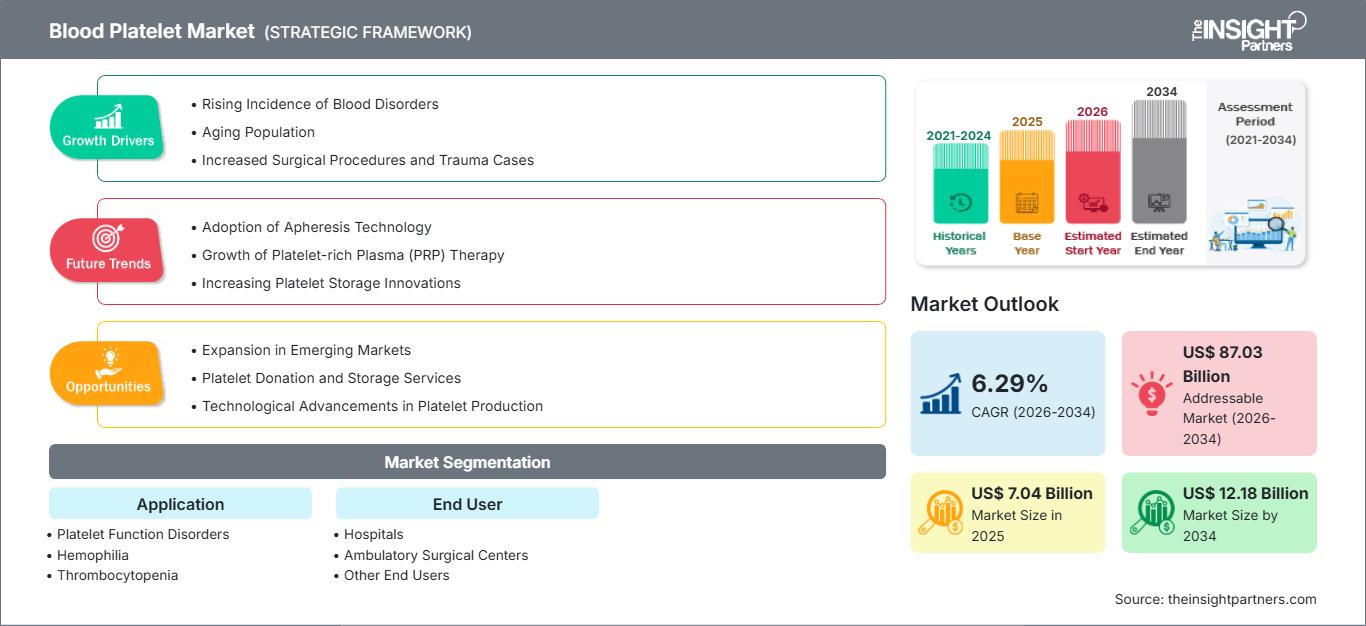
2025 Market Size
US$ 7.04 Bn
Base year value
2034 Forecast
US$ 12.18 Bn
Projected by 2034
CAGR 2026-2034
6.29 %
Growth rate
Addressable Market
US$ 87.03 Bn
(2026-2034)
The Blood Platelet Market size is anticipated to increase from US$ 7.04 Billion in 2025 to US$ 12.18 Billion by 2034 with a CAGR of 6.29%. These factors include a growing reliance on platelet concentrates, apheresis, pathogen reduction, and transfusions for treatment purposes in hematology, oncology, trauma, perioperative procedures, and bleeding disorders.
North America continues to be an important commercial market, which is driven by advanced blood banking infrastructure, robust hospital transfusion policies, and the use of apheresis platelets. It is anticipated that the region will experience a growth rate between 5.8% and 6.4% over the forecast period of 2026–2034, driven by intensive oncological procedures and investment in automated component preparation.
Blood Platelet Market Assessment and Insights
- North America held a 38–41% Blood Platelet Market share in 2025 and is expected to grow at a CAGR of 5.8–6.4% during 2026–2034, supported by hospital-based platelet utilization, apheresis infrastructure, and strong transfusion governance.
- US accounted for 82–86% of North America in 2025 and is projected to grow at a CAGR of 5.7–6.3% during 2026–2034, reflecting high oncology and surgical transfusion volumes.
- Europe captured a 24–27% share in 2025 and is forecast to grow at a CAGR of 5.4–6.0% during 2026–2034, with Germany, France, and the UK leading adoption.
- Asia Pacific represented a 22–25% share in 2025 and is expected to grow at a CAGR of 7.0–7.8% during 2026–2034, led by China, Japan, South Korea, India, and Australia.
- Largest Segment Hospitals held a market share of 68–72% in 2025 and are expected to grow at a CAGR of 5.9–6.5% during 2026–2034.
- High Growth Segment Thrombocytopenia held a market share of 31–35% in 2025 and is expected to grow at a CAGR of 6.8–7.6% during 2026–2034.
- Key companies analyzed in detail: Terumo Blood and Cell Technologies Corporation, Haemonetics Corporation, Fresenius Kabi AG, Grifols S.A., CSL Behring LLC, BioLife Plasma Services L.P., Medtronic plc, Baxter International Inc., Octapharma AG, Blood Systems Inc.
Source: The Insight Partners' analysis based on proprietary research, government publications, company annual reports, investor presentations, industry databases, and expert interviews.
Automation has brought about platelet collection from manual separation to a closed system apheresis, whole blood component automation, inventory analytics, and bacterial risk reduction. The companies in the Blood Platelet Market compete through consistency in yield, donor comfort, speed of processing, leukoreduction, data connectivity, and shelf life. The production process is limited by platelet storage duration, donor availability, seasonal collection patterns, and high quality standards.
In the coming years, faster adoption is likely in health systems in Asia, Middle East, and Latin America that are increasing their capacity for oncology, trauma, and cardiovascular surgeries. These include hemovigilance standards, pathogen reduction, and modernization of national blood systems. Automated collection technology, cold chain management, and inventory management are expected to attract more investments.
Blood Platelet Market Report Scope
| Report Attribute | Details |
|---|---|
| Market size in 2025 | US$ 7.04 Billion |
| Market Size by 2034 | US$ 12.18 Billion |
| Global CAGR (2026 - 2034) | 6.29% |
| Historical Data | 2021-2024 |
| Forecast period | 2026-2034 |
Blood Platelet Market Analysis
Clinical drivers are based on cancers, chemotherapy-related thrombocytopenia, hematopoietic stem cell transplantation, trauma, and complicated surgeries. The expansion of the Blood Platelet Market is supported by transfusion-limit guidelines, increased utilization of apheresis platelets from single donors, and a high volume of procedures in tertiary hospitals. Global blood donation deficit reported by the WHO emphasizes the structural pressures on the supply, particularly with a lack of component processing capacity.
The chain includes donor recruitment, collection process, screening and testing, components processing, storage, distribution, transfusion services in hospitals, and monitoring after the transfusions. Short shelf life makes supply chain resilience a key commercial factor. Blood banks are implementing automation processes and demand forecasting tools, as well as pathogen reduction techniques, to minimize wastage and ensure availability.
There is intense competition amongst the vendors operating in the categories of device technology, plasma, blood management, and hemostasis technologies. According to the Blood Platelet Market Analysis, Terumo Blood and Cell Technologies Corporation, Haemonetics Corporation, and Fresenius Kabi AG are competing in the collection and processing systems market segment, whereas Grifols S.A., CSL Behring LLC, Octapharma AG, BioLife Plasma Services L.P., Medtronic plc, Baxter International Inc., and Blood Systems Inc. are affecting the neighboring ecosystem.
Strategic investments will focus on platforms with capabilities to increase platelet yield, improve operator efficiency, and integrate collection system data with hospital demand. Organizations with large installed base can sustain their position through software, consumables, services, and regulatory documentation. Future differentiations will be based on non-DEHP technology, pathogen reduction compatible systems, inventory management, and transfusion decision support.
● REPORT CUSTOMIZATION
Tailor This Report To Align With Your Specific Business Requirements
This report can be customized to align precisely with your business objectives, scope, and target markets. Customization options include tailored segmentation, geography, competitive analysis, and strategic insights to support informed decision-making.
Customize This Report →WHAT YOU CAN ADJUST
- ● Segmentations
- ● Geography
- ● Competitive Analysis
- ● Language Preferences
Blood Platelet Market: Strategic Insights
Regional Insights
North America Blood Platelet Market
The North American market accounted for 38-41% market share in 2025 and is anticipated to grow at a CAGR of 5.8-6.4% from 2026 to 2034. Market Share of the Blood Platelet Market is fueled by the extensive use of apheresis platelets, intensive therapy of cancers, and formation of hospital transfusion committees.
The geographical region is influenced by well-established regulatory controls by the FDA and AABB guidelines, as well as ongoing benchmarking of platelet usage. Blood centers are adopting technologies for automated whole blood processing, demand forecasting using software solutions, and risk management against bacteria. Geographical limitations in this region include lack of staff, donor exhaustion, weather-related factors, and management of a five-to-seven-day usable component under normal storage conditions.
U.S. Blood Platelet Market
In 2025, the United States represented 82-86% of North America and is projected to grow at a CAGR of 5.7-6.3% between 2026 and 2034. Utilization is influenced by oncology, stem cell transplant, cardiac surgery, and emergencies. The dominance of apheresis has increased platelet supply; however, whole-blood platelet programs are gaining traction again due to the need to reduce supply vulnerability.
Companies have a good representation in the collection process, processing phase, and the hospitals where transfusions take place. Terumo Blood and Cell Technologies Corporation, Haemonetics Corporation, Fresenius Kabi AG, Baxter International Inc., and Blood Systems Inc. play a strategic role in equipment, consumable products, software, and through their relationship with the blood centers. Application-wise, the demand for thrombocytopenia and perioperative indications is high due to platelet availability.
Europe Blood Platelet Market
The region accounted for 24-27% market share in 2025 and expected to grow at CAGR of 5.4%-6.0% over 2026-2034. Germany is the key country due to advanced transfusion medicine, robust hospital infrastructure and central quality systems. Stable demand in the UK is driven by oncology and trauma services and need to optimize platelet usage amid NHS resource constraints.
Germany benefits from high procedure volume, developed clinical laboratory services and widespread component therapy application in hematology and surgical settings. France continues to operate an organized system of blood establishments. There is improvement in donor motivation and regional logistic operations in Italy and Spain.
There are growth inhibitors in the form of cost control, selective transfusion practices and labor shortages. However, platelet apheresis collections, pathogen reduction technologies implementation and advanced blood inventory management systems help drive consistent growth. The Blood Platelets Market in Europe is getting more influenced by the balance between clinical opportunities and conservative transfusion practices.
APAC Blood Platelet Market
The APAC segment constituted a 22-25% market share in 2025 and is projected to witness a CAGR of 7.0-7.8% through 2026-2034. China leads the countries in the region, followed by Japan, South Korea, India, and Australia. Growing demand in APAC is driven by the increase in cancer treatments, private hospitals, trauma cases, and the modernization of blood systems.
Favorable policies towards safe blood component usage, investments in tertiary healthcare facilities in urban areas, and expansion in hematology centers are aiding the adoption. Quality and traceability are the key focus in Japan and Australia; whereas India and China provide expansion opportunities owing to their scale.
Middle East & Africa Blood Platelet Market
MEA is predicted to have a CAGR of 6.2-7.0% between 2026 and 2034. Saudi Arabia is considered the largest market in this region, driven by investments into hospital facilities, the building of medical cities, and the expansion of oncology treatment. UAE is focusing on developing its specialty hospitals, whereas South Africa stays the most developed platform in sub-Saharan region.
Government expenditure for healthcare through energy funding in Gulf nations is driving advancements such as modern blood banks, trauma preparedness, and tertiary surgery. Growth in the Rest of MEA is not steady due to a lack of donors, cold chain constraints, and a scattered transfusion service network.
Segmentation Analysis
Application
The Application segment is expected to grow at a CAGR of 6.3–6.9% during 2026–2034. Blood Platelet Market scope across applications is defined by clinical urgency, transfusion guidelines, and disease burden. Demand is strongest where platelet deficits create immediate bleeding risk, especially in oncology, inherited bleeding disorders, surgical support, and immune-mediated or treatment-induced thrombocytopenia.
- Platelet Function Disorders account for specialized demand where normal platelet counts may still be clinically inadequate. Testing accuracy, hematology consultation, and targeted perioperative planning make this a strategically important use case.
- Hemophilia supports demand through adjunctive hemostasis management, complex bleeding events, and perioperative care. Factor replacement and gene therapies influence patterns, but specialized centers continue to require platelet support.
- Thrombocytopenia is the high-growth application, driven by chemotherapy, marrow failure, immune disorders, infections, and critical illness. Its recurring transfusion need makes it central to inventory planning.
- Perioperative Indications remain essential in cardiac, orthopedic, transplant, trauma, and neurosurgical settings. Hospitals prioritize rapid platelet availability to reduce surgical delays and manage bleeding complications.
End User
The End User segment is expected to grow at a CAGR of 5.8–6.4% during 2026–2034. Adoption is concentrated in settings with transfusion oversight, emergency readiness, surgical capacity, and hematology expertise. Hospitals dominate due to inpatient oncology, intensive care, surgical blood management, and established blood bank infrastructure, while ambulatory surgical centers are emerging users for selected procedures.
- Hospitals are the largest end users because they manage complex oncology, trauma, transplant, and emergency cases. Their transfusion committees and blood banks drive standardized platelet ordering and usage.
- Ambulatory Surgical Centers show rising adoption for eligible procedures requiring blood management preparedness. Growth depends on case complexity, accreditation requirements, and relationships with hospital-linked blood suppliers.
Opportunity Snapshot
| Segment Name | Revenue Contribution | Trend Tag | Adoption Stage |
| Platelet Function Disorders | Medium | Diagnostic Precision | Scaling |
| Hemophilia | Medium | Factor Adjunct | Mature |
| Thrombocytopenia | High | Oncology Support | Scaling |
| Perioperative Indications | High | Surgical Readiness | Mature |
Blood Platelet Market Growth Drivers and Impact Analysis
Rising oncology and stem cell transplant procedure intensity
Cancer care is the most durable demand driver because chemotherapy, hematologic malignancies, and stem cell transplantation frequently suppress platelet production. Hospitals require reliable platelet availability to prevent bleeding, maintain treatment schedules, and support high-risk inpatient care. This creates predictable repeat demand rather than one-time procedural use. The market impact is strongest in tertiary hospitals and cancer networks that manage leukemia, lymphoma, myeloma, and transplant patients. As oncology access expands in Asia Pacific and parts of the Middle East, platelet consumption is expected to rise faster than total blood collection unless component processing capacity improves. Suppliers that help blood centers increase yield, reduce wastage, and manage inventory variability will be positioned to capture recurring demand.
Automation improving collection productivity and consistency
Automation is changing the operating economics of platelet supply by reducing manual processing steps, standardizing component quality, and improving labor efficiency. Apheresis systems and automated whole-blood processing platforms allow blood centers to collect or separate platelets with more predictable yields. This matters because platelet supply is unusually sensitive to donor availability, staffing, quality control, and short shelf life. The commercial impact extends beyond equipment sales into consumables, service contracts, software, and workflow integration. Blood centers facing labor shortages are prioritizing systems that lower training burden and shorten processing time. Hospitals also benefit through fewer stockouts, better matched supply, and improved readiness for trauma, oncology, and surgical use.
Stronger transfusion safety and hemovigilance requirements
Regulatory and clinical expectations are increasing around bacterial contamination control, traceability, donor screening, adverse event reporting, and appropriate utilization. Platelets are stored at room temperature, which creates higher bacterial risk than many other blood components. This has made safety interventions, including culture testing, rapid testing, pathogen reduction, leukoreduction, and improved quality documentation, central to procurement decisions. The market impact is a shift from low-cost component availability toward validated, auditable, and system-supported platelet supply. Suppliers with regulatory experience and compatibility across testing, processing, and storage pathways can strengthen customer retention. In emerging markets, adoption of hemovigilance systems will also create demand for standardized equipment and training.
Blood Platelet Market Future Trends
Digital platelet inventory orchestration
Blood Platelet Market trends are moving toward predictive inventory systems that link donor collections, component age, hospital orders, emergency requirements, and wastage risk. Future platforms will use historical demand, seasonality, surgery schedules, oncology bookings, and trauma patterns to guide allocation. This trend will be especially valuable because platelets cannot be stocked for long periods. Blood centers and hospitals will increasingly seek interoperability between collection software, laboratory systems, and transfusion records. The result will be fewer emergency shortages, lower expiry losses, and improved visibility across regional networks. Vendors that combine devices, consumables, and software analytics can differentiate beyond hardware performance and win longer-term partnerships.
Greater use of alternative platelet supply models
Apheresis platelets will remain clinically important, but future supply models will diversify. Whole-blood-derived platelets, pooled systems, pathogen-reduced components, extended-storage research, and early-stage manufactured platelet technologies will receive growing attention. This shift is driven by donor aging, seasonal collection declines, and the need for resilience during public health or weather disruptions. The trend does not imply replacement of current systems, but rather a broader supply toolkit. Blood services will evaluate models based on cost, safety, compatibility, donor burden, and clinical acceptance. Countries building blood infrastructure may leapfrog toward automated component separation and integrated safety systems rather than replicating older manual workflows.
Blood Platelet Market Opportunities
Modernization of blood centers in emerging economies
Emerging economies offer a significant investment opportunity as governments expand oncology care, surgical capacity, trauma systems, and national blood programs. Blood Platelet Market Forecasts indicate that infrastructure-led demand will grow where component separation is underpenetrated relative to hospital procedure volumes. Suppliers can target public procurement, training partnerships, service models, and bundled systems that include collection devices, consumables, software, and maintenance. The strongest opportunities are in India, China’s tier-two cities, Southeast Asia, Gulf countries, and selected African medical hubs. Success will require affordability, uptime, multilingual support, and compliance guidance adapted to local regulations rather than simply exporting premium systems.
Integrated hospital blood management partnerships
Hospitals are under pressure to reduce unnecessary transfusions while ensuring immediate availability for high-risk patients. This creates an opportunity for partnerships that combine platelet supply planning, utilization analytics, clinical education, and decision support. Vendors and blood services can help hospitals align ordering practices with guidelines, reduce wastage, and improve emergency readiness. The opportunity is particularly relevant for large networks managing oncology, cardiovascular surgery, trauma, and transplant care. Contract models may shift toward performance-based supply reliability, data visibility, and total cost reduction. Companies that support both clinical governance and operational continuity will gain strategic value beyond product delivery.
Recent Developments
- December 2025: Terumo Blood and Cell Technologies Corporation announced that Appleton’s Community Blood Center became the fifth U.S. site to deploy the Reveos Automated Blood Processing System and Lumia Software Platform. The implementation focused on improving platelet supply resilience, reducing manual processing time, and supporting more than 40 hospitals across Wisconsin, Illinois, and Michigan’s Upper Peninsula.
- December 2025: CSL Behring LLC reported five-year HOPE-B study results for HEMGENIX in adults with hemophilia B, with 94% of patients remaining free from continuous prophylaxis through five years after a single infusion. The data reinforced long-term treatment durability in inherited bleeding disorder care and may influence future transfusion support needs.
- January 2025: Haemonetics Corporation completed the sale of its whole blood assets to GVS S.p.A. for cash consideration of up to US$ 67.8 million. The company stated that its Blood Center business would continue to manufacture and provide apheresis solutions for automated collection, including platelets, plasma, and red cells.
Frequently Asked Questions

- Comprehensive Market Sizing and Forecast Analysis
- Detailed Segmentation Analysis
- In-Depth Market Dynamics Assessment
- Regional and Country-Level Insights
- Competitive Landscape and Company Benchmarking
- Strategic Business Intelligence
Recent Reports
Testimonials

The Insight Partners provided valuable market intelligence that supported our global go-to-market strategy. Their team was professional, responsive, and attentive to our feedback, providing thoughtful analysis and helpful methodological clarifications throughout the project.
Junmo Kim Chief Financial Officer (CFO), Enertech Co., Ltd.
The Insight Partners' SCADA System Market report is comprehensive, with valuable insights on current trends and future forecasts. The team was highly professional, responsive, and supportive throughout. We are very satisfied and highly recommend their services.
RAN KEDEM Partner, Reali Technologies LTDs
I requested a report on a very specific software market and the team produced the report in a few days. The information was very relevant and well presented. I then requested some changes and additions to the report. The team was again very responsive and I got the final report in less than a week.
JEAN-HERVE JENN Chairman, Future Analytica
We worked with The Insight Partners for an important market study and forecast. They gave us clear insights into opportunities and risks, which helped shape our plans. Their research was easy to use and based on solid data. It helped us make smart, confident decisions. We highly recommend them.
PIYUSH NAGPAL Sr. Vice President, High Beam Global
The Insight Partners delivered insightful, well-structured market research with strong domain expertise. Their team was professional and responsive throughout. The user-friendly website made accessing industry reports seamless. We highly recommend them for reliable, high-quality research services
YUKIHIKO ADACHI CEO, Deep Blue, LLC.
This is the first time I have purchased a market report from The Insight Partners.While I was unsure at first, I visited their web site and felt more comfortable to take the risk and purchase a market report.I am completely satisfied with the quality of the report and customer service. I had several questions and comments with the initial report, but after a couple of dialogs over email with their analyst I believe I have a report that I can use as input to our strategic planning process.Thank you so much for taking the extra time and making this a positive experience.I will definitely recommend your service to others and you will be my first call when we need further market data.
JOHN SUZUKI President and Chief Executive Officer, Board Director, BK Technologies
I wish to appreciate your support and the professionalism you displayed in the course of attending to my request for information regarding to infectious disease IVD market in Nigeria. I appreciate your patience, your guidance, and the fact that you were willing to offer a discount, which eventually made it possible for us to close a deal. I look forward to engaging The Insight Partners in the future, all thanks to the impression you have created in me as a result of this first encounter.
DR CHIJIOKE ONYIA MANAGING DIRECTOR, PineCrest Healthcare Ltd.Reason to Buy
- Informed Decision-Making
- Understanding Market Dynamics
- Competitive Analysis
- Identifying Emerging Markets
- Customer Insights
- Market Forecasts
- Risk Mitigation
- Boosting Operational Efficiency
- Strategic Planning
- Investment Justification
- Tracking Industry Innovations
- Aligning with Regulatory Trends





 Get Free Sample for