
Body Fat Reduction Market Growth, Trends & Demand by 2034
Coverage: By Procedure (Surgical and Non-Surgical), Gender(Female and Male), Service Provider (Hospitals & Clinics, Medical Spas, and Others), and Geography (North America, Europe, Asia Pacific, Middle East & Africa, and South & Central America)
- Status : Data Released
- Report Code : TIPRE00014855
- Category : Life Sciences
- No. of Pages : 150
- Available Report Formats :


- Last update date : July 29, 2026


2025 Market Size
US$ 13.81 Bn
Base year value
2034 Forecast
US$ 31.38 Bn
Projected by 2034
CAGR 2026-2034
9.54 %
Growth rate
Addressable Market
US$ 201.49 Bn
(2026-2034)
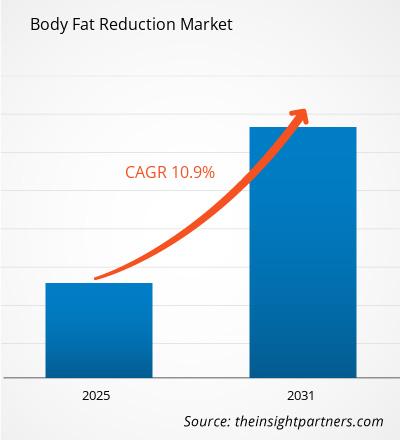
The Body Fat Reduction market size is expected to increase from US$ 13.81 Billion in 2025 to US$ 31.38 Billion in 2034, witnessing a CAGR of 9.54% during 2026-2034. Factors such as increasing body contouring surgery cases, rising demand for fat reduction treatments, and aesthetic procedures being performed on male and female patients will drive the growth of the market size.
In North America, the market is driven by high levels of awareness, availability of specialists, and quick adoption of energy-based devices. It is expected that the market size will witness a CAGR between 8.5-9.2% in the period 2026-2034. Obesity management discussions, reshaping body through GLP-1, and preference of minimal downtime treatment are factors driving demand.
Body Fat Reduction Market Assessment and Insights
- North America accounted for 42–45% Body Fat Reduction Market share in 2025 and is expected to grow at a CAGR of 8.5–9.2% between 2026–2034, supported by board-certified plastic surgery networks, high disposable income, and strong uptake of non-invasive body contouring technologies.
- US represented 82–86% of North America in 2025 and is projected to expand at a CAGR of 8.3–9.1% between 2026–2034, led by high treatment volumes and device-led med spa expansion.
- Europe held 25–28% share in 2025 and is expected to grow at a CAGR of 8.1–8.8% between 2026–2034, with the UK, Germany, France, Italy, and Spain leading adoption through regulated aesthetic clinics.
- Asia Pacific captured 19–22% share in 2025 and is forecast to grow at a CAGR of 10.8–11.7% between 2026–2034, driven by China, Japan, South Korea, India, and Australia.
- Largest Segment Non-Surgical procedures held 58–62% market share in 2025 and are projected to grow at a CAGR of 10.1–10.9% during 2026–2034, reflecting demand for lower-downtime fat reduction.
- High Growth Segment Medical Spas accounted for 24–28% market share in 2025 and are expected to grow at a CAGR of 11.2–12.0% during 2026–2034 as consumers shift toward accessible aesthetic care.
- Key companies analyzed in detail: Amirlak Plastic Surgery, Apollo Cosmetic Clinics, JK Plastic Surgery Center, VLCC Wellness and Beauty, The Plastic Surgery Clinic, Transform Cosmetic Surgery, Waldman Schantz Plastic Surgery Center, Lumenis Be Ltd., UltraShape Ltd., Allergan Aesthetics, Cynosure Lutronic Inc., BTL Industries Inc., and InMode Ltd.
Source: The Insight Partners' analysis based on proprietary research, government publications, company annual reports, investor presentations, industry databases, and expert interviews.
The Body Fat Reduction Market has shifted from surgical procedures for fat removal to a more diversified ecosystem that includes liposuction, cryolipolysis, laser lipolysis, radio frequency, ultrasound cavitation, and electromagnetic muscle stimulation. Companies working on body fat removal devices have been enhancing ergonomics of applicators, temperature control, treatment time, and multi-site capacity. Combining body fat reduction and skin tightening is also common now, because people who want to refine their contours after losing weight through diet and medication are coming up in numbers.
During the forecast period, use will grow in Asia Pacific, Latin America, and Middle East countries due to the increasing acceptance of aesthetics treatments by urban population and investments in technology based systems by clinics. Favorable regulatory environment will be provided by clear device approvals, rigorous physician education and standard operating protocols. Wellness-driven market positioning will also support Body Fat Reduction Market.
Body Fat Reduction Market Report Scope
| Report Attribute | Details |
|---|---|
| Market size in 2025 | US$ 13.81 Billion |
| Market Size by 2034 | US$ 31.38 Billion |
| Global CAGR (2026 - 2034) | 9.54% |
| Historical Data | 2021-2024 |
| Forecast period | 2026-2034 |
Body Fat Reduction Market Analysis
The Growth Perspective for the Body Fat Reduction market is influenced by three demand segments, namely obesity rates, expenditure on aesthetic self-care services, and body sculpting after weight loss. According to WHO, more than 1 billion people suffered from obesity in 2022, thus creating a huge demand for localized fat removal and body shaping. Different treatments are offered by clinics depending on patient type and the pathway that leads to the purchase: surgical and non-surgical procedures and maintenance treatments are offered in separate ways.
The supply situation is also becoming more complex. The companies are moving away from single technology solutions toward combined platforms that use radiofrequency, ultrasound, cooling, laser, and muscle stimulation technologies. Such a shift is lowering the financial risk for the provider because one platform can be used for multiple purposes.
The Market analysis highlights competition dynamics that exist between specialty clinic chains and innovators using equipment. Competitors in the market such as Allergan Aesthetics, BTL Industries Inc., Cynosure Lutronic Inc., InMode Ltd., Lumenis Be Ltd., and UltraShape Ltd. compete on technology leadership, installation base, and provider training. On the other hand, Amirlak Plastic Surgery, JK Plastic Surgery Center, and The Plastic Surgery Clinic are bolstering premium surgical category.
Positioning is increasingly dependent on delivering credible results. Companies like Apollo Cosmetic Clinics, VLCC Wellness and Beauty, Transform Cosmetic Surgery, and Waldman Schantz Plastic Surgery Center rely on wide range of services, physicians’ reputation, and bundling treatments for increased conversions. Investments are being made in med spas, hybrid centers, and digital consultations reducing friction from awareness to repeat visits.
● REPORT CUSTOMIZATION
Tailor This Report To Align With Your Specific Business Requirements
This report can be customized to align precisely with your business objectives, scope, and target markets. Customization options include tailored segmentation, geography, competitive analysis, and strategic insights to support informed decision-making.
Customize This Report →WHAT YOU CAN ADJUST
- ● Segmentations
- ● Geography
- ● Competitive Analysis
- ● Language Preferences
Body Fat Reduction Market: Strategic Insights
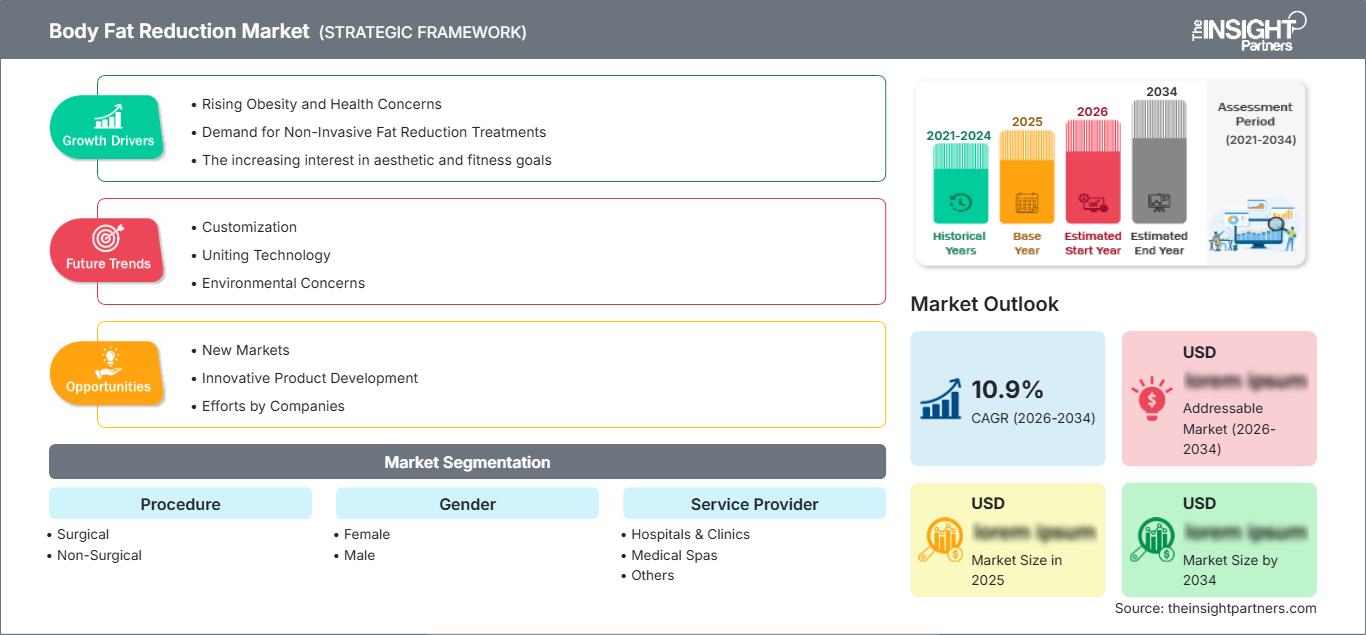
Regional Insights
North America Body Fat Reduction Market
North America had 42-45% market share in 2025 and is forecasted to achieve a CAGR of 8.5-9.2% for the period 2026-2034. These numbers are driven by good procedure literacy, high density of providers and presence of reimbursement independent spending on aesthetics. North America continues to maintain market share leadership due to plastic surgery providers, dermatological centers and brand device networks.
Trends favor combination treatment regimens that target fat removal, muscle toning, and skin tightening. Procedure data from ASPS & ISAPS confirm continuing demand for liposuction procedures, non-invasive fat reduction and skin tightening services. North American providers were early adopters of loyalty programs, seasonal offers and financing options to increase conversions.
U.S. Body Fat Reduction Market
In 2025, the US held a market share between 82%-86% of North America and is expected to grow at a CAGR between 8.3%-9.1% in 2026-2034. The presence of specialists, consumers’ high level of awareness, and quick growth of med spas help the country to become the key profit generator in the region. Devices are cleared in the US due to the rapid commercial success.
Such companies as Allergan Aesthetics, BTL Industries Inc., Cynosure Lutronic Inc., InMode Ltd., and Lumenis Be Ltd. have a clear commercial presence in the US through training doctors, consumers’ direct communication, and device demonstration. Trends are shifting from treating the abdomen and flanks to arms, thighs, submental contouring, and weight loss tightening. Procedures are presented as multi-session processes.
Europe Body Fat Reduction Market
Europe constituted 25–28% market share in 2025 and is anticipated to grow at a CAGR of 8.1–8.8% from 2026 to 2034. The United Kingdom constitutes a major market owing to private aesthetics clinics, consumer financing, and the popularity of nonsurgical contouring. Chain clinics are focusing on safety, credentials, and evidence-based consultation practices to gain patient trust.
Germany demonstrates consistent adoption due to medical supervision, certified devices, and conservative approach to planning the procedures. Demand is divided evenly between surgical liposuction carried out in specialist clinics and nonsurgical tightening/fat reduction provided by dermatology clinics. France, Italy, and Spain contribute through wellness tourism, urban beauty culture, and high levels of acceptance of minimally-invasive aesthetic procedures.
Regulation is a critical driver in Europe. Adherence to CE certification, advertising regulations, and practitioner standards affects the pace of adoption. Therefore, providers focus on platforms supported by clinical documentation and structured training collaborations. It makes the market environment predictable and moderate in terms of growth compared to fast growth witnessed in Asia-Pacific region.
APAC Body Fat Reduction Market
The Asia Pacific region accounted for 19-22% of market shares in 2025 and is estimated to register a CAGR of 10.8-11.7% over 2026-2034. China is the dominant market due to the presence of urban clinics, rising disposable incomes, and aesthetic treatments' acceptance. Japan and South Korea have premium technology use and sophisticated procedures.
India and Australia have also emerged as key emerging regions. Indian market growth is fueled by the development of private hospitals, wellness centers, and middle-class urban consumers, while that of Australia is bolstered by regulations and awareness. The focus on the quality of medical devices and clinic licenses is likely to boost confidence and adoption.
Middle East & Africa Body Fat Reduction Market
The Middle East & Africa region is predicted to register a CAGR of 8.9-9.7% in 2026-2034, driven by the UAE's prominence in premium aesthetic facilities and medical tourism. Saudi Arabia is developing its private health care facilities, whereas South Africa drives the demand through its specialized surgical facilities and aesthetic clinics.
Affluence from the energy sector, tourism facilities, and investments in private hospitals are enabling premium body-sculpting services in the Gulf region. Adoption by the Rest of MEA is selective due to differences in affordability, qualified practitioners' presence, and after-sale service networks for devices.
Segmentation Analysis
Procedure
The Procedure segment is projected to grow at a CAGR of 9.2–10.0% during 2026–2034. Body Fat Reduction Market scope across surgical and non-surgical procedures is widening as patients choose treatments based on downtime, anatomical target, BMI profile, and desired intensity of correction. Surgical procedures remain relevant for high-volume fat removal, while non-surgical procedures are expanding through repeatable, lower-risk protocols.
- Surgical procedures remain strategically important for patients seeking larger-volume fat removal, defined contour correction, or combined body reshaping after weight loss, particularly when performed by certified plastic surgeons.
- Non-Surgical procedures lead adoption due to limited downtime, repeat-session flexibility, and compatibility with med spa settings, making them attractive for localized fat pockets and maintenance-focused consumers.
Gender
The Gender segment is anticipated to grow at a CAGR of 8.9–9.7% during 2026–2034. Female patients continue to represent the larger demand base, but male adoption is rising as body contouring becomes linked with fitness, professional appearance, and age management. Providers are adapting consultation language, treatment zones, and marketing channels to address different expectations across patient groups.
- Female patients account for broad demand across abdomen, thighs, arms, and post-pregnancy contouring, with treatment decisions often influenced by safety, visible outcomes, and clinic reputation.
- Male patients are increasingly seeking abdominal, flank, chest, and jawline contouring, supporting growth in discreet consultation models, performance-oriented messaging, and combined muscle-toning services.
Service Provider
The Service Provider segment is forecast to grow at a CAGR of 9.4–10.2% during 2026–2034. Hospitals and clinics retain procedural authority for surgical and higher-risk treatment plans, while medical spas are scaling fast through accessibility, bundled packages, and device-centered services. Provider differentiation depends on training, equipment portfolio, consultation depth, and post-treatment follow-up.
- Hospitals & Clinics dominate complex surgical and physician-led procedures, benefiting from medical oversight, anesthesia capability, complication management, and stronger trust among patients needing intensive contour correction.
- Medical Spas are expanding quickly by offering non-surgical fat reduction, skin tightening, and muscle stimulation through appointment-friendly formats, recurring packages, and lifestyle-oriented patient engagement.
Opportunity Snapshot
| Service Provider | Revenue Contribution | Trend Tag | Adoption Stage |
| Hospitals & Clinics | High | Surgical Trust | Mature |
| Medical Spas | High | Body Sculpting | Scaling |
| Others | Low | Referral Care | Emerging |
Body Fat Reduction Market Growth Drivers and Impact Analysis
Rising Post-Weight-Loss Body Contouring Demand
The rapid adoption of weight-loss with GLP-1 therapies is giving rise to a novel path for body contouring. People lose weight but still have stubborn fatty pockets and loose skin that cannot be resolved through conventional diet and exercise programs. This trend has led to requests for combined treatments consisting of liposuction, skin tightening with RF, cryolipolysis, and muscle toning. The commercial value lies in the ability of practitioners to help patients who are stabilized in their weight without resorting to single treatment methods.
Technology Improvements in Non-Surgical Fat Reduction
Energy-based modalities are getting better in terms of accuracy, comfort, and flexibility. Modern devices have improved techniques such as cooling, applicator development, radiofrequency management, treatment mapping, and multilevel heating that make the procedures less variable. All these changes are important in light of the fact that the patients undergoing non-surgical procedures tend to expect an improvement in appearance without any down time and minimum interference with their working schedules. There are other advantages for the device producers too, such as wider indications, training courses for the specialists, and regular services. Technological improvements make it possible for clinics to transition from experimentation to protocol application.
Expansion of Medical Spas and Hybrid Clinics
Medical spas and hybrid physician-led clinics are widening access to body contouring by placing treatments closer to consumer beauty and wellness spending. These providers often combine consultation, financing, loyalty programs, and bundled sessions, which makes non-surgical procedures easier to adopt. The model is especially effective for abdomen, flank, thigh, arm, and submental treatments because patients can schedule sessions without hospital-based workflows. Growth in this channel also increases demand for compact, multi-application devices and standardized staff training. As a result, the provider mix is becoming more diverse, supporting higher penetration in urban and suburban markets.
Body Fat Reduction Market Future Trends
AI-Assisted Treatment Planning and Outcome Tracking
Body Fat Reduction Market trends will increasingly include AI-assisted imaging, body composition mapping, and outcome documentation. Clinics are expected to use standardized photography, 3D visualization, and software-guided treatment planning to set realistic expectations and reduce dissatisfaction. These tools can help providers compare baseline anatomy, select treatment zones, and document progress across sessions. Over time, digital records may also support better protocol design across body types, genders, and weight-loss histories. This trend will be especially relevant for multi-session non-surgical plans where patient retention depends on transparent progress measurement.
Combination Protocols for Fat, Muscle, and Skin
Future treatment programs will place less emphasis on fat reduction alone and more emphasis on total contour quality. Providers are likely to combine lipolysis, radiofrequency tightening, electromagnetic stimulation, and maintenance sessions to address fat pockets, muscle tone, and skin laxity together. This reflects changing patient expectations after weight loss, aging, or pregnancy, where one modality may not deliver a balanced result. Combination protocols also improve clinic economics because they support higher-value packages and longer patient relationships. The shift will reward providers that can personalize sequencing safely and consistently.
Body Fat Reduction Market Opportunities
Premium Non-Surgical Packages for Med Spas
Medical spas can capture new revenue by developing structured packages for abdomen, flank, thigh, arm, and submental contouring. The strongest opportunity lies in combining consultation, device-based treatment, progress imaging, and maintenance sessions into transparent programs. Body Fat Reduction Market Forecasts indicate that providers offering outcome-led bundles can improve conversion among consumers who are hesitant about surgery but willing to invest in visible refinement. Investment should focus on staff training, device utilization, patient screening, and post-treatment follow-up. This approach can reduce commoditization and position med spas as credible body contouring destinations.
Asia Pacific Clinic Network Expansion
Asia Pacific offers a strong investment opportunity for device companies and service providers because demand is rising across China, South Korea, India, Japan, and Australia. Urban consumers are increasingly familiar with aesthetic technologies, while private healthcare operators are investing in premium outpatient formats. Companies can scale through distributor partnerships, physician education centers, and localized service programs that reduce downtime for installed devices. The priority should be market-by-market compliance, training quality, and after-sales support. Providers that balance affordability with clinical credibility can build durable demand in high-growth metropolitan clusters.
Recent Developments
- March 2026: Allergan Aesthetics announced its fourth annual CoolMonth campaign for CoolSculpting, offering first-time users promotional access to non-surgical body contouring treatments and reinforcing consumer education around FDA-cleared fat reduction. The initiative supported provider consultations and positioned CoolSculpting as a seasonal entry point for patients considering body contouring before summer.
- August 2025: Cynosure Lutronic Inc. received U.S. FDA clearance for the XERF radiofrequency device, a non-invasive skin-tightening system designed for comfortable treatment without needles, numbing, or downtime. The clearance strengthened the company’s North American aesthetics portfolio and supported provider demand for multi-depth RF technologies applicable to contour refinement and skin quality improvement.
- May 2025: BTL Industries Inc. launched its sixth annual National Emsculpt Week across North America, combining provider recognition, patient education, and a nationwide treatment giveaway. The campaign highlighted Emsculpt and Emsculpt NEO as non-invasive technologies for muscle building and fat reduction, while reinforcing the company’s shift toward functional wellness and body sculpting applications.
Frequently Asked Questions

- Comprehensive Market Sizing and Forecast Analysis
- Detailed Segmentation Analysis
- In-Depth Market Dynamics Assessment
- Regional and Country-Level Insights
- Competitive Landscape and Company Benchmarking
- Strategic Business Intelligence
Recent Reports
Testimonials

The Insight Partners' SCADA System Market report is comprehensive, with valuable insights on current trends and future forecasts. The team was highly professional, responsive, and supportive throughout. We are very satisfied and highly recommend their services.
RAN KEDEM Partner, Reali Technologies LTDs
I requested a report on a very specific software market and the team produced the report in a few days. The information was very relevant and well presented. I then requested some changes and additions to the report. The team was again very responsive and I got the final report in less than a week.
JEAN-HERVE JENN Chairman, Future Analytica
We worked with The Insight Partners for an important market study and forecast. They gave us clear insights into opportunities and risks, which helped shape our plans. Their research was easy to use and based on solid data. It helped us make smart, confident decisions. We highly recommend them.
PIYUSH NAGPAL Sr. Vice President, High Beam Global
The Insight Partners delivered insightful, well-structured market research with strong domain expertise. Their team was professional and responsive throughout. The user-friendly website made accessing industry reports seamless. We highly recommend them for reliable, high-quality research services
YUKIHIKO ADACHI CEO, Deep Blue, LLC.
This is the first time I have purchased a market report from The Insight Partners.While I was unsure at first, I visited their web site and felt more comfortable to take the risk and purchase a market report.I am completely satisfied with the quality of the report and customer service. I had several questions and comments with the initial report, but after a couple of dialogs over email with their analyst I believe I have a report that I can use as input to our strategic planning process.Thank you so much for taking the extra time and making this a positive experience.I will definitely recommend your service to others and you will be my first call when we need further market data.
JOHN SUZUKI President and Chief Executive Officer, Board Director, BK Technologies
I wish to appreciate your support and the professionalism you displayed in the course of attending to my request for information regarding to infectious disease IVD market in Nigeria. I appreciate your patience, your guidance, and the fact that you were willing to offer a discount, which eventually made it possible for us to close a deal. I look forward to engaging The Insight Partners in the future, all thanks to the impression you have created in me as a result of this first encounter.
DR CHIJIOKE ONYIA MANAGING DIRECTOR, PineCrest Healthcare Ltd.Reason to Buy
- Informed Decision-Making
- Understanding Market Dynamics
- Competitive Analysis
- Identifying Emerging Markets
- Customer Insights
- Market Forecasts
- Risk Mitigation
- Boosting Operational Efficiency
- Strategic Planning
- Investment Justification
- Tracking Industry Innovations
- Aligning with Regulatory Trends





 Get Free Sample for