
Brain Monitoring Market Share, Growth & Demand by 2034
Coverage: by Product (Devices and Accessories), Disease (Stroke, Sleep Disorders, Traumatic Brain Injuries, Parkinson Disease, Huntington Disease and Others), End User (Hospitals, Ambulatory Surgical Centers, Diagnostic Centers and Others) , and Geography (North America, Europe, Asia Pacific, and South and Central America)
- Status : Data Released
- Report Code : TIPRE00003096
- Category : Life Sciences
- No. of Pages : 150
- Available Report Formats :


- Last update date : August 05, 2026


2025 Market Size
US$ 9.18 Bn
Base year value
2034 Forecast
US$ 21.36 Bn
Projected by 2034
CAGR 2026-2034
9.84 %
Growth rate
Addressable Market
US$ 136.01 Bn
(2026-2034)
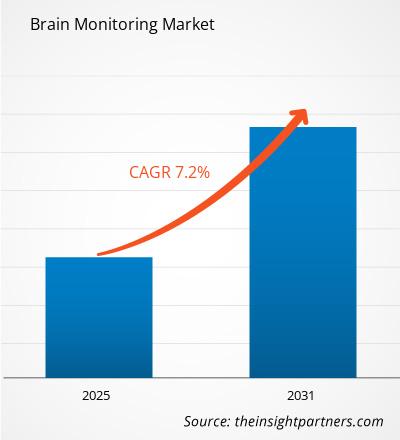
The Brain Monitoring Market will reach US$ 9.18 billion in 2025 growing to reach US$ 21.36 billion by 2034 at a CAGR of 9.84%. Market growth will be propelled by greater screening of neurological conditions, need for constant neurocritical care monitoring, and the increasing usage of portable EEG devices, cerebral oximetry, and intracranial pressure monitoring in acute care, sleep diagnosis, and specialist neurology settings.
North America will continue to remain the most developed region in terms of demand, where the Brain Monitoring Market size will be driven by an established neurodiagnostics system, stroke centers, and integrated hospital monitoring systems. North America will witness a CAGR of 8.9–9.6% during the forecast period.
Brain Monitoring Market Assessment and Insights
- North America accounted for 38–41% share in 2025 and is expected to grow at a CAGR between 8.9–9.6% during 2026–2034, supported by neurocritical care protocols, advanced ICU networks, and early adoption of AI-enabled EEG systems.
- US represented 82–86% of North America share in 2025 and is projected to grow at a CAGR between 8.8–9.5% during 2026–2034, led by stroke care pathways and epilepsy monitoring capacity.
- Europe held 25–28% share in 2025 and is forecast to expand at a CAGR between 8.1–8.8% during 2026–2034, with Germany, the UK, and France leading adoption through hospital modernization and neurology service expansion.
- Asia Pacific captured 21–24% share in 2025 and is anticipated to grow at a CAGR between 10.9–11.7% during 2026–2034, with China, Japan, India, South Korea, and Australia increasing investment in diagnostic access.
- Largest Segment: Devices held 68–72% market share in 2025 and is projected to grow at a CAGR between 9.1–9.8% during 2026–2034, anchored by EEG, oximetry, and ICP system installations.
- High Growth Segment: Diagnostic Centers held 14–17% market share in 2025 and is expected to grow at a CAGR between 10.5–11.3% during 2026–2034, supported by outpatient sleep and EEG testing volumes.
- Key companies analyzed in detail: GE HealthCare Technologies Inc., Koninklijke Philips N.V., Medtronic plc, Natus Medical Incorporated, Siemens Healthineers AG, Advanced Brain Monitoring, Inc., Compumedics Limited, Nihon Kohden Corporation, CAS Medical Systems, Inc., and Nonin Medical, Inc.
Source: The Insight Partners' analysis based on proprietary research, government publications, company annual reports, investor presentations, industry databases, and expert interviews.
Clinical practice is transitioning from episodic neurological evaluation to continuous and multimodal monitoring in emergency departments, ICU, operating room, and outpatient diagnostics network. The Brain Monitoring Market has gone through development stages like small amplifiers, wireless EEG recordings, digital sleep solutions, brain oximeters, and machine-interpretation of brain signals. There is also the balance between hardware manufacture and software in cloud computing, secured data storage, and disposables.
In the future, the contribution of incremental demand by emerging economies will be more important due to the launch of national stroke programs, epilepsy detection, and the expansion of private diagnostics networks. There are regulatory tailwinds in terms of connectivity of medical devices, cybersecurity in hospitals, and clinical decision-making support increasing the validation demands for the products.
Brain Monitoring Market Report Scope
| Report Attribute | Details |
|---|---|
| Market size in 2025 | US$ 9.18 Billion |
| Market Size by 2034 | US$ 21.36 Billion |
| Global CAGR (2026 - 2034) | 9.84% |
| Historical Data | 2021-2024 |
| Forecast period | 2026-2034 |
Brain Monitoring Market Analysis
The rising incidence of neurological diseases represents the primary driver for the development of the brain monitoring market, as hospitals will need rapid diagnosis of seizures, cerebral hypoxia, sleep problems, trauma sequelae, and stroke development. The supply chain includes hardware producers, electrode and sensor suppliers, hospital IT departments, neurologists, anesthesiologists, intensivists, and diagnostic services. The demand for solutions will be highest where they offer improved triage and treatment.
Changes in the supply landscape favor validated consumables, software modules with AI support, and integrated bedside solutions. Availability of components, quality of sensors, cyber security standards, and uptime are as important as hardware specifications. Hardware suppliers with a broad range of patient monitoring products can incorporate brain monitoring features into the enterprise-level contracts, while specialized vendors can compete with accuracy and speed of acquisition, implementation, and analysis.
Positioning within the Brain Monitoring Market report takes place through the following key criteria: installed base, clinical validation, integration capacity, and usability within urgent healthcare facilities. Koninklijke Philips N.V. and Medtronic plc have been developing an integrated patient monitoring portfolio, whereas Natus Medical Incorporated and Nihon Kohden Corporation keep their specific neurodiagnostic portfolio. GE HealthCare Technologies Inc. and Siemens Healthineers AG offer neuroimaging-based workflows for large hospital networks.
Portability of EEG devices, remote neurology interpretation, cloud storage, and AI-assisted review are being considered as the priorities of investors because of the workforce-related solutions provided and recurring revenues in form of software. Advanced Brain Monitoring, Inc., Compumedics Limited, CAS Medical Systems, Inc., and Nonin Medical, Inc. position themselves through specific technologies used in sleep testing, cerebral oximetry, and physiological sensing. The strategic differentiation is now shifting to data-driven clinical alerts.
● REPORT CUSTOMIZATION
Tailor This Report To Align With Your Specific Business Requirements
This report can be customized to align precisely with your business objectives, scope, and target markets. Customization options include tailored segmentation, geography, competitive analysis, and strategic insights to support informed decision-making.
Customize This Report →WHAT YOU CAN ADJUST
- ● Segmentations
- ● Geography
- ● Competitive Analysis
- ● Language Preferences
Brain Monitoring Market: Strategic Insights

Regional Insights
North America Brain Monitoring Market
The Brain Monitoring Market Share in North America stood at 38-41% in 2025 and is expected to register CAGR of 8.9-9.6% from 2026-2034. Factors such as certification of stroke centers, presence of epilepsy monitoring units, penetration of ICUs and adoption of integrated patient monitoring systems make the region an attractive market. Growth is seen in terms of demand for rapid EEG, cerebral oximetry and neurocritical care monitoring in tertiary care hospitals.
US dominates regional revenues whereas Canada is responsible for its growth via procurement in public hospitals as well as through sleep diagnostics. Key structural factors include aging population, high prevalence of stroke evaluation, increasing anesthesia depth monitoring and initiatives by hospitals to decrease delay in seizure detection.
U.S. Brain Monitoring Market
The US represented 82–86% of the North America market in 2025 and is expected to expand at a CAGR range of 8.8–9.5% during 2026–2034. Strong demand comes from emergency departments, ICUs, operating rooms, sleep labs, and epilepsy monitoring units. Hospitals are adopting fast-setup EEG to identify non-convulsive seizures and support earlier neurological intervention in critical care settings.
Company reach is extensive, including Medtronic plc, Koninklijke Philips N.V., GE HealthCare Technologies Inc., Natus Medical Incorporated, Advanced Brain Monitoring, Inc., Nonin Medical, Inc., and Nihon Kohden Corporation working in monitoring, neurodiagnostics, and sensors. Trends in application indicate an integration of patient monitoring systems, ambulatory EEG for outpatients, sleep screening, and workflow optimization to increase neurologists' productivity due to shortage of specialists.
Europe Brain Monitoring Market
The Europe region accounted for 25-28% of the market share in 2025 and is expected to experience growth in the range of CAGR between 8.1% and 8.8% from 2026 to 2034. The leading country in the Europe region is Germany because of their advanced hospital facilities, capacity of inpatients with neurological disorders, and preference for high-quality neurodiagnostic systems.
The UK is expanding its pathways for treatment for stroke and epilepsy by modernizing NHS, digital triage, and specialty networks in regions. France, Italy, and Spain contribute to the demand owing to the aging population, diagnosis of sleep disorders, and utilization of cerebral oxygenation in the operating room. There is a focus on reimbursement due to proven benefits of workflow, robustness of the device, and standardization.
APAC Brain Monitoring Market
APAC contributed 21-24% market share in 2025 and will expand at a CAGR of 10.9-11.7% from 2026 to 2034. China is the largest nation in this market due to hospitals' growth, neurodiagnostic needs at home, and increasing availability of high-quality imaging and critical care facilities. Japan and South Korea value quality EEG tests, stroke treatments, and aging-related neurological screenings.
Growth will also be provided by India and Australia, thanks to private chain hospitals, sleep clinics, trauma centers, and tele-neurology practices. Drivers of this market include government spending on tertiary care, insurance penetration, and digital health infrastructure.
Middle East & Africa Brain Monitoring Market
Middle East & Africa is expected to grow at a CAGR range of 9.2–10.0% during 2026–2034, led by Saudi Arabia and the UAE. Large hospital projects, medical tourism, and specialist neurology investments support procurement of EEG, cerebral oximetry, and ICU monitoring systems. South Africa remains the most developed sub-Saharan market for private neurodiagnostics.
Investment programs for national energy-related health care facilities keep being provided in the Gulf countries, where there are both specialized tertiary care centers and electronic monitoring systems. RoMEA adoption rate is not so successful due to lack of neurologists, procurement constraints, and lack of service availability. Development will depend on education, distribution channels, and reliable devices.
Segmentation Analysis
Product
Product is expected to grow at a CAGR range of 9.0–9.8% during 2026–2034. The Brain Monitoring Market scope across this segment covers capital equipment and recurring components used for EEG, sleep diagnostics, cerebral oxygenation, and intracranial monitoring. Hospitals prioritize devices for accuracy and integration, while accessories support test volume scalability and recurring replacement demand.
- Devices dominate revenue because hospitals and specialty centers rely on EEG systems, cerebral oximeters, sleep diagnostic platforms, and intracranial pressure monitors for acute and longitudinal neurological assessment.
- Accessories support steady replacement cycles through electrodes, sensors, cables, caps, batteries, gels, and disposables that preserve signal quality and enable higher daily testing throughput.
Disease
Disease is projected to grow at a CAGR range of 9.3–10.1% during 2026–2034, reflecting widening use of neurological monitoring across acute, chronic, and degenerative conditions. Stroke and traumatic injury require rapid decisions, while sleep disorders and movement disorders depend on structured diagnostic pathways. Technology selection varies by clinical urgency, duration of monitoring, and interpretation complexity.
- Stroke remains a major clinical application because neurological monitoring supports triage, cerebral perfusion assessment, seizure detection, and post-event surveillance in emergency and intensive care environments.
- Sleep Disorders generate steady outpatient demand as diagnostic centers and sleep laboratories use EEG-linked polysomnography and home-compatible systems to evaluate sleep abnormalities.
- Traumatic Brain Injuries require continuous assessment of intracranial pressure, cerebral oxygenation, and electrical activity, especially in trauma ICUs and neurosurgical units.
- Parkinson Disease supports monitoring demand through neurophysiology, imaging-linked evaluation, and specialist assessment workflows that help characterize disease progression and therapy response.
- Huntington Disease contributes specialized demand where neurophysiological testing, cognitive evaluation, and longitudinal monitoring support multidisciplinary management of progressive neurological impairment.
End User
End User is anticipated to grow at a CAGR range of 9.4–10.2% during 2026–2034. Demand is shaped by where neurological testing is performed, who interprets the results, and how quickly intervention is required. Hospitals remain central for high-acuity monitoring, while diagnostic centers and ambulatory settings expand access to sleep, EEG, and follow-up testing.
- Hospitals lead adoption because ICUs, operating rooms, emergency departments, neurology units, and stroke centers require continuous and high-acuity brain monitoring capabilities.
- Ambulatory Surgical Centers use selected monitoring tools for anesthesia depth, cerebral oxygenation, and perioperative safety in procedures requiring neurological vigilance.
- Diagnostic Centers are scaling EEG and sleep testing capacity with portable systems, standardized workflows, and cloud-enabled reporting that improve patient access outside hospitals.
Opportunity Snapshot
| Segment Name | Revenue Contribution | Trend Tag | Adoption Stage |
| Hospitals | High | ICU EEG | Mature |
| Ambulatory Surgical Centers | Medium | Anesthesia Safety | Scaling |
| Diagnostic Centers | Medium | Sleep Testing | Scaling |
| Others | Low | Remote Care | Emerging |
Brain Monitoring Market Growth Drivers and Impact Analysis
Rising Neurological Disease Burden Across Care Settings
Neurological disorders are now a front-line health system challenge, increasing the need for faster diagnosis and continuous monitoring. Stroke, epilepsy, traumatic injury, sleep disorders, Parkinson disease, and Huntington disease create different workflows, but all benefit from objective neurological measurement. Hospitals are expanding bedside EEG, cerebral oximetry, and intracranial pressure monitoring to shorten time to intervention. Diagnostic centers are adding sleep and ambulatory EEG capacity to manage outpatient volumes. The practical market impact is wider device utilization across emergency, intensive care, operating room, and follow-up environments. As clinicians face higher caseloads and limited specialist availability, Brain Monitoring Market demand rises for tools that reduce interpretation burden and standardize neurological assessment.
Shift Toward Portable, Connected, and AI-Assisted Monitoring
Portable EEG, wireless acquisition, digital sleep systems, and cloud-enabled review platforms are changing how neurological data is collected and interpreted. Traditional systems depended heavily on specialist setup and fixed laboratory infrastructure, but newer platforms support bedside deployment, remote review, and faster escalation. AI-assisted analysis helps prioritize abnormal studies, reduce manual screening time, and support facilities with limited neurophysiology staff. This driver has direct commercial impact because buyers increasingly compare software, cybersecurity, interface design, and service support alongside hardware accuracy. Vendors that combine validated sensors, reliable signal quality, and integrated analytics can capture both capital equipment sales and recurring revenue from software, disposables, and support contracts.
Expansion of Stroke, ICU, and Perioperative Monitoring Protocols
Clinical protocols are increasingly formalizing neurological monitoring in high-risk environments, especially stroke units, neurocritical care ICUs, trauma centers, and operating rooms. Continuous or rapid brain monitoring can detect non-convulsive seizures, cerebral desaturation, pressure changes, and other complications that may be missed by basic vital signs. This is creating budget justification for hospitals to purchase dedicated systems and integrate brain parameters into broader patient monitoring networks. The market impact is strongest in tertiary care, where complex cases require multimodal data. Over time, protocol-driven adoption is expected to move into regional hospitals and ambulatory surgical settings as simplified devices and remote interpretation models reduce operational barriers.
Brain Monitoring Market Future Trends
AI-Enabled Neurological Workflow Automation
Brain Monitoring Market trends will increasingly center on automated review, prioritization, and reporting rather than hardware alone. AI models will support seizure detection, abnormal EEG classification, sleep staging, and multimodal data correlation with imaging and vital signs. The next phase will involve workflow automation that alerts clinicians to clinically meaningful changes while filtering noise and artifacts. Adoption will depend on transparent validation, explainable outputs, and compatibility with hospital information systems. Vendors will need to prove that automation improves speed, consistency, and staffing efficiency without weakening specialist oversight. This trend will reshape competition by making software evidence and clinical usability central purchasing criteria.
Decentralized Monitoring Across Home and Outpatient Settings
Monitoring will move further beyond tertiary hospitals as ambulatory EEG, home sleep testing, and remote neurological follow-up gain clinical acceptance. Decentralized models reduce patient travel, improve access for chronic conditions, and allow specialists to review data asynchronously. Diagnostic centers, tele-neurology providers, and hospital outreach programs will use portable systems to expand capacity without building large inpatient units. Data quality, patient comfort, cybersecurity, and reimbursement clarity will determine adoption speed. The long-term effect will be a more distributed care model where high-acuity monitoring remains hospital-based, while routine and longitudinal assessment increasingly occurs through connected outpatient and home-enabled platforms.
Brain Monitoring Market Opportunities
Scaling Diagnostic Centers for Sleep and Ambulatory EEG
Diagnostic centers represent a strong investment opportunity because they can absorb rising sleep disorder and EEG testing volumes at lower operational intensity than hospitals. Brain Monitoring Market Forecasts indicate that outpatient channels will gain importance as payers and providers look for efficient testing models. Operators can differentiate through rapid appointment availability, standardized electrode workflows, cloud reporting, and partnerships with neurologists. Equipment vendors can support this opportunity through compact systems, consumable bundles, technician training, and analytics that reduce review time. The most attractive openings are in urban and semi-urban regions where patient volumes are high but hospital neurodiagnostic capacity remains constrained.
Embedding Brain Parameters Into Enterprise Monitoring Platforms
A second opportunity lies in integrating neurological measurements into broader enterprise monitoring systems used across ICUs, operating rooms, emergency departments, and step-down units. Hospitals increasingly prefer unified platforms that reduce device fragmentation, simplify training, and centralize alarms. Vendors can capture larger contracts by embedding BIS, EEG, cerebral oximetry, capnography, and vital signs in validated workflows. This approach also supports cybersecurity management, data continuity, and clinical documentation. Partnerships between specialized neurodiagnostic firms and major patient monitoring companies will become more relevant as providers seek modular solutions. Success will depend on interoperability, clinical evidence, and service models that support system-wide deployment.
Recent Developments
- December 2025: Nihon Kohden Corporation showcased its integrated EEG portfolio at the American Epilepsy Society 2025 Annual Meeting, including the FDA-cleared JE-940 EEG Amplifier and solutions for rapid, ambulatory, routine, long-term, sEEG, and research applications. The update highlighted mobility, connectivity, and signal quality for epilepsy and neurodiagnostic workflows.
- November 2025: Koninklijke Philips N.V. extended its partnership with Cortechs.ai to integrate AI-enabled neuroimaging analytics with Philips MR systems. The collaboration targets more standardized brain volumetrics, lesion quantification, and tumor tracking within imaging workflows, supporting faster and more reproducible neurological assessment.
- July 2025: Medtronic plc announced a renewed multi-year strategic partnership with Philips to expand access to patient monitoring technology. The agreement includes integration of Medtronic technologies into Philips monitoring solutions, including BIS brain monitoring, alongside training and validated equipment programs for healthcare providers.
Frequently Asked Questions

- Comprehensive Market Sizing and Forecast Analysis
- Detailed Segmentation Analysis
- In-Depth Market Dynamics Assessment
- Regional and Country-Level Insights
- Competitive Landscape and Company Benchmarking
- Strategic Business Intelligence
Recent Reports
Testimonials

The Insight Partners' SCADA System Market report is comprehensive, with valuable insights on current trends and future forecasts. The team was highly professional, responsive, and supportive throughout. We are very satisfied and highly recommend their services.
RAN KEDEM Partner, Reali Technologies LTDs
I requested a report on a very specific software market and the team produced the report in a few days. The information was very relevant and well presented. I then requested some changes and additions to the report. The team was again very responsive and I got the final report in less than a week.
JEAN-HERVE JENN Chairman, Future Analytica
We worked with The Insight Partners for an important market study and forecast. They gave us clear insights into opportunities and risks, which helped shape our plans. Their research was easy to use and based on solid data. It helped us make smart, confident decisions. We highly recommend them.
PIYUSH NAGPAL Sr. Vice President, High Beam Global
The Insight Partners delivered insightful, well-structured market research with strong domain expertise. Their team was professional and responsive throughout. The user-friendly website made accessing industry reports seamless. We highly recommend them for reliable, high-quality research services
YUKIHIKO ADACHI CEO, Deep Blue, LLC.
This is the first time I have purchased a market report from The Insight Partners.While I was unsure at first, I visited their web site and felt more comfortable to take the risk and purchase a market report.I am completely satisfied with the quality of the report and customer service. I had several questions and comments with the initial report, but after a couple of dialogs over email with their analyst I believe I have a report that I can use as input to our strategic planning process.Thank you so much for taking the extra time and making this a positive experience.I will definitely recommend your service to others and you will be my first call when we need further market data.
JOHN SUZUKI President and Chief Executive Officer, Board Director, BK Technologies
I wish to appreciate your support and the professionalism you displayed in the course of attending to my request for information regarding to infectious disease IVD market in Nigeria. I appreciate your patience, your guidance, and the fact that you were willing to offer a discount, which eventually made it possible for us to close a deal. I look forward to engaging The Insight Partners in the future, all thanks to the impression you have created in me as a result of this first encounter.
DR CHIJIOKE ONYIA MANAGING DIRECTOR, PineCrest Healthcare Ltd.Reason to Buy
- Informed Decision-Making
- Understanding Market Dynamics
- Competitive Analysis
- Identifying Emerging Markets
- Customer Insights
- Market Forecasts
- Risk Mitigation
- Boosting Operational Efficiency
- Strategic Planning
- Investment Justification
- Tracking Industry Innovations
- Aligning with Regulatory Trends





 Get Free Sample for