
Braze Alloys Market Share, Size & Demand by 2034
Coverage: By Base Metal Type (Copper, Gold, Silver, Aluminum, Others); End User Industry (Automotive, Aerospace, Electronics and Electrical, Construction, Others) , and Geography (North America, Europe, Asia Pacific, and South and Central America)
- Status : Data Released
- Report Code : TIPRE00005975
- Category : Chemicals and Materials
- No. of Pages : 150
- Available Report Formats :


- Last update date : July 16, 2026


2025 Market Size
US$ 3.22 Bn
Base year value
2034 Forecast
US$ 5.32 Bn
Projected by 2034
CAGR 2026-2034
5.75 %
Growth rate
Addressable Market
US$ 38.73 Bn
(2026-2034)
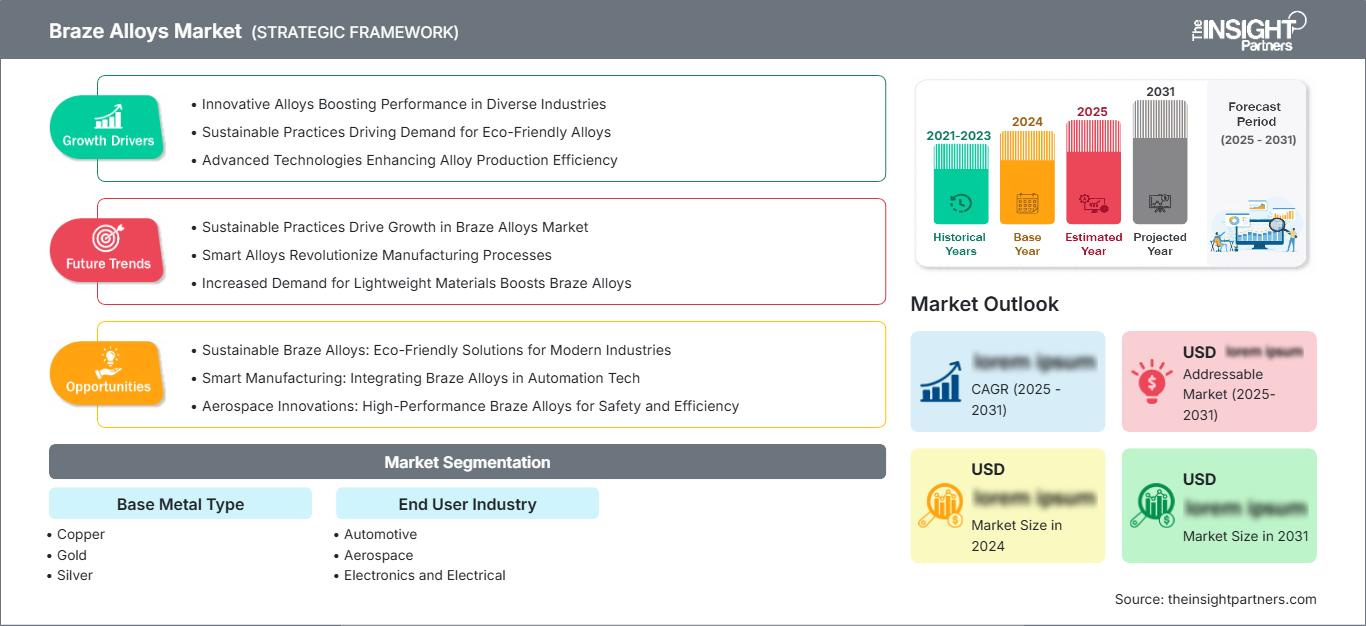
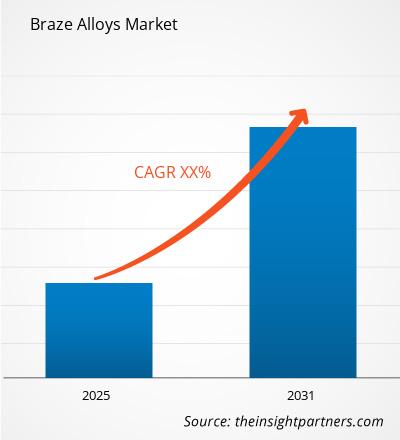
Braze Alloys Market size was US$ 3.22 Billion in 2025 and is forecast to grow to US$ 5.32 Billion by 2034, representing a CAGR of 5.75% from 2026–2034. The expansion will be driven by increasing adoption of precision metal bonding in automotive heat exchangers, aerospace structures, electronic packaging, and construction materials that require robust, leak-proof, and temperature-resistant joints in mixed-metal manufacturing.
North America Braze Alloys Market is forecast to exhibit a CAGR of 5.2–5.8% over 2026-2034, driven by growth in aerospace engine overhauls, electric vehicles, HVAC upgrades, and military production. Growth will be supplemented by domestic reshoring initiatives, greater incorporation of aluminum and copper assemblies, and more stringent performance requirements for joints exposed to vibration, pressure, and temperature fluctuations.
Braze Alloys Market Assessment and Insights
- North America: Accounted for 27–30% share in 2025 and is projected to grow at a CAGR of 5.2–5.8% during 2026–2034, supported by aerospace repair, EV thermal systems, HVAC replacement, and defense-grade joining demand.
- US: Represented 78–82% of North American revenue in 2025 and is anticipated to expand at a CAGR of 5.3–5.9% during 2026–2034, driven by aircraft, automotive, and electronics manufacturing clusters.
- Europe: Held 23–26% share in 2025 and is expected to grow at a CAGR of 4.9–5.5% during 2026–2034, led by Germany, France, the UK, Italy, and Spain through precision engineering and aerospace production.
- Asia Pacific: Accounted for 38–42% share in 2025 and is forecast to register a CAGR of 6.3–6.9% during 2026–2034, led by China, Japan, India, South Korea, and Australia through electronics, HVAC, and vehicle manufacturing.
- Largest Segment: Copper held 34–38% Braze Alloys Market market share in 2025 and is expected to grow at a CAGR of 5.4–6.0% during 2026–2034, reflecting cost-effective conductivity and broad industrial use.
- High Growth Segment: Electronics and Electrical represented 24–28% market share in 2025 and is projected to grow at a CAGR of 6.4–7.0% during 2026–2034, supported by power modules and compact thermal systems.
- Key companies analyzed in detail: Aimtek, Inc.; Bellman-Melcor, LLC; Cupro Alloys Corporation; Indian Solder and Braze Alloys Pvt. Ltd.; Johnson Matthey Plc; Lucas-Milhaupt, Inc.; Morgan Advanced Materials plc; Oerlikon Management AG; Saru Silver Alloy Private Limited; The Harris Products Group, Inc.
Source: The Insight Partners' analysis based on proprietary research, government publications, company annual reports, investor presentations, industry databases, and expert interviews.
Brazing in industry has evolved from traditional methods of filler metal supply to advanced joining systems that integrate alloy chemistry, flux characteristics, furnace operations, and automation for filler metal dispensing. Today, Braze Alloys have the capability of meeting requirements for thinner parts, multi-metal assemblies, and higher heat loads in automotive, aerospace, electronics, and building systems applications. The production dynamics will continue to evolve due to a decrease in silver content, qualification of copper alloy, and consistency of pastes, wires, foils, rods, and preforms.
The market will see further development through the trend of localized manufacturing, energy-efficient HVAC, electric mobility, fleet replacement in the aerospace industry, and electronics miniaturization. In addition, investments will likely flow into Asia-Pacific capacity expansions, aerospace rework capabilities in North America, and the development of specialty alloys in Europe. Increasing environmental pressure from such regulations as RoHS and REACH requires the development of cadmium-free, lead-free, and reduced-emission brazing technologies.
Braze Alloys Market Report Scope
| Report Attribute | Details |
|---|---|
| Market size in 2025 | US$ 3.22 Billion |
| Market Size by 2034 | US$ 5.32 Billion |
| Global CAGR (2026 - 2034) | 5.75% |
| Historical Data | 2021-2024 |
| Forecast period | 2026-2034 |
Braze Alloys Market Analysis
Demand is driven by applications where welding could cause distortion in thin metal sheets and soldering would not meet the mechanical and thermal requirements. Growth in the Braze Alloys Market can be attributed to heat exchangers, aircraft turbine parts, EV battery coolant plate assemblies, semiconductor packaging, HVAC coil production, and construction fasteners. It gains from the ability to join dissimilar materials, minimize scrap, automate processes, and make leak-free connections in a highly cyclical industrial environment.
The ecosystem consists of alloy refiners, precious-metal suppliers, powder makers, paste manufacturers, furnace equipment providers, distributors, and end users. Price volatility in silver and copper is driving greater recycling and hedging, as well as the development of low-precious-metal braze alloys. On the other hand, automobile and electronic device manufacturers need a steady global supply, consistent melting ranges, and compliance to aerospace, medical device, and high-reliability industrial manufacturing standards.
The level of competitive rivalry is moderate, since there are additional barriers to entry beyond commodity metal availability. According to Braze Alloys Market analysis, major market players include Lucas-Milhaupt, Inc., Johnson Matthey Plc, Morgan Advanced Materials plc, and The Harris Products Group, Inc. These companies utilize broad product catalog, technical assistance, and a worldwide distribution network in their competition. Companies with specific skills, such as Aimtek, Inc. and Bellman-Melcor, LLC, focus on providing highly-precise and repairing services.
Trends in investments include automated brazing, controlled-atmosphere furnaces, near-net-shape preforms, and custom formulations for electric mobility and aerospace repair. In addition, Cupro Alloys Corporation, Indian Solder and Braze Alloys Pvt. Ltd., Saru Silver Alloy Private Limited, and Oerlikon Management AG provide increased regional access through unique metallurgy capabilities. Companies with both formulation and process expertise can sustain higher margins regardless of volatile raw materials prices.
● REPORT CUSTOMIZATION
Tailor This Report To Align With Your Specific Business Requirements
This report can be customized to align precisely with your business objectives, scope, and target markets. Customization options include tailored segmentation, geography, competitive analysis, and strategic insights to support informed decision-making.
Customize This Report →WHAT YOU CAN ADJUST
- ● Segmentations
- ● Geography
- ● Competitive Analysis
- ● Language Preferences
Braze Alloys Market: Strategic Insights
Regional Insights
North America Braze Alloys
North America accounted for 27–30% of Braze Alloys Market share in 2025 and is expected to expand at a CAGR of 5.2–5.8% during 2026–2034. Regional demand reflects aerospace engine maintenance, defense electronics, EV thermal management, and replacement of HVAC coils using copper, aluminum, and silver-based filler metals. Manufacturing reshoring also supports localized qualification of high-performance joining materials.
There remain efforts by industry associations to promote joint integrity, capillary action, and process control in brazed joints, thereby continuing quality-oriented sourcing. Suppliers would enjoy proximity to aircraft, automobile, refrigeration, and electronic manufacturers who would demand traceable lots and technical problem-solving. The use of cadmium- and lead-free alloys is becoming increasingly common as well.
U.S. Braze Alloys Market
The US accounted for 78-82% of the North American Braze Alloys market in 2025 and will register a CAGR of 5.3-5.9% in 2026-2034. Demand will be driven by aerospace clusters, automotive assembly belts, electronics assembly, and HVAC manufacturing applications. Domestic consumers demand brazing materials that can endure thermal cycling, corrosion, vibration, and leak-pressure tests.
Corporate presence is retained via Lucas-Milhaupt, Inc., The Harris Products Group, Inc., Aimtek, Inc., Bellman-Melcor, LLC, and foreign competitors among certified industrial customers. Applications include aluminum brazing in EV coolant packs, copper phosphorus alloys in HVAC units, and silver alloys for aerospace repairs. Technical services play a key role as joint design and furnace conditions determine the qualification of products.
Europe Braze Alloys Market
Europe held 23–26% Braze Alloys Market share in 2025 and is forecast to advance at a CAGR of 4.9–5.5% during 2026–2034. Germany is the leading country because automotive powertrain, industrial machinery, and precision engineering demand high-reliability joints. The UK supports aerospace repair and specialty manufacturing, while France benefits from aircraft and energy equipment supply chains.
Italy and Spain benefit from industries such as HVAC, refrigeration, construction, and metalworking that require economically sound copper and aluminum fillers. Procurement in Europe is significantly affected by REACH and RoHS regulations, carbon reduction efforts, and customers who demand cadmium-free filler material. Companies that can prove compliance to these environmental policies, while providing proper wetting and fatigue resistance, will gain market share.
APAC Braze Alloys Market
The Asia Pacific region contributed 38-42% in 2025 and is forecast to grow at a CAGR of 6.3-6.9% in 2026-2034. China leads regional consumption in electronics, HVAC, vehicle manufacturing, and industrial fabrication, while Japan and South Korea sustain demand through precision electronics and mobility value chains.
Indonesia is developing its market by localizing vehicle manufacturing, construction, and electrical appliance production, while Australia will ensure demand through maintenance and mining machinery, as well as infrastructure value chains. The policies in favor of manufacturing, electronics independence, and electric vehicles value chain will fuel regional demand of fillers like aluminum, copper, and silver.
Middle East & Africa Braze Alloys Market
The Braze Alloys Market in Middle East and Africa will register a CAGR of 4.7 to 5.3% during 2026-2034. The key drivers are Saudi Arabia due to its energy projects, industrial maintenance, and infrastructure localization, along with the UAE due to HVAC, construction, and specialized repair needs related to its commercial buildings and airline services.
As far as Sub-Saharan Africa is concerned, South Africa holds a dominant position due to its mining equipment repair needs, power infrastructure, and fabrication industries. The rest of MEA region is showing a gradual improvement in demand due to increased need for leak-tight joining in cooling, fuel, and process equipment, driven by industrial diversification schemes.
Segmentation Analysis
Base Metal Type
Base Metal Type is projected to grow at a CAGR of 5.5–6.1% during 2026–2034, as users balance conductivity, melting temperature, corrosion resistance, and cost. The Braze Alloys Market scope spans copper systems for volume manufacturing, silver systems for premium joining, aluminum fillers for lightweight assemblies, and gold alloys for specialized high-reliability electronics and medical components.
- Copper – Maintains broad use in HVAC, refrigeration, electrical assemblies, and industrial components because it offers strong conductivity, reliable flow, and cost advantages for high-volume manufacturing environments.
- Gold – Serves high-reliability applications where oxidation resistance, biocompatibility, and stable performance justify premium cost, especially in electronics, sensors, vacuum devices, and selected medical technologies.
- Silver – Remains important in aerospace, tooling, electrical contacts, and precision assemblies because of strong wetting performance, lower joining temperatures, and compatibility with multiple base metals.
- Aluminum – Gains traction in lightweight vehicles, heat exchangers, battery cooling plates, and HVAC components where corrosion resistance and thermal management are critical design requirements.
End User Industry
End User Industry is expected to grow at a CAGR of 5.7–6.3% during 2026–2034, reflecting wider adoption of automated joining in transportation, aerospace, electronics, and building systems. End users increasingly require alloys that deliver repeatable capillary flow, clean joints, thermal fatigue resistance, and compatibility with lean production lines using furnaces, torches, induction systems, or controlled atmospheres.
- Automotive – Uses brazing in heat exchangers, fuel systems, exhaust assemblies, sensors, and EV thermal modules where lightweight materials, leak resistance, and vibration durability are essential.
- Aerospace – Requires premium alloys for turbine components, honeycomb structures, hydraulic systems, repair work, and high-temperature assemblies where qualification standards and reliability expectations are stringent.
- Electronics and Electrical – Expands through power modules, connectors, heat sinks, semiconductor packaging, and battery systems where compact designs need efficient thermal and electrical pathways.
- Construction – Uses brazing in copper tubing, HVAC installations, fittings, roofing systems, and mechanical services where joint integrity, corrosion resistance, and installation efficiency support lifecycle performance.
Opportunity Snapshot
| Segment Name | Revenue Contribution | Trend Tag | Adoption Stage |
| Automotive | High | EV Cooling | Scaling |
| Aerospace | Medium | Turbine Repair | Mature |
| Electronics and Electrical | High | Power Modules | Scaling |
| Construction | Medium | HVAC Retrofit | Mature |
Braze Alloys Market Growth Drivers and Impact Analysis
Electrification increases demand for reliable thermal joining
The growth of electric vehicles has increased demand for brazed aluminum and copper assemblies used in battery cooling plates, power electronics, compressors, and heat exchangers. Electric cars are designed to have small thermal systems that help regulate battery temperature, facilitate smooth charging, and protect electronic components from overheating. The brazing process fulfills these criteria by ensuring a leak-free passage while maintaining structural integrity even when temperatures fluctuate due to vibrations. Another trend in the automotive industry is vehicle weight reduction, which calls for aluminum construction and specially formulated filler metals.
Aerospace maintenance and engine efficiency strengthen premium alloy use
The demand for the braze alloys in aerospace industry is driven by commercial aircraft utilization, defense system upgrades, and repairs to parts exposed to extreme temperatures. The brazing process is used in turbine blades, honeycomb seals, fuel systems, heat exchangers, and engine repair operations when dimensional control and metallurgy are crucial. Silver, nickel, and specialized copper systems will continue to be used for aerospace joints that must resist thermal stress, oxidation, and pressure fluctuations. Qualified suppliers, who can offer specification capabilities, documentation and technical services, have the competitive edge due to long qualification cycles and high switching cost. This driver has high value effect because of low volumes and high value materials utilized in aerospace industry.
Electronics miniaturization raises demand for precision filler systems
Electronics manufacturers will seek joining materials offering conductivity, thermal capability, and reliability in compact packaging. Electronics used in power modules, sensors, semiconductor manufacturing equipment, data centers, telecommunications, and battery electronics must be clean joinery capable of withstanding heat, current density, and mechanical stress. Brazing meets these needs by providing precisely placed filler metal and higher joint strength than many low-temperature options. This driver is driven by the rise of 5G technology, AI servers, renewable energy power electronics, and industrial control electronics. Manufacturers capable of producing foils, pastes, rings, and preforms with small melting temperature ranges will assist in automation and rework reduction.
Braze Alloys Market Future Trends
Lower-precious-metal and compliant alloy development
Future formulation development will focus on reducing the amount of precious metal used while preserving joint strength, wetting, and fatigue resistance. Current Braze Alloys Market trends are increasingly driven by customers' need for silver price management and environmental restrictions on potentially harmful substances. Customers can expect alloy manufacturers to develop more cadmium-, lead-, and fume-free solutions for the electronics, heating, ventilation, and air conditioning, medical, and aerospace industries. Improved process monitoring through digitization will further enable acceptance by verifying that new formulations can meet repeatability specifications.
Automated brazing lines and engineered preforms
Automation will reshape procurement as manufacturers move from generic filler metals toward engineered joining packages. Robotic dispensing, induction brazing, controlled-atmosphere furnaces, and sensor-based quality checks require alloys supplied in repeatable forms such as preforms, rings, foils, and precisely blended pastes. This shift supports lower scrap rates and more consistent cycle times in automotive, HVAC, electronics, and aerospace production. Suppliers that understand joint geometry, surface preparation, flux chemistry, and furnace profiles can command stronger customer relationships. The trend also supports data-driven quality assurance because manufacturers need traceability from alloy batch to finished component performance.
Braze Alloys Market Opportunities
Localized supply for EV and HVAC manufacturing hubs
Manufacturing localization creates opportunities for alloy producers to build supply positions near EV battery, automotive HVAC, and refrigeration clusters. Braze Alloys Market Forecasts suggest that buyers will prioritize shorter lead times, application engineering, and supply continuity as thermal management systems become more complex. Producers can invest in regional warehousing, toll blending, recycling partnerships, and technical centers that support customer qualification. Local service is especially valuable where brazing parameters must be adjusted for aluminum grades, copper tube dimensions, furnace atmospheres, or flux residues. Companies that combine regional availability with metallurgical support can reduce customer risk and secure long-term supply agreements.
Specialty alloys for high-reliability electronics and aerospace repair
Specialty alloy development offers margin-accretive opportunities in applications where failure costs are high and qualification standards are strict. Aerospace repair, semiconductor equipment, vacuum systems, medical devices, sensors, and power electronics require consistent alloys with controlled melting ranges, cleanliness, and documented performance. Producers can differentiate through customized preforms, low-voiding pastes, gold-bearing compositions, and silver systems optimized for thermal fatigue. Technical collaboration during design and process validation can increase switching costs and deepen customer relationships. This opportunity favors companies with laboratory capability, application engineers, and quality systems aligned with regulated industries rather than suppliers competing only on metal price.
Recent Developments
- October 2025: Trusted AeroSpace Engineering (TASE) Global announced a US$30 million expansion through organic and inorganic growth, including the acquisition of Joined Alloys in Arizona for approximately US$12 million. The acquisition strengthens TASE Global's capabilities in precision machining, sheet metal fabrication, brazing, welding, heat treatment, and non-destructive testing, enhancing its position in the aerospace manufacturing and advanced metal joining value chain.
- August 2025: Lincoln Electric Holdings, Inc. acquired the remaining interest in Alloy Steel International, making the company a wholly owned subsidiary. The acquisition expands Lincoln Electric's advanced alloy materials portfolio and reinforces its position in metal joining technologies, including brazing alloys, welding consumables, and wear-resistant material solutions for mining, infrastructure, energy, and heavy industrial applications.
Frequently Asked Questions

- Comprehensive Market Sizing and Forecast Analysis
- Detailed Segmentation Analysis
- In-Depth Market Dynamics Assessment
- Regional and Country-Level Insights
- Competitive Landscape and Company Benchmarking
- Strategic Business Intelligence
Recent Reports
Testimonials

The Insight Partners provided valuable market intelligence that supported our global go-to-market strategy. Their team was professional, responsive, and attentive to our feedback, providing thoughtful analysis and helpful methodological clarifications throughout the project.
Junmo Kim Chief Financial Officer (CFO), Enertech Co., Ltd.
The Insight Partners' SCADA System Market report is comprehensive, with valuable insights on current trends and future forecasts. The team was highly professional, responsive, and supportive throughout. We are very satisfied and highly recommend their services.
RAN KEDEM Partner, Reali Technologies LTDs
I requested a report on a very specific software market and the team produced the report in a few days. The information was very relevant and well presented. I then requested some changes and additions to the report. The team was again very responsive and I got the final report in less than a week.
JEAN-HERVE JENN Chairman, Future Analytica
We worked with The Insight Partners for an important market study and forecast. They gave us clear insights into opportunities and risks, which helped shape our plans. Their research was easy to use and based on solid data. It helped us make smart, confident decisions. We highly recommend them.
PIYUSH NAGPAL Sr. Vice President, High Beam Global
The Insight Partners delivered insightful, well-structured market research with strong domain expertise. Their team was professional and responsive throughout. The user-friendly website made accessing industry reports seamless. We highly recommend them for reliable, high-quality research services
YUKIHIKO ADACHI CEO, Deep Blue, LLC.
This is the first time I have purchased a market report from The Insight Partners.While I was unsure at first, I visited their web site and felt more comfortable to take the risk and purchase a market report.I am completely satisfied with the quality of the report and customer service. I had several questions and comments with the initial report, but after a couple of dialogs over email with their analyst I believe I have a report that I can use as input to our strategic planning process.Thank you so much for taking the extra time and making this a positive experience.I will definitely recommend your service to others and you will be my first call when we need further market data.
JOHN SUZUKI President and Chief Executive Officer, Board Director, BK Technologies
I wish to appreciate your support and the professionalism you displayed in the course of attending to my request for information regarding to infectious disease IVD market in Nigeria. I appreciate your patience, your guidance, and the fact that you were willing to offer a discount, which eventually made it possible for us to close a deal. I look forward to engaging The Insight Partners in the future, all thanks to the impression you have created in me as a result of this first encounter.
DR CHIJIOKE ONYIA MANAGING DIRECTOR, PineCrest Healthcare Ltd.Reason to Buy
- Informed Decision-Making
- Understanding Market Dynamics
- Competitive Analysis
- Identifying Emerging Markets
- Customer Insights
- Market Forecasts
- Risk Mitigation
- Boosting Operational Efficiency
- Strategic Planning
- Investment Justification
- Tracking Industry Innovations
- Aligning with Regulatory Trends





 Get Free Sample for