
Breast Augmentation Market Trends, Size & Forecast by 2034
Coverage: By Product (Silicone Breast Implant, Saline Breast Implant); Shape (Anatomical, Round); Surface (Smooth, Textured); Procedure (Inframammary Fold, Trans-axillary, Perio-aeriolar. Trans-umbical); End-User (Hospitals, Cosmetology Clinics and Ambulatory Care Settings, And others) , and Geography (North America, Europe, Asia Pacific, and South and Central America)
- Status : Data Released
- Report Code : TIPRE00022685
- Category : Life Sciences
- No. of Pages : 150
- Available Report Formats :


- Last update date : August 05, 2026


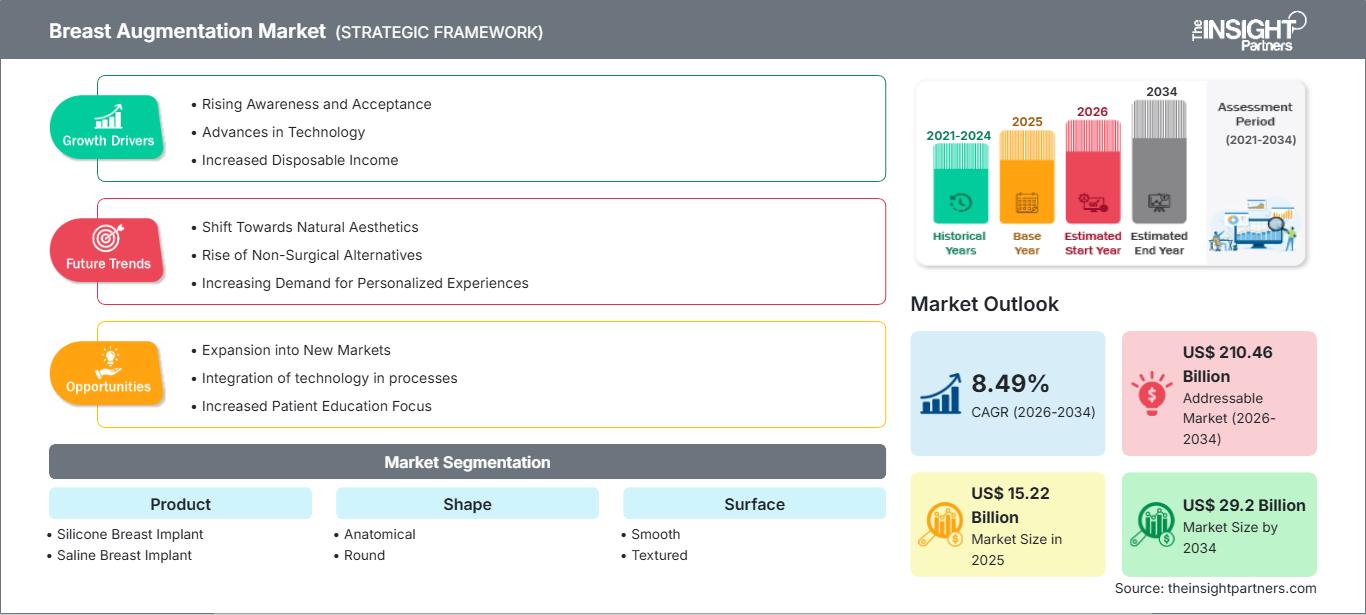
2025 Market Size
US$ 15.22 Bn
Base year value
2034 Forecast
US$ 29.2 Bn
Projected by 2034
CAGR 2026-2034
8.49 %
Growth rate
Addressable Market
US$ 210.46 Bn
(2026-2034)
The Breast Augmentation Market is forecast to reach US$ 15.22 billion in 2025 and will further register an 8.49% CAGR during 2026-2034, to achieve US$ 29.2 billion in 2034. The factors driving demand include procedural normalization, development of implants, revision procedures, and reconstructive breast augmentation after mastectomy. There is more emphasis on safety communication, post-market surveillance and preference for long-lasting and natural feeling products.
North America continues to be a lucrative revenue generator, with the support of specialized plastic surgeons, FDA approved implants and high transparency of procedures driving the Breast Augmentation Market size in North America. The region is anticipated to witness growth at 7.8%-8.4% CAGR during 2026-2034, backed by reconstruction availability, disposable income, patient education online and adoption of smooth surface silicone implants.
Breast Augmentation Market Assessment and Insights
- North America held 38–42% share in 2025 and is expected to grow at a CAGR of 7.8–8.4% between 2026–2034. Market demand is reinforced by FDA-cleared products, specialist surgeons, reconstruction programs, and implant registry participation.
- US represented 82–86% of North America in 2025 and is projected to grow at a CAGR of 7.9–8.5% between 2026–2034, supported by implant approvals, revision surgery, and reconstruction demand.
- Europe accounted for 24–28% share in 2025 and is expected to grow at a CAGR of 7.2–7.8% between 2026–2034. Germany, France, Italy, Spain, and the UK lead demand through private aesthetic clinics and MDR-aligned suppliers.
- Asia Pacific captured 22–26% share in 2025 and is projected to grow at a CAGR of 9.2–10.0% between 2026–2034. China, Japan, South Korea, India, and Australia drive gains through rising medical aesthetics expenditure and surgeon training.
- Largest Segment Silicone Breast Implant held 78–84% market share in 2025 and is expected to grow at a CAGR of 8.4–9.0% between 2026–2034, reflecting patient preference for natural feel and broader product availability.
- High Growth Segment Smooth surfaced implants held 58–64% market share in 2025 and are forecast to grow at a CAGR of 9.0–9.8% between 2026–2034, supported by safety-driven purchasing shifts after textured implant scrutiny.
- Key companies analyzed in detail: Mentor Worldwide LLC, Allergan Aesthetics, Sientra, a division of Tiger Aesthetics Medical LLC, Ideal Implant Incorporated, Laboratoires Arion, CEREPLAS, Sebbin SAS, GC Aesthetics plc, POLYTECH Health & Aesthetics GmbH, Guangzhou Wanhe Plastic Materials Co., Ltd.
Source: The Insight Partners' analysis based on proprietary research, government publications, company annual reports, investor presentations, industry databases, and expert interviews.
Breast Augmentation Market has transitioned from simple breast volume augmentation to more advanced implant science, procedure planning, and safety management. Manufacturers focus on cohesive gel implants, shell structure, smooth surface, larger implant profiles, and surgeon training. Manufacturing factors impacting production have become regulation-driven, post-approval testing, compliance with the quality system, and regional distribution partners. In this way, evidence, traceability, and warranty become as important as the physical characteristics of the products.
In the forecast period, the market would benefit from growing demand in Asia Pacific and the Middle East, where aesthetic clinics would be growing in number. Regulations would not inhibit market growth but rather would direct it to approved, evidenced, and physician-approved products. Future investment is expected to go into differentiated silicone products, digital consultation tools, and reconstruction products.
Breast Augmentation Market Report Scope
| Report Attribute | Details |
|---|---|
| Market size in 2025 | US$ 15.22 Billion |
| Market Size by 2034 | US$ 29.2 Billion |
| Global CAGR (2026 - 2034) | 8.49% |
| Historical Data | 2021-2024 |
| Forecast period | 2026-2034 |
Breast Augmentation Market Analysis
Growth in the market for breast augmentation surgery is driven by increased acceptance of elective aesthetics, increased reconstruction surgery, and consumer preference for personalization. Growth in demand happens in locations where there are specialized plastic surgeons, registry tracking for implants, and funding. There are changes in supply as well due to the fact that the FDA has compelled manufacturers to move towards implants with a smooth surface, clear patient decision checklists, and evidence-based positioning for their products.
There are several players in the value chain of the industry such as suppliers of silicone raw materials, implant makers, regulatory specialists, distributors, hospitals, ASCs, and plastic surgery clinics. Breast reconstruction for cancer is an important structural layer of demand, particularly in developed markets with well-organized oncological care. Professional societies and physician training programs also contribute to the ecosystem.
The Breast Augmentation Market report reveals that competition is becoming technology-driven rather than price-driven. Mentor Worldwide LLC and Allergan Aesthetics rely on a larger portfolio and access to hospitals, whereas Sientra through Tiger Aesthetics Medical LLC is repositioning via regenerative medicine adjacency. On the other hand, GC Aesthetics plc and POLYTECH Health & Aesthetics GmbH are competing with their European manufacturing capabilities and portfolio.
Positioning has become highly dependent on regulatory, surgical familiarity, and surface differentiations. The approval of Motiva implants from Establishment Labs in the U.S. market has made people talk about the newer generation of smooth-surface implants but outside the company list. Specialists like Laboratoires Arion, CEREPLAS, Sebbin SAS, and Guangzhou Wanhe Plastic Materials Co., Ltd. cater to the regional requirements with their catalog strengths and relationships with surgeons.
● REPORT CUSTOMIZATION
Tailor This Report To Align With Your Specific Business Requirements
This report can be customized to align precisely with your business objectives, scope, and target markets. Customization options include tailored segmentation, geography, competitive analysis, and strategic insights to support informed decision-making.
Customize This Report →WHAT YOU CAN ADJUST
- ● Segmentations
- ● Geography
- ● Competitive Analysis
- ● Language Preferences
Breast Augmentation Market: Strategic Insights
Regional Insights
North America Breast Augmentation Market
The North American market represented 38–42% market share in 2025 and is expected to grow at a CAGR of 7.8–8.4% through 2026–2034. The share of Breast Augmentation Market in North America is attributed to FDA-approved implant offerings, procedure disclosure, post-market monitoring, and solid reconstruction pathways. Patient decision checklist and boxed warning have raised awareness, but at the same time created more traction towards informed, physician-led decisions.
Expansion will be led by the US, followed by Canada, where networks of cosmetic surgeons and breast reconstruction programs continue to be well established. The activities of manufacturers have been prominent in silicone implants, smooth texture, and premium product lines. Market demand is further boosted by the infrastructure of clinical registries, including the National Breast Implant Registry.
U.S. Breast Augmentation Market
The US makes up 82-86% of North America in 2025 and is estimated to experience a CAGR of 7.9-8.5% between 2026 and 2034. The approval processes in place by the FDA, high surgeon densities, and patient financing contribute to a high per-procedure value. The recent approval of large-sized reconstruction implants and smooth-surface devices has provided surgeons with more choices and competition among devices.
Significant importance in the US market is held by Mentor Worldwide LLC, Allergan Aesthetics, and Sientra, a subsidiary of Tiger Aesthetics Medical LLC, on account of their product approvals, educational initiatives, and warranties. Trends in applications reveal continued interest in primary augmentation, implant replacement, and reconstruction post-mastectomy. Contracting in hospitals for reconstruction surgery is also becoming important.
Europe Breast Augmentation Market
Europe accounted for 24–28% share in 2025 and is projected to experience a CAGR of 7.2–7.8% over 2026–2034. Germany dominates the region on account of its specialty clinics, advanced surgical facilities, and preference towards traceable implants due to the regulation by MDR. Companies such as GC Aesthetics plc, POLYTECH Health & Aesthetics GmbH, Sebbin SAS, CEREPLAS, and Laboratoires Arion help augment the supplier landscape of Europe.
The UK is governed by private cosmetic surgery groups, referrals for reconstruction, and stringent patient counseling protocols. The demand is evenly distributed among primary augmentation and replacement implants, where professional consultations affect the selection of the implant. Smooth surface implants and safety records are becoming differentiating factors in the closely watched category of Market.
France, Italy, and Spain offer extra scale because of their long-term history of aesthetic medicine along with specialized surgeons. France enjoys a strong presence of local manufacturers and strict regulations, while Italy and Spain have consistent private clinic volumes. In these markets, Market is shifting towards documentation, surgeon training, and patient-specific implant planning.
APAC Breast Augmentation Market
The share of APAC was 22-26% in 2025 and is forecasted to have a CAGR of 9.2-10.0% from 2026 to 2034. China is the top country, followed by Japan, South Korea, India, and Australia. Increasing disposable income, medical aesthetics acceptance, and growth in the number of specialist clinics drive demand.
Factors that influence policy are good registration of medical devices, investment in private sector healthcare, and quality control. South Korea and Japan influence the development of aesthetics technology, while India and China offer volume through the use of the procedures in cities. Demand for market in APAC is influenced by distributors and surgeons’ training programs.
Middle East & Africa Breast Augmentation Market
CAGR forecast in Middle East & Africa between 2026 and 2034 will be 8.0%-8.8%, with the UAE leading the way in terms of the use of implants in the region. Countries such as Saudi Arabia, South Africa, and the Rest of MEA are involved via private hospitals, medical tourism, and luxury aesthetic clinics.
Growing investments in healthcare infrastructure and clinics specializing in procedures involving implants have made implant procedures easier. Public investments in healthcare in the Gulf region as a result of energy investments make provision for premium procedures, while South Africa continues to act as a hub of procedures for parts of the continent.
Segmentation Analysis
Product
The Product segment is expected to grow at a CAGR of 8.3–8.9% during 2026–2034. Breast Augmentation Market scope across product types is defined by implant feel, rupture behavior, cost, regulatory approval, and patient preference. Silicone products dominate mature markets, while saline products retain relevance where adjustability, incision size, and pricing influence surgeon recommendations.
- Silicone Breast Implant: Silicone implants hold the strongest market position due to natural feel, broad profile availability, and strong surgeon familiarity. They are strategically important for premium augmentation and reconstruction planning.
- Saline Breast Implant: Saline implants serve cost-sensitive and specific clinical needs, particularly where adjustability is valued. Their role remains narrower but relevant in selected patient groups and surgical preferences.
Shape
The Shape segment is projected to grow at a CAGR of 8.1–8.7% during 2026–2034. Shape selection depends on body frame, desired contour, surgeon technique, implant pocket planning, and reconstruction requirements. Round implants are widely used because of procedural simplicity and predictable fullness, while anatomical implants retain value in selected aesthetic and reconstructive indications.
- Anatomical: Anatomical implants support contour-specific procedures and reconstruction cases where a natural slope is desired. Their use depends on careful pocket control and surgeon experience.
- Round: Round implants maintain broad demand because they provide upper-pole fullness, easier orientation, and wide product availability. They are strategically important in high-volume aesthetic procedures.
Surface
The Surface segment is forecast to grow at a CAGR of 8.6–9.2% during 2026–2034. Surface selection has become central to safety perception, clinical counselling, and procurement. Smooth implants are gaining preference after regulatory scrutiny of textured products, while textured implants remain selectively used where local approvals and clinical judgment support their application.
- Smooth: Smooth implants are increasing in strategic importance because of safety-related purchasing shifts, regulatory confidence, and patient preference. They are strongly aligned with current product innovation.
- Textured: Textured implants retain selected use in reconstruction and anatomical positioning, but demand is constrained by heightened safety scrutiny and surgeon caution in several mature markets.
Opportunity Snapshot
| Segment Name | Revenue Contribution | Trend Tag | Adoption Stage |
| Silicone Breast Implant | High | Natural Feel | Mature |
| Saline Breast Implant | Medium | Adjustable Fill | Mature |
| Anatomical | Medium | Contour Planning | Scaling |
| Round | High | Upper Fullness | Mature |
| Smooth | High | Safety Shift | Scaling |
| Textured | Low | Selective Use | Mature |
Breast Augmentation Market Growth Drivers and Impact Analysis
Rising reconstruction demand after breast cancer surgery
Breast reconstruction is a durable structural driver because it links implant demand to oncology pathways rather than discretionary aesthetics alone. In the US, Johnson & Johnson MedTech stated that more than 246,000 women undergo mastectomy each year, creating a continuing need for implant-based reconstruction choices. Larger implant designs now target patients who previously lacked proportionate options, improving surgeon ability to personalize outcomes. This expands addressable demand beyond traditional augmentation clinics and increases hospital procurement relevance. The Market benefits when oncology centers, plastic surgeons, and device manufacturers coordinate around reconstruction timing, patient counseling, and implant availability. Over time, this driver should support higher-value silicone implant adoption, especially in mature healthcare systems with insurance-linked reconstruction coverage.
Shift toward smooth-surface and evidence-backed implants
Safety communication has materially changed product selection. FDA materials emphasize that breast implants are not lifetime devices and that risks must be clearly communicated before surgery. The agency also continues to evaluate medical device reports, post-approval study compliance, and manufacturer labeling. These requirements are strengthening demand for products supported by clinical evidence, transparent labeling, and traceable postmarket data. Smooth-surface systems are gaining strategic importance as patients and surgeons seek products aligned with safety expectations. The Market is therefore not simply expanding through higher procedure volume; it is upgrading toward regulated, documented, and lower-friction product categories. Manufacturers with strong evidence generation, compliance systems, and surgeon education will be better positioned than firms competing mainly on cost.
Broader implant portfolios enabling personalized surgery
Portfolio depth is increasingly important because patients differ by anatomy, reconstruction history, desired projection, and tolerance for revision risk. Allergan Aesthetics has highlighted Natrelle’s range of more than 300 implant options, while Mentor Worldwide LLC has introduced larger reconstruction-focused implants. These developments show that competitive advantage is moving toward profile breadth, gel choices, sizes, and application-specific families. Surgeons can better match implant characteristics with tissue envelope, body frame, and aesthetic objectives. The Market benefits because personalization can improve patient satisfaction and reduce compromise in complex cases. Manufacturers that support planning, education, and reliable availability across sizes can increase surgeon loyalty, reduce substitution risk, and capture premium demand across augmentation, revision, and reconstruction workflows.
Breast Augmentation Market Future Trends
Digital planning and patient-specific implant selection
Breast Augmentation Market trends will increasingly include digital consultation, imaging-based sizing, and structured decision support. Clinics are likely to use visualization tools to improve expectation management, reduce sizing uncertainty, and document shared decision-making. This trend will matter because implant selection is highly preference-sensitive, and dissatisfaction often relates to size, projection, or symmetry rather than device failure alone. Digital workflows can also support follow-up reminders, implant card management, and revision planning. Manufacturers may integrate educational platforms with surgeon networks to influence product selection earlier in the consultation journey. The long-term effect will be a more data-driven pathway where clinical judgment, patient goals, and device attributes are aligned before surgery.
Regulatory-led preference for traceable premium devices
Future demand will be shaped by patient awareness, global device vigilance, and surgeon preference for traceable products. Registries such as the National Breast Implant Registry demonstrate how device tracking can support safety monitoring and evidence development. As regulators and professional societies continue emphasizing informed consent, patients will likely favor brands with accessible labeling, postmarket data, and reliable warranties. This creates a premiumization trend, especially in North America and Europe, where procurement decisions are increasingly linked to compliance confidence. The Market will therefore reward companies that invest in quality systems, long-term studies, and transparent risk communication rather than relying on visual differentiation alone.
Breast Augmentation Market Opportunities
Expansion in Asia Pacific premium aesthetic centers
Asia Pacific offers a strong investment pathway because procedure acceptance, private clinic expansion, and urban income growth are converging. Breast Augmentation Market Forecasts point to above-global growth in the region, especially where trained surgeons and premium device distributors are building capacity. China, South Korea, Japan, India, and Australia each require different channel strategies, from hospital relationships to aesthetic clinic education. Manufacturers can capture value by supporting physician training, localized patient materials, and reliable regulatory submissions. Premium silicone and smooth-surface implant lines should perform well where patients increasingly compare safety, feel, and brand reputation. The main execution requirement is disciplined market access, since regulatory registration and distributor quality vary significantly across APAC countries.
Reconstruction-focused hospital partnerships
Hospital supply partnerships create an opportunity to stabilize demand beyond discretionary cosmetic cycles. Allergan Aesthetics’ supplier agreement with Vizient demonstrates how procurement networks can widen access to implant portfolios across academic medical centers, community hospitals, and integrated delivery networks. This model is strategically relevant because reconstruction often depends on hospital purchasing, reimbursement pathways, and multidisciplinary cancer care. Manufacturers can strengthen adoption by offering surgeon education, inventory reliability, patient documentation, and warranty support. The Breast Augmentation Market can gain higher-quality growth from these institutional channels because they are less vulnerable to short-term consumer sentiment than elective aesthetics. Companies that align with oncology reconstruction priorities will also improve clinician trust and long-term brand continuity.
Recent Developments
- October 2025: Allergan Aesthetics, an AbbVie company announced that Natrelle was awarded a supplier agreement by Vizient, expanding provider access to its implant portfolio across academic medical centers, community hospitals, integrated delivery networks, and non-acute care providers. The agreement supports procurement efficiency, pricing access, and reconstruction program availability for US healthcare organizations.
- May 2025: Johnson & Johnson MedTech launched MENTOR MemoryGel Enhance Breast Implants in the US for reconstruction patients with larger breast sizes after mastectomy. The line offers sizes from 930 cc to 1445 cc and targets patients who previously lacked proportionately sized reconstruction options, addressing an estimated 15% post-mastectomy access gap.
- April 2024: Tiger Aesthetics Medical LLC acquired substantially all assets associated with Sientra Inc.’s breast implant business. The transaction positioned Sientra as a division of Tiger Aesthetics Medical LLC and combined the company’s implant portfolio with Tiger’s regenerative medicine strategy, while maintaining manufacturing and operations at Sientra’s Franklin, Wisconsin facilities.
Frequently Asked Questions

- Comprehensive Market Sizing and Forecast Analysis
- Detailed Segmentation Analysis
- In-Depth Market Dynamics Assessment
- Regional and Country-Level Insights
- Competitive Landscape and Company Benchmarking
- Strategic Business Intelligence
Recent Reports
Testimonials

The Insight Partners' SCADA System Market report is comprehensive, with valuable insights on current trends and future forecasts. The team was highly professional, responsive, and supportive throughout. We are very satisfied and highly recommend their services.
RAN KEDEM Partner, Reali Technologies LTDs
I requested a report on a very specific software market and the team produced the report in a few days. The information was very relevant and well presented. I then requested some changes and additions to the report. The team was again very responsive and I got the final report in less than a week.
JEAN-HERVE JENN Chairman, Future Analytica
We worked with The Insight Partners for an important market study and forecast. They gave us clear insights into opportunities and risks, which helped shape our plans. Their research was easy to use and based on solid data. It helped us make smart, confident decisions. We highly recommend them.
PIYUSH NAGPAL Sr. Vice President, High Beam Global
The Insight Partners delivered insightful, well-structured market research with strong domain expertise. Their team was professional and responsive throughout. The user-friendly website made accessing industry reports seamless. We highly recommend them for reliable, high-quality research services
YUKIHIKO ADACHI CEO, Deep Blue, LLC.
This is the first time I have purchased a market report from The Insight Partners.While I was unsure at first, I visited their web site and felt more comfortable to take the risk and purchase a market report.I am completely satisfied with the quality of the report and customer service. I had several questions and comments with the initial report, but after a couple of dialogs over email with their analyst I believe I have a report that I can use as input to our strategic planning process.Thank you so much for taking the extra time and making this a positive experience.I will definitely recommend your service to others and you will be my first call when we need further market data.
JOHN SUZUKI President and Chief Executive Officer, Board Director, BK Technologies
I wish to appreciate your support and the professionalism you displayed in the course of attending to my request for information regarding to infectious disease IVD market in Nigeria. I appreciate your patience, your guidance, and the fact that you were willing to offer a discount, which eventually made it possible for us to close a deal. I look forward to engaging The Insight Partners in the future, all thanks to the impression you have created in me as a result of this first encounter.
DR CHIJIOKE ONYIA MANAGING DIRECTOR, PineCrest Healthcare Ltd.Reason to Buy
- Informed Decision-Making
- Understanding Market Dynamics
- Competitive Analysis
- Identifying Emerging Markets
- Customer Insights
- Market Forecasts
- Risk Mitigation
- Boosting Operational Efficiency
- Strategic Planning
- Investment Justification
- Tracking Industry Innovations
- Aligning with Regulatory Trends





 Get Free Sample for