
Cables for Endoscopes Market Size, Trends & Growth by 2034
Coverage: By Type (Signal Cables, Fiber Optic Cables, Hybrid Cables), Endoscope Type (Flexible Endoscopes and Rigid Endoscopes), Material (Silicone and TPE (Thermoplastic Elastomer), Connector Type (Standard Connectors and Custom Connectors), End-Use Industry (Hospitals and Clinics, Ambulatory Surgical Centers (ASCs), OEMs and Device Manufacturers, and Others), and Geography (North America, Europe, Asia Pacific, the Middle East and Africa, and South and Central America)
- Status : Data Released
- Report Code : TIPRE00043070
- Category : Life Sciences
- No. of Pages : 150
- Available Report Formats :


- Last update date : August 14, 2026


2025 Market Size
US$ 1.10 Bn
Base year value
2034 Forecast
US$ 2.08 Bn
Projected by 2034
CAGR 2026-2034
7.12 %
Growth rate
Addressable Market
US$ 14.18 Bn
(2026-2034)
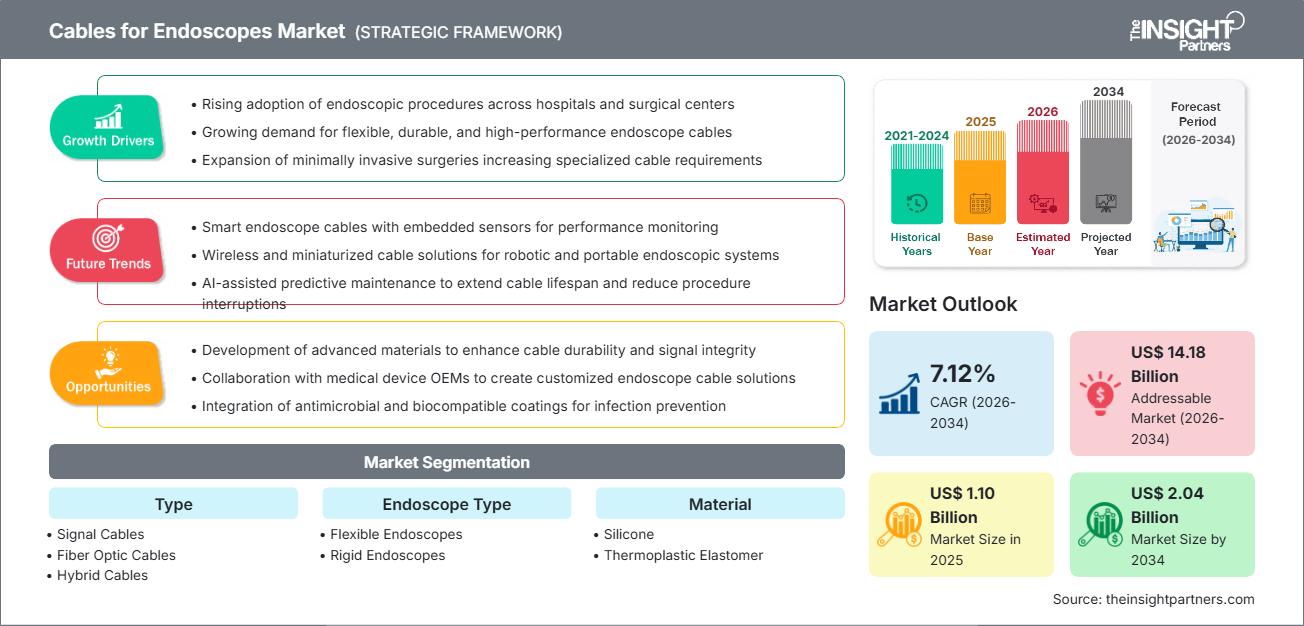
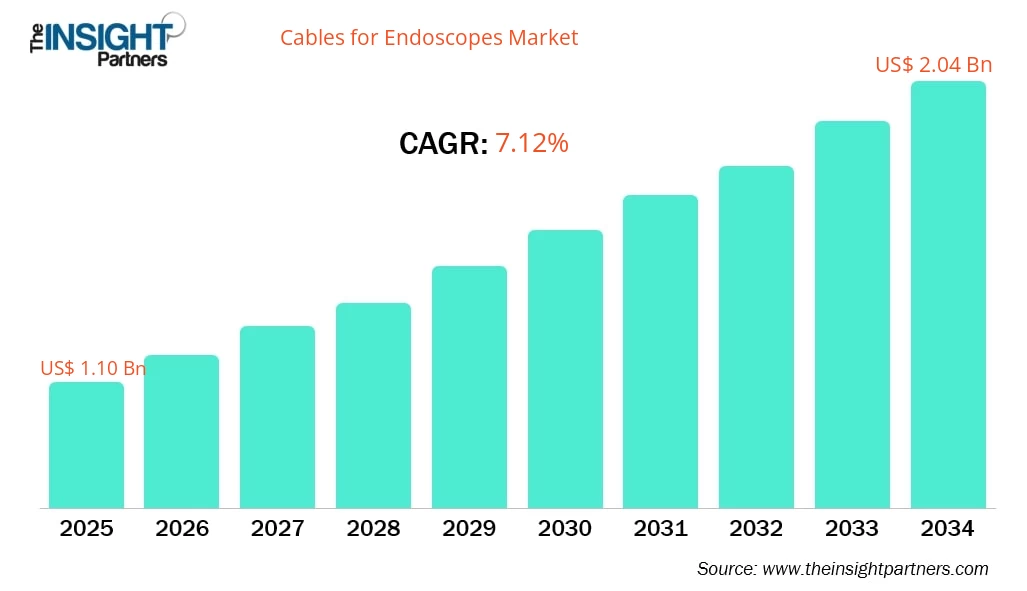
The Cables for Endoscopes Market was valued at US$ 1.10 billion in 2025 and is expected to reach US$ 2.08 billion by 2034, growing at a CAGR of 7.12% from 2026 to 2034. The market is positioned within the broader medical interconnect ecosystem, where endoscope signal integrity, sterilization tolerance, optical transmission, and miniaturized cable assemblies are becoming decisive design priorities for original equipment manufacturers.
North America remains a high-value demand center, supported by advanced endoscopy suites, ambulatory surgery center expansion, and rapid replacement of aging visualization systems. The Cables for Endoscopes Market size in the region is expected to grow at a CAGR range of 6.8–7.4% through 2034, driven by clinical preference for minimally invasive procedures and stricter reusable-device reprocessing expectations from U.S. health authorities.
Cables for Endoscopes Market Assessment and Insights
- North America held a Share in 2025 of 34–37% and is growing at a CAGR between 2026 – 2034 of 6.8–7.4%, supported by hospital upgrades, FDA reprocessing scrutiny, and strong demand for flexible endoscopy platforms.
- US accounted for 78–82% of North America Share in 2025 and is growing at a CAGR between 2026 – 2034 of 6.9–7.5%, led by GI, pulmonology, urology, and surgical visualization adoption.
- Europe recorded a Share in 2025 of 25–28% and is growing at a CAGR between 2026 – 2034 of 6.3–6.9%, with Germany, the UK, France, Italy, and Spain leading procurement.
- Asia Pacific represented a Share in 2025 of 23–26% and is growing at a CAGR between 2026 – 2034 of 7.8–8.6%, led by Japan, China, South Korea, India, and Australia.
- Largest Segment Signal Cables held market share of 42–46% in 2025 and is growing at a CAGR range of 6.6–7.2%, reflecting high-volume use in video endoscopy systems.
- High Growth Segment Hybrid Cables held market share of 20–24% in 2025 and is growing at a CAGR range of 8.2–9.0%, supported by combined signal, power, and optical transmission.
- Key companies analyzed in detail: Junkosha Inc., TE Connectivity plc, Oki Electric Industry Co., Ltd., ODU GmbH & Co. KG, Proterial Cable America Inc., Olympus Corporation, Medtronic plc, Bolton Surgical Ltd, Fort Wayne Metals Research Products, LLC, Stryker Corporation.
Source: The Insight Partners' analysis based on proprietary research, government publications, company annual reports, investor presentations, industry databases, and expert interviews.
Cable migration is affecting the structure of cables as high definition imaging, chip on tip scope, robotics, and ultrasound devices call for small conductors with less attenuation and better shielding properties. Manufacturing is being directed towards more customized assemblies, higher levels of validation, tight bend radius control and traceability of materials used. These needs call for manufacturers with expertise in polymers, connector design, fiber optics and medical device quality system as opposed to just wires manufacturing.
Demand is expected to be driven by adoption of advanced endoscopy at hospitals in Asia Pacific region, Latin America tertiary care centers and specialty ambulatory centers in developed markets, who do not require large investments in capital infrastructure. Compliance factors also need to be considered as reprocessing quality, electrical safety and EM compliance standards drive device manufacturers to proven cable materials and connectors.
Cables for Endoscopes Market Report Scope
| Report Attribute | Details |
|---|---|
| Market size in 2025 | US$ 1.10 Billion |
| Market Size by 2034 | US$ 2.08 Billion |
| Global CAGR (2026 - 2034) | 7.12% |
| Historical Data | 2021-2024 |
| Forecast period | 2026-2034 |
Cables for Endoscopes Market Analysis
Cables for Endoscopes Market development is mainly due to high procedure volumes, advanced technology adoption, and increased reliance on information-based endoscopy platforms. The supply chain consists of material suppliers, fluoropolymer and elastomers manufacturers, micro-wire manufactures, connector suppliers, endoscope Original Equipment Manufacturers (OEMs), sterilization testing services and healthcare institutions. Additionally, growth of healthcare expenditure that is tracked by the WHO has an impact on the demand side since it provides for capital renewal in hospitals and specialty institutions.
The supply situation remains niche-oriented since endoscope cables need to provide certain properties such as flexibility, tensile strength, signal transmission capabilities, biocompatibility, chemical resistance, and frequent cleaning exposure. In flexible endoscopes, cables should have low memory jackets and be properly routed. Rigid endoscopes require durable and reliable video and light-transmitting cables. FDA and CDC sources on device reprocessing are relevant for cable material choice.
The Cables for Endoscopes Market Report is characterized by a competition between broadly interconnecting companies and dedicated manufacturers of medical components. Competition is seen between medical connector solutions from TE Connectivity plc and ODU GmbH & Co. KG, while Junkosha Inc. and Fort Wayne Metals Research Products, LLC offer advanced polymer and wire manufacturing capabilities. Olympus Corporation, Medtronic plc, and Stryker Corporation define end-use needs through their offerings in endoscopy and surgical visualization.
The investment will be more concentrated in the field of hybrid cables, which have capabilities to transmit 4K video and AI enabled video, miniaturized connectors and assemblies with robotic capability. Companies such as Proterial Cable America Inc., Oki Electric Industry Co., Ltd., Bolton Surgical Ltd., and many others exploit their strengths where OEM requires application-specific products. The successful positioning depends now more on design collaboration, documentation, and scaling clean production without loss of tolerance.
● REPORT CUSTOMIZATION
Tailor This Report To Align With Your Specific Business Requirements
This report can be customized to align precisely with your business objectives, scope, and target markets. Customization options include tailored segmentation, geography, competitive analysis, and strategic insights to support informed decision-making.
Customize This Report →WHAT YOU CAN ADJUST
- ● Segmentations
- ● Geography
- ● Competitive Analysis
- ● Language Preferences
Cables for Endoscopes Market: Strategic Insights
Regional Insights
North America Cables for Endoscopes Market
North America held 34–37% regional Cables for Endoscopes Market share in 2025 and is projected to grow at a CAGR of 6.8–7.4% through 2034. Demand is anchored by advanced GI, urology, ENT, laparoscopy, and bronchoscopy procedure settings. The region also benefits from strong reimbursement pathways, robust ambulatory surgery center penetration, and frequent replacement of visualization equipment in integrated delivery networks.
FDA categorizes the endoscopes as instruments that require elaborate cleaning, disinfection, or sterilization processes and hence the robustness and sealed connectors are important factors for purchasing decisions. The endoscope manufacturers prefer suppliers who can offer engineering services in North America along with quick prototyping and cable assembly validation. North America would continue to be the leading regional market, despite increasing competition from Asia-Pacific.
U.S. Cables for Endoscopes Market
The U.S. represented 78–82% of North America demand in 2025 and is projected to grow at a CAGR of 6.9–7.5% from 2026 to 2034. Its scale comes from high procedure density, large endoscopy-suite installed bases, and early adoption of AI-assisted colonoscopy, therapeutic cholangioscopy, robotic visualization, and OR integration platforms.
Presence in the market has been seen with respect to the OEMs of endoscopes, connector development for medical purposes, and contract manufacturers of components for GI and surgical visualization applications. Olympus made several announcements for the introduction of their U.S. endoscopy ecosystems in 2025 and 2026, while Medtronic has extended their pancreaticobiliary endoscopy distribution into the U.S. in 2025.
Europe Cables for Endoscopes Market
The Europe region had a market share of 25–28% in 2025 and expected to register a CAGR of 6.3–6.9% during 2026–2034. Germany leads the region due to medical engineering density, hospital procurement process, and advanced user base of surgical visualization. The UK derives benefit out of reduced NHS backlog in diagnosis, private endoscopy, and slow development of independent centers for treatment.
France, Italy, and Spain are key players because of ongoing efforts by public hospitals for upgrading endoscopy units and regional purchases of cables that have long lifespans. Documentation of compliance with MDR regulations is helping suppliers to provide traceability, sterilization information, and electrical safety compliance. The medical connectors range of ODU demonstrates its focus on endoscopy, catheter, robotics, and IEC 60601 standards, improving the component ecosystem of Europe.
Increasing sustainability and lifecycle economics are dictating the demand, as hospitals consider the durability of reusable assets versus repairs. Cable vendors that can provide replacement assembly support, validation of cleanability compatibility, and ergonomic connector designs will see design-in wins in premium rigid and flexible platforms.
APAC Cables for Endoscopes Market
APAC had 23%-26% market share in 2025 and is expected to maintain a CAGR of 7.8%-8.6% up until 2034. Japan is strong in the manufacture of endoscopy equipment, while China supports the market through hospital growth and manufacturing. South Korea, India, and Australia provide additional demand via specialty diagnosis and surgical procedures.
Local industrial policies are aiding the APAC's presence in component manufacturing. The Japanese companies Olympus and Junkosha support APAC’s technological strength, while Junkosha identifies endoscopes as one of the healthcare applications for their fluoropolymer products.
Middle East & Africa Cables for Endoscopes Market
The Middle East & Africa region is projected to grow at a CAGR of 5.7–6.4% through 2034. Saudi Arabia is the leading country, supported by hospital infrastructure investment, medical tourism ambitions, and modernization of tertiary care assets. The UAE follows with private hospital expansion and premium diagnostic capacity.
South Africa and the Rest of MEA remain more price-sensitive, but demand is improving where referral hospitals invest in GI, urology, and laparoscopic platforms. Energy-linked public investment in Gulf states indirectly supports healthcare infrastructure procurement cycles.
Segmentation Analysis
Type
Type is projected to grow at a CAGR of 7.0–7.6% from 2026 to 2034. The Market scope across type is shifting from basic transmission to integrated cable designs that support high-quality imaging, lighting, power, and digital communication. OEMs increasingly select cable formats based on signal loss, sterilization tolerance, flexibility, and ease of assembly within compact endoscope shafts.
- Signal Cables dominate installed demand because video processors, camera heads, and chip-on-tip designs rely on stable electrical transmission, shielding, and repeatable performance during clinical handling.
- Fiber Optic Cables remain strategically important in illumination-intensive and high-bandwidth systems, especially where optical clarity, low signal degradation, and compact routing support advanced visualization.
- Hybrid Cables are gaining preference in premium devices because one assembly can combine power, data, signal, and optical pathways, reducing bulk and improving device ergonomics.
Endoscope Type
Endoscope Type is projected to grow at a CAGR of 6.9–7.5% from 2026 to 2034. Flexible endoscopes create higher cable design complexity due to repeated bending, twisting, disinfection, and narrow lumen routing. Rigid endoscopes remain important in surgical visualization, laparoscopy, arthroscopy, and urology, where robust external cable assemblies and connector durability directly affect operating room efficiency.
- Flexible Endoscopes generate strong demand for ultra-flexible, low-profile cable systems that withstand repeated movement, high-level disinfection, torque, and moisture exposure in GI and pulmonary procedures.
- Rigid Endoscopes require ruggedized assemblies that support consistent video, lighting, and power delivery in operating rooms, where rapid setup and repeated sterilization are critical.
Material
Material is projected to grow at a CAGR of 6.7–7.3% from 2026 to 2034. Material selection is becoming more strategic as hospitals demand longer device life and lower repair frequency. Silicone offers softness and biocompatibility, while thermoplastic elastomer supports processability, abrasion resistance, and design flexibility. The strongest opportunities are in material systems that balance cleanability, strain relief, insulation, and tactile handling.
- Silicone is favored where flexibility, softness, and biocompatibility are essential, especially for cable jackets and strain-relief areas exposed to frequent clinical handling.
- Thermoplastic Elastomer supports scalable manufacturing and durable insulation, making it attractive for assemblies needing abrasion resistance, color coding, and compatibility with compact connector designs.
Connector Type
Connector Type is projected to grow at a CAGR of 7.2–7.8% from 2026 to 2034. Connector design is central to device reliability because endoscopy cables must endure repeated mating cycles, fluid exposure, cleaning agents, and electromagnetic interference. Standard connectors support cost efficiency and serviceability, while custom connectors enable miniaturization, system differentiation, and specialized routing.
- Standard Connectors remain widely used in established endoscope systems because they reduce service complexity, streamline replacement, and support predictable procurement across healthcare facilities.
- Custom Connectors are gaining strategic importance as OEMs pursue proprietary designs, smaller footprints, improved sealing, higher data density, and differentiated endoscopy system performance.
Opportunity Snapshot
| Endoscope Type | Revenue Contribution | Trend Tag | Adoption Stage |
| Flexible Endoscopes | High | AI Imaging | Scaling |
| Rigid Endoscopes | Medium | OR Integration | Mature |
Cables for Endoscopes Market Growth Drivers and Impact Analysis
Expansion of Minimally Invasive Procedure Volumes
As minimally invasive procedures continue to boost the demand for reliable endoscope cable assemblies since visualization has an influence on physician’s level of confidence, time taken, and outcome of procedure. Gastroenterology, urology, pulmonology, ENT, and laparoscopy applications tend to rely more on sophisticated imaging processors, distal sensing capabilities and ergonomic scopes which put more strain on the design of cable assembly. This effect can be witnessed in the increased demand for small diameter conductors, shielded assembly, and connectors which are more resilient to handling by healthcare facilities. They also prefer endoscopy because of its ability to cut down hospital stays and aid in early diagnosis.
Higher Reprocessing and Patient Safety Requirements
Reusable endoscopes necessitate an organized cleaning, disinfecting, and sterilizing process, and cables have to withstand such treatment without developing jacket cracks, seal failures, or degraded signals. FDA and CDC publications note that reprocessing is a thorough and quality-oriented procedure, and any shortcomings in this process can lead to infections, thus motivating OEMs to rely on validated materials, mold strain relief, shielded connectors, and prevention of fluid penetration into the device. Suppliers who can provide documentation regarding chemical and mechanical performance and lifecycle testing of their cables get an upper hand in the OEM qualification process.
Shift Toward High Definition and Connected Endoscopy
Advanced endoscopy platforms now integrate high-definition imaging, AI lesion detection, cloud connectivity, ultrasound, fluorescence visualization, and operating room control systems. Olympus’ OLYSENSE launch and Stryker’s 1788 visualization platform show how imaging ecosystems are moving toward richer data and connected workflows. These systems require cables that maintain signal integrity under motion, support high bandwidth, and minimize electromagnetic interference. The commercial consequence is higher value per assembly, especially for hybrid cables and customized connector sets. Suppliers must support co-development with OEM engineering teams, as cable performance is increasingly tied to total system reliability rather than treated as a peripheral component.
Cables for Endoscopes Market Future Trends
Hybrid Transmission Architectures Becoming Standard
Cables for Endoscopes Market trends point toward hybrid assemblies that combine electrical conductors, optical fibers, power lines, and shielding in one smaller package. This design direction is expected to expand as endoscopes integrate imaging sensors, lighting, therapeutic tools, and software-enabled modules. The future advantage is system simplification, reduced assembly bulk, better ergonomics, and fewer failure points. ODU’s medical connector positioning around endoscopy, robotics, catheter applications, and shielded designs reflects this broader interconnect transition. Cable makers that master hybrid routing and validation will be better positioned for premium OEM programs.
Design for Serviceability and Circular Procurement
Hospitals are expected to evaluate cable assemblies more closely through lifecycle economics, not only initial procurement price. Repair frequency, downtime, replacement lead times, and compatibility with reprocessing workflows will influence buying criteria. Future endoscope platforms may use modular cable and connector designs that simplify servicing without compromising safety. This trend should benefit suppliers offering standardized subassemblies, clear traceability, and validated replacement parts. The pressure will be strongest in North America and Europe, where equipment utilization is high and infection prevention committees scrutinize reusable device performance.
Cables for Endoscopes Market Opportunities
OEM Co-Development for Next-Generation Flexible Endoscopes
Flexible endoscope platforms create the strongest design-in opportunity because they require compact, durable, and high-performance interconnects within constrained shafts. Cables for Endoscopes Market Forecasts indicate that suppliers can improve margins by engaging earlier in OEM development, particularly for chip-on-tip imaging, therapeutic channels, and AI-ready visualization systems. The opportunity is not limited to cable supply; it includes materials recommendation, rapid prototyping, bend testing, sterilization compatibility, and connector integration. Companies with engineering centers near major OEM clusters in Japan, the U.S., Germany, and Ireland can shorten qualification timelines and secure longer product lifecycles.
Localized Manufacturing for APAC and Gulf Healthcare Expansion
APAC and Gulf markets are expanding healthcare infrastructure, creating demand for reliable endoscopy systems and replacement components. Suppliers can capture opportunity by establishing regional assembly, technical support, and inventory partnerships that reduce lead times for OEMs and service providers. China and India offer scale, Japan and South Korea offer precision manufacturing, and Saudi Arabia and the UAE offer premium hospital expansion. Localized production must still meet global documentation, biocompatibility, and electrical safety requirements. This creates an opening for joint ventures, distributor partnerships, and clean manufacturing investments aligned with device OEM localization strategies.
Recent Developments
- June 2026: Olympus Corporation announced a federal healthcare facility distribution agreement with First Nation Group, strengthening access to its medical technology portfolio for U.S. federal healthcare channels. The development supports broader availability of endoscopy-related systems and accessories across government care settings, where supplier qualification, service coverage, and procurement reliability are central purchasing factors.
- April 2025: Medtronic plc announced a strategic U.S. distribution agreement with Dragonfly Endoscopy, Inc. for the Dragonfly pancreaticobiliary system. The platform includes a fully rotatable flexible shaft, a 42% larger working channel diameter versus the current standard, and capability for 40% larger biopsy samples, supporting higher-performance endoscopic intervention.
- February 2025: ODU GmbH & Co. KG introduced Push-Lock Medical, a modular ODU-MAC Blue-Line connector variant for demanding medical environments. The product features push-pull locking, hygienic materials, modular configuration, long mechanical life, and custom laser marking, strengthening connector options for medical devices requiring secure signal, data, and power transmission.
Frequently Asked Questions

- Comprehensive Market Sizing and Forecast Analysis
- Detailed Segmentation Analysis
- In-Depth Market Dynamics Assessment
- Regional and Country-Level Insights
- Competitive Landscape and Company Benchmarking
- Strategic Business Intelligence
Recent Reports
Testimonials

The Insight Partners provided valuable market intelligence that supported our global go-to-market strategy. Their team was professional, responsive, and attentive to our feedback, providing thoughtful analysis and helpful methodological clarifications throughout the project.
Junmo Kim Chief Financial Officer (CFO), Enertech Co., Ltd.
The Insight Partners' SCADA System Market report is comprehensive, with valuable insights on current trends and future forecasts. The team was highly professional, responsive, and supportive throughout. We are very satisfied and highly recommend their services.
RAN KEDEM Partner, Reali Technologies LTDs
I requested a report on a very specific software market and the team produced the report in a few days. The information was very relevant and well presented. I then requested some changes and additions to the report. The team was again very responsive and I got the final report in less than a week.
JEAN-HERVE JENN Chairman, Future Analytica
We worked with The Insight Partners for an important market study and forecast. They gave us clear insights into opportunities and risks, which helped shape our plans. Their research was easy to use and based on solid data. It helped us make smart, confident decisions. We highly recommend them.
PIYUSH NAGPAL Sr. Vice President, High Beam Global
The Insight Partners delivered insightful, well-structured market research with strong domain expertise. Their team was professional and responsive throughout. The user-friendly website made accessing industry reports seamless. We highly recommend them for reliable, high-quality research services
YUKIHIKO ADACHI CEO, Deep Blue, LLC.
This is the first time I have purchased a market report from The Insight Partners.While I was unsure at first, I visited their web site and felt more comfortable to take the risk and purchase a market report.I am completely satisfied with the quality of the report and customer service. I had several questions and comments with the initial report, but after a couple of dialogs over email with their analyst I believe I have a report that I can use as input to our strategic planning process.Thank you so much for taking the extra time and making this a positive experience.I will definitely recommend your service to others and you will be my first call when we need further market data.
JOHN SUZUKI President and Chief Executive Officer, Board Director, BK Technologies
I wish to appreciate your support and the professionalism you displayed in the course of attending to my request for information regarding to infectious disease IVD market in Nigeria. I appreciate your patience, your guidance, and the fact that you were willing to offer a discount, which eventually made it possible for us to close a deal. I look forward to engaging The Insight Partners in the future, all thanks to the impression you have created in me as a result of this first encounter.
DR CHIJIOKE ONYIA MANAGING DIRECTOR, PineCrest Healthcare Ltd.Reason to Buy
- Informed Decision-Making
- Understanding Market Dynamics
- Competitive Analysis
- Identifying Emerging Markets
- Customer Insights
- Market Forecasts
- Risk Mitigation
- Boosting Operational Efficiency
- Strategic Planning
- Investment Justification
- Tracking Industry Innovations
- Aligning with Regulatory Trends





 Get Free Sample for